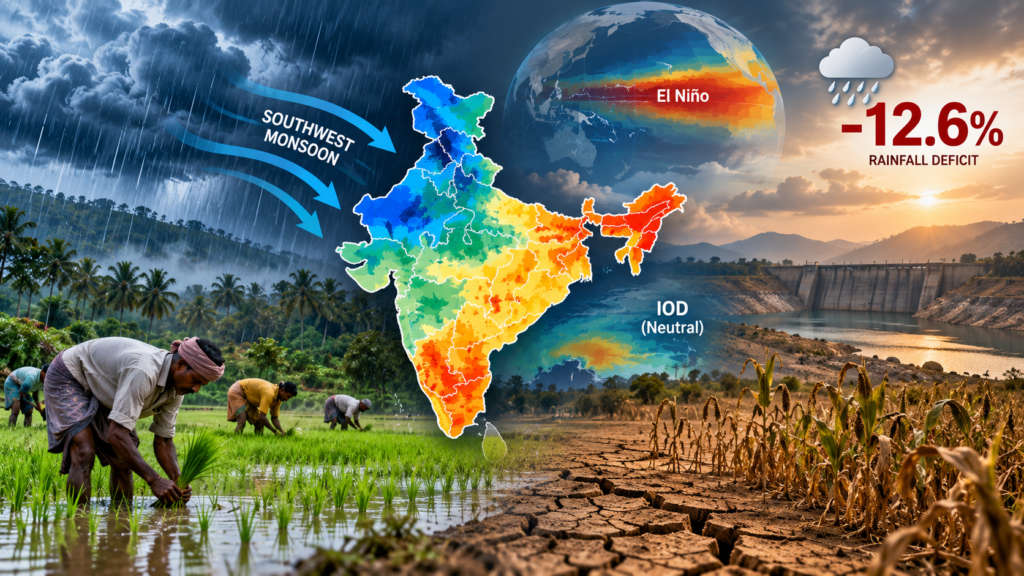
2026 Southwest Monsoon Deficit: Causes, El Niño, Regional Impact and UPSC Relevance
UPSC Current Affairs | Geography | Environment | Agriculture | GS Paper I & III
Why in News?
The 2026 Southwest Monsoon season ended on 30 September 2026 with a significant rainfall deficit.
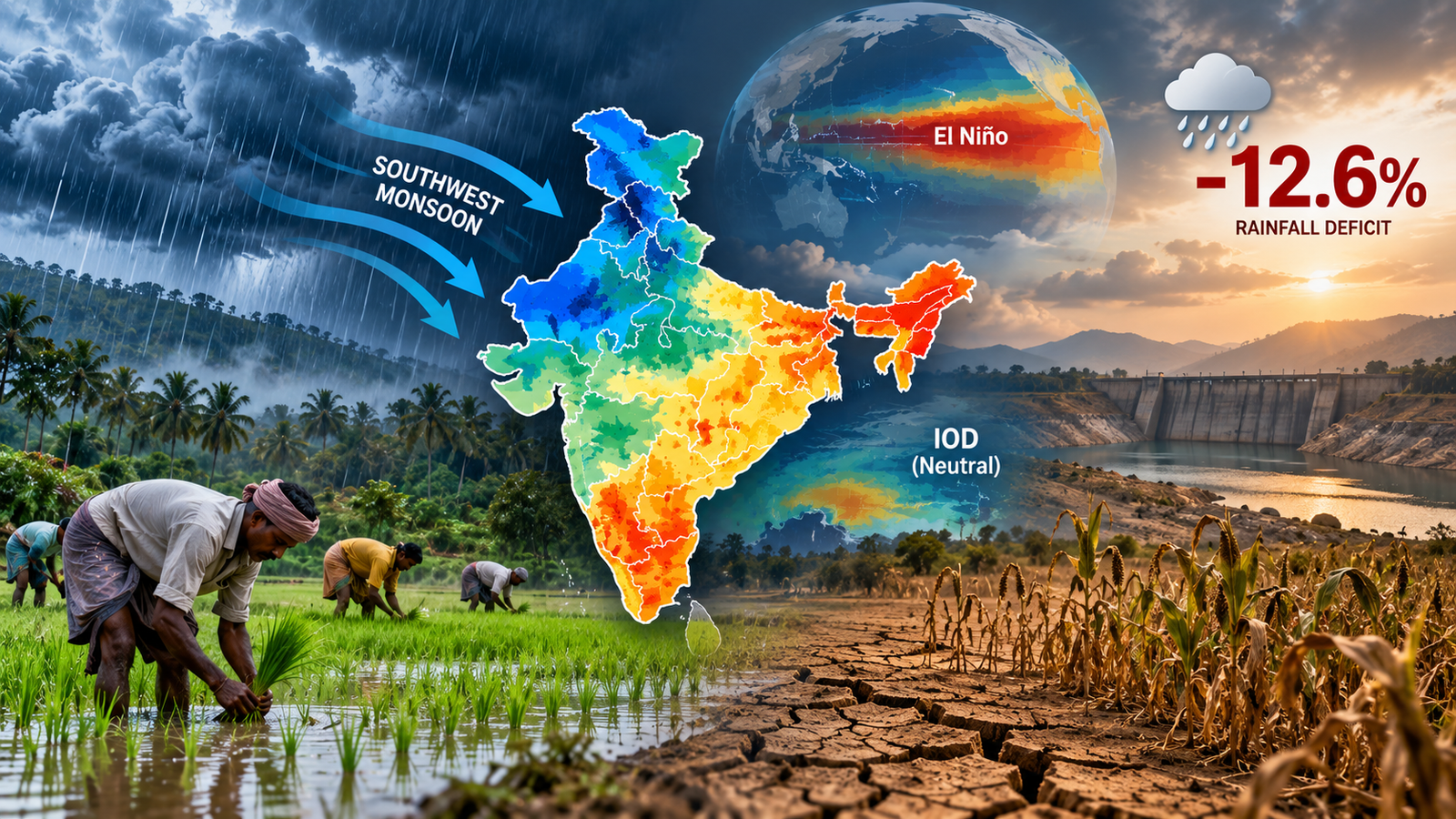
According to the India Meteorological Department (IMD), India received around 759.4 mm of rainfall during June–September 2026, compared with the Long Period Average (LPA) of about 868.6 mm.
This represents a 12.6% deficit from the LPA. The 2026 monsoon was the lowest seasonal rainfall since 2015, and the fourth-lowest since 2001.
The deficit was not uniform across India. East and Northeast India recorded their lowest southwest monsoon rainfall since 1901, while the South Peninsula also experienced a major shortfall.
The development is important for UPSC because the Indian monsoon is directly connected with agriculture, water resources, food security, inflation, hydropower, ecology and the broader Indian economy.
What is the Southwest Monsoon?
The Southwest Monsoon is the seasonal reversal of winds that brings most of India’s annual rainfall during June to September.
It is called the southwest monsoon because the dominant moisture-bearing winds generally approach the Indian subcontinent from the southwest.
The monsoon is driven by the seasonal heating and cooling of the Asian landmass and surrounding oceans, but its behaviour is influenced by several atmospheric and oceanic factors.
These include:
- Differential heating of land and sea
- Inter-Tropical Convergence Zone (ITCZ)
- Mascarene High
- Somali Jet
- Tibetan Plateau
- El Niño–Southern Oscillation
- Indian Ocean Dipole
- Madden–Julian Oscillation
- Monsoon depressions
- Tropical and subtropical circulation patterns
Therefore, the Indian monsoon is not simply a result of “summer heating”.
It is a complex coupled ocean-atmosphere-land system.
What is the Long Period Average?
Long Period Average (LPA)
LPA is the average rainfall received over a specified reference period and is used as a benchmark for comparing actual seasonal rainfall.
For the current IMD monsoon assessment, the LPA for the June–September southwest monsoon is around 868.6 mm, based on the 1971–2020 reference period.
Thus:
Actual rainfall = 759.4 mm
LPA = 868.6 mm
Departure = –12.6%
This is why the 2026 monsoon is described as a deficient monsoon.
2026 Monsoon: Key Numbers
| Indicator | 2026 |
|---|---|
| Monsoon season | June–September |
| Actual rainfall | ~759.4 mm |
| LPA | ~868.6 mm |
| Departure from LPA | –12.6% |
| Percentage of LPA | ~87% |
| Lowest since | 2015 |
| Fourth-lowest since | 2001 |
| Seasonal rank since 1901 | Among the lowest years |
How Did Rainfall Behave During 2026?
The rainfall deficit was not equally distributed across the four monsoon months.
June: Major Deficit
June was particularly weak.
Rainfall was around 35% below normal according to the IMD-based assessment.
This created an early-season rainfall deficit.
July: Temporary Recovery
July brought a major recovery.
Rainfall was around 101% of normal, helping reduce the cumulative deficit.
August: Deficit Returned
Rainfall again fell below normal in August, with the monthly deficit around 16%.
September: Another Deficit
September also remained below normal, with rainfall around 8% below normal.
Therefore, the broad pattern was:
Weak June → Strong July → Weak August → Weak September
The strong July rainfall was not sufficient to compensate for the deficits during the other months.
Regional Distribution of Rainfall
One of the most important aspects of the 2026 monsoon was regional variability.
The all-India figure can hide major differences between regions.
Northwest India
Northwest India received around 94% of its LPA.
Central India
Central India received around 97% of its LPA, making it relatively less affected compared with several other regions.
South Peninsula
South Peninsular India received only around 76% of its LPA.
East and Northeast India
East and Northeast India received around 74% of its LPA.
This regional pattern is especially important because rainfall has very different implications depending on local dependence on agriculture, rivers, groundwater and monsoon systems.
East and Northeast India: A Major Concern
One of the most significant findings of the 2026 monsoon was the performance of East and Northeast India.
The region recorded around 1,017 mm of rainfall, its lowest southwest monsoon rainfall since 1901, according to IMD-based reporting. The shortfall was around 26% from the LPA.
This is particularly significant because the Northeast is generally associated with very high rainfall.
Why is this important?
The region contains:
- Major river systems
- Dense forests
- Biodiversity-rich ecosystems
- Rain-fed agriculture
- Mountainous terrain
- Important groundwater and surface-water resources
A major change in rainfall can therefore affect:
Agriculture + River flows + Forest ecosystems + Wetlands + Hydropower + Livelihoods
South Peninsula Also Experienced Major Deficit
South Peninsular India received around 542 mm of rainfall, which was among its lowest seasonal totals in the historical record.
The southern peninsula has a particularly important relationship with the Northeast Monsoon, which becomes important during October–December.
Therefore, the southwest monsoon deficit does not automatically mean the entire southern region will remain dry for the rest of the year.
The Northeast Monsoon can still play an important role in replenishing water resources in parts of southern India.
Major Factor: El Niño
One of the key climatic factors associated with the 2026 monsoon was El Niño.
El Niño
El Niño is the abnormal warming of sea-surface temperatures in the central and eastern tropical Pacific Ocean.
It is one phase of the broader El Niño–Southern Oscillation (ENSO) system.
El Niño can alter global atmospheric circulation and is historically associated with a tendency towards weaker Indian summer monsoon rainfall.
In 2026, weak El Niño conditions developed in June and strengthened during the monsoon season, reaching strong intensity towards the end of September.
How Can El Niño Affect the Indian Monsoon?
The relationship can be simplified as:
Pacific Ocean warming
↓
Changes in tropical atmospheric circulation
↓
Changes in Walker Circulation
↓
Changes in convection over the Indian Ocean region
↓
Alteration of monsoon circulation
↓
Potential reduction in Indian rainfall
However, this relationship is not deterministic.
That means:
El Niño does not guarantee a deficient Indian monsoon every time.
Other atmospheric and oceanic factors can strengthen or weaken its influence.
What is Walker Circulation?
Walker Circulation
Walker circulation is an east–west atmospheric circulation pattern over the tropical Pacific and adjoining regions, driven largely by differences in atmospheric pressure and convection.
Under normal conditions, strong convection occurs over the warmer western Pacific.
During El Niño, warmer water shifts eastward.
This changes atmospheric convection and pressure patterns across the tropical Pacific.
These changes can influence atmospheric circulation beyond the Pacific, including the Indian monsoon system.
Indian Ocean Dipole and 2026
Another important factor is the Indian Ocean Dipole (IOD).
Indian Ocean Dipole
IOD is an irregular variation in sea-surface temperatures between the western and eastern tropical Indian Ocean.
It has two broad phases:
Positive IOD
Western Indian Ocean relatively warmer and eastern Indian Ocean relatively cooler.
Negative IOD
Eastern Indian Ocean relatively warmer and western Indian Ocean relatively cooler.
A positive IOD can sometimes support Indian monsoon rainfall and partly offset the negative influence of El Niño.
However, in 2026 the IOD remained broadly neutral during the monsoon season.
Therefore, there was no strong positive IOD signal to counter the developing El Niño influence.
Important UPSC Concept: El Niño Does Not Act Alone
A common mistake is to write:
“El Niño causes weak monsoon.”
This is an oversimplification.
A better explanation is:
El Niño increases the probability of below-normal Indian monsoon rainfall, but the actual monsoon outcome depends on multiple oceanic and atmospheric factors.
These include:
- ENSO
- IOD
- MJO
- Snow cover
- Land-surface conditions
- Monsoon circulation
- Low-pressure systems
- Tropical disturbances
- Intraseasonal variability
This distinction is important for both Geography Optional and GS Paper I.
Monsoon Depressions: An Important Counter-Factor
Despite the influence of El Niño, the 2026 monsoon also experienced a significant number of low-pressure systems.
There were around 77 low-pressure-system days, compared with a normal of about 57 days.
Low-Pressure System
A low-pressure system is a region where atmospheric pressure is relatively lower than surrounding areas, often associated with cloud formation and rainfall.
Monsoon depressions and low-pressure areas are important rainfall-producing systems.
Their activity can help distribute rainfall across central and northern India.
This helps explain why the relationship between El Niño and actual rainfall is not always straightforward.
Why is the Indian Monsoon So Important?
The southwest monsoon is critical for India because it influences multiple sectors simultaneously.
Agriculture
A significant portion of Indian agriculture remains dependent on rainfall.
A weak monsoon can affect:
- Sowing
- Crop growth
- Soil moisture
- Irrigation demand
- Crop yields
- Rural incomes
The impact can be particularly significant for rain-fed agriculture.
Impact on Water Resources
Monsoon rainfall contributes to:
- Reservoir storage
- Groundwater recharge
- River flows
- Soil moisture
- Wetlands
- Drinking-water availability
A rainfall deficit can therefore create water stress even if some regions receive heavy rainfall during short periods.
This highlights an important concept:
Total seasonal rainfall is not the only issue; rainfall distribution across space and time also matters.
Impact on Food Security
A weak monsoon can affect agricultural production.
Potential consequences include:
Lower crop output
↓
Reduced market supply
↓
Pressure on food prices
↓
Possible inflationary pressure
However, the final impact depends on:
- Irrigation
- Reservoir levels
- Crop stocks
- Government procurement
- Imports
- Crop diversification
- Regional rainfall distribution
Therefore, a deficient monsoon does not automatically mean a food crisis.
Impact on Inflation
Rainfall affects agricultural production and therefore can influence food prices.
This is particularly important for:
- Pulses
- Vegetables
- Oilseeds
- Cereals
- Fruits
If rainfall deficits reduce production, supply-side pressure can contribute to food inflation.
However, inflation depends on many other factors as well, including:
- Global commodity prices
- Input costs
- Government policy
- Storage
- Imports and exports
- Supply-chain conditions
Impact on Hydropower
Hydropower generation depends partly on water availability.
Monsoon rainfall contributes to reservoir inflows.
Therefore:
Weak monsoon → Lower inflows → Potential pressure on hydropower generation
However, the impact depends on:
- Existing reservoir storage
- River basin conditions
- Snow and glacier melt
- Seasonal rainfall distribution
- Electricity demand
This has particular relevance for Himalayan states such as Himachal Pradesh.
Himachal Pradesh Connection
For HPPSC aspirants, the 2026 monsoon can be connected with:
- Himalayan hydrology
- Hydropower
- Reservoir management
- Agriculture
- Horticulture
- Cloudbursts
- Landslides
- Flash floods
- Water security
- Climate variability
An important geographical point is that low seasonal rainfall does not eliminate the possibility of extreme rainfall events.
A region can experience an overall rainfall deficit while still receiving short-duration episodes of intense rainfall.
This is particularly important in the Himalayan region.
Monsoon Deficit vs Extreme Rainfall
These two ideas are not contradictory.
For example:
Annual/seasonal rainfall can be below normal
while
short-duration extreme rainfall events can still occur.
Why?
Because rainfall distribution matters.
Consider:
10 days of very heavy rainfall + long dry periods
versus
regular moderate rainfall throughout the season
Both may produce different hydrological and agricultural outcomes even if their seasonal totals are similar.
This is an important link between monsoon variability and climate extremes.
Climate Change Connection
The relationship between climate change and monsoon behaviour is complex.
Climate change does not simply mean:
“More rainfall everywhere.”
Instead, a warmer atmosphere can influence:
- Moisture-holding capacity
- Rainfall intensity
- Rainfall variability
- Dry spells
- Extreme precipitation
- Heat waves
- Evaporation
- Soil moisture
Therefore, one of the important emerging concerns is greater variability in rainfall distribution.
This makes climate-resilient agriculture and water management increasingly important.
What is Monsoon Variability?
Monsoon Variability
Monsoon variability refers to changes in the amount, timing, duration and spatial distribution of monsoon rainfall.
It can occur:
- Between different years
- Between different months
- Between different regions
- Within the same monsoon season
For India, intraseasonal variability is particularly important.
Southwest Monsoon vs Northeast Monsoon
This is an important Prelims topic.
| Feature | Southwest Monsoon | Northeast Monsoon |
|---|---|---|
| Main period | June–September | October–December |
| Major direction | Southwest winds | Northeast winds |
| Major importance | Most of India | Especially southeastern/southern peninsula |
| Major region | Pan-India | Tamil Nadu and parts of south India |
| Key mechanism | Summer monsoon circulation | Retreating monsoon conditions |
| Major relevance | Kharif agriculture | Rabi agriculture in some southern regions |
The Northeast Monsoon is particularly important for Tamil Nadu and parts of the southern peninsula.
Post-Monsoon Outlook 2026
The IMD’s post-monsoon outlook indicated that rainfall during the broader October–December 2026 period was expected to be below normal over much of India, although the South Peninsular region was expected to receive broadly normal rainfall.
This distinction is important:
Southwest Monsoon deficit ≠ automatic Northeast Monsoon deficit
The two rainfall systems have different seasonal dynamics.
What Can India Do?
A monsoon deficit cannot be prevented by government policy, but its impacts can be reduced.
Water Conservation
Promote:
- Rainwater harvesting
- Watershed development
- Groundwater recharge
- Efficient irrigation
Climate-Resilient Agriculture
Promote:
- Drought-resistant crops
- Short-duration varieties
- Crop diversification
- Micro-irrigation
- Weather-based advisories
Better Weather Forecasting
Strengthen:
- Satellite observations
- Doppler weather radar
- Numerical weather prediction
- AI-based forecasting
- District-level forecasts
The IMD itself is expanding the use of advanced forecasting systems, including multi-model approaches and AI-based forecasting tools.
Reservoir Management
Water storage should be managed using:
- Seasonal forecasts
- Reservoir levels
- River-basin conditions
- Agricultural requirements
- Drinking-water demand
Disaster Preparedness
Preparedness should address both:
Drought-like conditions
and
Extreme rainfall events
because the two can occur within the same season.
UPSC Prelims Perspective
The following facts are important:
- Southwest Monsoon generally covers June to September.
- The Long Period Average (LPA) is used as a rainfall benchmark.
- Current monsoon LPA is based on the 1971–2020 reference period.
- India’s 2026 monsoon rainfall was around 759.4 mm.
- LPA was around 868.6 mm.
- Departure was around –12.6%.
- 2026 was the weakest seasonal monsoon since 2015.
- East and Northeast India recorded their lowest seasonal rainfall since 1901.
- El Niño strengthened during the 2026 monsoon.
- IOD remained broadly neutral.
- Low-pressure-system activity remained significant.
- Northeast Monsoon is particularly important for southern peninsular India.
- A monsoon deficit does not necessarily mean absence of extreme rainfall events.
Possible Prelims Question
Consider the following statements regarding the Indian monsoon:
- El Niño always results in a deficient Indian monsoon.
- The Indian Ocean Dipole can influence the relationship between ENSO and Indian monsoon rainfall.
- A season with below-normal cumulative rainfall cannot experience extreme rainfall events.
- The Long Period Average is used as a benchmark for assessing seasonal rainfall.
Which of the statements given above are correct?
Answer: 2 and 4 only
Explanation
Statement 1 is incorrect because El Niño influences the probability of monsoon outcomes but does not mechanically determine them.
Statement 2 is correct because IOD can modify the influence of ENSO on the Indian monsoon.
Statement 3 is incorrect because a season can have an overall rainfall deficit while still experiencing intense short-duration rainfall events.
Statement 4 is correct because LPA is used as a benchmark for assessing rainfall departure.
UPSC Mains Perspective
GS Paper I
The topic can be linked with:
- Indian climatology
- Indian monsoon
- ENSO
- IOD
- Atmospheric circulation
- Rainfall variability
- Climate change
- Extreme weather events
GS Paper III
It can be linked with:
- Agriculture
- Irrigation
- Water resources
- Food security
- Inflation
- Disaster management
- Climate-resilient agriculture
- Hydropower
Possible Mains Question
“The Indian monsoon is increasingly characterised by high spatial and temporal variability. Discuss its implications for agriculture, water security and disaster management.”
Introduction
The Indian summer monsoon is a critical component of India’s climate system, supplying a major share of annual rainfall. However, its spatial and temporal variability can produce both rainfall deficits and episodes of extreme precipitation.
Body
Discuss:
Causes
- ENSO
- IOD
- MJO
- Land-sea thermal contrast
- Monsoon circulation
- Climate variability
Agricultural impact
- Soil moisture
- Crop productivity
- Irrigation demand
- Farm incomes
- Food prices
Water impact
- Reservoirs
- Groundwater
- River flows
- Drinking water
Disaster impact
- Drought
- Floods
- Landslides
- Flash floods
Way forward
- Climate-resilient agriculture
- Water harvesting
- Better forecasting
- Micro-irrigation
- Crop diversification
- Integrated river-basin management
- Localised weather advisories
Conclusion
India needs to move from a rainfall-dependent response system towards climate-resilient water and agricultural management, where both rainfall deficits and extreme rainfall events are addressed through forecasting, storage, conservation and adaptive planning.
Geography Optional Perspective
For Geography Optional, the 2026 monsoon provides an excellent contemporary example for topics such as:
Indian Climatology
Mechanism of Indian monsoon
Jet streams
ITCZ
ENSO
IOD
Monsoon depressions
Contemporary Examples
Use 2026 as an example of:
El Niño + deficient monsoon + strong regional variability
This can enrich answers on:
- Variability of Indian monsoon
- Role of ENSO
- Climatic hazards
- Indian agriculture
- Climate change and extreme events
Important Keywords
Southwest Monsoon
Seasonal wind system that brings most of India’s annual rainfall during June–September.
Long Period Average
Reference average used to compare actual rainfall with the normal rainfall over a defined historical period.
El Niño
Abnormal warming of the central and eastern tropical Pacific Ocean that alters global atmospheric circulation.
La Niña
Abnormal cooling of the central and eastern tropical Pacific Ocean, generally associated with stronger monsoon conditions in India.
Indian Ocean Dipole
Difference in sea-surface temperature patterns between the western and eastern tropical Indian Ocean.
Monsoon Depression
A relatively organised low-pressure system that can produce widespread rainfall during the monsoon season.
Intraseasonal Variability
Variation in rainfall and monsoon activity within the same monsoon season.
Rain-fed Agriculture
Agriculture that depends primarily on rainfall rather than assured irrigation.
Climate Resilience
The ability of people, ecosystems and economic systems to withstand and adapt to climate-related stresses and shocks.
2026 Monsoon: Quick Revision
The Numbers
759.4 mm
Actual rainfall
868.6 mm
LPA
–12.6%
Departure
87%
Approximate share of LPA
2015
Previous comparable low-rainfall year
The Climate Drivers
El Niño strengthened
IOD remained neutral
Low-pressure activity remained significant
Regional Pattern
Central India → relatively near normal
Northwest India → near normal but below LPA
South Peninsula → major deficit
East & Northeast → major deficit and lowest since 1901
Memory Trick
Remember the 2026 monsoon using:
“D-E-I-M-A”
D — Deficient rainfall
E — El Niño strengthened
I — IOD remained neutral
M — Monsoon variability
A — Agriculture and water impacts
This gives you the basic structure for both Prelims and Mains answers.
Final Takeaway
The 2026 Southwest Monsoon ended with around 12.6% below-normal rainfall, making it India’s weakest seasonal monsoon since 2015. However, the most important lesson is not simply the national rainfall deficit.
The bigger geographical story is the uneven distribution of rainfall.
East and Northeast India experienced their lowest southwest monsoon rainfall since 1901, while the South Peninsula also recorded a substantial deficit. At the same time, low-pressure systems produced significant rainfall in some areas.
The 2026 monsoon therefore demonstrates an important principle of Indian climatology:
The impact of a monsoon depends not only on how much rain India receives, but also on where, when and how intensely that rain falls.
For UPSC, the topic connects Indian Geography, ENSO, IOD, climate change, agriculture, water security, food inflation, disaster management and Himalayan ecology.
In short: 2026 shows why India needs to prepare not simply for “less rainfall”, but for greater rainfall variability and its unequal regional impacts.