Green Energy Corridor Phase-III: India’s 135 GW Renewable Energy Grid, Battery Storage and Energy Transition
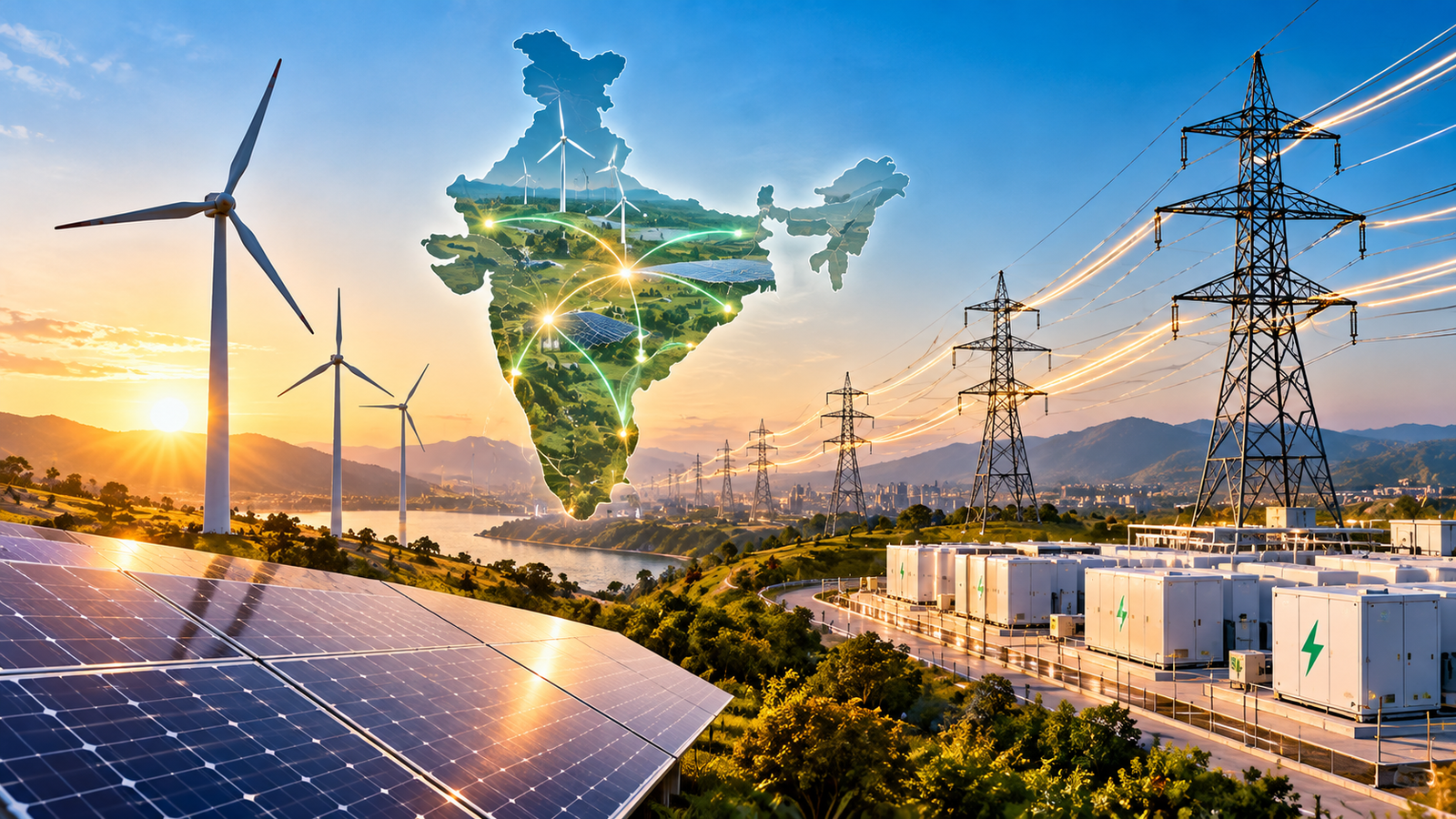
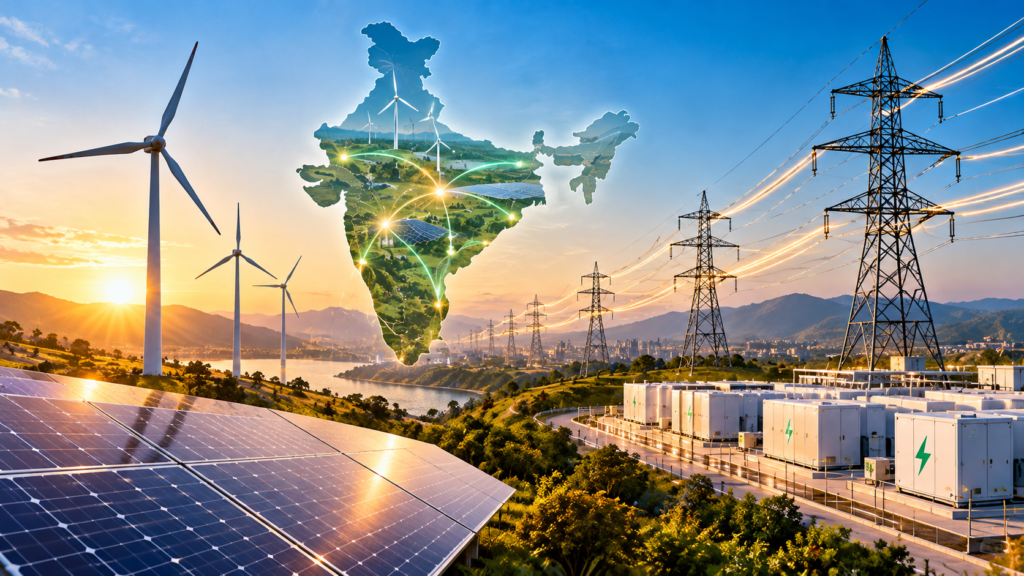
The Union Cabinet approved the Green Energy Corridor Phase-III (GEC-III) on 30 September 2026. The scheme aims to strengthen India’s intra-state electricity transmission network so that up to 135 GW of renewable energy can be evacuated and integrated into the national power system.
The scheme has a total outlay of ₹1,86,405 crore, including ₹1,36,378 crore for intra-state transmission systems and ₹50,000 crore for 50 GWh of Battery Energy Storage Systems (BESS). The Central Financial Support under the scheme will be ₹54,082 crore. The scheme is targeted for implementation by FY 2032–33.
For UPSC aspirants, GEC-III is much more than a power-sector scheme. It connects with:
Renewable Energy → Electricity Transmission → Battery Storage → Grid Stability → Energy Security → Climate Change → India’s 2030 Targets → Green Transition
Why Is Green Energy Corridor Phase-III in News?
The Union Cabinet has approved Green Energy Corridor Phase-III (GEC-III) to expand and strengthen India’s intra-state transmission infrastructure.
The major objective is to ensure that electricity generated from renewable sources such as solar and wind can reach consumers efficiently.
The scheme will support:
- evacuation of up to 135 GW renewable energy;
- 50 GWh Battery Energy Storage Systems;
- strengthening of intra-state transmission networks;
- reduction of renewable-energy curtailment;
- improvement in grid flexibility;
- integration of renewable energy into the electricity grid;
- long-term energy security.
The scheme is expected to contribute to India’s long-term goal of integrating 900 GW of installed non-fossil-fuel capacity by 2035.
First Understand: What Is a Green Energy Corridor?
Before understanding GEC-III, we need to understand the basic problem.
India is rapidly increasing its renewable-energy capacity.
Solar and wind projects are often located in areas where:
- sunlight is abundant;
- wind conditions are favourable;
- large land parcels are available.
However, these renewable-energy-rich regions are not always close to major electricity-consuming centres.
This creates a basic problem:
Electricity may be generated, but without adequate transmission infrastructure, it cannot be efficiently delivered to consumers.
A Green Energy Corridor (GEC) is designed to address this problem.
Simple Definition
Green Energy Corridor is a dedicated transmission infrastructure system designed to evacuate and integrate electricity generated from renewable-energy sources into the power grid.
In simple words:
Renewable Energy Generation → Transmission Network → Power Grid → Consumers
The transmission network is the bridge between renewable-energy generation and electricity consumption.
Why Does India Need a Green Energy Corridor?
India’s renewable-energy capacity has expanded rapidly.
As of 31 August 2026, India’s total installed renewable-energy capacity stood at about 295.55 GW, while total installed non-fossil capacity, including large hydro and nuclear, was about 304.33 GW according to MNRE data. Solar alone stood at around 168.04 GW, while wind capacity was around 58.52 GW.
This creates a new challenge.
The problem is no longer only:
“How do we generate renewable electricity?”
It is increasingly:
“How do we transmit, store and integrate large quantities of renewable electricity reliably?”
This is why transmission infrastructure and energy storage have become critical components of India’s energy transition.
The Renewable Energy Problem: Generation Is Not Enough
Suppose a solar park produces a large amount of electricity during the afternoon.
At that time:
Solar generation ↑
But electricity demand may not rise by the same amount.
Later, in the evening:
Solar generation ↓
while:
Electricity demand ↑
This creates a mismatch between generation and demand.
Wind power has a similar issue because wind speeds are variable.
This phenomenon is known as intermittency.
What Is Renewable Energy Intermittency?
Simple Meaning
Intermittency means that renewable-energy generation from sources such as solar and wind is variable and cannot always be produced continuously according to demand.
For example:
Solar power
High generation → Daytime
Low/zero generation → Night
Wind power
Generation varies according to wind conditions.
Therefore, a renewable-heavy electricity system needs:
- stronger transmission;
- flexible generation;
- energy storage;
- better forecasting;
- smart-grid technologies;
- demand management.
GEC-III addresses several of these challenges through transmission expansion and battery storage.
What Is Power Evacuation?
The term power evacuation is very important for UPSC.
It does not mean removing electricity from the country.
It means:
Moving electricity generated at a power plant through transmission infrastructure to the wider electricity grid.
For example:
Solar Park → Substation → Transmission Line → Grid → Distribution Network → Consumer
If adequate transmission capacity is unavailable, electricity generation may have to be reduced even when the plant is technically capable of producing power.
This is called curtailment.
What Is Renewable Energy Curtailment?
Curtailment means reducing or stopping available electricity generation because the electricity system cannot absorb or transmit all the power being generated.
This may happen because of:
- insufficient transmission capacity;
- grid congestion;
- low demand;
- system-security requirements;
- lack of storage.
Therefore:
More renewable generation without adequate transmission and storage does not automatically mean more usable renewable electricity.
This is one of the central reasons behind GEC-III.
Green Energy Corridor: Evolution
The Green Energy Corridor programme originated from the need to develop dedicated transmission infrastructure for large-scale renewable-energy projects.
A study by Power Grid Corporation of India Limited (PGCIL) in 2012 identified inadequate transmission infrastructure near several potential renewable-energy locations. Based on the study, States prepared transmission plans, which were subsequently appraised by the Central Electricity Authority. Implementation began in 2015 after the required approvals.
The programme has subsequently evolved through different phases.
GEC Phase-I
The first phase focused on developing transmission infrastructure required to integrate renewable-energy generation into the grid.
The larger objective was to create transmission capacity in renewable-energy-rich States and facilitate the movement of renewable electricity.
The programme established the foundation for India’s renewable-energy transmission architecture.
GEC Phase-II
The second phase strengthened the intra-state transmission system.
According to MNRE, GEC-II is being implemented in:
- Gujarat
- Himachal Pradesh
- Karnataka
- Kerala
- Rajasthan
- Tamil Nadu
- Uttar Pradesh
The scheme envisages approximately:
- 10,750 circuit kilometres of transmission lines
- 27,500 MVA of substations
- integration of approximately 20 GW of renewable generation capacity
The total project cost is about ₹12,031.33 crore, with Central Financial Assistance of around ₹3,970.34 crore.
GEC Phase-III: The New Development
The latest phase takes the programme to a much larger scale.
GEC-III at a Glance
| Feature | GEC Phase-III |
|---|---|
| Approval | 30 September 2026 |
| Main focus | Intra-State Transmission System |
| Renewable-energy evacuation | Up to 135 GW |
| Battery storage | 50 GWh BESS |
| Total outlay | ₹1,86,405 crore |
| Transmission component | ₹1,36,378 crore |
| BESS component | ₹50,000 crore |
| Central Financial Support | ₹54,082 crore |
| Target completion | FY 2032–33 |
| Long-term contribution | Integration of 900 GW non-fossil capacity by 2035 |
Why Is 135 GW Important?
The number 135 GW is one of the most important Prelims facts from this current affair.
GEC-III is designed to enable the evacuation of up to:
135 GW of Renewable Energy
This does not mean that the scheme itself will generate 135 GW.
Rather:
It will provide the transmission infrastructure required to evacuate and integrate renewable electricity generated by renewable-energy projects.
This distinction is extremely important.
Common Confusion
Incorrect:
“GEC-III will generate 135 GW of renewable energy.”
Correct:
“GEC-III will enable evacuation and integration of up to 135 GW of renewable energy.”
What Is Intra-State Transmission?
This is another important technical term.
Intra-State
Within a State.
Therefore, an intra-state transmission system carries electricity within the boundaries of a State.
For example:
Solar/Wind Project → State Transmission Network → State Grid → Distribution System
GEC-III specifically focuses on strengthening this intra-state transmission infrastructure.
Intra-State vs Inter-State Transmission
| Intra-State | Inter-State |
|---|---|
| Within a State | Between States |
| Managed primarily through State transmission structures | Involves the national/inter-state transmission system |
| Connects generation and loads within State | Transfers electricity across State boundaries |
| Important for renewable-rich States | Important for moving power across regions |
UPSC Tip
Do not treat the entire Green Energy Corridor as simply an “inter-state transmission project.”
The GEC-III scheme approved in September 2026 specifically strengthens intra-state transmission systems.
Why Is Battery Storage Included in GEC-III?
This is perhaps the most important conceptual feature of the new phase.
GEC-III is not merely a transmission scheme.
It also includes:
50 GWh of Battery Energy Storage Systems
The storage component has an allocation of approximately ₹50,000 crore.
Why?
Because electricity generation and electricity demand do not always occur at the same time.
Storage helps bridge this gap.
What Is Battery Energy Storage System?
Simple Definition
A Battery Energy Storage System (BESS) stores electricity in batteries when electricity is available and supplies it later when required.
Think of it as:
Electricity Bank
During surplus:
Grid → Battery
During shortage:
Battery → Grid
How BESS Helps Renewable Energy
Consider solar power.
Afternoon
Solar generation is high.
↓
Excess electricity can be stored.
↓
Evening
Solar generation falls.
↓
Demand remains high.
↓
Stored electricity can be discharged.
Thus:
Solar + BESS = More flexible renewable electricity
This can reduce:
- renewable-energy curtailment;
- grid congestion;
- peak-hour stress;
- mismatch between supply and demand.
The government specifically identifies intermittency, congestion, peak-hour curtailment and non-solar-hour demand as problems the BESS component is intended to address.
What Does 50 GWh Mean?
Do not confuse:
GW and GWh.
GW — Gigawatt
Measures power/capacity.
It tells us:
How much electricity can be produced or delivered at a given moment.
GWh — Gigawatt-hour
Measures energy.
It tells us:
How much electricity can be stored or supplied over time.
Therefore:
135 GW → renewable-energy evacuation capacity
50 GWh → battery energy storage capacity
This distinction is a potential Prelims question.
Where Will the BESS Be Installed?
The scheme allows BESS deployment:
- at the renewable-energy developer/generator end; or
- at other locations important for grid flexibility.
This gives the system greater flexibility in managing electricity flows.
Why Is Energy Storage Important for India?
As India’s renewable-energy share rises, the electricity system needs greater flexibility.
India’s National Electricity Plan projections already show a rapidly increasing requirement for battery storage and other storage technologies.
The Central Electricity Authority’s planning studies estimate substantial BESS requirements as renewable generation expands through 2031–32.
Thus:
Renewable Energy Expansion → Storage Requirement → Grid Flexibility
GEC-III and India’s 500 GW Target
One of the most important connections for UPSC is India’s 2030 non-fossil capacity target.
India has committed to achieving:
500 GW of non-fossil electricity capacity by 2030
India had already achieved 50% of cumulative installed electricity capacity from non-fossil sources in June 2025, five years ahead of the original 2030 timeline for that particular NDC milestone.
The challenge now is not only adding generation capacity.
India also needs:
Transmission + Storage + Grid Flexibility + Distribution Reform
This is where GEC becomes important.
From 500 GW to 900 GW
The GEC-III announcement also links the scheme with the longer-term goal of integrating approximately:
900 GW of installed non-fossil capacity by 2035
The Central Electricity Authority has separately prepared transmission planning for integrating over 900 GW of non-fossil capacity by 2035–36.
Therefore, India’s energy-transition strategy can be understood as a progression:
500 GW by 2030
↓
Expanded transmission infrastructure
↓
Storage + grid flexibility
↓
900 GW non-fossil capacity by 2035
This is an important long-term planning perspective.
GEC-III and India’s Net-Zero Goal
India has announced a long-term goal of achieving:
Net-Zero emissions by 2070
The renewable-energy transition is one component of this larger strategy.
Other components include:
- energy efficiency;
- electric mobility;
- green hydrogen;
- nuclear power;
- renewable energy;
- carbon sinks;
- cleaner industrial processes;
- energy storage.
Therefore:
GEC → Renewable Integration → Lower dependence on fossil-based electricity → Lower carbon intensity
However, the corridor itself is a transmission infrastructure programme, not a standalone net-zero programme.
GEC-III and Energy Security
Energy security means ensuring that a country has:
- adequate energy supply;
- reliable access;
- affordable energy;
- resilient infrastructure.
Renewable energy can improve India’s energy security because solar and wind resources are domestically available.
However, large-scale renewable deployment also creates new dependencies involving:
- transmission infrastructure;
- battery technology;
- critical minerals;
- grid management;
- manufacturing supply chains.
Therefore, India’s energy security strategy must increasingly consider the entire energy ecosystem.
GEC-III and Grid Stability
A power grid must maintain a balance between:
Electricity generation = Electricity demand
If generation and demand become significantly mismatched, grid stability can be affected.
Large amounts of variable renewable energy make this balancing task more complex.
GEC-III addresses the challenge through:
- transmission strengthening;
- battery storage;
- grid flexibility;
- better evacuation;
- reduced congestion.
What Is Grid Flexibility?
Simple Meaning
Grid flexibility is the ability of the electricity system to respond quickly to changes in electricity generation and demand.
Flexibility can come from:
- batteries;
- pumped-storage hydropower;
- flexible thermal generation;
- demand response;
- inter-regional transmission;
- smart grids;
- improved forecasting.
GEC-III adds more transmission and BESS capacity to this flexibility toolkit.
Tariff-Based Competitive Bidding
GEC-III also introduces an important implementation mechanism.
Greenfield Projects
New transmission projects under the InSTS component will be implemented through:
Tariff-Based Competitive Bidding (TBCB)
In simple terms:
Different eligible transmission developers compete through a bidding process to provide transmission services at competitive tariffs.
What About Brownfield Projects?
Greenfield
A greenfield project is a new project built from the beginning.
Brownfield
A brownfield project involves upgrading, expanding or strengthening an existing system.
Under GEC-III:
Greenfield projects → TBCB
Brownfield upgradation/network strengthening → Cost Plus Basis
The State Transmission Utilities will be the overall implementing agencies. Transmission Service Providers will participate through the Build-Own-Operate-Maintain (BOOM) model under the competitive-bidding route.
Central Financial Support
The total project outlay is:
₹1,86,405 crore
It consists of:
₹1,36,378 crore
For intra-state transmission systems.
₹50,000 crore
For 50 GWh BESS.
The government will provide:
₹54,082 crore Central Financial Support
The objective is also to help offset intra-state transmission charges and keep electricity costs lower for consumers.
Why Government Financial Support Is Necessary
Transmission infrastructure requires large upfront investment.
Renewable-energy projects may also be located in remote areas.
Without financial support:
- transmission charges could rise;
- renewable power could become less competitive;
- States could face financial constraints;
- project implementation could slow down.
Central support can therefore reduce the financial burden on States and transmission infrastructure developers.
GEC-III and Employment
The scheme is expected to create employment through:
- transmission construction;
- manufacturing;
- engineering;
- infrastructure development;
- battery manufacturing;
- installation;
- operation and maintenance;
- grid management.
The BESS component can also support India’s domestic energy-storage ecosystem.
GEC-III and Make in India
Large-scale transmission and storage deployment can create demand for:
- batteries;
- power electronics;
- transformers;
- substations;
- transmission equipment;
- control systems;
- grid-management technologies.
Therefore, GEC-III can contribute to both:
Energy transition + domestic manufacturing
Himachal Pradesh Connection
This topic is particularly relevant for HPPSC aspirants.
Himachal Pradesh is already one of the States covered under GEC Phase-II.
This is important because Himachal Pradesh has significant renewable-energy potential, particularly in:
- hydropower;
- solar energy;
- small hydro;
- emerging green-energy technologies.
The State’s mountainous geography also creates specific challenges related to:
- transmission infrastructure;
- difficult terrain;
- landslides;
- extreme weather;
- environmental sensitivity;
- evacuation of hydropower.
The CEA also maintains transmission-planning material specifically concerning hydro projects in Himachal Pradesh.
HPPSC Angle
A question can potentially connect:
Himachal Hydropower → Transmission → Green Energy Corridor → Energy Security → Environmental Concerns
Why Transmission Is a Major Challenge in Himachal Pradesh
Himachal Pradesh generates substantial hydropower, but its geography creates infrastructure challenges.
Mountainous terrain can increase the difficulty and cost of:
- constructing transmission lines;
- building substations;
- maintaining infrastructure;
- managing landslide risks;
- obtaining clearances.
Thus, for Himachal Pradesh:
Energy generation capacity alone is insufficient; evacuation infrastructure is equally important.
Major Benefits of GEC-III
Better Renewable Energy Integration
More renewable electricity can be connected to the grid.
Reduced Curtailment
Improved transmission and storage can reduce situations where renewable power must be curtailed.
Greater Grid Flexibility
BESS can help balance fluctuations.
Energy Security
Greater use of domestic renewable resources can reduce dependence on imported fossil fuels.
Climate Benefits
Greater renewable-energy integration can support lower carbon intensity.
Economic Benefits
Transmission and storage investment can create employment and manufacturing opportunities.
Consumer Benefits
Central support is intended to help contain transmission-related costs.
Major Challenges
GEC-III is significant, but implementation will not be automatic.
High Capital Cost
The scheme requires an investment of ₹1.86 lakh crore.
Large infrastructure projects require:
- financing;
- land;
- equipment;
- skilled manpower;
- coordination between agencies.
Land and Right-of-Way Issues
Transmission lines require corridors across large geographical areas.
Land acquisition and right-of-way issues can delay projects.
Environmental Concerns
Transmission infrastructure can affect:
- forests;
- wildlife habitats;
- agricultural land;
- fragile mountain ecosystems.
This is particularly relevant in Himalayan States.
Battery Supply Chains
Large-scale BESS deployment creates demand for battery materials and technologies.
This raises questions about:
- lithium;
- nickel;
- cobalt;
- graphite;
- rare earth-related supply chains;
- recycling.
Therefore:
Renewable-energy transition → Critical minerals demand
Battery Waste and Recycling
Large-scale battery deployment will eventually generate battery waste.
India will therefore need:
- recycling infrastructure;
- safe disposal;
- material recovery;
- circular-economy systems.
Grid Management
More renewable energy means more complex electricity-system management.
India will need:
- better forecasting;
- advanced control systems;
- smart grids;
- storage;
- demand response.
Green Energy Corridor and Smart Grid
A smart grid is an electricity network that uses digital technologies, sensors, communication systems and automated controls to monitor and manage electricity flows.
As renewable-energy penetration rises, smart-grid technologies become increasingly important.
The future electricity system is therefore likely to look like:
Renewable Generation
↓
Transmission
↓
Battery/Pumped Storage
↓
Smart Grid
↓
Distribution
↓
Consumers
This is the emerging architecture of India’s clean-energy transition.
Green Energy Corridor vs Green Hydrogen
These two concepts are related but different.
Green Energy Corridor
Focus:
Electricity transmission and renewable-energy integration
Green Hydrogen
Focus:
Production of hydrogen using renewable electricity
The Green Energy Corridor can indirectly support green hydrogen because renewable electricity must be reliably transmitted to hydrogen-production facilities.
The CEA also lists transmission planning for connectivity to green-hydrogen plants among its responsibilities.
GEC and Pumped-Storage Hydropower
Battery storage is not India’s only storage option.
Another important technology is:
Pumped-Storage Hydropower (PSP)
During periods of surplus electricity:
Water is pumped to a higher reservoir.
During periods of high demand:
Water flows downward through turbines to generate electricity.
India is increasingly considering pumped storage as an important component of grid flexibility.
The CEA has also prepared a roadmap for 100 GW of pumped-storage projects.
Thus:
BESS + Pumped Storage + Transmission = Renewable Grid Flexibility
The Bigger Picture: India’s Energy Transition
GEC-III should not be studied in isolation.
It forms part of a much larger ecosystem:
Generation
Solar + Wind + Hydro + Nuclear + Biomass
↓
Transmission
Green Energy Corridor + Inter-State Transmission System
↓
Storage
BESS + Pumped Storage
↓
Grid
Smart Grid + Forecasting + Flexibility
↓
End Use
Industry + Transport + Agriculture + Households
↓
Long-Term Goal
Energy Security + Lower Emissions + Sustainable Development
Key Government Initiatives Connected With GEC
UPSC aspirants should connect GEC-III with:
- National Solar Mission
- National Green Hydrogen Mission
- PM Surya Ghar: Muft Bijli Yojana
- Renewable Purchase Obligations
- Green Energy Open Access Rules
- Battery Energy Storage Systems
- Pumped Storage Projects
- National Electricity Plan
- Green Energy Corridor
- National Mission for Enhanced Energy Efficiency
These are not identical schemes, but they form part of India’s broader clean-energy transition.
Prelims Perspective
Important Facts to Remember
Green Energy Corridor Phase-III
→ Approved on 30 September 2026
→ Strengthens intra-state transmission
→ Enables evacuation of up to 135 GW renewable energy
→ Includes 50 GWh BESS
→ Total outlay: ₹1,86,405 crore
→ Transmission component: ₹1,36,378 crore
→ BESS component: ₹50,000 crore
→ Central Financial Support: ₹54,082 crore
→ Target completion: FY 2032–33
→ Supports integration of 900 GW non-fossil capacity by 2035
Important Conceptual Distinctions
GW vs GWh
GW = power/capacity
GWh = energy/storage quantity
Generation vs Evacuation
Generation = producing electricity
Evacuation = transmitting generated electricity to the grid
Greenfield vs Brownfield
Greenfield = new infrastructure
Brownfield = upgrading existing infrastructure
Intra-State vs Inter-State
Intra-State = within a State
Inter-State = between States
Renewable Capacity vs Renewable Generation
Installed capacity tells us the maximum rated generating capability.
Actual generation depends on factors such as:
- sunlight;
- wind;
- water availability;
- plant utilisation;
- grid availability.
Possible UPSC Prelims Questions
Question 1
With reference to Green Energy Corridor Phase-III, consider the following statements:
- It aims to strengthen intra-state transmission systems.
- It includes provision for Battery Energy Storage Systems.
- It will itself generate 135 GW of renewable electricity.
- It is targeted for completion by FY 2032–33.
Which of the statements given above are correct?
Answer: 1, 2 and 4 only
The scheme enables evacuation of up to 135 GW; it does not itself generate 135 GW.
Question 2
Consider the following pairs:
| Term | Meaning |
|---|---|
| GW | Power/capacity |
| GWh | Energy/storage quantity |
| Curtailment | Reduction of available generation |
| Power evacuation | Transmission of generated electricity to the grid |
Which of the above are correctly matched?
Answer: All four
Question 3
The primary purpose of a Green Energy Corridor is to:
A. Produce electricity from renewable sources
B. Provide transmission infrastructure for integrating renewable electricity
C. Manufacture solar panels
D. Replace all thermal power plants
Answer: B
UPSC Mains Perspective
GS Paper III
This topic is primarily relevant to:
Infrastructure + Energy + Environment + Science & Technology
It can also be connected with:
- economic development;
- climate change;
- energy security;
- critical minerals;
- manufacturing.
Possible Mains Question
“India’s renewable-energy transition requires not only generation capacity but also adequate transmission and storage infrastructure. Discuss with reference to the Green Energy Corridor Phase-III.”
Introduction
India is rapidly expanding its renewable-energy capacity as part of its energy-security and climate objectives. However, the growing share of variable renewable energy creates challenges relating to transmission, grid stability and supply-demand balancing. Green Energy Corridor Phase-III seeks to address these constraints.
Body
Need for GEC
- Renewable-energy projects are often geographically concentrated.
- Generation centres may be far from demand centres.
- Solar and wind generation is variable.
- Transmission bottlenecks can cause curtailment.
Key features of GEC-III
- ₹1.86 lakh crore outlay
- 135 GW renewable-energy evacuation
- 50 GWh BESS
- Central Financial Support of ₹54,082 crore
- intra-state transmission strengthening
- implementation targeted by FY 2032–33
Significance
- renewable-energy integration;
- grid flexibility;
- lower curtailment;
- energy security;
- employment;
- manufacturing;
- climate mitigation.
Challenges
- land acquisition;
- environmental concerns;
- high capital requirements;
- battery supply chains;
- recycling;
- grid management;
- inter-agency coordination.
Way Forward
India should adopt an integrated approach combining:
Transmission + BESS + Pumped Storage + Smart Grids + Domestic Manufacturing + Recycling + Better Forecasting
Conclusion
The success of India’s renewable-energy transition will depend not merely on how much renewable capacity is installed, but on how effectively that electricity can be transmitted, stored and integrated into a reliable grid. GEC-III therefore represents an important shift from simply adding renewable capacity towards building the infrastructure required to make renewable electricity usable at scale.
Essay Perspective
GEC-III can also be used in essays on:
“Energy Security in the Age of Climate Change”
“Infrastructure as the Backbone of Sustainable Development”
“India’s Path Towards a Green Economy”
“Technology and the Energy Transition”
“Balancing Development and Environmental Sustainability”
Keywords You Must Know
Renewable Energy
Energy obtained from naturally replenishing sources such as solar, wind, hydro and biomass.
Non-Fossil Energy
Energy sources that do not rely on fossil fuels; in India’s policy context this includes renewable sources and nuclear power.
Transmission
Movement of electricity over high-voltage networks from generation facilities towards distribution systems.
Power Evacuation
Transfer of generated electricity from a power plant through transmission infrastructure to the grid.
Curtailment
Reduction or restriction of electricity generation despite available generating capability, often because the grid cannot absorb or transmit all available power.
Intermittency
Variability of electricity generation from sources such as solar and wind.
Grid Flexibility
The ability of an electricity system to respond to changes in supply and demand.
BESS
Battery Energy Storage System used to store electricity and supply it when required.
Smart Grid
A digitally enabled electricity network capable of monitoring, controlling and optimising power flows.
Pumped Storage
A hydropower-based storage technology that stores energy by pumping water to an elevated reservoir and generates electricity when water is released.
TBCB
Tariff-Based Competitive Bidding, a competitive mechanism used for selecting transmission service providers.
One-Page Revision Notes
Green Energy Corridor Phase-III — 2026
Approved: 30 September 2026
Ministry: Ministry of New and Renewable Energy
Core focus: Intra-State Transmission System
Renewable evacuation: 135 GW
Storage: 50 GWh BESS
Total outlay: ₹1,86,405 crore
Transmission: ₹1,36,378 crore
BESS: ₹50,000 crore
Central Financial Support: ₹54,082 crore
Completion: FY 2032–33
Long-term objective: Support integration of 900 GW non-fossil capacity by 2035
Major problems addressed:
- Intermittency
- Transmission congestion
- Curtailment
- Peak-hour demand
- Non-solar-hour demand
Implementation:
Greenfield → TBCB
Brownfield → Cost Plus Basis
Implementing agency: State Transmission Utilities
Transmission providers: BOOM model under TBCB
The Bigger UPSC Takeaway
The most important lesson from GEC-III is:
India’s renewable-energy challenge is moving from “How much electricity can we generate?” to “How effectively can we transmit, store and integrate that electricity?”
This represents a major shift in India’s energy-transition strategy.
Earlier, the primary emphasis was on:
Solar + Wind Capacity Addition
Now the system increasingly requires:
Generation + Transmission + Storage + Smart Grids + Flexibility
Therefore, GEC-III should be understood as an important piece of India’s broader transition towards a reliable, renewable-rich and low-carbon electricity system.
For UPSC, remember the complete chain:
Renewable Energy → Transmission → Storage → Grid Flexibility → Energy Security → Climate Goals
That single chain can help you connect this current affair with GS-III, Environment, Economy, Science & Technology, Geography and Essay.