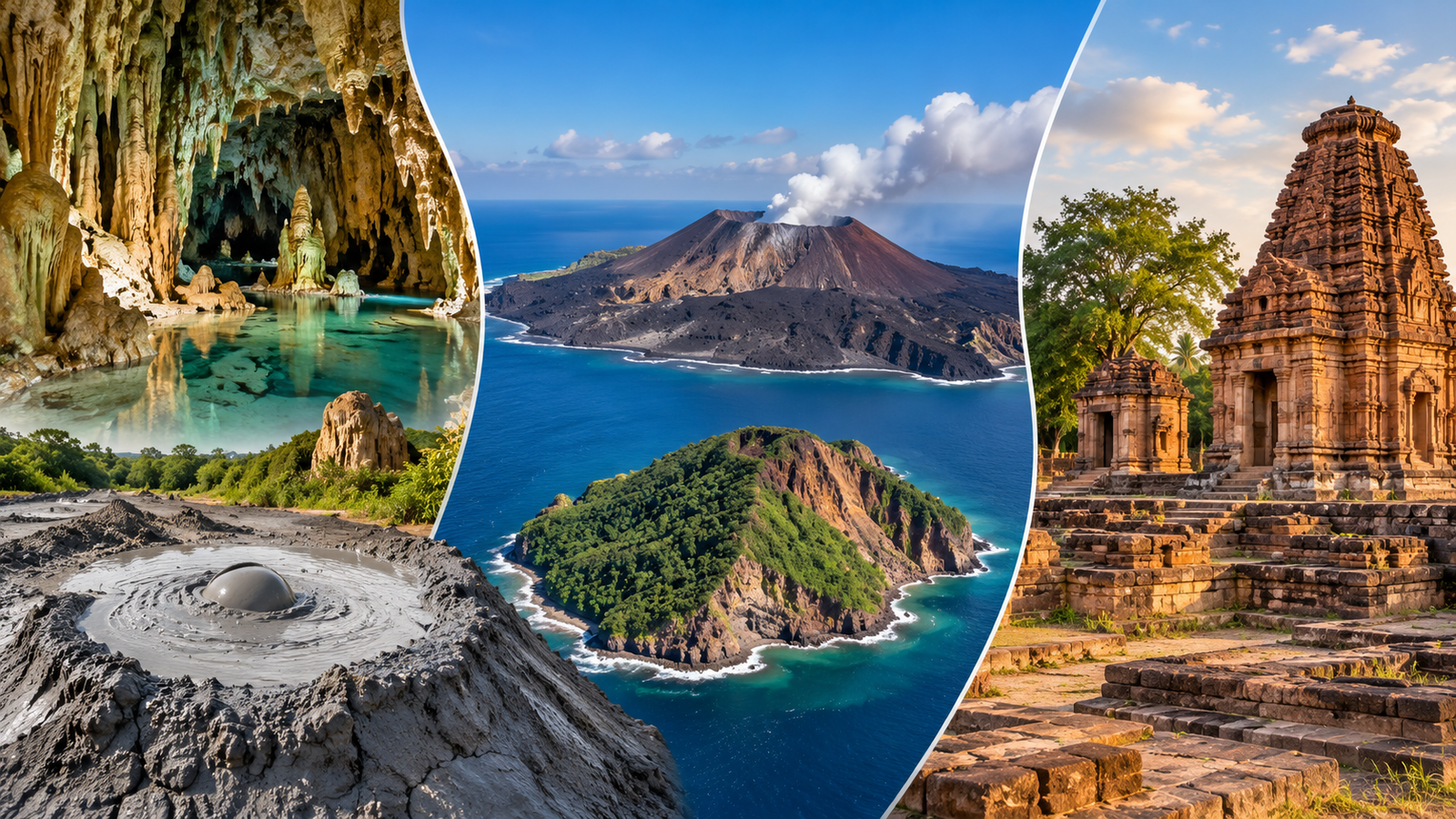
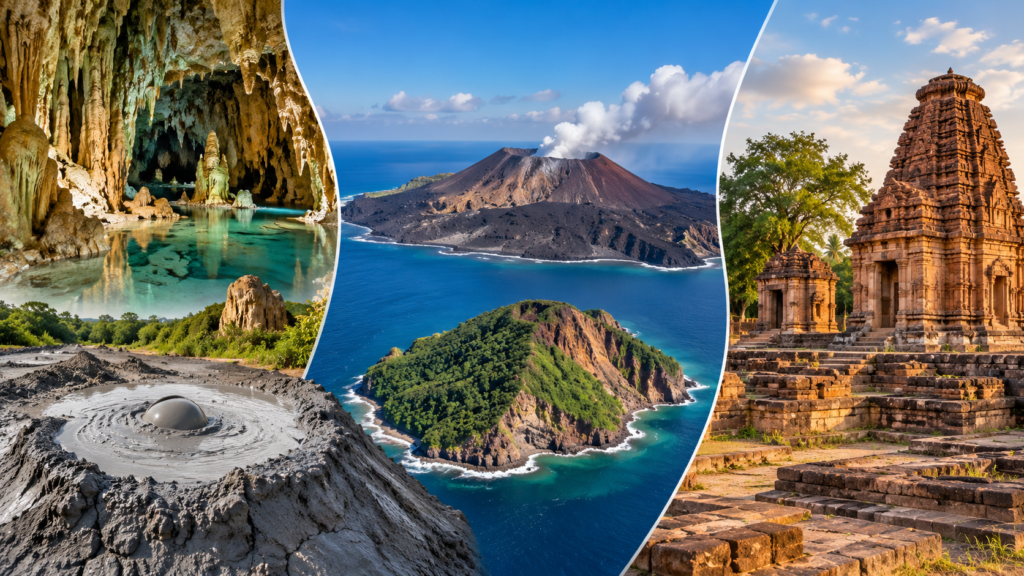
Three Indian Sites Added to UNESCO Tentative List 2026: Baratang, Andaman Volcanoes and Sirpur
India’s UNESCO Tentative List has reached 81 sites following the addition of three remarkable natural and cultural landscapes. The new entries highlight the geological wonders of the Andaman and Nicobar Islands and the rich archaeological heritage of Sirpur in Chhattisgarh.
Why Is It in the News?
Three Indian sites have been added to the UNESCO World Heritage Tentative List in October 2026. The additions were submitted by India on 28 September 2026 and announced publicly in October.
The three sites are:
- Karst-Mud-Volcano Complex of Baratang — Andaman and Nicobar Islands
- Andaman Subduction Volcanoes — Narcondam and Barren Islands
- Sirpur Cultural and Archaeological Landscape — Chhattisgarh
With these additions, India’s Tentative List has reached 81 sites.
The development is important because the three sites represent different dimensions of India’s heritage: rare geological formations, volcanic landscapes and ancient cultural traditions.
Important: Inclusion in the Tentative List does not mean that a site has been declared a UNESCO World Heritage Site. It is a preliminary step towards possible future nomination and inscription.
What Is the UNESCO Tentative List?
The UNESCO World Heritage Tentative List is an inventory of sites that a country considers suitable for future nomination to the World Heritage List.
A site must generally be included in its country’s Tentative List before it can be formally nominated for World Heritage status.
The nomination process involves detailed documentation, evaluation of the site’s significance, assessment of its conservation arrangements and a final decision by the World Heritage Committee.
The main purpose is to identify and protect places that possess Outstanding Universal Value—meaning cultural or natural significance considered exceptional for humanity.
The Three Newly Added Sites
Baratang Karst-Mud-Volcano Complex
Location: Baratang Island, Andaman and Nicobar Islands
Category: Natural heritage
Baratang Island is known for its limestone caves, distinctive geological formations and mud volcanoes. These features make it important for understanding geological processes and the evolution of the Andaman region.
The proposed site combines two significant natural phenomena: karst landscapes and mud volcanism.
What Is a Karst Landscape?
A karst landscape develops when water gradually dissolves soluble rocks, particularly limestone.
Rainwater absorbs carbon dioxide and forms a weak carbonic-acid solution. Over long periods, this water dissolves limestone and enlarges cracks into underground passages and caves.
The process can be summarised as:
Rainwater enters cracks in limestone → Rock gradually dissolves → Cavities enlarge → Caves and other karst landforms develop.
Baratang’s limestone caves provide an example of this natural process.
What Is a Mud Volcano?
A mud volcano is a geological feature through which mud, water and gases rise from underground and emerge at the surface.
Unlike conventional volcanoes, mud volcanoes do not necessarily involve molten rock or magma. Their activity is generally associated with pressurised sediments, fluids and gases moving through geological fractures.
Baratang’s mud volcanoes are particularly significant because they occur in a tectonically active region influenced by the movement of the Indian Plate beneath the Burma microplate.
Why Is Baratang Important?
The site provides opportunities to study:
- Limestone dissolution and cave formation
- Sedimentary processes
- Mud volcanism
- Underground water movement
- Tectonic activity
- The relationship between geological formations and biodiversity
Its significance lies in the combination of unusual geological features within a tropical island ecosystem.
Andaman Subduction Volcanoes: Narcondam and Barren Islands
Location: Andaman Sea, Andaman and Nicobar Islands
Category: Natural heritage
The second proposed site comprises two volcanic islands: Narcondam Island and Barren Island.
Both are associated with the geological processes that shape the Andaman volcanic arc. However, they have different volcanic histories and ecological characteristics.
What Is Subduction?
Subduction occurs when one tectonic plate moves beneath another and descends into the Earth’s interior.
In the Andaman region, the oceanic part of the Indian Plate descends beneath the Burma microplate. This process is associated with the formation of magma and volcanic activity.
The simplified process is:
Converging tectonic plates → Subduction → Magma generation → Magma rises through the crust → Volcanic activity.
This geological setting makes the Andaman Islands important for understanding plate tectonics and volcanic processes.
Barren Island: India’s Active Volcano
Barren Island is widely recognised as India’s only confirmed active volcano.
Located in the Andaman Sea, it has experienced several episodes of volcanic activity. Its landscape provides evidence of volcanic eruptions, lava flows and the development of volcanic landforms.
The island is valuable for studying:
- Volcanic activity and eruption patterns
- Lava and volcanic rock formation
- Caldera development
- Ecological recovery following eruptions
- The relationship between tectonic activity and volcanism
A caldera is a large depression that forms when part of a volcano collapses, commonly following the withdrawal of magma from beneath it.
Narcondam Island: A Unique Volcanic Ecosystem
Narcondam Island is a forested volcanic island known for its distinctive biodiversity.
It is particularly important as the habitat of the Narcondam hornbill, a bird endemic to the island.
An endemic species is naturally restricted to a particular geographical area.
The island’s isolation makes it valuable for studying:
- Island biodiversity
- Endemic species
- Ecological succession
- Evolution in isolated habitats
- The relationship between geology and ecosystems
Together, Narcondam and Barren Islands demonstrate how volcanic processes and ecological development can produce different landscapes and habitats within the same broader geological region.
Sirpur Cultural and Archaeological Landscape
Location: Mahasamund district, Chhattisgarh
Category: Cultural heritage
Sirpur is an important archaeological landscape situated on the eastern bank of the Mahanadi River.
Historically known as Shripura, it developed as an important settlement in the ancient region of Dakshina Kosala.
The remains at Sirpur provide evidence of religious life, architecture, trade and settlement development, particularly between the fifth and twelfth centuries CE.
Unlike a site consisting of a single monument, Sirpur represents a wider cultural landscape containing temples, Buddhist monasteries and other archaeological remains.
Lakshmana Temple
The Lakshmana Temple is one of Sirpur’s best-known monuments.
It is an important example of early medieval brick temple architecture and is associated with the Vaishnava tradition, which centres on the worship of Vishnu.
Its architectural features provide valuable evidence of the development of temple construction in central India.
Buddhist Monasteries and Religious Diversity
Sirpur contains the remains of Buddhist monastic establishments, including Anandaprabhu Kuti Vihara.
A vihara is a monastery or residential establishment for Buddhist monks.
The presence of Hindu and Buddhist religious structures, along with evidence of Jain traditions, highlights the cultural diversity of the region.
These remains help historians understand the relationship between religious institutions, political patronage, education and urban life in early medieval India.
Why Was Sirpur an Important Settlement?
Sirpur’s location near the Mahanadi River supported its development as a settlement and cultural centre.
Rivers historically contributed to:
- Agricultural production
- Water availability
- Movement of people and goods
- Trade and commerce
- Political administration
- Religious and cultural exchange
Sirpur therefore illustrates the close relationship between riverine geography and the growth of historical settlements.
Why Are These Additions Important for India?
The three sites highlight different aspects of India’s natural and cultural heritage.
Geological heritage: Baratang demonstrates the significance of limestone caves, karst landscapes and mud volcanism.
Volcanic heritage: Narcondam and Barren Islands provide opportunities to study subduction, volcanism and island biodiversity.
Cultural heritage: Sirpur preserves evidence of ancient architecture, religious diversity and settlement development.
Their inclusion also strengthens the case for conserving sites that are scientifically or historically important but may be less widely recognised than India’s most famous heritage destinations.
Challenges in Conservation
Tentative List inclusion is only the beginning. Long-term conservation requires effective planning and protection.
Protecting Fragile Geological Formations
Baratang’s limestone caves and mud volcanoes require careful management to prevent physical damage, pollution and disturbance of surrounding ecosystems.
Protecting Island Biodiversity
Narcondam and Barren Islands contain ecologically sensitive habitats. Conservation efforts must consider endemic species, volcanic activity and restrictions needed to protect fragile environments.
Preserving Archaeological Remains
Sirpur faces the broader challenges associated with archaeological conservation, including weathering, development pressure, tourism management and the need for continued research.
Promoting Responsible Tourism
Tourism can support local livelihoods and increase public awareness, but poorly managed visitor activity can damage natural and cultural heritage.
Conservation must therefore remain the priority.
Way Forward
India should focus on five priorities:
- Strengthen conservation management: Develop long-term plans to protect the geological, ecological and cultural features of each site.
- Improve scientific documentation: Support geological surveys, archaeological research and biodiversity assessments.
- Promote responsible tourism: Improve visitor facilities without damaging fragile landscapes or archaeological remains.
- Involve local communities: Ensure that conservation supports local livelihoods and respects cultural and ecological relationships.
- Prepare strong nominations: Demonstrate each site’s Outstanding Universal Value and establish effective long-term protection arrangements.
Conclusion
The addition of the Baratang Karst-Mud-Volcano Complex, Andaman Subduction Volcanoes and Sirpur Cultural and Archaeological Landscape to India’s UNESCO Tentative List highlights the country’s remarkable diversity of natural and cultural heritage.
From limestone caves and volcanic islands to ancient temples and Buddhist monasteries, these sites help explain the geological processes and historical developments that have shaped India.
However, Tentative List inclusion does not guarantee World Heritage status. Their future recognition will depend on detailed evaluation, strong conservation measures and successful nominations.
For India, the larger lesson is that heritage conservation must extend beyond famous monuments to include geological formations, unique ecosystems and cultural landscapes that preserve the story of both nature and civilisation.
UPSC Exam Relevance
GS Paper I: Indian culture, architecture, ancient and medieval history, geographical features.
GS Paper III: Biodiversity conservation, environmental protection, geology and natural hazards.
Important Prelims Facts
| Topic | Fact |
|---|---|
| UNESCO Tentative List | Preliminary inventory for potential World Heritage nominations |
| Baratang | Andaman and Nicobar Islands |
| Barren Island | India’s only confirmed active volcano |
| Narcondam Island | Habitat of the endemic Narcondam hornbill |
| Sirpur | Mahasamund district, Chhattisgarh |
| River associated with Sirpur | Mahanadi |
| Karst landscape | Formed by the dissolution of soluble rocks |
| Subduction | One tectonic plate descends beneath another |
Practice MCQs
1. Which of the following is associated with the Karst-Mud-Volcano Complex of Baratang?
(a) Glacial valleys and moraines
(b) Limestone caves and mud volcanoes
(c) Coral atolls and lagoons only
(d) Sand dunes and loess deposits
Answer: (b)
2. Barren Island is known for which of the following?
(a) India’s only confirmed active volcano
(b) India’s highest dormant volcano
(c) A major Himalayan volcanic system
(d) A mud volcano in the Arabian Sea
Answer: (a)
3. Sirpur is located near which river?
(a) Narmada
(b) Godavari
(c) Mahanadi
(d) Krishna
Answer: (c)
4. Inclusion in UNESCO’s Tentative List means that a site:
(a) Automatically becomes a World Heritage Site
(b) Has been identified as a potential candidate for future nomination
(c) Is guaranteed international conservation funding
(d) No longer requires national protection
Answer: (b)