Himachal Pradesh High Court Halts Construction and Tarring of Forest Roads: Reasons, Environmental Concerns and UPSC Relevance
Why in News?
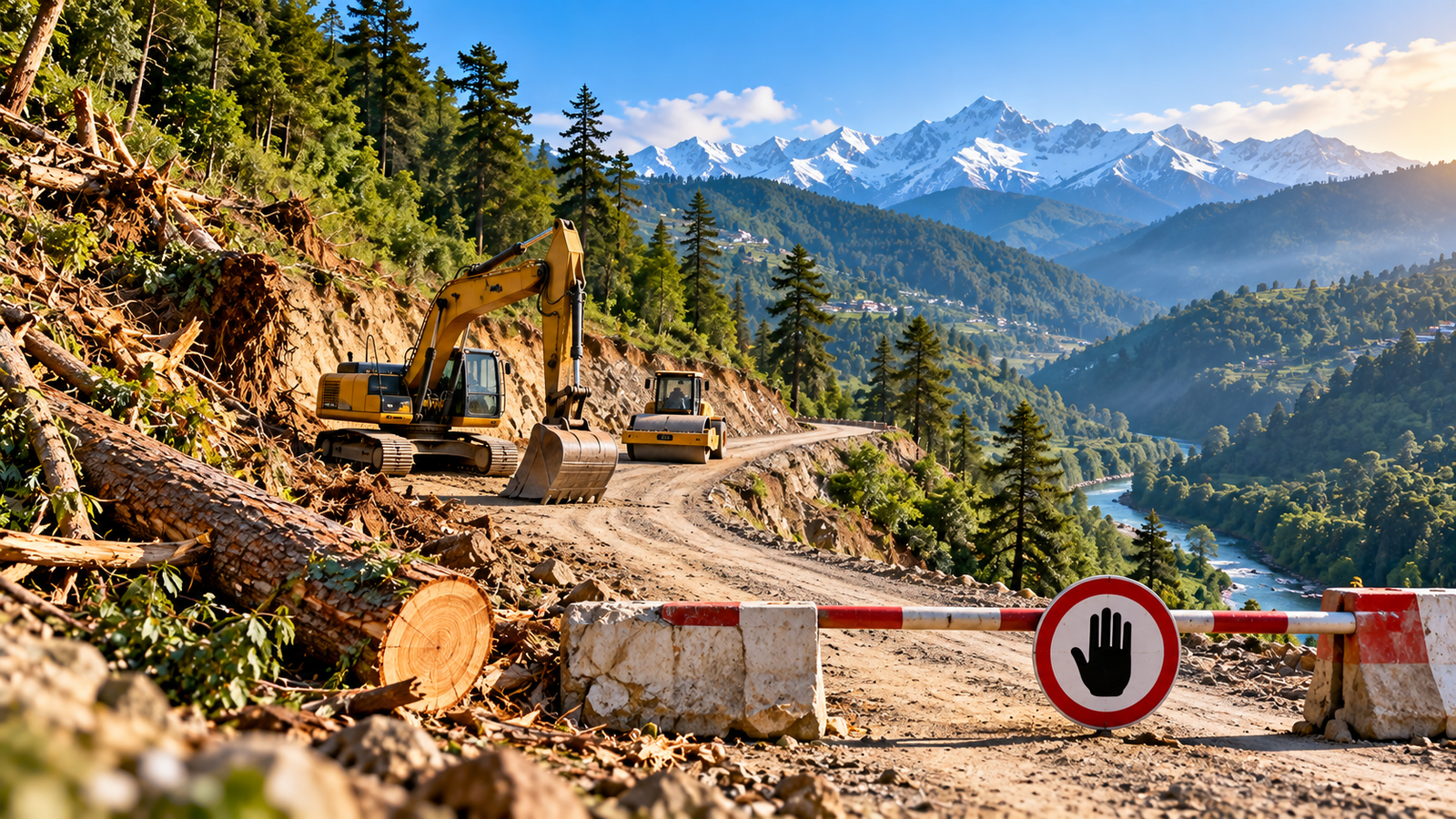
On October 8, 2026, the Himachal Pradesh High Court reiterated its earlier interim order of August 17, 2026, directing that construction and tarring of forest roads must not take place until further orders.
The order came during hearings related to environmental degradation and alleged violations of forest-conservation requirements in ecologically fragile areas of Himachal Pradesh.
The issue gained attention after an amicus curiae—a person appointed to assist the court—submitted information about 55 roads in the Seraj Assembly constituency of Mandi district that were allegedly constructed without the required forest-clearance process being completed.
The case raises important questions about forest conservation, infrastructure development, environmental governance and the rights of local communities.
The matter is scheduled for further hearing on December 2, 2026.
What Has the High Court Directed?
The High Court reiterated that construction and tarring of the forest roads concerned would remain suspended until further orders.
The proceedings highlighted the following concerns:
- 55 roads in Seraj: A chart submitted before the Court identified 55 roads allegedly constructed in violation of forest-conservation requirements in the Seraj constituency, which falls under the Nachan Forest Division.
- Forest-clearance concerns: In a majority of the reported cases, the roads were reportedly already constructed even though proposals from the user agencies for forest clearance had yet to be received.
- Incomplete road projects: The Court was informed that work on some of the listed roads remained incomplete. One example mentioned in the reporting was the 10.165-km Bagsaid–Rahidhar–Kathyali–Dharwar–Dhansal road.
- Tree felling: The proceedings raised concerns about the felling of green trees for road construction and its consequences for fragile forest ecosystems.
- Helipads in Seraj: The presence of 16 helipads was also brought to the Court’s attention, with concerns about potential wildlife disturbance and the need to assess environmental impacts.
Important clarification: These details include submissions made to the Court. The interim order should not be interpreted as a final judicial finding that every one of the 55 roads or all 16 helipads is illegal.
Background: Why Are Forest Roads a Concern in Himachal Pradesh?
Himachal Pradesh is a Himalayan state characterised by steep slopes, deep valleys, forests, rivers, glaciers and ecologically sensitive mountain landscapes.
Roads are essential for connecting remote villages with schools, hospitals, markets and administrative centres. They also support tourism, agriculture, horticulture and emergency services.
However, road construction in mountainous terrain can cause serious environmental problems when it is undertaken without adequate planning, statutory approvals or safeguards.
Environmental risks of unplanned road construction
Deforestation: Clearing forest land for roads removes trees and vegetation. This can reduce carbon storage, damage wildlife habitats and weaken the ecological functions of forests.
Soil erosion: Vegetation holds soil together. When trees and ground cover are removed, rainfall and surface runoff can carry soil downhill more easily.
Landslides: Cutting steep slopes for road construction can disturb their stability. Poor drainage, loose debris and intense rainfall may increase the risk of slope failure.
Habitat fragmentation: A continuous forest habitat may be divided into smaller patches by roads. This can restrict animal movement, disrupt breeding and feeding patterns, and increase human-wildlife encounters.
Disturbance to wildlife: Traffic, construction noise, artificial lighting and increased human movement can affect wildlife, especially in sensitive habitats.
Tourism pressure: Better motorable access can increase visitor numbers at ecologically fragile sites. Without carrying-capacity limits and waste-management facilities, this may increase littering, traffic, water demand and pressure on local ecosystems.
The High Court’s intervention reflects the need to examine whether road development in sensitive landscapes is being carried out in accordance with applicable laws and environmental safeguards.
Why Did the Court Raise Concerns About Ecologically Fragile Sites?
Earlier proceedings highlighted the environmental implications of providing motorable access to ecologically sensitive locations, including Chandertal Lake, Shikari Devi Mandir and Churdhar Temple.
Such places may have high ecological, religious or tourism value. Increasing accessibility can benefit visitors and local economies, but it can also create pressure on habitats and natural resources.
The central issue is not whether all roads are harmful. Rather, it is whether each project is properly assessed, legally approved and designed to minimise environmental damage.
A road serving a remote village’s essential needs may have a strong public-interest justification. A road primarily facilitating access to a highly sensitive site may require a different assessment of its necessity, alternatives and environmental costs.
Therefore, road planning in the Himalayas must consider both connectivity needs and ecological carrying capacity.
Legal Framework Governing Forest Roads
Van (Sanrakshan Evam Samvardhan) Adhiniyam, 1980
The law originally known as the Forest (Conservation) Act, 1980 is now titled the Van (Sanrakshan Evam Samvardhan) Adhiniyam, 1980.
Its central purpose is forest conservation. The law regulates the dereservation of forests and the use of forest land for non-forest purposes, subject to the applicable statutory provisions and approval requirements.
Where a proposed road involves the diversion of forest land for a non-forest purpose, the applicable approval process must be followed. A road project should not assume that construction can proceed first and the required forest approvals can be obtained later.
Exam point: Forest clearance and road construction approval are not interchangeable. A project may require multiple permissions under different laws, depending on its location and characteristics.
Forest Rights Act, 2006
The Scheduled Tribes and Other Traditional Forest Dwellers (Recognition of Forest Rights) Act, 2006 recognises the rights of eligible forest-dwelling Scheduled Tribes and other traditional forest dwellers.
These rights can include individual and community rights, access to forest resources, and community rights to protect, regenerate, conserve or manage community forest resources.
The Forest Rights Act is not a general substitute for forest-diversion approval. Its provisions must be applied according to the purpose and conditions of the Act.
In the present case, concerns were raised before the Court about permissions reportedly granted under the Forest Rights Act in circumstances that required closer scrutiny. The legal validity of particular permissions must be assessed on the relevant facts and applicable law.
Environment (Protection) Act, 1986 and other environmental requirements
Depending on the nature, location and scale of a project, additional environmental laws, wildlife-related requirements, rules and administrative approvals may apply.
For projects located in or near protected areas, wildlife habitats or other sensitive landscapes, authorities must examine the relevant legal requirements rather than assume that ordinary road permissions are sufficient.
Not every road project automatically requires the same set of clearances. The applicable requirements depend on the project’s specific characteristics and the law in force.
What Is an Amicus Curiae?
An amicus curiae is a person who assists a court by providing relevant information, legal analysis or other material that may help the court decide a case.
The expression is Latin for “friend of the court”.
In public-interest cases involving environmental damage, an amicus curiae can help organise information, identify relevant legal issues and bring important facts to the Court’s attention.
In this matter, the amicus curiae placed a chart of 55 roads before the High Court and raised concerns about forest clearances and environmental impacts.
The submissions assist the Court’s examination of the issue; they do not, by themselves, constitute a final judicial determination.
Environmental Significance of the Case
Forest conservation and biodiversity
Forests provide habitat for wildlife, store carbon, regulate local water cycles and support ecological processes. Road development that removes vegetation or divides habitats can weaken these functions.
Protecting forests is especially important in the Himalayas, where species may depend on specific elevation zones and connected habitats.
Soil and slope stability
Mountain roads require cutting and reshaping slopes. If the work is not supported by proper geological assessment, drainage and slope protection, it may increase erosion and landslide vulnerability.
Roadside drainage is particularly important because concentrated runoff can erode slopes and destabilise areas below the road.
Watersheds and water security
Forests help regulate runoff, support soil-water interactions and protect catchment areas. Disturbance to vegetation and soil can increase sediment movement into streams and rivers.
This matters in Himachal Pradesh, where communities, agriculture, hydropower and ecosystems depend on mountain water systems.
Climate resilience
The Himalayas face risks associated with changing rainfall patterns, extreme precipitation, warming and other environmental pressures. Infrastructure that ignores local geology and climate risks may become vulnerable to landslides, erosion and damage during extreme weather.
Climate-resilient road planning must therefore combine engineering standards with ecological assessment.
Development Versus Conservation: Finding the Balance
The case illustrates a major governance challenge: how to provide essential connectivity without causing avoidable ecological damage.
Why roads are important
- They connect remote communities to healthcare, education and public services.
- They improve access to markets for farmers and horticulturists.
- They support emergency response, disaster relief and evacuation.
- They can reduce the isolation of mountain settlements.
- They contribute to tourism and economic activity when planned sustainably.
Why safeguards are necessary
- Unplanned construction can lead to forest loss and habitat fragmentation.
- Weak drainage and slope protection can increase erosion and landslide risks.
- Roads can increase pressure on sensitive religious, tourism and ecological sites.
- Construction without the necessary approvals undermines the rule of law.
- Repairing environmental damage may impose long-term costs on the state and local communities.
The appropriate approach is not to stop every road project indiscriminately. It is to distinguish essential connectivity from avoidable expansion, ensure legal compliance, consider alternatives and minimise environmental impacts.
Way Forward
Strengthen pre-construction scrutiny: Forest-land status, applicable clearances, slope stability, drainage and ecological sensitivity should be examined before work begins.
Ensure legal compliance: Departments and executing agencies should follow the applicable forest-diversion and environmental approval processes. Construction should not precede legally required approvals.
Prioritise existing infrastructure: Where feasible, improving the safety and drainage of existing roads may be preferable to opening new routes through intact forest areas.
Use scientific road planning: Geological surveys, landslide-susceptibility assessments, watershed mapping and biodiversity studies should inform road alignment and design.
Adopt nature-sensitive engineering: Appropriate retaining structures, slope stabilisation, cross-drainage, erosion control and restoration of disturbed sites can reduce environmental impacts.
Assess alternatives: Authorities should examine whether public transport, controlled access, walking routes or other lower-impact options can meet the objective of a project, especially near sensitive sites.
Manage tourism carrying capacity: Visitor limits, waste management, parking controls and regulated access may be necessary where motorable connectivity creates excessive pressure on fragile locations.
Improve transparency and monitoring: Publicly accessible records of approvals, project status, tree felling, mitigation measures and compliance inspections can improve accountability.
Involve local communities: Residents possess important knowledge about local terrain, water sources, traditional routes and ecological changes. Their participation can improve planning and help ensure that infrastructure responds to genuine needs.
UPSC and HPPSC Syllabus Mapping
UPSC Prelims
- Environment and Ecology
- Forest conservation legislation
- Biodiversity and habitat fragmentation
- Environmental institutions and statutory approvals
- Disaster-management concepts related to landslides and erosion
UPSC Mains
- GS Paper II: Government policies, implementation, judicial intervention and accountability.
- GS Paper III: Environment, biodiversity, conservation, infrastructure and disaster management.
- GS Paper IV: Environmental ethics, public interest, accountability and responsible administration.
HPPSC/HPAS
- Himachal Pradesh’s geography and fragile Himalayan environment
- Forests and biodiversity of Himachal Pradesh
- Landslides, erosion and mountain hazards
- State infrastructure and rural connectivity
- Forest administration and environmental governance
- Sustainable tourism and development planning
Prelims Quick Revision
- High Court: Himachal Pradesh High Court.
- Location at the centre of the reported road issue: Seraj Assembly constituency, Mandi district.
- Forest division mentioned: Nachan Forest Division.
- Roads reported by the amicus curiae: 55, allegedly constructed in violation of forest-conservation requirements.
- Other infrastructure mentioned in the proceedings: 16 helipads; their mention does not mean the road-specific interim restraint is a final ruling against every helipad.
- Earlier interim order: August 17, 2026.
- Order reiterated: October 8, 2026.
- Next reported hearing: December 2, 2026.
- Key forest law: Van (Sanrakshan Evam Samvardhan) Adhiniyam, 1980.
- Related legislation: Forest Rights Act, 2006.
- Core issue: Balancing essential infrastructure with forest conservation and environmental safeguards.
Practice MCQs
Q1. The recent Himachal Pradesh High Court proceedings concerning forest roads primarily relate to which of the following?
A. Regulation of inter-state river water sharing
B. Forest conservation and construction in ecologically fragile areas
C. Allocation of mining royalties
D. Regulation of agricultural exports
Answer: B. The proceedings concern forest-road construction, compliance with forest-conservation requirements and potential environmental damage.
Q2. Consider the following statements about the Forest Rights Act, 2006:
- It recognises certain rights of eligible forest-dwelling Scheduled Tribes and other traditional forest dwellers.
- It serves as a general substitute for every approval required for diversion of forest land.
- It recognises certain community rights relating to forest resources and conservation.
Which of the statements given above are correct?
A. 1 only
B. 1 and 2 only
C. 1 and 3 only
D. 1, 2 and 3
Answer: C. The Act recognises eligible individual and community forest rights. It does not automatically replace other statutory forest-diversion approvals.
Q3. Which of the following can be consequences of poorly planned road construction in the Himalayas?
- Increased slope instability
- Habitat fragmentation
- Soil erosion
- Reduced pressure on all sensitive ecosystems in every case
Select the correct answer:
A. 1, 2 and 3 only
B. 1 and 4 only
C. 2 and 4 only
D. 1, 2, 3 and 4
Answer: A. Poorly planned construction can increase erosion, slope instability and habitat fragmentation. Improved access can increase pressure on sensitive ecosystems rather than automatically reduce it.
Mains Practice Question
Question: “Infrastructure development in the Himalayan region must be guided by ecological sensitivity and legal compliance.” Discuss in the context of the Himachal Pradesh High Court’s recent intervention concerning forest roads.
Suggested answer framework
Introduction: Explain the importance of road connectivity in mountain states and the ecological sensitivity of the Himalayas.
Body:
- Explain the reported forest-clearance concerns in Seraj.
- Discuss the ecological risks of deforestation, habitat fragmentation, erosion and landslides.
- Explain the importance of forest legislation and statutory compliance.
- Recognise the need for roads for healthcare, education, agriculture, disaster response and livelihoods.
- Suggest scientific planning, alternatives, nature-sensitive engineering, transparent approvals and community participation.
Conclusion: Emphasise that sustainable Himalayan development requires essential connectivity, strict legal compliance and protection of fragile ecosystems.
Final Takeaway
The Himachal Pradesh High Court’s intervention highlights a fundamental principle of environmental governance: development projects must meet applicable legal requirements and account for ecological consequences, particularly in fragile mountain regions.
For Himachal Pradesh, the long-term objective should be reliable connectivity for local communities without unnecessary forest loss, avoidable slope instability or irreversible damage to biodiversity. Sustainable road planning must integrate engineering, environmental science, transparent administration and the genuine needs of residents.