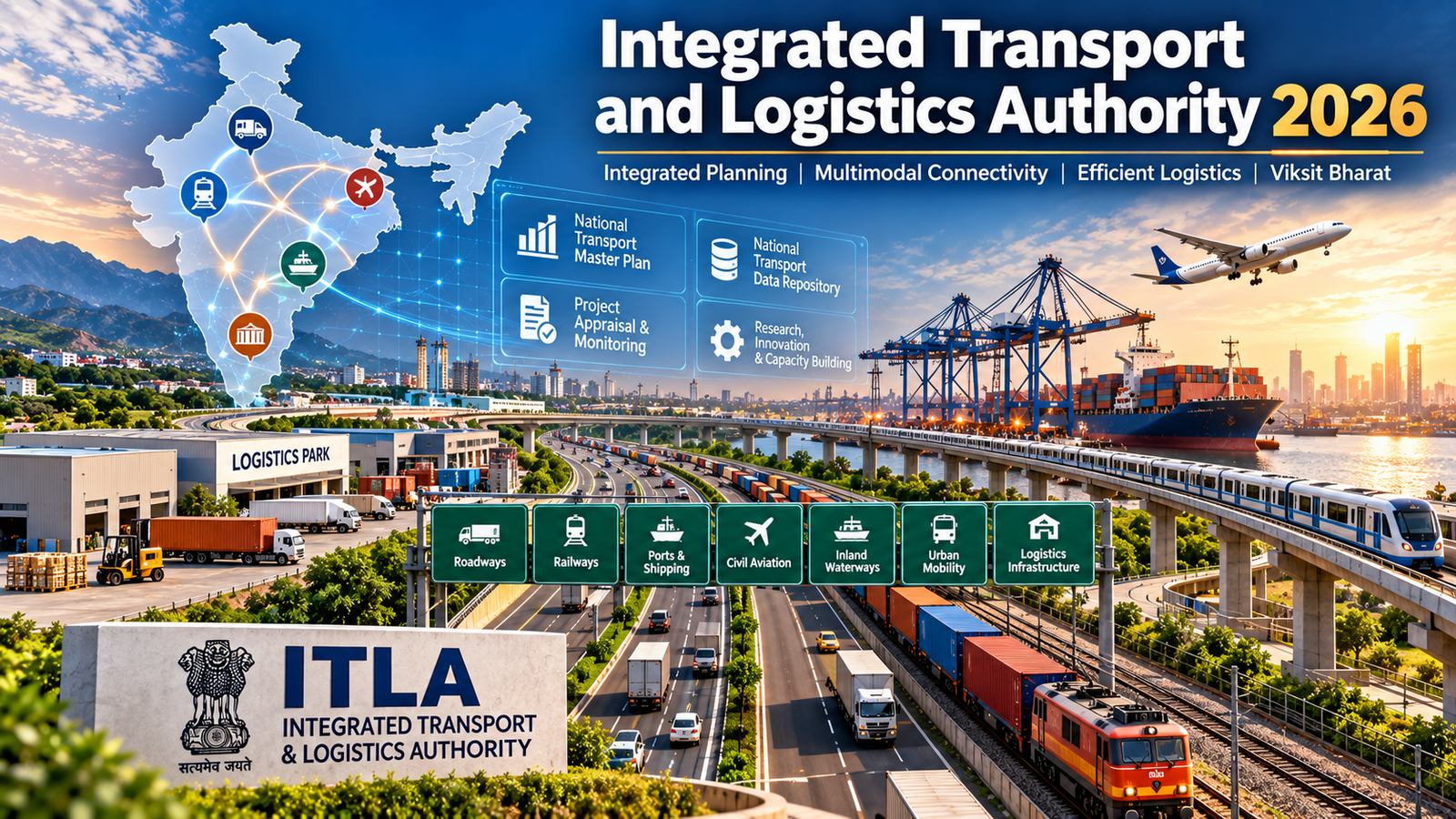
Integrated Transport and Logistics Authority 2026: ITLA, National Transport Master Plan and Data Repository Explained
Why in News?
The Union Cabinet on 6 October 2026 approved the establishment of the Integrated Transport & Logistics Authority (ITLA) as a Special Purpose Vehicle (SPV).
The new institution is intended to strengthen integrated transport and logistics planning, research, project appraisal, monitoring and impact assessment across India.
The move aims to address a long-standing problem in India’s infrastructure system: different transport sectors and government agencies often plan and implement projects separately.
ITLA will therefore promote a more integrated, multimodal and data-driven approach to transport infrastructure.
What is ITLA?
ITLA = Integrated Transport & Logistics Authority
It will function as a national-level institutional mechanism for:
- transport planning
- logistics planning
- infrastructure project appraisal
- project monitoring
- impact assessment
- transport data analytics
- policy support
- research and innovation
- capacity building
The Cabinet has described ITLA as the apex institution for integrated transport and logistics planning, research, project appraisal and monitoring.
English Definition
ITLA is a national institutional mechanism designed to integrate transport and logistics planning across different modes, improve project appraisal and monitoring, and enable data-driven infrastructure development.
Why Does India Need ITLA?
India’s transport system includes several major modes:
Roads
Railways
Ports and shipping
Civil aviation
Inland waterways
Coastal shipping
Urban mobility
Logistics infrastructure
The problem is that these systems are interconnected.
A railway line without adequate road connectivity may not efficiently move goods to the final destination.
Similarly:
Port → Railway → Highway → Warehouse → Market
must work as one logistics chain.
If each component is planned independently, bottlenecks can develop.
Therefore, India’s infrastructure planning increasingly needs to move from:
Silo-based planning
to
Integrated multimodal planning
This is the central logic behind ITLA.
What is Multimodal Transport?
This is one of the most important concepts in this topic.
Hinglish
Multimodal transport ka matlab hai goods ya passengers ko efficiently move karne ke liye multiple modes of transport ko ek integrated system ki tarah use karna.
For example:
Truck → Railway → Port → Ship
Agar ye modes properly connected hain, toh transportation faster aur cheaper ho sakta hai.
English Definition
Multimodal transport refers to the coordinated movement of people or goods using two or more modes of transport within an integrated transport system.
Why is Multimodal Connectivity Important?
Consider an export product manufactured in Himachal Pradesh.
Its journey could involve:
Factory
↓
Road
↓
Railway
↓
Port
↓
Ship
↓
International Market
If every mode operates separately, there may be:
- delays
- multiple handling points
- higher costs
- poor coordination
- congestion
Integrated planning can reduce these inefficiencies.
This is why transport infrastructure should not be viewed as isolated roads, railway lines or ports.
It should be viewed as a network.
ITLA’s National Transport Master Plan
One of the most important functions of ITLA will be preparation of a comprehensive National Transport Master Plan.
The plan will have a planning horizon of:
10 years or more
It will cover:
- roads
- railways
- ports and shipping
- civil aviation
- inland waterways
- coastal shipping
- urban mobility
- logistics
This provides a long-term framework for transport infrastructure development.
What is a Transport Master Plan?
Hinglish
Transport Master Plan ek long-term planning framework hota hai jisme future mein transport infrastructure ki requirement, location, connectivity aur integration ko systematically plan kiya jata hai.
English Definition
A Transport Master Plan is a long-term strategic framework for planning, coordinating and developing transport infrastructure and services across different modes.
Why Long-Term Planning Matters
Transport infrastructure has a very long life.
A highway, railway line, port or airport can influence economic activity for decades.
Therefore, infrastructure decisions should consider:
- future population
- urbanisation
- industrialisation
- trade
- freight demand
- tourism
- migration
- regional development
- climate risks
- technological changes
A short-term approach may create infrastructure that becomes inadequate or poorly connected in the future.
ITLA and Short-Term Transport Plans
ITLA will not replace sectoral ministries.
Instead, it will evaluate their:
- short-term sectoral plans
- annual plans
and ensure that they are consistent with the longer-term National Transport Master Plan.
The short-term planning horizon is expected to be around five years, while the National Transport Master Plan will have a horizon of 10 years or more.
This creates a planning hierarchy:
10+ year National Transport Master Plan
↓
~5 year sectoral plans
↓
Annual plans
This can improve coordination between long-term objectives and individual projects.
ITLA and ₹500 Crore Projects
Another major responsibility of ITLA is technical appraisal.
ITLA will undertake technical appraisal of Government of India infrastructure projects costing:
₹500 crore or more
However, there is an important distinction.
ITLA
Technical appraisal
Existing financial appraisal mechanisms
Financial appraisal
This distinction is important for UPSC Prelims.
What is Technical Appraisal?
Hinglish
Technical appraisal ka matlab hai project technically feasible hai ya nahi, uski design, connectivity, capacity, implementation requirements aur broader infrastructure implications ko evaluate karna.
English Definition
Technical appraisal is the systematic assessment of a project’s technical feasibility, design, capacity, implementation requirements and infrastructure implications.
What is Project Impact Assessment?
A project should not be judged only by whether it was completed.
The more important question is:
Did the project actually achieve its intended outcomes?
For example, a highway may be completed on time.
But did it:
- reduce travel time?
- reduce freight costs?
- improve connectivity?
- increase economic activity?
- reduce congestion?
ITLA will undertake post-implementation impact assessment to evaluate project outcomes and performance.
National Transport Data Repository
One of the most innovative aspects of ITLA is the proposed:
National Transport Data Repository (NTDR)
The repository will integrate transport and logistics data from multiple sources.
These include:
- GSTN e-way bills
- FASTag
- VAHAN
- GPS-based systems
- urban traffic management systems
- other relevant databases
This will allow the government to use real-world transport data for infrastructure planning.
What is GSTN E-Way Bill Data?
An e-way bill is an electronic document used to track the movement of goods subject to applicable GST requirements.
Transport data from e-way bills can provide information about:
- movement of goods
- origin
- destination
- freight flows
- commercial activity
When combined with other transport data, it can help identify major freight corridors.
What is FASTag Data?
FASTag is an electronic toll-payment system using RFID technology.
FASTag data can provide information about:
- vehicle movement
- toll crossings
- traffic patterns
- road usage
When aggregated and analysed appropriately, such data can help understand traffic and freight movement.
What is VAHAN?
VAHAN is India’s national vehicle registration and related vehicle database system.
It contains information related to registered vehicles.
Integration of such data can support transport planning and policy analysis.
What is Origin-Destination Analysis?
This is an important technical term.
Hinglish
Origin-Destination, ya O-D analysis, ka matlab hai ye study karna ki goods ya people kahan se start karte hain aur kahan jaate hain.
For example:
Factory in Punjab → Port in Gujarat
This is an origin-destination movement.
English Definition
Origin-Destination analysis studies the starting point and destination of movements of people or goods to understand travel and freight-flow patterns.
ITLA will use freight-flow and O-D analytics for planning, monitoring and impact assessment.
Why Data Integration Matters
Imagine three separate databases:
FASTag
→ Road movement
E-way bills
→ Goods movement
GPS
→ Actual vehicle movement
Individually, each dataset provides limited information.
But together:
FASTag + E-way bills + GPS + VAHAN + traffic data
can create a much more complete picture of India’s transport network.
This is the concept of:
Data-driven infrastructure planning
From Infrastructure Planning to Data-Driven Planning
Traditional approach:
Need identified
↓
Project designed
↓
Project constructed
↓
Project completed
The emerging approach is:
Data
↓
Demand analysis
↓
Network modelling
↓
Project design
↓
Technical appraisal
↓
Implementation
↓
Real-time monitoring
↓
Impact assessment
↓
Policy correction
ITLA is intended to strengthen this second approach.
ITLA and PM GatiShakti
Do not confuse:
ITLA
with
PM GatiShakti National Master Plan
They are related, but they are not the same thing.
PM GatiShakti
Launched in 2021, PM GatiShakti is a GIS-based National Master Plan for multimodal connectivity.
It integrates infrastructure and economic-zone information on a common digital platform to improve planning and coordination.
ITLA
Approved in 2026, ITLA is an institutional mechanism for:
- integrated planning
- research
- project appraisal
- monitoring
- impact assessment
- data analytics
- transport policy support
ITLA is explicitly intended to complement existing initiatives such as PM GatiShakti and the National Logistics Policy.
ITLA vs PM GatiShakti
| Feature | PM GatiShakti | ITLA |
|---|---|---|
| Launched/approved | 2021 | 2026 |
| Core focus | Multimodal connectivity and integrated infrastructure planning | Transport & logistics planning, appraisal, monitoring and impact assessment |
| Nature | National Master Plan / digital planning framework | Special Purpose Vehicle |
| Major tool | GIS-based platform | Institutional + analytical mechanism |
| Data | Infrastructure and economic-zone datasets | Transport/logistics datasets including FASTag, e-way bills, VAHAN, GPS etc. |
| Major planning horizon | Master planning framework | 10+ year National Transport Master Plan |
| Project role | Integrated network planning | Technical appraisal of ₹500 crore+ projects |
| Impact assessment | Supports monitoring | Explicit post-implementation impact assessment |
The two are therefore complementary rather than competing institutions.
ITLA and National Logistics Policy
India’s National Logistics Policy seeks to create an integrated, efficient, reliable, green and cost-effective logistics ecosystem.
The policy aims to improve India’s logistics competitiveness through:
- technology
- process improvement
- digitalisation
- infrastructure
- skilled manpower
- better coordination
ITLA will advise and assist in the review and updating of the National Logistics Policy, 2022.
What is Logistics?
Hinglish
Logistics ka simple matlab hai goods ko right place, right time aur right condition mein efficiently move karna.
It includes:
- transportation
- warehousing
- inventory management
- packaging
- freight handling
- distribution
- information flows
English Definition
Logistics is the planning and management of the movement, storage and distribution of goods and related information from origin to destination.
Logistics vs Transportation
These terms are often confused.
Transportation
Focuses mainly on:
Movement of goods or people
Logistics
Is broader.
It includes:
Transportation + storage + inventory + warehousing + distribution + information
Therefore:
Transportation is a component of logistics.
Why Logistics Costs Matter
High logistics costs can reduce the competitiveness of Indian products.
Suppose two countries manufacture the same product.
If India’s product costs:
₹100 production + ₹20 logistics = ₹120
while another country’s product costs:
₹100 production + ₹10 logistics = ₹110
the second country may have a competitive advantage.
Therefore, reducing logistics inefficiencies can improve:
- exports
- manufacturing competitiveness
- supply chains
- domestic market integration
- investment
A 2025 government logistics-cost assessment estimated India’s overall logistics cost at around 7.97% of GDP, substantially below older private estimates that had often placed it around 13–14%.
The key point is that measurement methodologies matter, so older and newer estimates should not be compared without considering methodology.
ITLA and India’s Global Competitiveness
Efficient logistics is essential for India’s ambition to become a major manufacturing and export hub.
The chain is:
Better infrastructure
↓
Lower delays
↓
Lower logistics costs
↓
Higher productivity
↓
More competitive exports
↓
Greater global value-chain integration
Thus, ITLA has significance beyond transportation.
It can influence India’s broader economic competitiveness.
What are Global Value Chains?
Hinglish
Global Value Chain (GVC) mein product ke different stages—design, manufacturing, assembly, distribution etc.—different countries mein spread ho sakte hain.
English Definition
A global value chain is a production system in which different stages of producing and delivering a good or service are distributed across multiple countries.
Efficient logistics is essential for GVC participation.
If components cannot move quickly and reliably between locations, global manufacturing networks become difficult to operate.
ITLA and India’s Manufacturing Strategy
Manufacturing depends on reliable connectivity between:
Raw-material source
↓
Factory
↓
Warehouse
↓
Transport network
↓
Port/Airport
↓
Global market
ITLA can strengthen the institutional planning required to connect these nodes.
This can support India’s broader goals related to:
- manufacturing
- exports
- industrial corridors
- economic zones
- supply chains
- investment
ITLA and Regional Development
Transport infrastructure does not only move goods.
It changes the geography of economic activity.
Better connectivity can:
- connect remote regions with markets
- reduce travel time
- increase investment
- support tourism
- improve access to services
- encourage industrialisation
- influence migration
This makes ITLA relevant to Geography Optional as well.
Himachal Pradesh Connection
ITLA is particularly relevant to Himachal Pradesh because of the state’s:
- mountainous terrain
- difficult road connectivity
- high transport costs
- tourism economy
- horticulture sector
- fragile infrastructure
- landslide and extreme-weather risks
Consider the movement of apples:
Orchard
↓
Collection centre
↓
Cold storage
↓
Road transport
↓
Rail/Logistics hub
↓
Wholesale market
↓
Consumer
Any bottleneck can increase:
- transit time
- spoilage
- logistics cost
- farmer losses
Integrated transport planning can therefore have major implications for horticulture and mountain economies.
Geography Optional Connection
ITLA can be linked with several Geography concepts.
Transport Geography
Study of spatial patterns and systems of movement.
Network Connectivity
Degree to which different locations are linked through transport routes.
Accessibility
Ease with which people or goods can reach a location.
Transport Nodes
Places where different transport routes or modes converge.
Examples:
- ports
- railway terminals
- airports
- logistics parks
Transport Corridors
Major routes connecting important economic regions.
Multimodal Hubs
Locations where multiple transport modes are integrated.
ITLA and Sustainable Transport
Modern transport planning cannot focus only on speed and economic efficiency.
It must also consider:
- emissions
- fuel consumption
- congestion
- land use
- climate resilience
- public transport
- electric mobility
A well-integrated system can encourage movement of suitable freight from roads to:
Railways
or
Inland waterways
where economically and environmentally appropriate.
This can reduce pressure on road networks and potentially lower emissions.
ITLA and Urban Mobility
The authority’s scope includes urban mobility.
This is important because India’s cities face:
- traffic congestion
- air pollution
- parking pressure
- long commuting times
- fragmented public transport
Integrated urban transport planning can connect:
Metro
Railways
Buses
RRTS
Walking
Cycling
Last-mile connectivity
The objective is to create a seamless mobility system rather than isolated transport projects.
ITLA and Research & Innovation
ITLA will also promote:
- research
- innovation
- data analytics
- capacity building
- training
- skilling
This is important because transport systems are increasingly becoming technology-driven.
Future transport planning may involve:
- Artificial Intelligence
- GIS
- satellite imagery
- digital twins
- traffic modelling
- autonomous systems
- intelligent transport systems
- predictive analytics
What is a Digital Twin?
Hinglish
Digital twin kisi real-world infrastructure ya system ka digital model hota hai jise real-time ya updated data ke saath use karke monitoring, simulation aur prediction ki ja sakti hai.
English Definition
A digital twin is a digital representation of a physical asset or system that can be updated with data to support monitoring, simulation and decision-making.
Such technologies can potentially improve future infrastructure planning.
Major Benefits of ITLA
Integrated Planning
Different transport modes can be planned together.
Better Project Selection
Technical appraisal can identify weak or poorly integrated projects.
Reduced Duplication
Different agencies can avoid building overlapping infrastructure.
Better Data
Transport decisions can be based on actual movement patterns.
Improved Monitoring
Large projects can be tracked after approval and during implementation.
Impact Assessment
Government can assess whether projects actually achieved their objectives.
Lower Logistics Costs
Better coordination can reduce delays and inefficiencies.
Global Competitiveness
Efficient logistics can improve India’s export competitiveness.
Major Challenges
ITLA has significant potential, but implementation will be critical.
Inter-Ministerial Coordination
Different ministries have different priorities, institutional structures and mandates.
Creating genuine coordination will be difficult.
Data Integration
Different datasets may have:
- different formats
- different standards
- different update frequencies
- data-quality issues
Integrating them will require strong data governance.
Data Privacy and Security
Large-scale transport data can contain sensitive information.
Therefore, appropriate:
- cybersecurity
- privacy safeguards
- access controls
- data-governance standards
will be necessary.
Institutional Overlap
India already has several institutions and mechanisms dealing with infrastructure planning.
ITLA must complement rather than duplicate their functions.
Implementation Capacity
Preparing a master plan is easier than ensuring that annual projects actually follow it.
State-Level Coordination
Transport is not exclusively a Central Government concern.
State governments play an important role in:
- roads
- urban transport
- land
- logistics infrastructure
Therefore, Centre-State coordination will be essential.
ITLA and Cooperative Federalism
Transport networks cross state boundaries.
For example:
Industrial State A
↓
Transit State B
↓
Port State C
Therefore, infrastructure planning cannot be completely isolated within state boundaries.
ITLA’s success will require:
Centre + States + Local Governments + Private Sector
working together.
This creates an important governance angle:
Integrated transport planning requires cooperative and coordinated federalism.
ITLA and Vision 2047
The Government sees ITLA as part of India’s broader Vision 2047 framework.
Its expected contribution includes:
- stronger multimodal connectivity
- better infrastructure efficiency
- lower logistics costs
- improved global competitiveness
- stronger research capacity
- better data-driven decision-making
The larger objective is to build transport infrastructure that supports a more competitive Indian economy.
Important Comparison: ITLA, PM GatiShakti and National Logistics Policy
| Initiative | Core Idea |
|---|---|
| PM GatiShakti | Integrated multimodal infrastructure planning |
| National Logistics Policy | Improve India’s logistics ecosystem and competitiveness |
| ITLA | Institutional mechanism for integrated planning, appraisal, monitoring, data and impact assessment |
Remember:
GatiShakti = Planning & Connectivity
NLP = Logistics Ecosystem
ITLA = Institutional Coordination, Appraisal, Monitoring & Data
This is a useful Prelims memory framework.
Prelims Facts
| Feature | ITLA 2026 |
|---|---|
| Full form | Integrated Transport & Logistics Authority |
| Approved | 6 October 2026 |
| Structure | Special Purpose Vehicle (SPV) |
| Role | Apex institution for integrated transport & logistics planning |
| Master Plan | 10 years or more |
| Project technical appraisal | ₹500 crore or more |
| Financial appraisal | Existing mechanisms |
| Data platform | National Transport Data Repository |
| Data sources | E-way bills, FASTag, VAHAN, GPS, urban traffic systems etc. |
| O-D analytics | Yes |
| National Logistics Policy | Review/update support |
| Research | Transport & logistics research and innovation |
| Skills | Training and capacity building |
| Major objective | Multimodal connectivity and lower logistics costs |
These details are based primarily on the Cabinet and PIB announcement.
Important Keywords for UPSC
Integrated Transport Planning
English Definition: Coordinated planning of multiple transport modes as parts of a single interconnected system.
Multimodal Connectivity
English Definition: Seamless connectivity between two or more transport modes for movement of people and goods.
Logistics
English Definition: Planning and management of the movement, storage and distribution of goods and related information.
Special Purpose Vehicle
English Definition: A separate legal or institutional vehicle created for a specific purpose or set of activities.
Technical Appraisal
English Definition: Assessment of the technical feasibility, design and implementation requirements of a project.
Impact Assessment
English Definition: Evaluation of the actual outcomes and effects of a project or policy after implementation.
Origin-Destination Analysis
English Definition: Analysis of where movements begin and where they end to understand travel and freight-flow patterns.
Transport Corridor
English Definition: A major transportation route connecting important economic centres or regions.
Logistics Hub
English Definition: A strategic location where transportation, storage, distribution and logistics activities are concentrated.
Data-Driven Planning
English Definition: Decision-making based on systematically collected and analysed data rather than only conventional assumptions.
UPSC Prelims Practice Question
Consider the following statements regarding the Integrated Transport & Logistics Authority (ITLA):
- It will prepare a National Transport Master Plan with a planning horizon of ten years or more.
- It will undertake technical appraisal of Government of India infrastructure projects costing ₹500 crore or more.
- It will replace PM GatiShakti National Master Plan.
- It will develop a National Transport Data Repository integrating sources such as FASTag, VAHAN and GSTN e-way bill data.
Which of the statements given above are correct?
Answer: 1, 2 and 4 only
Explanation
Statement 1 — Correct
ITLA will prepare a National Transport Master Plan with a planning horizon of 10 years or more.
Statement 2 — Correct
It will undertake technical appraisal of Government of India infrastructure projects costing ₹500 crore or more.
Statement 3 — Incorrect
ITLA will complement existing initiatives such as PM GatiShakti rather than replace it.
Statement 4 — Correct
The National Transport Data Repository will integrate several transport and logistics datasets.
UPSC Mains Connection
GS Paper III
Syllabus Linkage
Infrastructure: Energy, Ports, Roads, Airports, Railways etc.
Also connect it with:
- Indian economy
- infrastructure
- logistics
- transport
- investment
- manufacturing
- global value chains
- technology
- regional development
Possible Mains Question
“Fragmented transport planning can increase infrastructure costs and reduce India’s logistics competitiveness. Discuss how the Integrated Transport & Logistics Authority can address this challenge.”
Answer Framework
Introduction
India’s growing economy requires integrated and efficient transport infrastructure. The creation of ITLA seeks to institutionalise coordinated planning across transport and logistics sectors.
Body
Problems
- fragmented planning
- inter-modal bottlenecks
- duplication
- poor data integration
- project delays
- weak post-project assessment
ITLA’s Role
- National Transport Master Plan
- multimodal planning
- ₹500 crore+ technical appraisal
- project monitoring
- impact assessment
- National Transport Data Repository
- data analytics
- research and innovation
Expected Benefits
- lower logistics costs
- better infrastructure utilisation
- improved connectivity
- stronger supply chains
- greater export competitiveness
- improved regional development
Challenges
- institutional overlap
- Centre-State coordination
- data governance
- implementation capacity
- cybersecurity
Conclusion
ITLA can strengthen India’s shift from isolated infrastructure development towards integrated, multimodal and evidence-based transport planning.
HPPSC Perspective
For HPPSC, this topic can be connected with:
- Himachal’s mountainous terrain
- road connectivity
- horticulture supply chains
- tourism
- logistics costs
- disaster-resilient infrastructure
- regional development
- multimodal transport
- Centre-State coordination
Himachal Example
Consider the apple supply chain:
Orchard
↓
Collection Centre
↓
Cold Storage
↓
Road Network
↓
Rail/Logistics Hub
↓
National Market
Any disruption can increase:
- transportation cost
- transit time
- spoilage
- farmer losses
Therefore, integrated transport planning has direct relevance for Himachal’s horticulture economy.
Geography Optional Connection
ITLA is highly relevant to Transport Geography.
Remember these concepts:
Accessibility
→ Ease of reaching a place.
Connectivity
→ Degree to which locations are linked.
Transport Node
→ Location where transport routes or modes converge.
Transport Corridor
→ Major route connecting economic regions.
Multimodal Hub
→ Location integrating multiple modes.
Logistics Network
→ Spatial system through which goods move from origin to destination.
A strong Geography Optional analytical chain is:
Transport Infrastructure
↓
Accessibility
↓
Market Integration
↓
Industrialisation
↓
Employment
↓
Regional Development
One-Page Revision Notes
ITLA 2026
Approved: 6 October 2026
Full Form: Integrated Transport & Logistics Authority
Structure: Special Purpose Vehicle
CORE IDEA
Fragmented Transport Planning
↓
ITLA
↓
Integrated Planning
↓
Multimodal Connectivity
↓
Lower Logistics Costs
↓
Higher Competitiveness
NATIONAL TRANSPORT MASTER PLAN
10+ years
Covers:
→ Roads
→ Railways
→ Ports & Shipping
→ Civil Aviation
→ Inland Waterways
→ Coastal Shipping
→ Urban Mobility
→ Logistics
PROJECT ROLE
₹500 crore+
→ Technical appraisal
→ Monitoring
→ Impact assessment
Financial appraisal
→ Existing mechanisms
DATA
National Transport Data Repository
→ GSTN E-way Bills
→ FASTag
→ VAHAN
→ GPS
→ Urban Traffic Data
↓
Freight Flow + O-D Analytics
ITLA + GATISHAKTI
GatiShakti
→ Multimodal infrastructure planning
ITLA
→ Institutional coordination + appraisal + monitoring + data
ITLA + NLP
National Logistics Policy
→ Logistics ecosystem
ITLA
→ Review/support + integrated transport planning
MAIN OBJECTIVES
→ Multimodal connectivity
→ Better project selection
→ Lower logistics costs
→ Better data
→ Improved monitoring
→ Global competitiveness
→ Vision 2047
Conclusion
The Integrated Transport & Logistics Authority 2026 represents an important institutional shift in India’s infrastructure planning.
Instead of viewing roads, railways, ports, airports, waterways and urban transport as separate systems, ITLA seeks to treat them as parts of a single interconnected transport and logistics ecosystem.
Its proposed 10-year-plus National Transport Master Plan, technical appraisal of projects costing ₹500 crore or more, post-implementation impact assessment and National Transport Data Repository can strengthen evidence-based infrastructure planning.
The real significance of ITLA, however, lies in its ability to solve India’s coordination problem.
The broader transformation can be represented as:
Silo-based planning → Integrated planning → Multimodal connectivity → Data-driven decisions → Lower logistics costs → Greater economic competitiveness
For UPSC and HPPSC, the key takeaway is that transport infrastructure is not merely about building roads and railways; it is about creating an integrated network that connects people, markets, industries and regions efficiently.