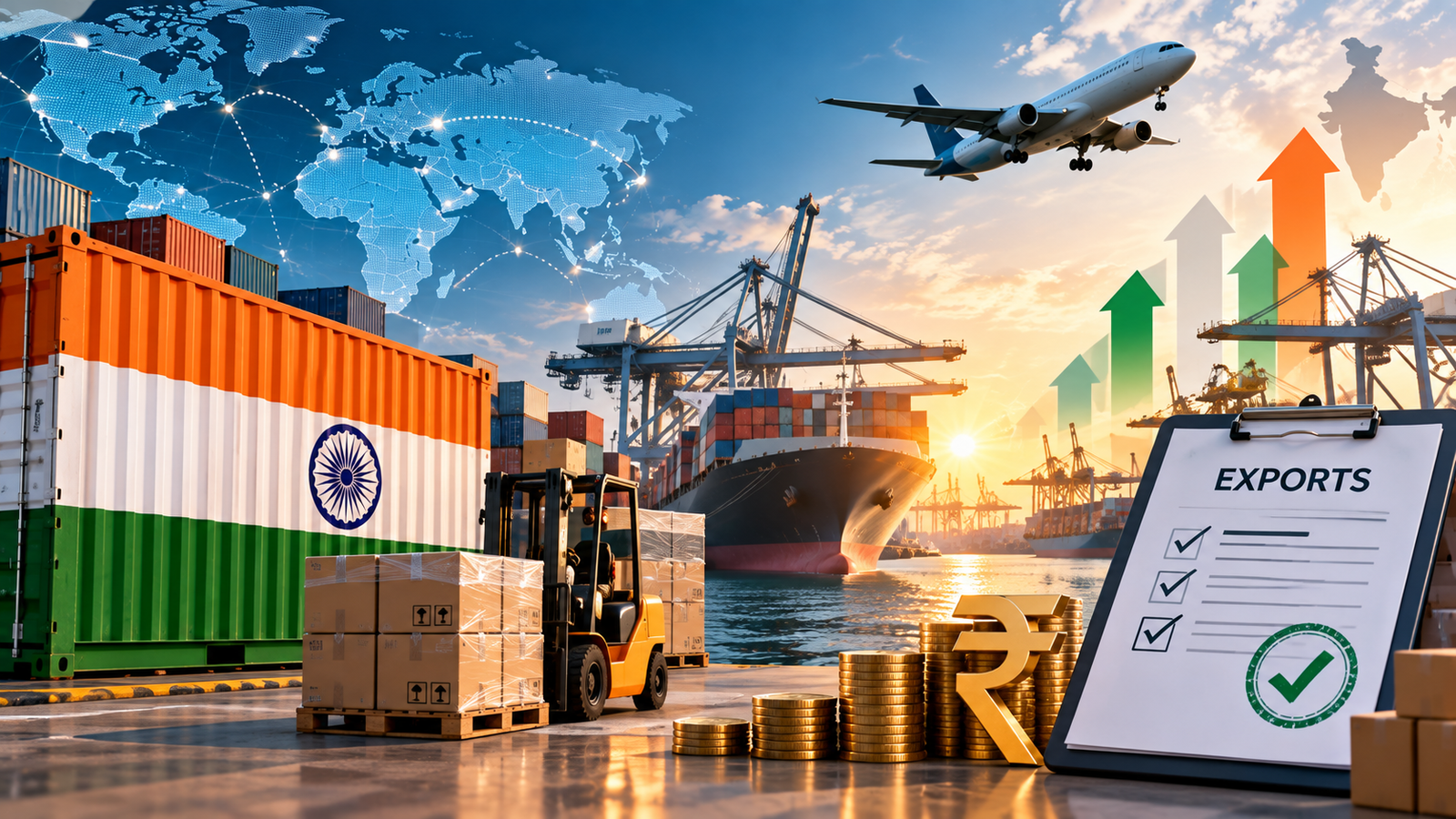
RoDTEP Scheme Extended Till 31 December 2026: Export Competitiveness and WTO-Compliant Tax Remission
Category: Indian Economy | International Trade | Government Schemes
UPSC GS: GS Paper III – Indian Economy, External Sector
HPPSC: Economy, Industries, Exports and Government Schemes
Key Concepts: RoDTEP, tax remission, exports, WTO, SEZ, EOU, Advance Authorisation, export competitiveness
Why in News?
The Government of India has extended the Remission of Duties and Taxes on Exported Products (RoDTEP) Scheme until 31 December 2026.
The extension was notified through Notification No. 41/2026–27 dated 30 September 2026 by the Department of Commerce.
The scheme will continue to cover exports made by:
- Domestic Tariff Area (DTA) units
- Advance Authorisation (AA) holders
- Special Economic Zone (SEZ) units
- Export Oriented Units (EOUs)
Importantly, the existing RoDTEP rates and value caps remain unchanged during the extended period.
The extension is intended to help maintain a level playing field for Indian exporters in international markets.
What is RoDTEP?
RoDTEP stands for Remission of Duties and Taxes on Exported Products.
Let us understand the term word by word.
Remission
Simple Meaning: Giving back or neutralising a tax or duty burden.
English Definition: Remission means allowing the exporter to recover specified eligible duties, taxes and levies that are not otherwise refunded.
Duties and Taxes
These are various government levies that may become embedded in the cost of producing or moving an export product.
Exported Products
Goods that are sold from India to foreign markets.
Therefore:
RoDTEP is a mechanism to remit eligible duties, taxes and levies embedded in exported products that have not been refunded or rebated through another mechanism.
The scheme is designed to ensure that such domestic tax burdens do not remain embedded in the price of India’s exports.
The Basic Idea Behind RoDTEP
Imagine an Indian manufacturer produces a product worth ₹1,000 for export.
During the production and movement of the product, certain taxes or levies may be paid at different stages.
Suppose some of these are:
- not refunded;
- not rebated;
- not otherwise exempted.
Then these unrecovered taxes become part of the cost of the exported product.
This creates a problem.
The product may become relatively more expensive in the international market.
RoDTEP tries to address this through:
Export product
↓
Identify eligible embedded duties/taxes/levies
↓
Remit the eligible amount
↓
Reduce unrecovered domestic tax burden
↓
Improve export competitiveness
This is the core concept you should remember.
What Does RoDTEP Actually Refund?
The scheme covers embedded, un-rebated Central, State and local duties, taxes and levies borne on exported products.
It can also cover prior-stage cumulative indirect taxes that are not otherwise rebated or refunded.
Examples can include certain:
- electricity-related taxes;
- fuel-related taxes;
- mandi-related levies;
- local taxes;
- other embedded indirect levies,
subject to the specific eligibility and rate structure.
Important
RoDTEP does not mean that every tax paid by an exporter is automatically refunded.
Only eligible, un-rebated duties, taxes and levies covered by the scheme can be remitted.
Why Was RoDTEP Introduced?
RoDTEP became effective for exports from 1 January 2021.
It replaced the earlier Merchandise Exports from India Scheme (MEIS) framework for addressing certain embedded taxes and duties.
The broader policy objective was to move towards a system where exporters are not burdened by domestic taxes that are not otherwise refunded.
The key principle is:
Exports should generally not carry domestic taxes that are meant to be neutralised under the export-remission framework.
RoDTEP and the WTO
This is one of the most important UPSC aspects of the scheme.
Why did India need a new export-support mechanism?
The earlier MEIS was challenged at the World Trade Organization (WTO).
In 2019, a WTO dispute panel found several Indian export subsidy schemes inconsistent with certain WTO subsidy rules.
This created the need for India to move towards an export-support framework that focuses on remission of actual embedded taxes and duties, rather than providing an export subsidy unrelated to such tax burdens.
RoDTEP was therefore designed as a WTO-compatible remission mechanism. The Government explicitly describes the scheme as WTO-compliant.
Subsidy vs Tax Remission
This distinction is extremely important.
Export Subsidy
A government benefit provided specifically to encourage exports, which may not necessarily correspond to an actual domestic tax burden.
Tax Remission
Refunding or neutralising taxes and duties that have already been incurred and remain embedded in the exported product.
Therefore:
Subsidy
→ Financial support to exporters
Remission
→ Neutralisation of eligible domestic tax burden
RoDTEP is based on the second approach.
Why WTO Compliance Matters
The WTO regulates international trade and disciplines certain forms of government support.
If a country provides prohibited export subsidies, other countries can challenge those measures under WTO rules.
Therefore, India’s export-support policies need to balance:
Export competitiveness
with
International trade obligations
RoDTEP attempts to achieve this by focusing on remission of un-refunded domestic duties and taxes rather than an export-linked incentive unrelated to actual tax incidence.
RoDTEP vs MEIS
This comparison is highly useful for Prelims.
| Feature | MEIS | RoDTEP |
|---|---|---|
| Full form | Merchandise Exports from India Scheme | Remission of Duties and Taxes on Exported Products |
| Broad approach | Export incentive | Tax/duty remission |
| Focus | Incentivising merchandise exports | Neutralising eligible un-rebated domestic taxes |
| WTO issue | Faced WTO challenge | Designed as WTO-compatible remission |
| Introduced | Earlier framework | Effective from 1 January 2021 |
| Core principle | Incentive | Remission |
Memory Trick
MEIS = Incentive
RoDTEP = Remission
Who Can Get RoDTEP?
Under the current extension, the scheme is available to exports by four broad categories:
Domestic Tariff Area Units
DTA refers broadly to the part of India’s customs territory outside Special Economic Zones.
Advance Authorisation Holders
These are exporters who receive duty-free import authorisation for inputs used in producing export goods, subject to the scheme’s conditions.
Special Economic Zones
SEZs are specially designated areas with a distinct regulatory and economic framework intended to promote exports, investment and economic activity.
Export Oriented Units
EOUs are units established primarily for producing goods or providing services for export, subject to the applicable policy framework.
The Government’s 2 October 2026 notification specifically confirms coverage of all four categories until 31 December 2026.
What is Domestic Tariff Area?
This term can be confusing.
Simple Meaning
The Domestic Tariff Area (DTA) broadly refers to the portion of India’s customs territory outside SEZs.
It is important because:
DTA unit ≠ SEZ unit
They operate under different regulatory frameworks.
What is Advance Authorisation?
Advance Authorisation (AA) is an export-promotion mechanism under which eligible exporters can import inputs without payment of applicable customs duties, subject to specified conditions and export obligations.
The basic idea is:
Import inputs duty-free
↓
Use them in production
↓
Manufacture export goods
↓
Meet prescribed export obligation
This helps reduce input costs for export production.
What is an SEZ?
SEZ = Special Economic Zone
An SEZ is a specially designated area established to promote:
- exports;
- investment;
- employment;
- infrastructure;
- international trade.
SEZs operate under a special policy and regulatory framework.
RoDTEP coverage for eligible SEZ exports is therefore important because SEZ units also face embedded costs and compete in global markets.
What is an EOU?
EOU = Export Oriented Unit
An EOU is an enterprise established under the export-oriented framework with the primary objective of producing goods or providing services for export.
EOUs can operate across sectors such as:
- manufacturing;
- processing;
- IT-enabled activities;
- other export-oriented operations,
subject to the applicable policy.
Current RoDTEP Extension
The latest decision is important because the Government has not changed the existing rates and value caps.
Current position
Extension: Until 31 December 2026
Existing rates: Continue
Existing value caps: Continue
Coverage: DTA + AA + SEZ + EOU
The extension therefore provides policy continuity for exporters during the additional three-month period.
What is a RoDTEP Rate?
A RoDTEP rate specifies the level of remission applicable to an eligible export product under the scheme.
Different products can have different rates because the incidence of eligible embedded duties and taxes can vary.
Therefore:
One universal RoDTEP rate for every product?
No.
Rates are product-specific under the notified schedule.
What is a Value Cap?
A value cap places an upper limit on the amount of remission that can be claimed in relation to the value of an eligible export product.
This prevents the remission from exceeding the prescribed ceiling.
Therefore:
RoDTEP rate + value cap
together determine the permissible remission for an eligible export.
RoDTEP Schedules: Appendix 4R and 4RE
The RoDTEP framework uses specific schedules.
Appendix 4R
Relevant primarily for DTA exports.
Appendix 4RE
Relevant for exports by:
- Advance Authorisation holders;
- EOUs;
- SEZ units.
The latest notification continues the existing rates and value caps under the applicable schedules.
RoDTEP and Customs Tariff Alignment
An important development earlier in 2026 was the revision of RoDTEP schedules to align them with amendments to the Customs Tariff structure.
On 30 April 2026, the Department of Commerce revised the RoDTEP schedules.
The revision involved 194 tariff lines, including:
- 142 new 8-digit tariff lines;
- deletion of 50 tariff lines;
- modification of 2 tariff-line descriptions.
The changes became effective from 1 May 2026.
Why was this necessary?
Customs classification and RoDTEP classification need to remain consistent.
Otherwise:
Customs tariff classification
≠
RoDTEP classification
This can create:
- classification disputes;
- processing delays;
- system errors;
- uncertainty for exporters.
Therefore, tariff alignment improves ease of doing business.
RoDTEP and Digital Processing
The scheme is implemented through a digital framework.
This allows:
- electronic claims;
- automated processing;
- digital documentation;
- greater transparency;
- faster crediting of benefits.
The Government has described the scheme as being implemented through an end-to-end digital platform.
This reflects the broader trend towards:
Digital trade facilitation
and
paperless customs administration.
Why is RoDTEP Important for Exports?
India competes with many countries in global markets.
Export prices depend on:
- raw-material costs;
- labour costs;
- electricity;
- logistics;
- transportation;
- taxation;
- port costs;
- compliance costs;
- exchange rates.
If domestic taxes remain embedded in an exported product, the product may face a cost disadvantage.
RoDTEP attempts to remove a specific component of this disadvantage.
Therefore:
RoDTEP
→ lower unrecovered domestic tax burden
→ improved cost competitiveness
→ better level playing field
→ support for exports.
The Government explicitly describes the scheme as supporting a level playing field for exporters in international markets.
Why Are MSMEs Important Here?
MSMEs = Micro, Small and Medium Enterprises
MSMEs are significant participants in India’s export ecosystem.
Smaller exporters can face greater difficulty in absorbing:
- logistics costs;
- compliance costs;
- working-capital costs;
- taxation-related costs.
Therefore, timely remission of eligible embedded duties can help improve their competitiveness.
A Parliamentary Committee in 2026 also noted the liquidity function of RoDTEP scrips for MSMEs, particularly in the context of elevated borrowing costs.
RoDTEP Scrip
The benefit under RoDTEP is provided through an electronic transferable duty credit mechanism commonly referred to as a RoDTEP e-scrip.
What is an e-scrip?
It is an electronic record of the remission benefit credited to the exporter.
It can be used for payment of specified customs duties, subject to the applicable rules.
The important concept is:
Export → Eligible remission → Electronic duty credit
Why Transferability Matters
If the remission benefit is transferable, it can provide greater liquidity and flexibility to exporters.
This is particularly relevant for businesses with:
- import requirements;
- working-capital constraints;
- customs-duty liabilities.
However, the benefit remains governed by the notified rules and eligible uses.
RoDTEP and Export Competitiveness
Export competitiveness means the ability of a country’s firms to compete effectively in international markets.
It depends on several factors.
Price competitiveness
Can the product be sold at a competitive price?
Quality
Does it meet international standards?
Logistics
Can it reach foreign markets efficiently?
Reliability
Can exporters deliver consistently?
Policy environment
Are taxes and regulations predictable?
RoDTEP addresses only one part of this larger ecosystem:
Embedded un-rebated duties and taxes.
It cannot by itself solve problems such as:
- high logistics costs;
- poor infrastructure;
- low productivity;
- weak branding;
- quality problems;
- lack of market access.
This distinction is important in a Mains answer.
RoDTEP and Ease of Doing Business
A predictable export-remission system can improve:
- cost calculations;
- contract pricing;
- working-capital management;
- customs compliance;
- export planning.
The 2026 tariff-line alignment also aimed to reduce classification-related ambiguity and improve the smooth processing of eligible export claims.
RoDTEP and India’s External Sector
RoDTEP is part of India’s broader external-sector policy.
India seeks to:
- expand merchandise exports;
- diversify export destinations;
- increase manufacturing exports;
- integrate with global value chains;
- improve trade competitiveness;
- reduce transaction costs.
Therefore, RoDTEP should be studied alongside:
- Foreign Trade Policy;
- SEZ policy;
- PLI schemes;
- logistics reforms;
- customs digitisation;
- trade agreements;
- export credit;
- infrastructure development.
RoDTEP and Global Value Chains
Global Value Chain (GVC) means production of a good or service is distributed across multiple countries.
For example:
Raw material
→ Country A
Components
→ Country B
Assembly
→ India
Final market
→ Country D
To participate effectively in GVCs, India needs:
- competitive costs;
- reliable logistics;
- predictable taxation;
- efficient customs;
- quality infrastructure.
RoDTEP can contribute to this environment by reducing certain unrecovered domestic tax burdens.
RoDTEP and Make in India
RoDTEP can support manufacturing exports by improving the cost position of export-oriented production.
The connection is:
Domestic manufacturing
↓
Export production
↓
Global market access
↓
Foreign exchange earnings
↓
Employment and industrial growth
But again, RoDTEP is only one component of the larger manufacturing and export ecosystem.
RoDTEP and Foreign Exchange
Exports generate foreign exchange earnings.
Higher and more competitive exports can contribute to:
- foreign exchange availability;
- balance-of-payments strength;
- financing of imports.
However, a rise in exports does not automatically imply an improvement in the current account because imports and other components also matter.
Therefore, in a Mains answer, write:
RoDTEP can support export competitiveness and thereby contribute indirectly to India’s external-sector resilience.
Avoid claiming that RoDTEP alone improves the balance of payments.
Why Was the Scheme Extended Again?
The latest extension provides policy continuity amid an uncertain global trade environment.
Indian exporters face changing conditions involving:
- geopolitical tensions;
- shipping disruptions;
- freight costs;
- tariff changes;
- changing global demand;
- supply-chain restructuring.
Earlier in March 2026, the Government restored RoDTEP rates and value caps after disruptions in West Asian maritime routes had affected logistics and freight costs.
The October extension therefore comes against a broader background of efforts to maintain stability for exporters.
RoDTEP and West Asia Disruptions
This is a useful current-affairs connection.
West Asian geopolitical disruptions affected:
- shipping routes;
- transit times;
- freight costs;
- insurance costs;
- supply chains.
The Government had restored RoDTEP rates and value caps in March 2026 to support exporters facing elevated logistics costs.
This demonstrates an important economic principle:
Trade competitiveness depends not only on tariffs but also on logistics and geopolitical stability.
Challenges of RoDTEP
Fiscal Cost
Any remission scheme involves a fiscal cost to the government.
Therefore, the government must balance:
Export support
with
Fiscal sustainability
Determining Correct Rates
Rates need to accurately reflect eligible embedded taxes and duties.
If rates are too low:
→ exporters may remain disadvantaged.
If rates are too high:
→ unnecessary fiscal expenditure may occur.
WTO Compliance
The scheme must continue to remain consistent with India’s international trade obligations.
Classification Issues
Changes in tariff classification can create:
- confusion;
- delays;
- incorrect claims.
The April 2026 revision was partly intended to address such issues.
Limited Scope
RoDTEP addresses embedded duties and taxes.
It does not directly solve:
- expensive logistics;
- low productivity;
- inadequate infrastructure;
- weak global branding;
- technology gaps.
Way Forward
Maintain WTO Compliance
Export support should remain based on genuine remission of domestic taxes and duties.
Improve Rate Methodology
Regularly update rates using reliable data on tax incidence.
Strengthen Digital Systems
Integrate:
Customs + DGFT + GST + RoDTEP
to reduce duplication.
Improve Export Logistics
Focus on:
- ports;
- rail freight;
- roads;
- warehousing;
- multimodal transport.
Support MSMEs
Provide easier access to:
- export finance;
- information;
- compliance assistance;
- international certification.
Expand Global Value-Chain Participation
Combine tax remission with:
- technology;
- skills;
- infrastructure;
- quality standards;
- trade agreements.
RoDTEP vs RoSCTL
Another useful Prelims comparison is with RoSCTL.
RoSCTL
Rebate of State and Central Taxes and Levies
It is specifically associated with exports of apparel/garments and made-ups.
RoDTEP
A broader remission framework covering eligible exported products under its notified schedules.
The Government has continued RoSCTL for the apparel and made-ups sector while using RoDTEP for other eligible textile products not covered by RoSCTL.
Memory Trick
RoSCTL → Textiles/Apparel
RoDTEP → Wider export-product framework
UPSC Prelims Perspective
Remember these facts:
Full form:
Remission of Duties and Taxes on Exported Products
Operational since:
1 January 2021
Latest extension:
31 December 2026
Notification:
No. 41/2026–27 dated 30 September 2026
Current rates:
Unchanged
Current value caps:
Unchanged
Eligible categories:
DTA + AA + SEZ + EOU
Core purpose:
Remission of eligible un-rebated embedded duties, taxes and levies
WTO:
Designed as a WTO-compatible remission mechanism
Digital mechanism:
Electronic duty credit/e-scrip framework
April 2026:
RoDTEP schedules aligned with amended Customs Tariff structure
Tariff lines revised:
194
Effective date of revised schedules:
1 May 2026.
Possible UPSC Prelims Question
Consider the following statements regarding the RoDTEP Scheme:
- It aims to remit eligible duties and taxes embedded in exported products that are not otherwise refunded.
- It is designed to provide a direct export subsidy unrelated to domestic tax incidence.
- Its current coverage includes DTA units, Advance Authorisation holders, SEZ units and EOUs.
- Its present extension is valid up to 31 December 2026.
Which of the statements given above are correct?
Answer: 1, 3 and 4 only
Explanation
Statement 1 is correct because RoDTEP remits eligible un-rebated duties, taxes and levies embedded in exports.
Statement 2 is incorrect. RoDTEP is structured as a remission mechanism, not a conventional export subsidy unrelated to tax incidence.
Statements 3 and 4 are correct under the latest notification.
Possible UPSC Mains Question
GS Paper III
“RoDTEP represents India’s attempt to reconcile export competitiveness with WTO obligations. Explain the rationale of the scheme and examine its limitations.”
Answer Framework
Introduction
Define RoDTEP and mention its extension until December 2026.
Body
Rationale
- neutralise embedded taxes;
- improve export competitiveness;
- create a level playing field;
- support MSMEs;
- facilitate global value-chain integration.
WTO Dimension
- earlier MEIS faced WTO challenge;
- shift from export incentive to tax remission;
- focus on actual domestic tax incidence.
Economic Significance
- lower export cost;
- greater predictability;
- support manufacturing;
- strengthen external-sector competitiveness.
Limitations
- fiscal cost;
- rate-calculation challenges;
- classification issues;
- logistics remain a major constraint;
- WTO compliance must be maintained.
Way Forward
- better data-based rate calculation;
- digital integration;
- logistics reforms;
- MSME support;
- GVC integration.
Conclusion
RoDTEP can improve India’s export competitiveness, but its effectiveness depends on combining tax remission with broader structural reforms in logistics, productivity, infrastructure and trade facilitation.
Economy Optional / Mains Conceptual Link
RoDTEP can be connected with several core economic concepts.
Comparative Advantage
Countries should specialise in goods and services where they have relative efficiency.
RoDTEP can help reduce certain domestic cost disadvantages.
Trade Competitiveness
A country’s ability to compete in international markets depends on:
Cost + Quality + Productivity + Logistics + Policy
RoDTEP mainly addresses the tax component.
Trade Facilitation
Simplifying customs and digital processing reduces transaction costs.
Export-Led Growth
Exports can contribute to:
- production;
- employment;
- foreign exchange;
- industrialisation.
But sustainable export growth requires productivity and competitiveness beyond fiscal support.
Important Keywords
RoDTEP
English Definition: A scheme that remits eligible un-refunded domestic duties, taxes and levies embedded in exported products.
Remission
English Definition: Neutralisation or refund of an eligible tax or duty burden.
Embedded Taxes
English Definition: Taxes and levies incorporated into the cost of a product through different stages of production and supply.
Export Competitiveness
English Definition: The ability of domestic producers to compete effectively in international markets.
WTO Compatibility
English Definition: Conformity of a trade measure with applicable World Trade Organization rules.
DTA
English Definition: Domestic Tariff Area, broadly referring to the portion of India’s customs territory outside SEZs.
SEZ
English Definition: A specially designated economic area operating under a distinct regulatory framework to promote exports and investment.
EOU
English Definition: Export Oriented Unit established primarily for export production or services.
Advance Authorisation
English Definition: An export-promotion mechanism allowing eligible duty-free import of inputs subject to specified export obligations.
Value Cap
English Definition: A prescribed maximum limit on the remission that can be claimed.
Global Value Chain
English Definition: A production system in which different stages of production are distributed across multiple countries.
Quick Revision: RoDTEP
RoDTEP
↓
Remission of Duties and Taxes on Exported Products
Started
→ 1 January 2021
Latest extension
→ 31 December 2026
Latest notification
→ 41/2026–27
Rates
→ Unchanged
Value caps
→ Unchanged
Coverage
→ DTA + AA + SEZ + EOU
Purpose
→ Remit eligible un-rebated domestic duties/taxes/levies
Core idea
→ Exports should not carry eligible unrecovered domestic tax burden
WTO
→ WTO-compatible remission approach
Digital benefit
→ Electronic duty credit/e-scrip
2026 tariff alignment
→ 194 tariff lines revised
Effective
→ 1 May 2026
Memory Trick
Remember:
“R–W–4–31”
R → Remission
W → WTO-compatible
4 → Four major categories
DTA + AA + SEZ + EOU
31 → 31 December 2026
And remember:
RoDTEP = “Refund the tax, not reward the export.”
This is not a literal legal definition, but it is a useful memory aid for understanding the conceptual distinction between tax remission and an export subsidy.
Final Takeaway
The extension of RoDTEP until 31 December 2026 provides policy continuity for Indian exporters at a time when global trade is facing geopolitical disruptions, changing tariffs, supply-chain risks and high logistics costs.
The core principle is simple:
Domestic taxes embedded in exports
↓
If not otherwise refunded
↓
Eligible remission under RoDTEP
↓
Lower unrecovered tax burden
↓
Better export competitiveness
For UPSC, however, the real importance of RoDTEP lies in the larger economic question:
How can India support exporters while remaining consistent with WTO obligations?
RoDTEP represents India’s answer through a tax-remission-based approach, but long-term export competitiveness will also depend on productivity, logistics, infrastructure, technology, quality standards, trade facilitation and deeper integration into global value chains.