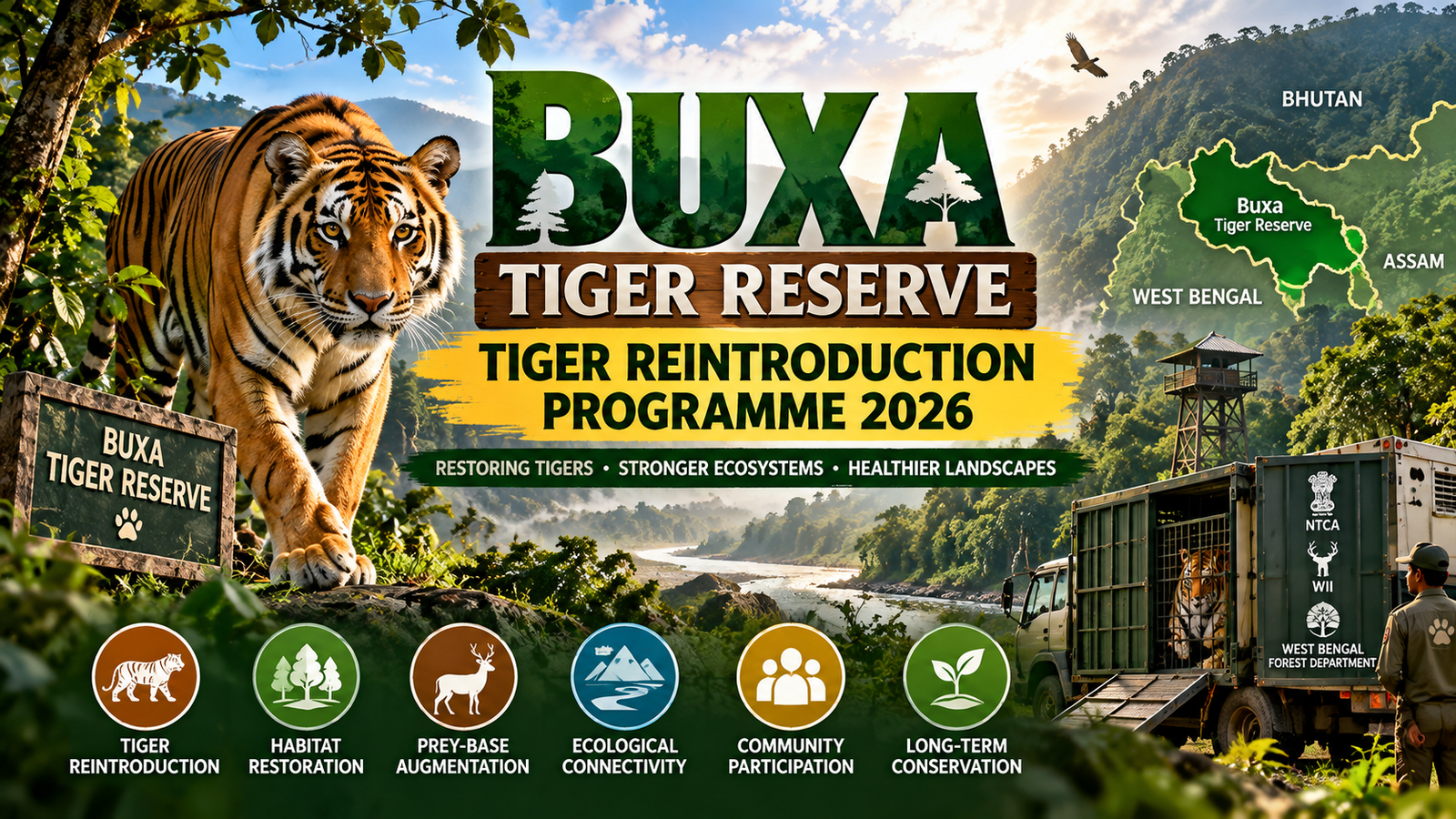
Buxa Tiger Reserve Tiger Reintroduction Programme 2026: Tiger Recovery, Ecological Connectivity and Conservation
Category: Environment & Ecology
UPSC GS: GS Paper III – Environment, Biodiversity, Conservation
HPPSC: Environment, Wildlife Conservation, National Parks and Tiger Reserves
Geography Optional: Ecology, Biogeography, Conservation Geography, Landscape Connectivity
Why in News?
On 2 October 2026, the first tigress was released into Buxa Tiger Reserve (BTR) in West Bengal under a phased Tiger Reintroduction Programme.
The tigress, identified as T138, was translocated from Valmiki Tiger Reserve in Bihar. The programme aims not merely to release individual tigers but to restore a viable, breeding and self-sustaining tiger population in Buxa.
The programme is being implemented through collaboration between the West Bengal Forest Department, National Tiger Conservation Authority (NTCA) and Wildlife Institute of India (WII).
The development is important because Buxa has historically been a tiger landscape, but it experienced a prolonged absence of a stable resident tiger population because of habitat degradation and fragmentation, changes in land use and decline in prey availability.
Buxa Tiger Reserve at a Glance
| Feature | Details |
|---|---|
| Location | Alipurduar district, West Bengal |
| Region | Eastern Dooars / North Bengal |
| Tiger Reserve status | 1983 |
| National Park status | 1997 |
| Major landscape | Himalayan foothills and Dooars |
| Ecological links | Bhutan, Assam and North Bengal |
| Current initiative | Tiger Reintroduction Programme |
| Source population | Valmiki Tiger Reserve, Bihar |
| First tigress released | T138 |
| Programme support | West Bengal Forest Department + NTCA + WII |
Buxa is therefore important not only as an individual protected area but as part of a larger transboundary wildlife landscape connecting India with Bhutan and adjoining tiger landscapes in Assam.
Understanding the Buxa Tiger Reserve
Before understanding the reintroduction programme, we need to understand why Buxa is ecologically important.
Buxa lies in the Dooars region of West Bengal, close to the eastern Himalayan foothills.
Its geographical position gives it an important ecological role.
The landscape provides connections towards:
- Bhutan;
- Assam;
- North Bengal;
- adjoining protected areas.
Such connectivity allows animals to move between different habitats.
This is particularly important for large mammals such as:
- tiger;
- elephant;
- leopard;
- gaur and other ungulates.
Therefore, Buxa is better understood as part of a landscape-level conservation system rather than as an isolated forest.
Why Did Tigers Decline in Buxa?
The most important point is that the current programme is not simply about bringing an animal into a forest.
The ecological conditions supporting a tiger population must first be restored.
Several factors contributed to the decline of a stable resident tiger population in Buxa.
Habitat Degradation
Habitat degradation means deterioration in the quality of a natural habitat.
For example:
Forest degradation
→ less suitable habitat
→ reduced prey availability
→ reduced carrying capacity
→ difficulty in maintaining tiger populations.
Habitat Fragmentation
Habitat fragmentation occurs when a large continuous habitat is divided into smaller and disconnected patches.
Fragmentation can:
- restrict animal movement;
- isolate populations;
- reduce genetic exchange;
- increase human-wildlife interactions;
- make large carnivores more vulnerable.
Decline in Prey Base
Tigers are apex predators.
They require sufficient populations of prey animals to survive and reproduce.
If prey availability declines:
Less prey → less food → lower tiger carrying capacity
Therefore, tiger conservation cannot focus only on tigers.
It must also conserve their prey base and habitat.
Land-Use Changes
Changes in land use can affect natural habitats through:
- agriculture;
- settlements;
- infrastructure;
- other human activities.
These changes can reduce habitat continuity and increase pressure on wildlife.
The Government has identified habitat degradation and fragmentation, land-use changes and declining prey availability among the factors that affected Buxa’s ability to sustain a resident tiger population.
Natural Recovery Was Already Taking Place
An important point for understanding this programme is that Buxa was not completely disconnected from the surrounding tiger landscape.
Camera traps recorded tiger presence in 2021, 2023 and 2026.
More importantly, an individual photographed in 2023 was matched with a tiger from Manas Tiger Reserve in Assam.
This provides evidence of natural movement between adjoining tiger landscapes.
Therefore, the present strategy is not simply:
“No tiger → bring tiger.”
It is:
Natural movement + habitat restoration + prey augmentation + scientific monitoring + carefully planned reintroduction
This is a much more important conservation concept for UPSC.
What is Tiger Reintroduction?
Simple Meaning
Tiger reintroduction means bringing tigers into a suitable habitat where the species has become locally extinct or where a viable population needs to be restored, followed by scientific monitoring and management.
Exam Definition
Tiger reintroduction is a conservation intervention involving the translocation and release of tigers into suitable habitat with the objective of establishing or restoring a viable, breeding and self-sustaining population.
It is different from simply releasing a rescued animal.
The objective is population recovery, not merely individual animal release.
Reintroduction vs Translocation vs Supplementation
These terms can easily confuse UPSC aspirants.
Reintroduction
Release of a species into an area where it has become locally extinct, with the objective of establishing a population.
Translocation
Movement of an animal from one location to another.
Translocation is therefore the method, while reintroduction is the conservation objective.
Population Supplementation
Adding individuals to an existing population to strengthen it.
Easy Memory
Translocation = Move
Reintroduction = Restore
Supplementation = Strengthen
Buxa Tiger Recovery Programme
The Tiger Augmentation and Recovery Project in Buxa has been under implementation since 2018 through collaboration among the West Bengal Forest Department, NTCA and WII.
The programme has focused on rebuilding the ecological conditions required for tiger recovery.
Its components include:
- habitat improvement;
- prey-base augmentation;
- protection;
- monitoring;
- scientific assessment;
- capacity building;
- community participation.
This demonstrates an important principle:
Tiger conservation is ecosystem conservation, not merely tiger conservation.
Prey-Base Augmentation
One of the major interventions has been increasing prey availability.
More than 800 chital have been released to supplement the prey base.
Around 380 hectares of grassland have also been restored or converted over the past eight years.
Scientific monitoring has indicated a positive trend in prey abundance.
Why is this important?
Consider the ecological chain:
Grassland restoration
↓
More suitable habitat for herbivores
↓
Higher prey availability
↓
Greater food availability for tigers
↓
Improved probability of tiger establishment
This is an example of bottom-up ecological management.
What is Prey Base?
Prey base means the population and availability of animals that serve as food for a predator.
For tigers, prey availability is an essential factor determining whether a landscape can support a viable population.
Therefore:
Tiger population cannot be sustainably increased without maintaining sufficient prey populations.
This is why tiger recovery programmes also monitor:
- chital;
- sambar;
- wild pig;
- other ungulates and prey species.
Grassland Restoration
Grasslands are often overlooked when discussing forest conservation.
But grasslands can provide important habitat for herbivores.
When grassland quality improves:
Better vegetation
→
More herbivores
→
Improved prey availability
→
Support for carnivores
Therefore, restoring grasslands can indirectly support tiger recovery.
This is a good example of ecosystem-based conservation.
The First Tigress: T138
The first tigress released in the current phase is identified as T138.
She was translocated from Valmiki Tiger Reserve in Bihar to Buxa.
The source location was selected after assessment of ecological, veterinary and management parameters and according to established protocols.
The animal is being intensively monitored after release.
Monitoring includes:
- telemetry;
- camera trapping;
- field-based monitoring.
These tools help scientists understand:
- movement;
- adaptation;
- health;
- behaviour;
- habitat use.
What is Telemetry?
Telemetry is the use of electronic devices to remotely collect information about an animal’s location or behaviour.
In wildlife conservation, an animal may be fitted with a tracking collar.
The collar can transmit location data to researchers.
This allows conservation managers to understand:
- where the animal moves;
- which habitats it prefers;
- how large its home range is;
- whether it approaches human settlements;
- whether it is adapting to the new environment.
Exam Definition
Wildlife telemetry is a remote-monitoring technique used to track the movement, behaviour or physiological parameters of animals.
What is a Soft Release?
A soft release is a method in which a translocated animal is first kept in a controlled acclimatisation enclosure before being released into the wider habitat.
The purpose is to allow the animal to:
- adjust to the new environment;
- become familiar with local conditions;
- reduce immediate stress;
- improve chances of successful adaptation.
The NTCA has used soft-release methods in previous tiger reintroduction programmes such as Sariska.
Soft Release vs Hard Release
Soft release
→ Acclimatisation first
→ Gradual transition
→ Greater monitoring
Hard release
→ Direct release into the target habitat
→ No prolonged acclimatisation enclosure
Why Valmiki Tiger Reserve?
The source population matters in wildlife translocation.
Scientists need to consider factors such as:
- ecological suitability;
- genetics;
- veterinary health;
- behaviour;
- disease risks;
- habitat compatibility;
- management requirements.
The Buxa programme therefore involved assessment of relevant ecological, veterinary and management parameters before the animal was translocated from Valmiki Tiger Reserve.
This reflects the principle of scientifically guided translocation.
Role of NTCA
The National Tiger Conservation Authority (NTCA) is a statutory body under the Ministry of Environment, Forest and Climate Change.
It was constituted under the Wildlife (Protection) Act, 1972, through the 2006 amendments.
Its responsibilities include:
- strengthening tiger conservation;
- approving tiger conservation plans;
- monitoring tiger populations;
- supporting scientific research;
- protecting tiger habitats;
- addressing human-wildlife conflict;
- supporting landscape connectivity;
- providing technical and financial assistance;
- developing conservation guidelines.
The NTCA also has a specific role in supporting scientifically planned tiger reintroduction and translocation programmes.
Role of Wildlife Institute of India
The Wildlife Institute of India (WII) is a premier wildlife research and training institution based in Dehradun.
In the Buxa recovery programme, WII is one of the scientific partners.
Its role illustrates an important conservation model:
Government agencies + Scientific institutions + Local communities
This combination is increasingly important for modern wildlife conservation.
Landscape Connectivity: The Bigger Picture
This is one of the most important UPSC concepts in the entire topic.
Buxa is connected ecologically with:
- North Bengal;
- Assam;
- Bhutan.
Therefore, wildlife movement can occur across administrative boundaries.
What is Landscape Connectivity?
Landscape connectivity refers to the degree to which a landscape allows animals, plants or ecological processes to move between habitat patches.
For wildlife, connectivity can provide:
- movement routes;
- access to food;
- breeding opportunities;
- genetic exchange;
- dispersal of young animals;
- escape from local disturbances.
Wildlife Corridor
A wildlife corridor is a relatively continuous or functionally connected habitat route that allows animals to move between otherwise separated habitat patches.
Think of it as an ecological bridge.
Protected Area A
↓
Wildlife Corridor
↓
Protected Area B
Without connectivity:
Population A | fragmented habitat | Population B
With connectivity:
Population A → Corridor → Population B
This can improve genetic exchange and long-term population viability.
Buxa–Bhutan–Assam Landscape
Buxa’s position is especially important because it forms part of a broader landscape connecting areas in Bhutan and Assam.
This creates opportunities for wildlife movement and dispersal.
The 2026 government release specifically highlights the ecological linkages of Buxa with North Bengal, Assam and Bhutan.
This means conservation planning should not stop at the administrative boundary of Buxa Tiger Reserve.
Instead, it should adopt a:
Landscape Approach
A landscape approach considers:
- protected areas;
- forests outside protected areas;
- corridors;
- villages;
- agricultural areas;
- infrastructure;
- local communities.
This is increasingly important for large-ranging species such as tigers and elephants.
Community Participation
Wildlife conservation cannot succeed only through laws and forest guards.
People living around protected areas are directly affected by:
- crop damage;
- livestock depredation;
- wildlife movement;
- restrictions on forest resources;
- tourism;
- conservation-related land-use changes.
Therefore, community participation is essential.
The Buxa programme has engaged 64 Eco-Development Committees/Joint Forest Management Committees.
The programme focuses on:
- community dialogue;
- livelihood opportunities;
- human-wildlife conflict mitigation;
- conservation-linked benefits.
Why Community Participation Matters
The basic relationship is:
Conservation without local support
→ conflict
→ resistance
→ weaker implementation
Whereas:
Conservation + local participation + livelihood benefits
→ greater cooperation
→ better protection
→ improved long-term conservation outcomes.
The NTCA also identifies addressing livelihood interests, human-wildlife conflict and people’s participation as important components of tiger-reserve management.
Human-Wildlife Conflict
As tiger numbers recover, the possibility of encounters between humans and wildlife can increase in certain landscapes.
Potential conflicts may involve:
- livestock predation;
- attacks on people;
- crop damage indirectly associated with prey species;
- wildlife entering human-dominated areas.
Therefore, tiger reintroduction must be accompanied by:
- early-warning systems;
- rapid response teams;
- compensation mechanisms;
- community awareness;
- livestock protection;
- scientific monitoring;
- safe wildlife corridors.
Important UPSC Point
Successful reintroduction is not simply measured by the number of animals released.
The real objective is:
A healthy + free-ranging + breeding + self-sustaining population with human-wildlife coexistence.
This is also the approach emphasised by the government for Buxa.
Adaptive Management
Another important term is Adaptive Management.
Simple Meaning
Conservation managers do not follow one fixed plan forever.
Instead:
Plan → Implement → Monitor → Evaluate → Modify → Implement again
If monitoring shows that something is not working, management is changed.
Exam Definition
Adaptive management is a conservation approach in which management actions are continuously modified according to monitoring results, new scientific evidence and changing ecological conditions.
Buxa’s phased recovery programme follows this principle, with further augmentation dependent on:
- habitat availability;
- prey availability;
- protection preparedness;
- population viability;
- monitoring results;
- expert advice.
What is Population Viability?
Population Viability Analysis (PVA) is a scientific approach used to estimate the likelihood that a population will persist over time under different ecological and demographic conditions.
It can consider:
- population size;
- birth rates;
- death rates;
- reproduction;
- habitat;
- genetic factors;
- environmental threats.
For tiger reintroduction, the question is not:
“Can we release a tiger here?”
The more important question is:
“Can this landscape support a breeding population over the long term?”
Genetic Diversity and Reintroduction
Genetic diversity is important because populations with greater genetic variation may have greater capacity to adapt to environmental changes and disease pressures.
A very small and isolated population can face:
Small population
→
Reduced genetic diversity
→
Higher vulnerability to demographic and environmental shocks
Therefore, landscape connectivity and appropriate selection of founder animals can contribute to long-term conservation.
However, genetic considerations must be combined with habitat, prey availability, disease management and behavioural suitability.
Buxa as a Tiger Landscape
The Buxa case demonstrates a broader transformation in conservation thinking.
Traditional approach
Protect the animal
Modern landscape approach
Protect the entire ecological system
This includes:
- tiger;
- prey;
- forest;
- grassland;
- water;
- corridors;
- surrounding communities;
- ecological processes.
This is why the Buxa programme has simultaneously focused on prey augmentation, habitat restoration, protection, monitoring and community participation.
Importance for Biodiversity Conservation
The tiger is an apex predator.
Its conservation can have wider ecological benefits because protecting a tiger habitat also protects many other species sharing that ecosystem.
This is sometimes described through the umbrella species concept.
Umbrella Species
An umbrella species is a species whose habitat requirements are sufficiently broad that protecting its habitat can also protect many other species occurring in the same ecosystem.
Tiger conservation can therefore contribute to the protection of:
- prey species;
- vegetation;
- smaller mammals;
- birds;
- reptiles;
- insects;
- aquatic ecosystems.
The exact ecological effect varies by landscape, but the broader principle is important.
Tiger Reintroduction in India: Previous Examples
Buxa should not be studied in isolation.
India has previous experience with tiger reintroduction.
Sariska Tiger Reserve
Tigers had become locally extinct in Sariska.
A scientifically managed reintroduction programme began in 2008, with tigers translocated from Ranthambore.
The NTCA describes Sariska as one of India’s important examples of scientific tiger reintroduction.
Panna Tiger Reserve
Tigers were also reintroduced into Panna using animals from other tiger reserves.
These examples provide lessons for:
- animal selection;
- soft release;
- radio/satellite monitoring;
- prey management;
- habitat protection;
- community participation.
The NTCA’s experience from Sariska and Panna has contributed to India’s broader reintroduction protocols.
Buxa and Project Tiger
Project Tiger was launched in 1973 as India’s flagship tiger conservation programme.
It focuses on in-situ conservation.
What is In-situ Conservation?
In-situ conservation means conserving species within their natural habitats.
Examples include:
- tiger reserves;
- national parks;
- wildlife sanctuaries.
Tiger reintroduction within suitable tiger landscapes is therefore part of broader in-situ conservation.
Buxa and Wildlife Protection Act
The institutional framework for tiger conservation in India is closely linked with the Wildlife (Protection) Act, 1972.
The 2006 amendments strengthened the institutional framework by providing for the National Tiger Conservation Authority.
The NTCA derives its statutory authority under the Act.
Prelims Point
NTCA is a statutory body.
It should not be confused with:
- an NGO;
- a purely advisory committee;
- a constitutional body.
Why Buxa Matters Beyond West Bengal
The Buxa programme has implications at three levels.
Local Level
- tiger recovery;
- livelihood opportunities;
- conflict management;
- eco-development.
Regional Level
- North Bengal connectivity;
- Assam connectivity;
- Bhutan linkages;
- wildlife dispersal.
National Level
- tiger conservation;
- ecological restoration;
- scientific reintroduction;
- landscape-level conservation.
Therefore, the programme represents a shift from protected-area-centric conservation to landscape-level conservation.
Challenges Ahead
The release of the first tigress is only the beginning.
Establishing a Breeding Population
A single animal cannot establish a population.
Successful recovery requires:
- males and females;
- reproduction;
- sufficient prey;
- suitable habitat;
- genetic viability.
Maintaining Connectivity
Infrastructure and land-use changes can fragment corridors.
Therefore, ecological connectivity must be maintained beyond protected-area boundaries.
Human-Wildlife Conflict
As tiger populations recover, interactions with humans may increase.
Conflict mitigation must therefore develop alongside tiger recovery.
Long-Term Monitoring
Reintroduction requires years of monitoring.
Managers need to understand:
- survival;
- movement;
- reproduction;
- territorial behaviour;
- prey availability;
- disease;
- conflict.
Climate Change
Climate change can alter:
- vegetation;
- water availability;
- prey distribution;
- forest composition;
- fire regimes.
Therefore, future conservation planning needs climate-resilient landscapes.
Way Forward
A successful Buxa recovery strategy should continue to focus on:
Habitat Restoration
Restore degraded forests and grasslands.
Prey-Base Management
Maintain adequate populations of natural prey.
Corridor Protection
Protect ecological linkages between Buxa, adjoining landscapes and Bhutan.
Scientific Monitoring
Use:
- camera traps;
- telemetry;
- GIS;
- remote sensing;
- genetic tools.
Community Participation
Strengthen:
- Eco-Development Committees;
- Joint Forest Management Committees;
- local employment;
- compensation systems;
- awareness programmes.
Conflict Management
Develop rapid-response systems and early-warning mechanisms.
Adaptive Management
Modify interventions according to scientific monitoring and population viability.
Long-Term Genetic Management
Ensure that the restored population retains adequate genetic diversity and connectivity.
UPSC Prelims Perspective
Remember these facts:
- Buxa Tiger Reserve → West Bengal
- Region → Dooars / North Bengal
- Tiger Reserve → 1983
- National Park → 1997
- First tigress → T138
- Source → Valmiki Tiger Reserve, Bihar
- Programme → Tiger Augmentation and Recovery Project
- Project initiated → 2018
- Key institutions → West Bengal Forest Department + NTCA + WII
- Chital released → More than 800
- Grassland restoration/conversion → About 380 hectares
- Community institutions engaged → 64 EDCs/JFMCs
- Connectivity → North Bengal + Assam + Bhutan
- Monitoring → Telemetry + Camera Trapping + Field Monitoring
These facts are based primarily on the Ministry of Environment, Forest and Climate Change’s 2 October 2026 release.
Possible UPSC Prelims Question
Consider the following statements regarding Buxa Tiger Reserve:
- It is located in West Bengal’s Dooars region.
- It was declared a Tiger Reserve in 1983.
- The current tiger reintroduction programme sources animals from Valmiki Tiger Reserve.
- The programme focuses only on releasing tigers and does not involve prey-base management.
Which of the statements given above are correct?
Answer: 1, 2 and 3 only
Explanation
Buxa is located in the Dooars region of West Bengal and became a Tiger Reserve in 1983.
The first tigress under the current programme was translocated from Bihar’s Valmiki Tiger Reserve.
However, the programme is much broader than animal release. It includes prey augmentation, habitat restoration, protection, monitoring and community participation.
Possible UPSC Mains Question
GS Paper III
“Tiger reintroduction is increasingly shifting from species-centric intervention to landscape-level ecological restoration. Discuss with reference to the Buxa Tiger Reserve.”
Answer Framework
Introduction
Define tiger reintroduction and mention the 2026 Buxa initiative.
Body
Discuss:
Ecological restoration
- habitat restoration;
- grassland management;
- prey augmentation.
Scientific intervention
- animal selection;
- telemetry;
- camera trapping;
- adaptive management.
Landscape conservation
- Buxa–Assam–Bhutan connectivity;
- wildlife corridors;
- genetic exchange.
Community participation
- EDCs/JFMCs;
- livelihood;
- conflict mitigation.
Challenges
- habitat fragmentation;
- human-wildlife conflict;
- small founder population;
- climate change;
- long-term genetic viability.
Way Forward
- protect corridors;
- strengthen prey base;
- scientific monitoring;
- community participation;
- adaptive management;
- landscape-level planning.
Conclusion
Tiger recovery should be measured not by the number of animals released but by whether the landscape ultimately supports a healthy, free-ranging and self-sustaining population.
Geography Optional Perspective
Buxa is highly relevant for Geography Optional.
Biogeography
Study:
Habitat → Species distribution → Prey availability → Predator population
Landscape Ecology
Study:
Fragmentation + Connectivity + Corridors + Habitat patches
Human Ecology
Study:
Protected areas + Local communities + Livelihoods + Human-wildlife conflict
Conservation Geography
Study:
Protected area network + Transboundary conservation + Ecological corridors
Map-Based Preparation
Locate:
Buxa Tiger Reserve
→ West Bengal
→ Dooars
→ Bhutan border
→ Assam
→ Manas Tiger Reserve
→ Jaldapara landscape
This makes Buxa a useful example for questions on wildlife corridors, transboundary conservation and landscape connectivity.
Important Keywords
Tiger Reintroduction
English Definition: Restoration of a tiger population in a suitable landscape through planned translocation and release.
Translocation
English Definition: Movement of an individual animal from one geographical location to another.
Prey Base
English Definition: The population and availability of prey species supporting a predator population.
Habitat Fragmentation
English Definition: Division of continuous habitat into smaller and disconnected patches.
Ecological Connectivity
English Definition: The ability of a landscape to facilitate movement of organisms and ecological processes between habitat patches.
Wildlife Corridor
English Definition: A connected habitat route that facilitates wildlife movement between otherwise separated habitats.
Soft Release
English Definition: Release preceded by an acclimatisation period in a controlled enclosure.
Telemetry
English Definition: Remote collection of information about an animal, particularly its location or movement.
Adaptive Management
English Definition: Management that is modified continuously using monitoring results and new scientific information.
Population Viability
English Definition: The likelihood that a population can survive and remain reproductively sustainable over the long term.
Apex Predator
English Definition: A predator occupying a very high trophic position with few or no natural predators in its ecosystem.
Umbrella Species
English Definition: A species whose habitat protection can provide conservation benefits to many other species sharing the same ecosystem.
Quick Revision: Buxa in One Page
Buxa Tiger Reserve
→ West Bengal
→ Dooars
→ Tiger Reserve: 1983
→ National Park: 1997
Problem
→ Habitat degradation
→ Fragmentation
→ Land-use changes
→ Declining prey availability
→ Prolonged absence of stable resident tiger population
Recovery Programme
→ Started 2018
→ West Bengal Forest Department
→ NTCA
→ WII
Ecological Restoration
→ 800+ chital released
→ ~380 ha grassland restored/converted
Current Development
→ First tigress released
→ T138
→ Source: Valmiki Tiger Reserve, Bihar
→ 2 October 2026
Monitoring
→ Telemetry
→ Camera traps
→ Field monitoring
Community
→ 64 EDCs/JFMCs
Landscape
→ North Bengal
→ Assam
→ Bhutan
Core Idea
Tiger recovery = Tiger + Prey + Habitat + Connectivity + Communities + Science
Memory Trick
Remember “B–P–C–C–S”:
B — Buxa
P — Prey base
C — Connectivity
C — Community
S — Science
If you remember these five words, you can reconstruct almost the entire Buxa Tiger Reintroduction topic in the examination.
Final Takeaway
The 2026 tiger reintroduction in Buxa Tiger Reserve is important because it represents much more than the release of a single tigress.
It combines:
Species Reintroduction
Habitat Restoration
Prey-Base Augmentation
Ecological Connectivity
Scientific Monitoring
Community Participation
Adaptive Management
The larger lesson is that successful wildlife conservation cannot be achieved by protecting an animal alone. A viable tiger population requires adequate habitat, sufficient prey, ecological connectivity, genetic viability, effective protection and coexistence with local communities.
For UPSC and HPPSC, Buxa should therefore be studied as a case study of landscape-level conservation and scientifically guided species recovery rather than as a simple current-affairs event.