Rabi MSP 2027-28: New Minimum Support Prices, Cost Formula and Crop Diversification
UPSC Current Affairs | Agriculture | Economy | GS Paper III
Why in News?
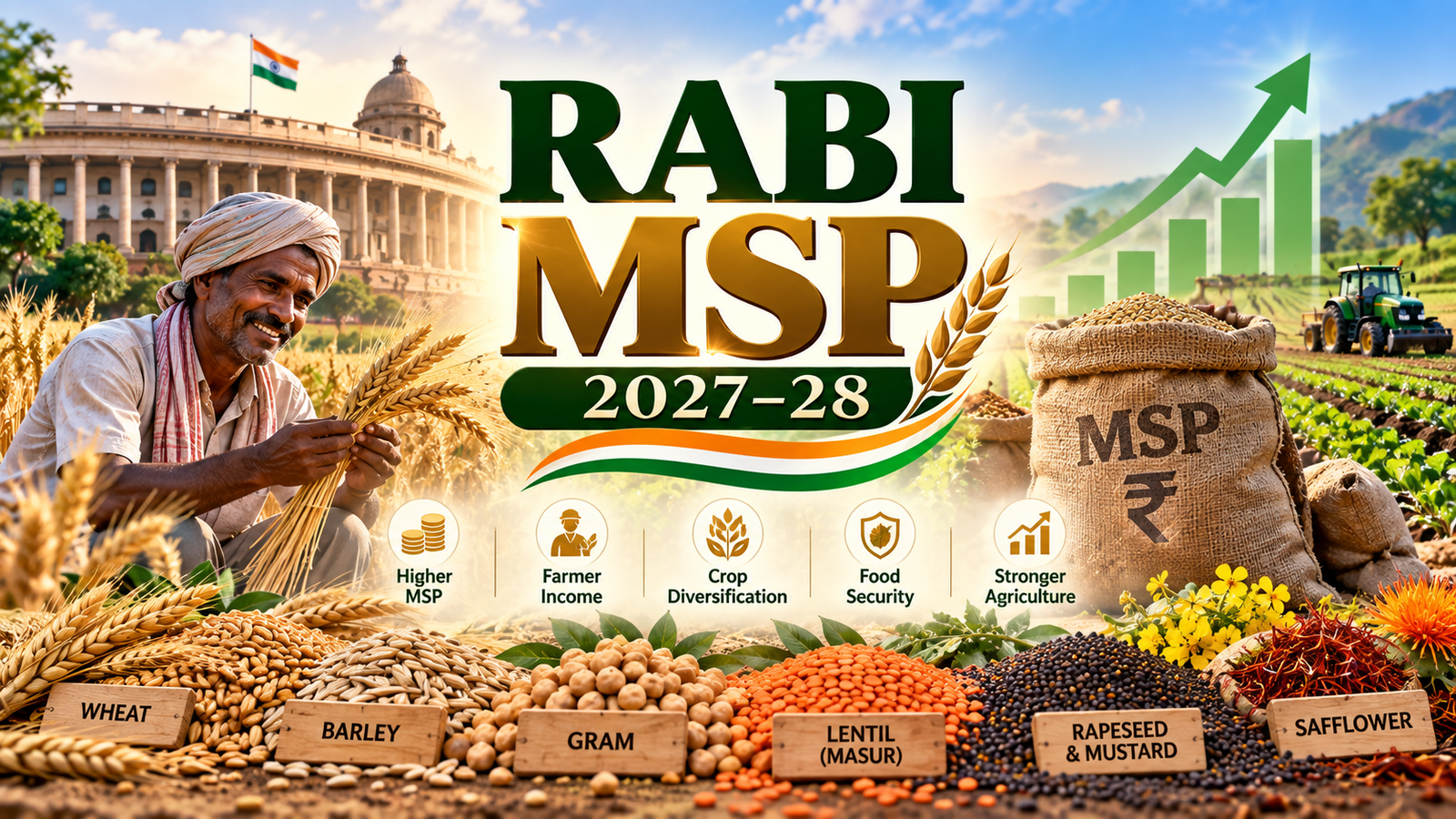
The Cabinet Committee on Economic Affairs (CCEA) approved higher Minimum Support Prices (MSP) for all six mandated Rabi crops for the Rabi Marketing Season (RMS) 2027-28 on 30 September 2026.
The largest increase was announced for safflower, at ₹675 per quintal, followed by rapeseed & mustard at ₹413 per quintal and lentil (masur) at ₹390 per quintal.
The government stated that the MSPs are aligned with the principle of providing at least 1.5 times the all-India weighted average cost of production and are intended to provide remunerative prices while encouraging crop diversification, particularly towards pulses and oilseeds.
What is MSP?
Minimum Support Price
MSP is a minimum price announced by the Government of India for specified agricultural crops, intended to provide price support to farmers.
It acts as a policy mechanism against sharp price declines.
For example, if market prices of a crop fall substantially, government procurement mechanisms can provide support to farmers where applicable.
However, an important UPSC point is:
MSP announcement does not mean that the government automatically purchases every unit of every MSP crop from every farmer.
Actual procurement depends on the crop, procurement agencies, government policy and operational arrangements.
MSP and Procurement Are Not the Same
This is one of the most important concepts for Prelims.
MSP
The government announces a support price for specified crops.
Procurement
Government agencies actually purchase agricultural produce under applicable procurement arrangements.
Therefore:
MSP announcement ≠ automatic government procurement of the entire crop
This distinction is extremely important when discussing India’s agricultural price policy.
Government procurement is particularly significant for crops such as wheat and paddy, while procurement mechanisms for other crops vary.
MSP for Rabi Crops 2027-28
The six mandated Rabi crops and their new MSPs are:
| Rabi Crop | MSP 2027-28 (₹/quintal) | Increase (₹/quintal) | Margin over Cost |
|---|---|---|---|
| Wheat | 2,610 | +25 | 106% |
| Barley | 2,286 | +136 | 58% |
| Gram | 5,958 | +83 | 59% |
| Lentil (Masur) | 7,390 | +390 | 92% |
| Rapeseed & Mustard | 6,613 | +413 | 96% |
| Safflower | 7,215 | +675 | 50% |
Most Important Numbers
Highest absolute increase: Safflower — ₹675/quintal
Second highest: Rapeseed & Mustard — ₹413/quintal
Third highest: Lentil — ₹390/quintal
Lowest increase: Wheat — ₹25/quintal
What is a Rabi Crop?
Rabi Crops
Rabi crops are generally sown during the winter season and harvested during spring or early summer.
Major Rabi crops include:
- Wheat
- Barley
- Gram
- Lentil
- Rapeseed and mustard
- Safflower
Their production is particularly important for:
- Food security
- Pulses supply
- Edible oils
- Farmer income
- Agricultural diversification
Why Has the Government Increased MSP?
The government has several objectives behind MSP policy.
Remunerative Returns
MSP is intended to provide farmers with a remunerative price for their produce.
Price Risk Protection
Agriculture is vulnerable to:
- Weather shocks
- Market fluctuations
- Production volatility
- Input-cost changes
MSP can provide a degree of price support.
Food Security
Government procurement and price support can help maintain supplies of important agricultural commodities.
Crop Diversification
Higher MSP support for pulses and oilseeds can encourage farmers to move beyond cereal-dominated cropping patterns.
Import Dependence
Increasing domestic production of pulses and oilseeds can contribute to reducing dependence on imports.
The government has specifically highlighted the role of higher MSPs for pulses and oilseeds in promoting diversification.
The 1.5 Times Cost Principle
One of the most important UPSC concepts associated with MSP is the 1.5 times cost principle.
The Union Budget 2018-19 announced the principle of keeping MSP at at least 1.5 times the all-India weighted average cost of production.
Since then, the government has stated that MSPs for mandated crops are fixed with a minimum 50% margin over this cost benchmark.
In simple terms:
MSP ≥ 1.5 × All-India Weighted Average Cost of Production
This is a very important formula for Prelims and Mains.
What Does “Cost of Production” Mean?
The cost of production used in MSP calculations includes various expenses associated with cultivation.
These include:
- Hired human labour
- Bullock labour
- Machine labour
- Rent paid for leased land
- Seeds
- Fertilisers
- Manure
- Irrigation
- Depreciation of farm equipment and buildings
- Interest on working capital
- Diesel
- Electricity for pump sets
- Other miscellaneous expenses
- Imputed value of family labour
Understanding A2, A2+FL and C2
This is an important area for UPSC Agriculture and Economy.
A2 Cost
A2 represents actual paid-out costs incurred by the farmer.
It can include:
- Purchased seeds
- Fertilisers
- Pesticides
- Hired labour
- Irrigation expenses
- Fuel
- Machinery expenses
- Interest on working capital
- Rent for leased land
A2 + FL
A2+FL includes A2 costs plus the imputed value of family labour.
Here:
FL = Family Labour
Therefore:
A2 + FL = Paid-out costs + estimated value of family labour
C2 Cost
C2 is a broader concept that includes A2+FL along with imputed costs of owned land and fixed capital assets.
It therefore captures a more comprehensive economic cost of cultivation.
Which Cost Does the Government Use for MSP?
This is a major Prelims trap.
The government has stated that the MSP formula is based on the all-India weighted average cost of production, with at least a 50% margin.
The cost used in the official MSP calculation is not simply the broader C2 concept often discussed in debates on MSP.
Therefore, do not write:
“MSP is always fixed at 1.5 times C2.”
That statement is incorrect.
The official framework refers to the all-India weighted average cost of production and the prescribed MSP methodology.
Who Recommends MSP?
The Commission for Agricultural Costs and Prices (CACP) recommends MSPs.
CACP
The Commission for Agricultural Costs and Prices is an expert body that recommends MSPs for mandated agricultural crops to the Government of India.
The government takes the recommendations of CACP into account along with the views of:
- State Governments
- Central Ministries
- Relevant departments
The final MSP is announced by the Government, not by CACP itself.
What Factors Does CACP Consider?
CACP considers several factors while recommending MSP.
These include:
Cost of Production
The cost involved in producing the crop.
Demand and Supply
Domestic and international demand-supply conditions.
Domestic and International Prices
Prices prevailing in Indian and global markets.
Inter-Crop Price Parity
The relative prices of different crops.
Terms of Trade
The relationship between prices received by agriculture and prices of goods and services purchased by the agricultural sector.
Impact on the Economy
The likely effect of agricultural price policy on the wider economy.
Resource Use
The rational utilisation of:
- Land
- Water
- Other production resources
How Many Crops Are Covered Under MSP?
The government announces MSP for 22 mandated agricultural crops.
These consist of:
14 Kharif Crops
- Paddy
- Jowar
- Bajra
- Maize
- Ragi
- Tur
- Moong
- Urad
- Groundnut
- Soyabean
- Sunflower
- Sesamum
- Nigerseed
- Cotton
6 Rabi Crops
- Wheat
- Barley
- Gram
- Masur
- Rapeseed & Mustard
- Safflower
2 Commercial Crops
- Jute
- Copra
Additional Prelims Point
MSP for toria is linked to the MSP of rapeseed and mustard, while MSP for de-husked coconut is linked to copra.
Why Is Safflower Important in the 2027-28 Announcement?
Safflower received the highest absolute MSP increase of ₹675 per quintal.
Its new MSP is:
₹7,215 per quintal
The government has projected a 50% margin over the all-India weighted average cost of production for safflower.
Safflower is an oilseed crop.
Therefore, the increase is relevant to the broader policy objective of strengthening domestic oilseed production.
Why Rapeseed and Mustard Matter
Rapeseed and mustard received an increase of:
₹413 per quintal
New MSP:
₹6,613 per quintal
The expected margin over cost is 96%.
Rapeseed and mustard are important oilseed crops.
Higher support for oilseeds can contribute to:
- Domestic edible-oil production
- Reduced import dependence
- Crop diversification
- Farmer income diversification
Why Are Pulses Important?
The government has also provided substantial MSP increases to pulses.
Lentil
MSP:
₹7,390/quintal
Increase:
₹390/quintal
Gram
MSP:
₹5,958/quintal
Increase:
₹83/quintal
Pulses are important because they provide:
- Protein
- Soil fertility benefits through biological nitrogen fixation in many pulse crops
- Crop diversification
- Reduced dependence on imported pulses
Therefore, MSP policy for pulses has implications beyond farmer income.
It also connects with nutrition security and import dependence.
MSP and Crop Diversification
India’s agricultural system has historically developed strong procurement incentives around certain cereals, particularly wheat and paddy.
This can influence farmers’ cropping decisions.
For example:
Assured procurement + MSP support
↓
Lower market risk
↓
Greater incentive to grow supported crops
This can contribute to concentration in certain crops and regions.
The Economic Survey has highlighted the need for a calibrated approach to diversification towards crops such as pulses, oilseeds and maize, depending on agro-climatic suitability and market conditions.
Why Crop Diversification Matters
Crop Diversification
Crop diversification means shifting from dependence on a limited number of crops towards a wider range of crops suited to local ecological and economic conditions.
It can help achieve:
- Better soil management
- Lower water stress
- Reduced production risk
- Nutritional security
- Higher-value agricultural production
- Reduced import dependence
For example:
Rice-Wheat Dominance
can be diversified towards:
Pulses + Oilseeds + Millets + Maize + Horticulture
where agro-climatic conditions permit.
MSP and Water Security
This is an important GS-III linkage.
Different crops have different water requirements.
If price incentives strongly favour water-intensive crops in water-stressed regions, farmers may continue cultivating them even when such cultivation places pressure on groundwater.
Therefore:
Price policy + Crop choice + Water use
are closely connected.
A more sustainable agricultural policy should align:
MSP + Procurement + Irrigation + Agro-climatic suitability + Market demand
rather than looking at MSP in isolation.
MSP and Food Security
MSP is closely linked with India’s food-security architecture.
Procurement of foodgrains can contribute to:
- Buffer stocks
- Public Distribution System
- Food security
- Price stabilisation
- Welfare programmes
For cereals such as wheat and rice, government procurement has historically played a major role in building public stocks.
The government procures cereals and coarse cereals through FCI and designated State agencies under applicable procurement arrangements.
MSP and Inflation
MSP can influence food prices through several channels.
Higher MSP
can increase the price incentive for producers.
Procurement
can influence market supply and government stocks.
Consumer Prices
Changes in agricultural prices can feed into food inflation.
Therefore, agricultural price policy has to balance:
Farmer income
with
Consumer affordability
and
Food security
This is why CACP considers the likely impact of agricultural price policy on the wider economy.
MSP and Farmer Income
MSP is one component of agricultural income policy.
Farmer income is also affected by:
- Yield
- Farm size
- Input costs
- Market prices
- Weather
- Irrigation
- Storage
- Transportation
- Processing
- Value addition
Therefore:
Higher MSP does not automatically mean proportionately higher income for every farmer.
The actual benefit depends on whether farmers can sell their produce through channels that realise the support price or higher prices.
MSP and Small Farmers
A large proportion of Indian farmers are small and marginal farmers.
For such farmers, challenges include:
- Small marketable surplus
- Limited storage
- High transportation costs
- Weak bargaining power
- Local trader dependence
- Limited access to organised markets
Therefore, simply announcing MSP may not be sufficient.
Effective price support requires:
MSP + Procurement access + Market infrastructure + Storage + Transport + Institutional support
What Is PM-AASHA?
PM-AASHA
Pradhan Mantri Annadata Aay Sanrakshan Abhiyan is a government framework aimed at providing price support to farmers, particularly for pulses, oilseeds and other specified agricultural commodities through different mechanisms.
It is relevant to the MSP discussion because price support does not operate through one single procurement mechanism for all crops.
The government has identified PM-AASHA among its major farmer-support measures.
MSP and WTO
MSP is also relevant to international trade.
India’s agricultural support policies have been discussed in the World Trade Organization (WTO) because certain forms of domestic support can have implications under WTO agriculture rules.
This creates a policy balance between:
Farmer support
Food security
Domestic production
and
International trade obligations
For UPSC, the important point is not to treat MSP as only a domestic agricultural issue.
It also has an international trade dimension.
Why MSP Is a Complex Policy Instrument
MSP simultaneously affects:
Farmers
Consumers
Government expenditure
Food stocks
Inflation
Trade
Water use
Cropping patterns
Food security
Therefore, evaluating MSP only from the perspective of either farmers or consumers gives an incomplete picture.
Major Benefits of MSP
Income Protection
Provides a price-support mechanism against sharp market declines.
Food Security
Supports procurement of important food crops.
Production Incentive
Provides price signals to farmers.
Crop Diversification
Higher support for pulses and oilseeds can encourage diversification.
Price Stability
Procurement and stocks can help manage certain market situations.
Major Challenges
Uneven Procurement
MSP exists for many crops, but actual procurement is not equally extensive across all crops.
Regional Concentration
Procurement intensity can vary significantly across states.
Cereal Bias
Strong procurement of wheat and rice can influence cropping patterns.
Water Stress
Price incentives can interact with irrigation and groundwater use.
Fiscal Cost
Procurement, storage and distribution involve significant public expenditure.
Storage Burden
Excess procurement can create storage and carrying-cost challenges.
Consumer Impact
Higher support prices can affect market prices and food inflation.
Market Distortion
Strong policy incentives can sometimes influence crop choices away from purely market or ecological signals.
How Can MSP Policy Be Improved?
A balanced approach can focus on several areas.
Expand Effective Market Access
Farmers should have better access to procurement and organised markets.
Promote Pulses and Oilseeds
Support should encourage crops important for:
- Nutrition
- Edible oils
- Import reduction
- Crop diversification
Align Price Policy with Agro-Climatic Conditions
Cropping incentives should consider:
- Water availability
- Soil conditions
- Climate
- Local ecology
Improve Storage
Better warehouses and cold-chain infrastructure can reduce distress sales.
Strengthen Farmer Producer Organisations
FPOs can improve:
- Bargaining power
- Aggregation
- Market access
- Input procurement
- Value addition
Promote Value Addition
Farmers can gain greater returns through:
Processing → Packaging → Branding → Direct marketing
rather than relying only on raw commodity sales.
MSP and Himachal Pradesh
For HPPSC aspirants, MSP can be connected with Himachal Pradesh agriculture.
Himachal has a different agricultural structure from the major wheat-rice procurement states.
The state is particularly important for:
- Horticulture
- Apples
- Fruits
- Vegetables
- Maize
- Wheat
- Pulses
- Off-season vegetables
Therefore, the MSP debate also highlights a broader issue:
Agricultural price policy must reflect regional agro-climatic diversity.
A policy suitable for the Indo-Gangetic plains cannot automatically produce the same outcomes in Himalayan agriculture.
UPSC Prelims Perspective
Remember these facts:
- MSP is announced by the Government of India.
- MSP recommendations are made by CACP.
- MSP is announced for 22 mandated agricultural crops.
- These include 14 Kharif + 6 Rabi + 2 commercial crops.
- The 2027-28 Rabi MSP applies to six crops.
- Wheat MSP for 2027-28 is ₹2,610/quintal.
- Safflower MSP is ₹7,215/quintal.
- Rapeseed & mustard MSP is ₹6,613/quintal.
- Lentil MSP is ₹7,390/quintal.
- The highest absolute increase is for safflower: ₹675/quintal.
- The 2018-19 policy principle targets at least 1.5 times the all-India weighted average cost of production.
- MSP announcement does not mean automatic procurement of unlimited quantities of every crop.
- Procurement arrangements vary by crop and government policy.
- CACP considers demand-supply, domestic and international prices, inter-crop parity, terms of trade and other factors.
Possible Prelims Question
Consider the following statements regarding Minimum Support Price:
- MSP is recommended by the Commission for Agricultural Costs and Prices and announced by the Government of India.
- MSP is announced for all agricultural crops produced in India.
- Government procurement of every crop covered under MSP is automatically guaranteed without any quantity or operational conditions.
- The 2018-19 policy principle envisages MSP at least 1.5 times the all-India weighted average cost of production.
Which of the statements given above are correct?
Answer: 1 and 4 only
Explanation
Statement 1 is correct.
Statement 2 is incorrect because MSP covers 22 mandated agricultural crops, not every agricultural crop.
Statement 3 is incorrect because MSP announcement and actual procurement are different concepts.
Statement 4 is correct.
UPSC Mains Perspective
GS Paper III
The topic can be linked with:
Agricultural pricing
Farm income
Food security
Crop diversification
Irrigation
Agricultural marketing
Public distribution system
Food inflation
WTO and agricultural subsidies
Sustainable agriculture
Possible Mains Question
“MSP is not merely a price-support mechanism; it also influences cropping patterns, food security, water use and agricultural trade. Discuss.”
Introduction
Minimum Support Price is a government-announced price-support mechanism for 22 mandated agricultural crops. The 2027-28 Rabi MSP revision again highlights the role of agricultural price policy in farmer income, food security and crop diversification.
Body
Discuss:
Role of MSP
- Income support
- Price-risk protection
- Production incentives
- Food security
Broader effects
- Cropping pattern
- Water consumption
- Food inflation
- Procurement
- Public stocks
- Import dependence
- WTO concerns
Challenges
- Uneven procurement
- Wheat-rice concentration
- Fiscal cost
- Storage burden
- Limited access for small farmers
Way Forward
- Crop diversification
- Better procurement access
- FPOs
- Storage infrastructure
- Agro-climatic planning
- Pulses and oilseed promotion
- Market reforms
- Value addition
Conclusion
A sustainable MSP framework should protect farmers from severe price risks while aligning agricultural incentives with food security, nutritional needs, water sustainability, ecological conditions and market realities.
Geography Optional Connection
For Geography Optional, MSP can be used as an example of how economic policies influence agricultural geography.
Price incentives can affect:
Crop choice → Cropping pattern → Irrigation demand → Land use → Regional agricultural specialisation
For example, strong support and procurement for wheat and paddy have historically contributed to their concentration in regions suited to these crops.
This can be linked with:
- Agricultural regionalisation
- Cropping patterns
- Irrigation geography
- Green Revolution
- Resource-use efficiency
- Sustainable agriculture
Important Keywords
Minimum Support Price
Government-announced price support for specified agricultural crops.
CACP
Commission that recommends MSPs to the Government of India after considering production costs and wider economic factors.
Procurement
Government purchase of agricultural produce through designated agencies under applicable policies.
Crop Diversification
Shift from dependence on a limited number of crops towards a wider and more suitable range of crops.
Marketable Surplus
The portion of agricultural production that remains available for sale after meeting the farmer’s own requirements and other uses.
A2 Cost
Actual paid-out cultivation expenses incurred by the farmer.
A2+FL
A2 costs plus the imputed value of family labour.
C2 Cost
A broader cost concept that includes A2+FL and imputed costs of owned land and fixed capital assets.
Price Support
Government intervention designed to protect producers from excessively low market prices.
Food Security
A condition in which people have regular access to sufficient, safe and nutritious food.
Rabi MSP 2027-28: Quick Revision
Wheat
₹2,610/quintal
Increase: ₹25
Margin: 106%
Barley
₹2,286/quintal
Increase: ₹136
Margin: 58%
Gram
₹5,958/quintal
Increase: ₹83
Margin: 59%
Lentil
₹7,390/quintal
Increase: ₹390
Margin: 92%
Rapeseed & Mustard
₹6,613/quintal
Increase: ₹413
Margin: 96%
Safflower
₹7,215/quintal
Increase: ₹675
Margin: 50%
Memory Trick
Remember the six Rabi crops using:
“W-B-G-L-R-S”
W — Wheat
B — Barley
G — Gram
L — Lentil
R — Rapeseed & Mustard
S — Safflower
For the highest MSP increase, remember:
Safflower = ₹675
For the highest MSP among these six, remember:
Safflower = ₹7,215
Final Takeaway
The Rabi MSP 2027-28 decision is more than a routine annual price announcement.
It provides an opportunity to understand India’s entire agricultural price-support framework.
The policy connects:
MSP → Farmer income → Procurement → Food security → Crop choice → Water use → Inflation → Import dependence → Trade policy
The 2027-28 revision is particularly significant because relatively large increases have been provided for safflower, rapeseed & mustard and lentil, crops associated with the broader policy objective of strengthening oilseed and pulse production and crop diversification.
For UPSC, the central conceptual distinction to remember is:
MSP is an announced price-support mechanism, while procurement is the actual purchase mechanism.
Understanding this distinction, along with CACP, cost of production, the 1.5-times principle, crop diversification and procurement, is more important than simply memorising the latest MSP figures.
In short: The 2027-28 Rabi MSP revision shows how agricultural price policy is increasingly connected with farmer income, food security, nutritional security, crop diversification and sustainable resource use.