Bankers’ Books Evidence Act, 2026: Digital Banking Records and Evidence Law
UPSC Current Affairs | Polity & Governance | Economy | GS Paper II & III
Why in News?
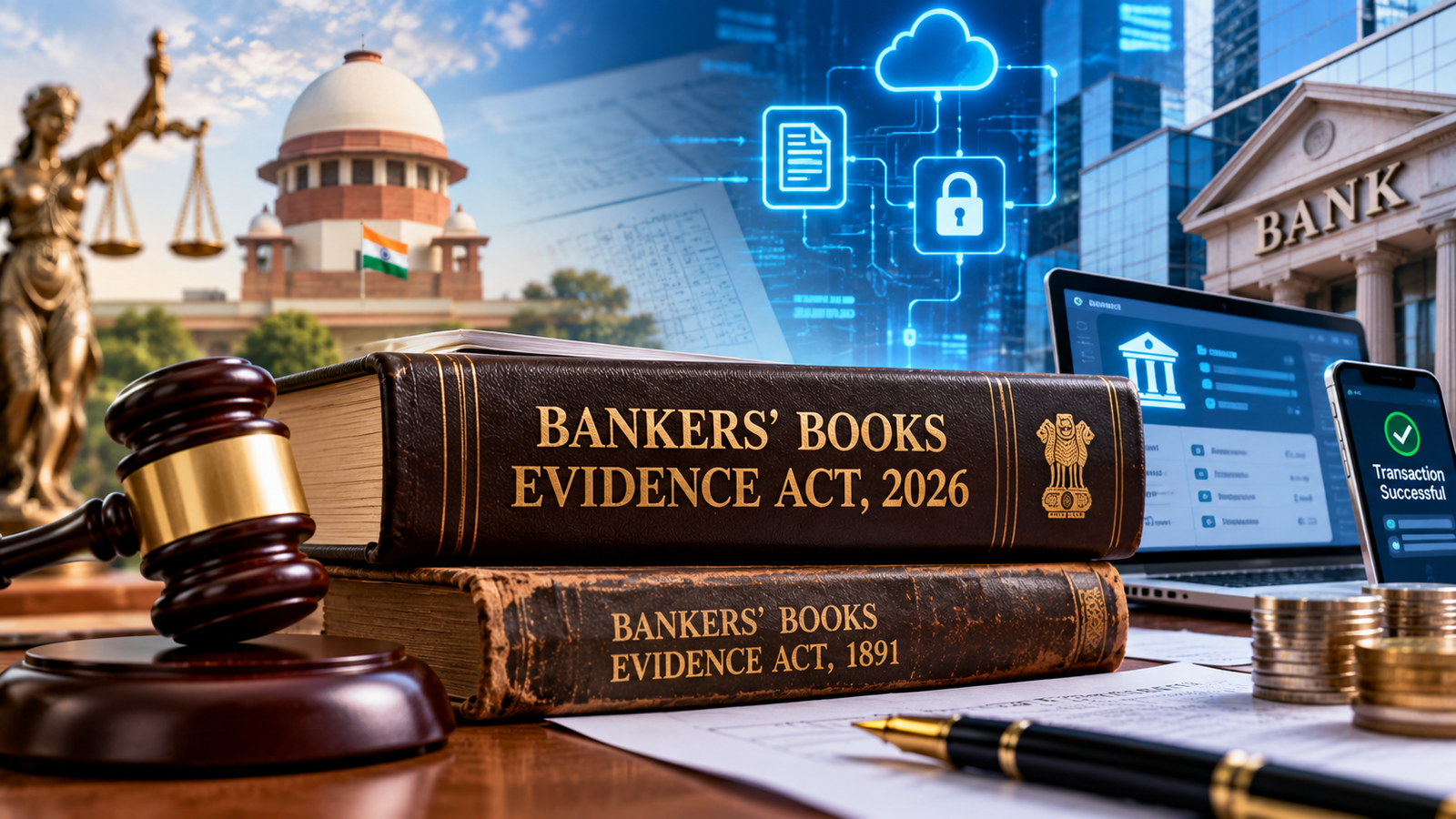
The Bankers’ Books Evidence Act, 2026 came into force on 1 October 2026, replacing the Bankers’ Books Evidence Act, 1891.
The new law updates the legal framework governing the use of banking records as evidence in courts, investigations, inquiries and arbitrations.
The major change is that the law now provides a technology-neutral framework covering banking records maintained in physical, electronic, digital, virtual and cloud-based forms.
The Act also introduces standardised procedures for authentication and certification of banking records and provides safeguards regarding when bank officials can be required to appear before a court.
The reform is particularly important because India’s banking system has moved far beyond the paper-based environment of the late nineteenth century.
What is the Bankers’ Books Evidence Act?
The Bankers’ Books Evidence Act is a law dealing with the use of banking records as evidence in legal proceedings.
In simple terms, suppose a court needs to establish:
- whether a bank transaction took place,
- whether money was transferred,
- what amount was credited or debited,
- what entries exist in a bank account, or
- what transaction records are maintained by a bank.
The law provides a legal framework for producing and proving such banking records.
The 2026 Act modernises this framework for the digital age.
Understanding the Term “Bankers’ Books”
The term bankers’ books may sound as if it refers only to physical books.
That is no longer the case.
Under the 2026 framework, bankers’ books include:
- Ledgers
- Day-books
- Cash-books
- Account books
- Other records maintained in the ordinary course of banking business
These records may exist in:
- Physical form
- Electronic form
- Digital form
- Virtual locations
- Cloud-based systems
- Off-site storage
- Backup systems
- Disaster-recovery systems
Therefore, the term “bankers’ books” is now technology-neutral.
Why Was a New Law Needed?
The original Bankers’ Books Evidence Act was enacted in 1891.
At that time:
- Banking records were primarily paper-based.
- Computers did not exist.
- Cloud storage did not exist.
- Mobile banking did not exist.
- Internet banking did not exist.
- Digital payment systems did not exist.
Modern banking is completely different.
Today, a single banking transaction may generate records across:
Mobile App → Bank Server → Database → Payment System → Cloud/Backup Infrastructure
Therefore, the legal system needs rules that can establish the authenticity and reliability of these records.
The 2026 Act attempts to bridge this gap between modern banking technology and evidence law.
Key Timeline
1891
The Bankers’ Books Evidence Act, 1891 was enacted.
13 August 2026
The Bankers’ Books Evidence Act, 2026 received the President’s assent.
It became Act No. 15 of 2026.
10 September 2026
The Central Government notified 1 October 2026 as the date on which the new Act would come into force.
1 October 2026
The Bankers’ Books Evidence Act, 2026 came into force, replacing the 1891 law.
What is “Evidence”?
Before understanding the Act, it is important to understand the word evidence.
Evidence
Evidence means information, material or testimony presented in a legal proceeding to establish or disprove a fact.
For example:
Suppose a person claims:
“₹10 lakh was transferred from Account A to Account B.”
A bank transaction record may be used as evidence to establish whether that transaction actually occurred.
The important question is therefore not merely:
“Does a digital record exist?”
It is:
“Can the record be reliably authenticated and legally accepted as evidence?”
This is where the Bankers’ Books Evidence Act becomes important.
What Has Changed Under the 2026 Act?
The 2026 Act retains the basic principle of proving banking records through certified copies, but updates the framework to cover electronic and digital records.
The major changes can be understood under five broad themes:
Digital recognition
Authentication
Certification
Procedural safeguards
Expansion to the wider financial sector
Recognition of Electronic and Digital Records
One of the most important provisions of the new law is the recognition of electronic and digital banking records as evidence.
An electronic or digital record can be admissible as evidence when the required conditions regarding authenticity and integrity are satisfied.
The record should, among other things:
- correctly represent the relevant entry or information,
- not show unauthorised changes, and
- not show tampering or an event affecting the integrity and accuracy of the system.
This is important because a digital record can potentially be altered without leaving an obvious physical trace.
The law therefore places emphasis on integrity and authenticity.
What is Data Integrity?
Data Integrity
Data integrity means maintaining the accuracy, consistency and reliability of data throughout its lifecycle.
For example, if a bank database shows that ₹50,000 was transferred from one account to another, the integrity of the record requires that the record has not been improperly altered.
Thus:
Authentic record + intact data + proper certification = stronger evidentiary value
Authentication of Banking Records
Authentication
Authentication is the process of establishing that a record is genuine and comes from the claimed source.
The 2026 Act provides for standardised authentication and certification of banking records.
Authentication may involve:
- Manual signatures
- Digital signatures
- Electronic signatures
This allows the law to accommodate both traditional and modern banking systems.
What is a Certified Copy?
A certified copy is a copy of a banking record accompanied by the prescribed certification establishing its authenticity.
The importance of this provision is that the court does not necessarily need the original physical banking ledger.
The contents of the banker’s book can generally be proved through a certified copy.
This makes the legal process more efficient.
Original Record vs Certified Copy
Under the framework:
Original banker’s book
does not ordinarily need to be physically produced simply to prove the contents.
Instead:
Certified copy of relevant record → Court
This can reduce unnecessary administrative burden on banks and courts.
Can a Bank Officer Be Called to Court?
This is another important feature.
Where the bank is not a party to the legal proceeding, a bank officer cannot ordinarily be compelled to:
- produce the banker’s book, or
- appear as a witness merely to prove the banking record.
However, there is an exception.
A court can require the officer to appear or produce records if there is a special cause, and the court must record the reason in writing.
What is “Special Cause”?
The Act identifies circumstances that can constitute special cause.
These include situations where:
Doubt About Accuracy or Authenticity
The accuracy or genuineness of the entry or information is doubtful.
Interruption in Record Keeping
An event has occurred suggesting that the normal or regular process of record keeping in the bank was interrupted.
Failure to Follow a Court Order
The bank does not comply with a previous court order relating to inspection or production of certified copies.
In such circumstances, the court may require the bank officer to appear or produce the relevant records.
Why Protect Bank Officials from Routine Appearance?
Imagine thousands of legal cases in which banking records are required.
If a bank employee had to physically appear in every case simply to confirm an ordinary transaction record, it could:
- increase the workload of courts,
- increase administrative costs,
- divert bank employees from regular duties,
- delay legal proceedings.
The certified-copy mechanism attempts to solve this problem.
Therefore:
Certified record → routine proof
while
Doubt/irregularity/special cause → possible appearance of bank official
This creates a balance between efficiency and evidentiary reliability.
Court’s Power to Inspect Banking Records
The Act also provides a mechanism through which a court may permit a party to:
- inspect entries in a banker’s book,
- take copies of relevant entries, or
- require the bank to prepare and produce certified copies.
This ensures that relevant banking records can still be accessed when they are necessary for a legal proceeding.
Where Does the Act Apply?
The Act applies to situations in which banking records may be required as evidence, including:
- Court proceedings
- Trials
- Inquiries
- Investigations
- Arbitrations
- Certain investigations under the Bharatiya Nagarik Suraksha Sanhita, 2023 (BNSS)
Thus, its scope is wider than ordinary civil litigation.
What is Arbitration?
Arbitration
Arbitration is a dispute-resolution mechanism in which parties agree to have their dispute decided by an arbitrator or arbitral tribunal instead of an ordinary court.
Banking records can be relevant in commercial and financial disputes.
Therefore, the Act also provides a framework for their use in arbitration proceedings.
Link with the Bharatiya Nagarik Suraksha Sanhita
The Act expressly recognises investigations or inquiries under the Bharatiya Nagarik Suraksha Sanhita, 2023 (BNSS) and other applicable laws where evidence may be collected.
This is important for criminal investigations because financial transactions can be relevant to cases involving:
- Fraud
- Money laundering
- Cheating
- Financial crimes
- Corruption
- Cybercrime
- Economic offences
The Bankers’ Books Evidence Act does not itself create these offences.
Rather, it provides a framework for how relevant banking records can be produced and proved as evidence.
Extension to Other Financial Sector Entities
The 1891 law primarily dealt with banking entities and certain post-office savings and money-order offices.
The 2026 Act retains these categories but introduces an important additional power.
The Central Government can extend the provisions of the Act to specified entities or classes of entities operating in the financial sector, subject to conditions, exceptions or modifications specified through notification.
This gives the framework greater flexibility as India’s financial ecosystem evolves.
Why is This Important for India’s Digital Economy?
India’s financial system has undergone rapid digitisation.
Banking is now closely connected with:
- Internet banking
- Mobile banking
- Digital payments
- Electronic databases
- Cloud infrastructure
- Automated transaction processing
- Digital authentication
This means that financial evidence is increasingly generated and stored digitally.
The legal framework therefore needs to answer three basic questions:
Is the record genuine?
Has the record been altered?
How can the record be legally produced?
The 2026 Act provides a structured framework for addressing these questions.
Technology-Neutral Framework
One of the most important terms associated with the Act is:
Technology-Neutral
A technology-neutral law is designed to apply regardless of the particular technology or storage system used, rather than being tied to one specific technology.
For example, a banking record may be stored:
On paper → Computer → Digital database → Cloud → Virtual system
The law should remain applicable across these technological changes.
This is why the 2026 Act adopts a technology-neutral approach.
Physical vs Digital Banking Records
| Feature | Traditional Record | Modern Record |
|---|---|---|
| Medium | Paper | Electronic/Digital |
| Example | Ledger | Digital database |
| Storage | Bank premises | Server/Cloud/Off-site |
| Authentication | Manual signature | Digital/Electronic signature |
| Evidence | Certified copy | Certified electronic/digital copy |
| Major concern | Physical alteration | Data tampering |
The 2026 Act attempts to provide a common legal framework for both.
Bankers’ Books Evidence Act 1891 vs 2026
| Feature | 1891 Act | 2026 Act |
|---|---|---|
| Historical context | Paper-based banking | Digital banking |
| Records | Primarily physical framework | Physical + electronic + digital |
| Technology | Limited relevance | Technology-neutral |
| Storage | Traditional records | On-site, off-site, virtual, cloud etc. |
| Certification | Existing certification mechanism | Standardised modern certification |
| Authentication | Traditional framework | Manual, digital and electronic signatures |
| Bank officials | Could be required in specified circumstances | Stronger protection from routine appearance |
| Financial sector | Mainly banking-related entities | Government can extend to specified financial-sector entities |
| Core purpose | Evidence regarding bankers’ books | Same core purpose, modernised for digital banking |
The important point is that the 2026 Act does not abandon the basic evidentiary framework of the earlier law. It modernises it for contemporary banking systems.
Why is This a Governance Reform?
The Act is not merely a banking-sector reform.
It also relates to good governance.
A modern legal system needs to keep pace with technological change.
If technology changes but laws remain tied to outdated systems, several problems can arise:
- Legal uncertainty
- Delays in proceedings
- Higher compliance costs
- Difficulties in proving digital transactions
- Increased administrative burden
By updating the evidentiary framework, the law seeks to make legal processes more compatible with digital banking.
Significance for Ease of Doing Business
The reform may also reduce procedural burdens.
For example, if certified banking records are sufficient to establish a transaction, there may be less need for:
- physical production of original records,
- repeated appearance of bank employees,
- unnecessary procedural delays.
This can support more efficient handling of commercial and financial disputes.
The government has linked the reform with modernising the financial and legal framework and improving ease of doing business.
Importance for Financial Crime Investigation
Banking records are often crucial in investigating financial offences.
A transaction trail may help investigators establish:
Source of funds → Transfer → Recipient → Subsequent transaction → Final destination
Digital banking records can therefore provide an important evidentiary trail.
The new framework can facilitate the lawful production and verification of such records while retaining requirements relating to authenticity and integrity.
Data Security and Privacy Dimension
The digitalisation of evidence also raises an important question:
How can access to banking records be balanced with privacy and data security?
Banking records can contain sensitive financial information.
Therefore, systems dealing with digital evidence must maintain:
- Data integrity
- Authentication
- Access controls
- Cybersecurity
- Confidentiality
- Auditability
The objective should be to ensure that only relevant and legally authorised records are accessed and used.
Key Challenges
The new framework also creates areas that require careful implementation.
Cybersecurity
As more records are digital, the risk of cyberattacks and unauthorised access increases.
Data Tampering
Digital evidence can potentially be altered, making integrity verification essential.
Cloud-Based Evidence
Bank records may be stored across different digital environments and locations, creating technical and jurisdictional complexities.
Data Privacy
Banking records contain highly sensitive personal and financial information.
Technological Capacity
Courts, investigators and legal professionals need adequate technological expertise to understand and verify digital evidence.
Important Keywords for UPSC
Admissibility
Admissibility means whether a piece of evidence can legally be accepted and considered in a legal proceeding.
Authentication
Authentication is the process of establishing that a record is genuine and comes from the claimed source.
Certification
Certification is formal confirmation that a copy or record satisfies prescribed requirements of accuracy and authenticity.
Data Integrity
Data integrity means maintaining the accuracy, consistency and reliability of data.
Technology-Neutral
A technology-neutral framework remains applicable across different technologies instead of depending on one specific technology.
Electronic Record
An electronic record is information created, stored or processed in electronic form.
Digital Evidence
Digital evidence is electronically stored or transmitted information that can be used to establish facts in legal proceedings.
Special Cause
Special cause refers to specified circumstances that may justify a court requiring a bank officer to produce records or testify.
Certified Copy
A certified copy is a copy accompanied by prescribed certification establishing its authenticity for legal purposes.
UPSC Prelims Perspective
The following facts are particularly important:
- The Bankers’ Books Evidence Act, 2026 replaced the 1891 Act.
- It came into force on 1 October 2026.
- The 2026 Act is Act No. 15 of 2026.
- Presidential assent was given on 13 August 2026.
- The Act covers physical, electronic and digital banking records.
- Banking records may be stored in on-site, off-site, virtual or cloud-based locations.
- Authentication can involve manual, digital or electronic signatures.
- Certified copies can be used to prove banking records.
- Bank officers are not ordinarily required to appear merely to prove records when the bank is not a party.
- A court can require their appearance or production of records for a special cause, recorded in writing.
- The Central Government can extend the Act to specified financial-sector entities.
- The Act applies to relevant legal proceedings, arbitrations, investigations and inquiries.
- The Act is connected with investigations under the BNSS, 2023.
Possible Prelims Question
With reference to the Bankers’ Books Evidence Act, 2026, consider the following statements:
- It recognises only physical banking records as evidence.
- It permits electronic and digital banking records to be used as evidence subject to prescribed conditions.
- A bank officer can never be required to appear before a court to prove banking records.
- The Central Government may extend the Act to specified entities operating in the financial sector.
Which of the statements given above are correct?
Answer: 2 and 4 only
Statement 1 is incorrect because the Act covers physical as well as electronic and digital records.
Statement 3 is incorrect because a bank officer may be required to appear where a court records a specified special cause.
UPSC Mains Connection
GS Paper II
The topic can be linked with:
Government policies and interventions
E-governance
Transparency and accountability
Judicial and legal reforms
Digital governance
Institutional reforms
GS Paper III
It can also be connected with:
Indian economy
Banking sector
Digital economy
Financial sector reforms
Cybersecurity
Financial crimes
Mains Answer Framework
Possible Question
“The Bankers’ Books Evidence Act, 2026 represents the adaptation of India’s legal framework to the digital transformation of the financial sector.” Discuss.
Introduction
The Bankers’ Books Evidence Act, 2026, which came into force on 1 October 2026, replaced the 1891 legislation and modernised the legal framework governing the use of banking records as evidence.
Body
Discuss the following:
Need for reform
- 1891 law was designed for a predominantly paper-based banking system.
- Rapid digitisation created new forms of banking records.
Major reforms
- Recognition of electronic and digital records
- Technology-neutral framework
- Standardised certification
- Digital/electronic authentication
- Certified copies
- Safeguards regarding bank officials
- Extension to specified financial-sector entities
Benefits
- Faster legal proceedings
- Reduced administrative burden
- Better compatibility with digital banking
- Greater legal certainty
- Support for financial investigations
- Ease of doing business
Challenges
- Cybersecurity
- Data tampering
- Privacy
- Cloud-based evidence
- Technical capacity of courts and investigators
Conclusion
The 2026 Act represents an attempt to align evidence law with India’s rapidly digitising financial system. Its long-term effectiveness will depend on secure authentication, strong cybersecurity, privacy safeguards and adequate technological capacity within the justice and financial systems.
How to Remember the Act
Remember the “D-A-C-S-F” framework:
D — Digital records
A — Authentication
C — Certification
S — Special cause
F — Financial-sector expansion
If you remember these five concepts, you can reconstruct most of the important provisions of the Act in the examination.
One-Page Revision Notes
Bankers’ Books Evidence Act, 2026
Effective: 1 October 2026
Replaces: Bankers’ Books Evidence Act, 1891
Act No.: 15 of 2026
Assent: 13 August 2026
Core Purpose
To modernise the law relating to the use of banking records as evidence.
Major Change
Recognition of:
Physical + Electronic + Digital + Virtual + Cloud-based records
Authentication
Manual + Digital + Electronic signatures
Certified Copy
Banking records can generally be proved through certified copies without requiring production of the original banker’s book.
Bank Officer
Ordinarily protected from compulsory appearance where the bank is not a party.
Exception
Court may order production/appearance for special cause, recorded in writing.
Special Cause
- Doubt about accuracy/authenticity
- Interruption in regular record keeping
- Non-compliance with a previous court order
Scope
- Legal proceedings
- Trials
- Inquiries
- Investigations
- Arbitrations
- Relevant BNSS investigations
Expansion
Central Government may extend the framework to specified financial-sector entities.
Final Takeaway
The Bankers’ Books Evidence Act, 2026 is an example of how law must evolve alongside technological and economic transformation.
The original 1891 framework was created for a banking system dominated by physical records. Modern India, however, operates through highly digitised banking systems involving electronic databases, mobile banking, digital payments and cloud-based infrastructure.
The new law therefore seeks to establish a legal bridge between digital banking and evidence law.
For UPSC aspirants, the most important conceptual chain is:
Digital Banking → Digital Records → Authentication → Data Integrity → Certified Evidence → Efficient Legal Proceedings
The Act is therefore relevant not only to banking but also to digital governance, legal reforms, financial-sector modernisation, cybersecurity, financial crimes and ease of doing business.
In short: The 2026 Act modernises the evidentiary framework for banking records without changing its core purpose—making reliable banking records usable as legal evidence.