BRICS 2026: 18th BRICS Summit, New Delhi Declaration, Expansion and Significance for India
BRICS has evolved from a small grouping of emerging economies into one of the most important platforms through which countries of the Global South coordinate on economic, financial, technological, developmental and global-governance issues.
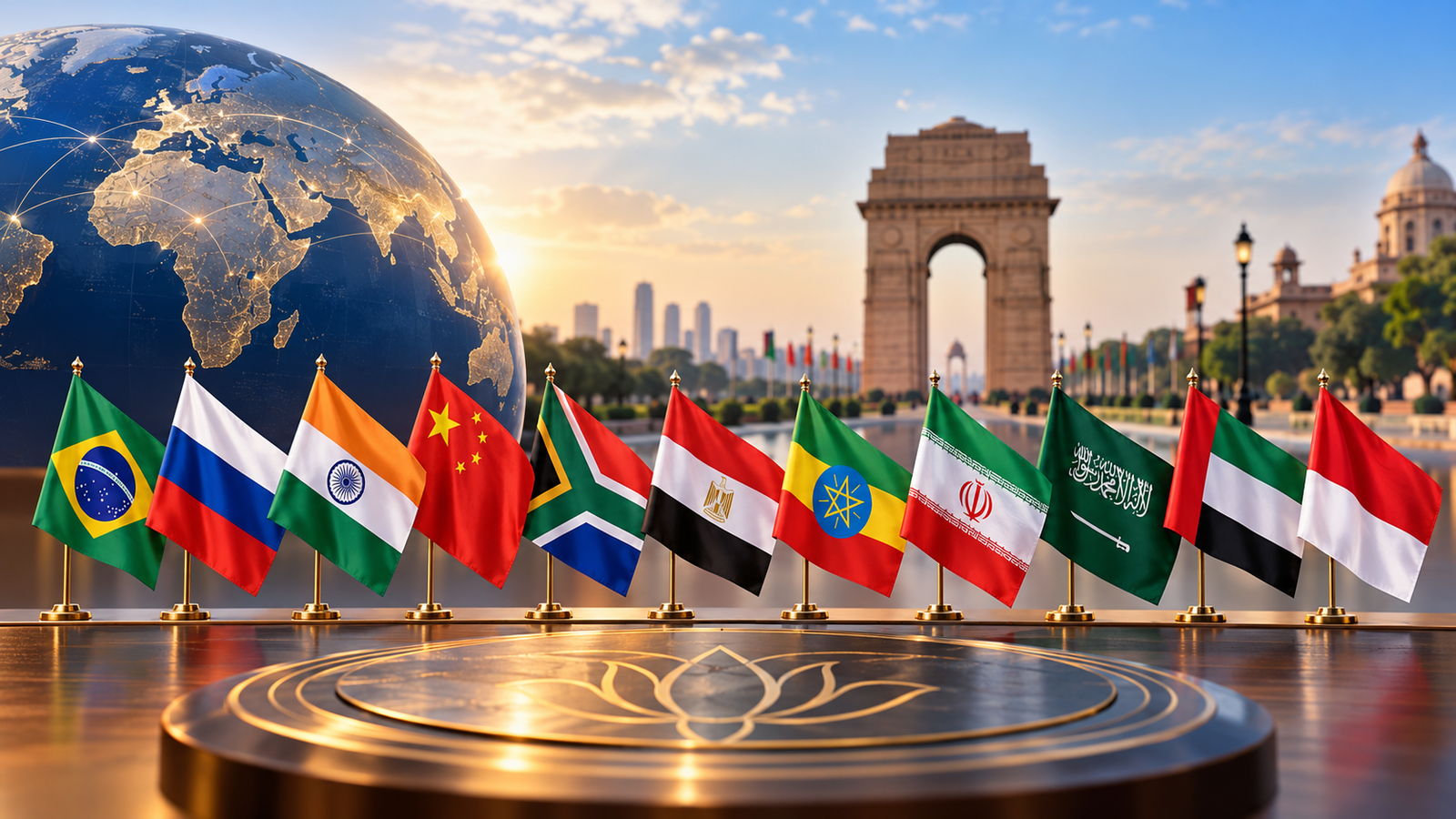
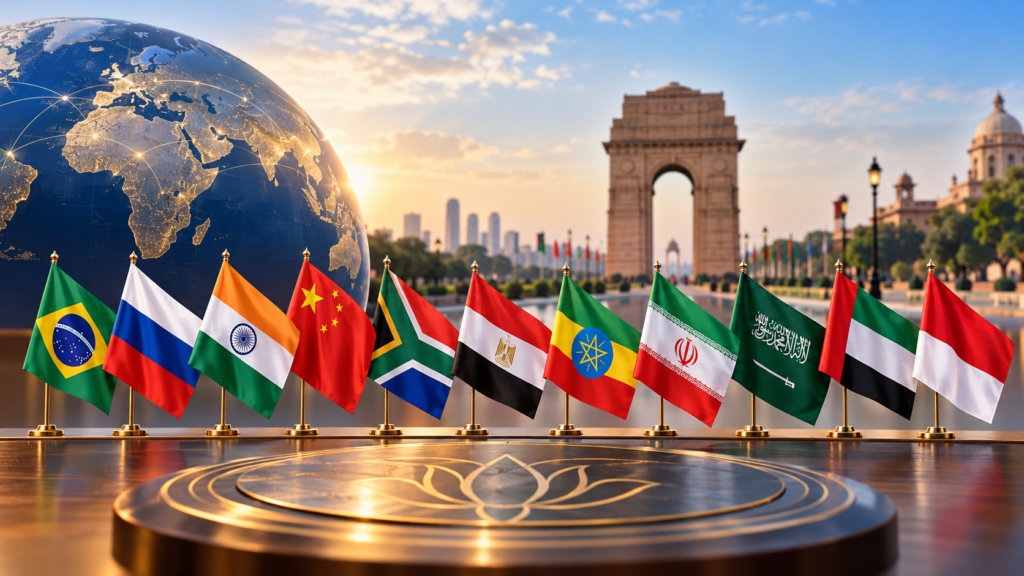
The 18th BRICS Summit, held in New Delhi on 12–13 September 2026, is especially important because it marked 20 years of BRICS and India’s fourth BRICS Chairship.
The 2026 Indian Chairship was guided by the theme:
“Building for Resilience, Innovation, Cooperation and Sustainability”
The summit produced the New Delhi Declaration, covering global governance reform, trade, finance, development, AI, climate change, energy, health, terrorism, digitalisation and people-to-people cooperation.
For UPSC and HPPSC aspirants, BRICS is therefore not merely an International Relations topic. It connects with Global South, multipolarity, multilateralism, UN reforms, IMF-World Bank reforms, WTO, international finance, climate diplomacy, AI governance, strategic autonomy and India’s foreign policy.
Why Is BRICS in News?
India hosted the 18th BRICS Summit in New Delhi on 12–13 September 2026.
The summit came at a time of major changes in the international system, including:
- growing geopolitical tensions;
- conflicts in different regions;
- trade protectionism and tariff disputes;
- debates over reform of global institutions;
- increasing importance of the Global South;
- rapid development of Artificial Intelligence;
- climate and disaster-related challenges;
- changes in global supply chains;
- growing discussions on alternative payment mechanisms.
The New Delhi Declaration reaffirmed the BRICS commitment to multilateralism, multipolarity, sustainable development and a greater voice for Emerging Markets and Developing Countries.
What is BRICS?
BRICS is a political and diplomatic coordination forum of major emerging economies.
It provides a platform for members to cooperate on areas such as:
- international economic governance;
- trade and investment;
- development finance;
- technology;
- energy;
- climate change;
- health;
- agriculture;
- education;
- counter-terrorism;
- people-to-people exchanges.
BRICS does not function like the European Union.
It does not have:
- a constitutive treaty;
- a permanent secretariat;
- a common parliament;
- a common currency;
- a common military structure.
Its presidency rotates among members, and cooperation largely takes place through summits, ministerial meetings, working groups and other institutional mechanisms.
BRICS: From BRIC to BRICS
The BRIC Concept
The term BRIC was coined in 2001 by economist Jim O’Neill of Goldman Sachs.
It referred to:
- Brazil
- Russia
- India
- China
The original idea was primarily economic: these countries were seen as major emerging economies with significant growth potential.
However, governments gradually transformed the economic idea into a political and diplomatic grouping.
Formation of BRIC
The four countries began formal political coordination in 2006.
The first BRIC leaders’ summit was held in Yekaterinburg, Russia, in 2009.
South Africa Joins
South Africa joined in 2011.
The name changed from:
BRIC → BRICS
The addition of South Africa was important because it strengthened the African dimension of the grouping.
BRICS Expansion
A major expansion was agreed at the 15th BRICS Summit in Johannesburg in 2023.
From January 2024, the grouping expanded to include:
- Egypt
- Ethiopia
- Iran
- Saudi Arabia
- United Arab Emirates
Indonesia subsequently became the 11th full member in January 2025.
Therefore, the present full membership consists of 11 countries:
| Region | BRICS Members |
|---|---|
| Asia | India, China, Indonesia, Iran |
| Africa | South Africa, Egypt, Ethiopia |
| Middle East/West Asia | Saudi Arabia, UAE, Iran |
| Europe/Eurasia | Russia |
| Latin America | Brazil |
The official BRICS framework identifies these 11 countries as members.
BRICS Partner Countries
BRICS has also developed a Partner Country category.
This is important because the grouping is no longer restricted to its full members.
Partner countries provide an additional mechanism for countries of the Global South and other emerging economies to engage with BRICS.
The partner-country framework was created following the expansion discussions at the Kazan Summit in 2024.
The partner countries include:
- Belarus
- Bolivia
- Cuba
- Kazakhstan
- Malaysia
- Nigeria
- Thailand
- Uganda
- Uzbekistan
- Vietnam
This creates a wider BRICS ecosystem without making every participating country a full member.
Full Member vs Partner Country
This distinction can be useful in Prelims.
Full Members
They participate as members of the expanded BRICS grouping.
Partner Countries
They participate through a structured engagement mechanism but are not full members.
Therefore:
BRICS expansion ≠ only increase in full membership.
It also involves the creation of a wider partnership network.
How Important Is BRICS Globally?
BRICS has acquired considerable demographic and economic weight.
According to Indian government material released ahead of the 2026 summit, the 11 members together represent approximately:
- 49.5% of global population
- 40% of global GDP
- 26% of global trade
These figures explain why BRICS has become increasingly relevant to discussions about global economic governance.
BRICS and the Global South
One of the most important concepts associated with BRICS is the Global South.
What is the Global South?
The Global South broadly refers to developing and emerging countries, particularly in:
- Asia
- Africa
- Latin America
- parts of the Middle East and other developing regions.
It is not simply a geographical term.
It also reflects common concerns relating to:
- development;
- poverty;
- unequal representation;
- access to finance;
- technology gaps;
- climate finance;
- historical inequalities in global institutions.
BRICS provides an important platform for these countries to coordinate their positions.
What Does BRICS Want?
BRICS does not have a single narrow objective.
Its broad objectives include:
Greater Voice for Emerging Economies
BRICS seeks greater representation of emerging and developing economies in global institutions.
Reform of Global Governance
It supports reforms in institutions such as:
- United Nations;
- UN Security Council;
- IMF;
- World Bank;
- WTO.
Economic Cooperation
Members cooperate on:
- trade;
- investment;
- finance;
- infrastructure;
- energy;
- agriculture;
- industry.
Development Cooperation
BRICS also promotes cooperation in:
- health;
- education;
- science and technology;
- climate change;
- sustainable development.
Three Broad Pillars of BRICS Cooperation
The New Delhi Declaration reaffirmed cooperation under three broad pillars:
Political and Security Cooperation
Includes:
- international peace and security;
- terrorism;
- conflict prevention;
- diplomatic coordination;
- global governance.
Economic and Financial Cooperation
Includes:
- trade;
- investment;
- development finance;
- payments;
- financial cooperation;
- infrastructure.
Cultural and People-to-People Cooperation
Includes:
- education;
- youth;
- tourism;
- culture;
- academic exchanges;
- civil society.
This three-pillar structure is important for understanding the broadening BRICS agenda.
18th BRICS Summit 2026
Venue and Dates
Venue: New Delhi, India
Dates: 12–13 September 2026
Summit: 18th BRICS Summit
Chair: India
Theme:
Building for Resilience, Innovation, Cooperation and Sustainability
The year 2026 also marks 20 years of BRICS.
India’s Fourth BRICS Chairship
India assumed the BRICS Chairship on 1 January 2026.
This was India’s fourth Chairship since the creation of the grouping.
The Indian Chairship focused on:
- resilience;
- innovation;
- sustainability;
- development;
- economic cooperation;
- technology;
- Global South priorities.
India also emphasised a people-centred approach under the broader idea of “Humanity First.”
India’s BRICS 2026 Theme
The four major words of the theme are highly relevant for UPSC:
Resilience
Ability of societies, economies and institutions to withstand shocks and recover from them.
Innovation
Development and adoption of new technologies, ideas and processes.
Cooperation
Collective action among member countries.
Sustainability
Development that meets present needs while protecting environmental and economic interests for the future.
India’s BRICS Chairship: Scale
The Indian Chairship involved more than 400 meetings and engagements across 30 Indian cities involving:
- ministers;
- parliamentarians;
- officials;
- experts;
- businesses;
- academics;
- civil society;
- people-to-people platforms.
This demonstrates that BRICS is no longer limited to an annual leaders’ summit.
It has developed a broad institutional ecosystem of working groups, ministerial meetings and sector-specific engagements.
New Delhi Declaration 2026
The major outcome of the summit was the:
New Delhi Declaration
It reaffirmed:
- multilateralism;
- multipolarity;
- sovereign equality;
- international law;
- sustainable development;
- inclusive growth;
- greater representation for developing countries.
The Declaration also covered a wide range of issues from UN reform to AI, climate change, trade and finance.
BRICS and Reform of the United Nations
This is one of the most important UPSC angles.
BRICS has consistently advocated reform of the UN Security Council.
The New Delhi Declaration again called for a more:
- democratic;
- representative;
- effective;
- efficient
UN system.
It also called for greater representation of developing countries.
Importantly, China and Russia reiterated support for the aspirations of Brazil and India to play a greater role in the UN, including the Security Council.
This is significant for India’s long-standing demand for UNSC reform.
What Does Multipolarity Mean?
Simple Explanation
A multipolar world is one in which power is distributed among several major countries or centres rather than concentrated primarily in one or two dominant powers.
Why Does India Support Multipolarity?
India’s foreign policy traditionally seeks:
- strategic autonomy;
- freedom of decision-making;
- diversified partnerships;
- greater representation of developing countries.
BRICS therefore provides India with one platform to advance these objectives.
BRICS and IMF–World Bank Reform
The Bretton Woods institutions were created in the post-World War II period.
They include institutions such as:
- International Monetary Fund
- World Bank
BRICS argues that their governance structures should better reflect the current global economic distribution.
The New Delhi Declaration again called for:
- greater representation of emerging economies;
- quota reforms;
- greater voice for developing countries;
- more representative leadership structures.
This is a major GS-II + GS-III topic.
BRICS and WTO Reform
BRICS also supports reform of the World Trade Organization.
The New Delhi Declaration reaffirmed support for:
- an open trading system;
- rules-based trade;
- non-discriminatory trade;
- transparency;
- inclusiveness.
It also raised concerns about increasing unilateral tariffs and non-tariff measures.
The grouping called for strengthening the WTO’s dispute settlement mechanism.
BRICS and Global Trade
The global trading system is facing several challenges:
- protectionism;
- tariff increases;
- supply-chain disruptions;
- geopolitical tensions;
- sanctions;
- fragmentation.
BRICS seeks greater coordination among emerging economies to reduce vulnerabilities arising from such disruptions.
This makes BRICS important in the context of:
Globalisation → Protectionism → Supply-chain resilience → Global South
BRICS Cross-Border Payments
One of the most discussed BRICS economic issues is cross-border payments.
The BRICS Payment Task Force is working on improving payment mechanisms among members.
The New Delhi Declaration highlighted efforts towards:
- interoperability of payment systems;
- efficient cross-border payments;
- trade settlement;
- investment;
- use of local currencies where appropriate.
The objective is to make cross-border payments:
- faster;
- cheaper;
- accessible;
- efficient;
- transparent;
- secure.
Importantly, the 2026 declaration does not establish a BRICS common currency.
Does BRICS Have a Common Currency?
No.
This is an important Prelims point.
BRICS does not currently have a common currency similar to the euro.
The current discussion is primarily around:
- payment interoperability;
- local-currency settlement;
- financial cooperation;
- reducing transaction costs;
- strengthening financial resilience.
Therefore:
BRICS common currency ≠ current reality
Is BRICS Trying to De-dollarise the World?
The issue is more nuanced.
BRICS countries have discussed:
- greater use of national currencies;
- local-currency trade;
- alternative payment mechanisms;
- reducing transaction costs.
However, this should not automatically be interpreted as the creation of an alternative global monetary system.
For UPSC answers, it is better to write:
BRICS is exploring greater financial autonomy and payment diversification rather than having already created a unified alternative to the existing global monetary system.
New Investment Platform
The summit also advanced discussions on a New Investment Platform (NIP).
The objective is to explore mechanisms for strengthening investment cooperation among BRICS members.
The 2026 Declaration noted progress on the initiative and continued technical discussions.
The approach is:
- consensus-based;
- phased;
- member-driven;
- respectful of national sovereignty;
- sensitive to different regulatory systems.
BRICS Risk Lab and GIFT City
India proposed taking forward discussions on a BRICS Risk Lab at:
GIFT City International Financial Services Centre (IFSC), Gujarat
The proposed platform can help explore cooperation in:
- insurance;
- reinsurance;
- risk modelling;
- financial resilience;
- specialised capabilities.
This creates a direct link between:
BRICS → Global Finance → GIFT City → India’s financial diplomacy
New Development Bank
One of the most concrete BRICS institutions is the:
New Development Bank (NDB)
It was established by BRICS countries to mobilise resources for infrastructure and sustainable development projects.
The founding members were:
- Brazil
- Russia
- India
- China
- South Africa
The NDB is headquartered in Shanghai, China.
Why Was the NDB Created?
Developing countries often face large infrastructure and development-financing requirements.
The NDB seeks to provide financing for:
- infrastructure;
- sustainable development;
- renewable energy;
- transport;
- urban development;
- other development projects.
It therefore complements, rather than simply replaces, existing international development institutions.
NDB Expansion
The NDB has expanded beyond the original five BRICS members.
Current members include:
- Brazil
- Russia
- India
- China
- South Africa
- Bangladesh
- UAE
- Egypt
- Algeria
- Uzbekistan
The NDB also lists prospective members.
This is important because:
BRICS membership and NDB membership are not identical.
A country can be associated with the NDB without being a full BRICS member.
BRICS-NDB Knowledge Portal
During the 2026 Summit, the BRICS-NDB Knowledge Portal was highlighted.
It is designed to facilitate:
- sharing of development experiences;
- best practices;
- policy innovations;
- lessons from NDB-financed projects;
- knowledge exchange across the Global South.
This represents a shift from simply providing finance towards sharing development knowledge and institutional capacity.
BRICS and Artificial Intelligence
AI was an important emerging area of BRICS cooperation.
The New Delhi Declaration recognised AI’s potential to contribute to:
- economic growth;
- sustainable development;
- productivity;
- social welfare.
At the same time, BRICS emphasised the need for AI to be:
- safe;
- secure;
- inclusive;
- reliable;
- trustworthy.
Why Is AI Important for BRICS?
Developing countries face a dual challenge:
AI opportunity + AI inequality
AI can improve:
- healthcare;
- agriculture;
- education;
- financial services;
- governance;
- disaster management.
But developing countries also face:
- computing shortages;
- data limitations;
- skill gaps;
- infrastructure constraints;
- digital divides.
Therefore, BRICS cooperation on AI can be important for making AI development more inclusive.
BRICS and Digital Public Infrastructure
The 2026 Chairship also included discussions around:
- digital skilling;
- digital connectivity;
- Digital Public Infrastructure;
- emerging technologies;
- digital governance.
India’s experience with Digital Public Infrastructure (DPI) gives it an opportunity to share policy and technological experiences with other developing countries.
BRICS and Climate Change
Climate change is another major BRICS agenda.
Developing countries face particularly high vulnerabilities because climate risks can affect:
- agriculture;
- water;
- infrastructure;
- health;
- livelihoods;
- food security.
The New Delhi Declaration emphasised:
- climate finance;
- adaptation;
- disaster resilience;
- early warning systems;
- climate-resilient infrastructure;
- community-based adaptation.
Climate Finance
A major issue for developing countries is the availability of adequate climate finance.
BRICS countries emphasised the importance of:
- accessible financing;
- adaptation finance;
- sustainable finance;
- technology transfer;
- capacity building.
The Declaration also highlighted the disproportionate climate burden faced by emerging and developing economies.
Disaster Risk Reduction
The 2026 BRICS agenda also connected climate change with disaster management.
The grouping welcomed:
- guidelines for disaster-management early-warning data integration;
- principles for climate-resilient urban infrastructure.
This is particularly relevant to India because of its exposure to:
- floods;
- cyclones;
- landslides;
- droughts;
- heatwaves;
- earthquakes.
BRICS and CDRI
The Coalition for Disaster Resilient Infrastructure (CDRI) was also recognised in the Declaration.
CDRI is an international partnership associated with India’s efforts to promote resilient infrastructure.
The connection is important:
Climate change → Disaster risk → Infrastructure vulnerability → Resilient infrastructure
BRICS and Energy
BRICS countries have very different energy profiles.
They include major:
- oil producers;
- gas producers;
- coal users;
- renewable-energy investors;
- nuclear-energy users.
Therefore, energy security is a major area of cooperation.
The 2026 Declaration supported cooperation involving:
- renewable energy;
- nuclear energy;
- hydrogen;
- hydropower;
- bioenergy;
- fossil fuels;
- energy storage;
- low-carbon technologies.
Smart Grids and Energy Storage
The summit also highlighted cooperation on:
- smart grids;
- energy storage;
- digitalisation of energy systems;
- AI and advanced data analytics.
This is relevant to the transition towards:
Renewable Energy + Storage + Smart Grids + Digitalisation
BRICS and MSMEs
MSMEs are important because they generate employment and support inclusive growth.
India’s Chairship convened the first BRICS SME Forum in Agra.
The discussions focused on:
- access to finance;
- access to technology;
- competitiveness;
- sustainable growth;
- exchange of best practices.
This connects BRICS with India’s domestic priorities around:
- MSMEs;
- employment;
- manufacturing;
- entrepreneurship;
- Industry 4.0.
BRICS and Industry 4.0
The BRICS Centre for Industrial Competencies works towards helping industries, including SMEs, adopt:
- advanced manufacturing;
- digital production;
- Industry 4.0;
- emerging technologies;
- AI.
India also established the India Centre for BRICS Industrial Competencies.
BRICS and Science & Technology
BRICS has developed extensive cooperation in:
- science;
- technology;
- innovation;
- research;
- capacity building.
The 2026 Declaration recognised the role of 14 thematic BRICS Science, Technology and Innovation Working Groups.
This shows that BRICS is increasingly becoming a platform for technological cooperation.
BRICS and Health
The grouping also discussed:
- health infrastructure;
- medical production;
- health emergency preparedness;
- surveillance systems;
- laboratory networks;
- digital health;
- AI in healthcare;
- vaccines;
- therapeutics;
- diagnostics.
For developing countries, local production of medical products can reduce vulnerability to global supply disruptions.
BRICS and Food Security
BRICS members collectively have major roles in global agricultural production.
The grouping highlighted:
- food security;
- nutrition;
- agricultural productivity;
- sustainability;
- fertilizer shortages;
- food-price volatility.
This has implications for both global food security and India’s agricultural diplomacy.
BRICS and Terrorism
Counter-terrorism remains an important security pillar.
BRICS cooperation includes:
- Counter-Terrorism Working Group;
- information sharing;
- countering terrorist financing;
- preventing radicalisation;
- addressing safe havens;
- cooperation among competent authorities.
The New Delhi Declaration also reaffirmed opposition to terrorism in all its forms and manifestations.
BRICS and the Middle East
The 2026 Summit occurred amid continuing tensions in West Asia.
The New Delhi Declaration called for:
- maximum restraint;
- protection of civilians;
- protection of civilian infrastructure;
- dialogue and diplomacy;
- smooth movement of global trade;
- secure energy flows.
This is significant because BRICS includes countries with different geopolitical positions and interests.
The declaration therefore demonstrates both the potential and limits of consensus-based cooperation within an expanded grouping.
BRICS and Palestine
The New Delhi Declaration also addressed the situation in Gaza and the Palestinian question.
It reaffirmed:
- support for Palestinian self-determination;
- opposition to forced displacement;
- humanitarian access;
- support for UNRWA;
- support for a two-state solution;
- support for Palestine’s full membership in the UN.
This makes the issue relevant to India’s broader engagement with the Global South.
BRICS and Ukraine
The Ukraine conflict remains another complex issue for BRICS because:
- Russia is a member;
- China is a major member;
- India has close relations with Russia;
- other members have different diplomatic positions.
The BRICS approach continues to emphasise:
- dialogue;
- consultation;
- diplomacy;
- peaceful resolution of disputes.
This illustrates the challenge of achieving a common foreign-policy position among countries with different strategic interests.
India’s Importance in BRICS
BRICS is particularly significant for India because it complements several elements of India’s foreign policy.
Strategic Autonomy
India seeks freedom to pursue relationships with multiple major powers.
BRICS allows India to engage simultaneously with:
- Russia;
- China;
- Brazil;
- South Africa;
- West Asian countries;
- other emerging economies.
Global South Leadership
India has increasingly positioned itself as a voice for developing countries.
BRICS provides an important platform for advancing issues such as:
- development finance;
- climate justice;
- technology access;
- institutional reform;
- food and energy security.
Reform of Global Institutions
India’s demand for greater representation in institutions such as:
- UNSC;
- IMF;
- World Bank;
- WTO
finds significant space within BRICS discussions.
BRICS and India’s Relations with the West
BRICS should not be understood simply as an anti-Western alliance.
This distinction is important.
India maintains extensive relations with:
- the United States;
- European Union;
- Japan;
- Australia;
- other developed economies.
At the same time, India participates actively in BRICS.
This reflects India’s broader approach of:
multi-alignment + strategic autonomy + issue-based cooperation
Therefore, BRICS membership does not mean India has to choose between BRICS and Western partnerships.
BRICS and Quad: Are They Opposite?
This is a common conceptual confusion.
BRICS
Broadly focused on:
- Global South;
- economic cooperation;
- development;
- global governance reform;
- multilateral institutions.
Quad
India, United States, Japan and Australia.
Its cooperation focuses strongly on:
- Indo-Pacific;
- maritime security;
- critical technologies;
- resilient supply chains;
- health;
- infrastructure.
India participates in both.
This demonstrates India’s multi-layered foreign policy rather than membership in one bloc determining all of its international relationships.
Why BRICS Expansion Matters
Expansion has increased the geographic and economic diversity of BRICS.
The grouping now includes:
- major Asian economies;
- African economies;
- Gulf economies;
- Latin America’s largest economy;
- Russia.
This gives BRICS greater reach.
However, expansion also creates a challenge.
More members mean:
More representation → but also more diverse interests → more difficult consensus-building
This is one of the central analytical points for UPSC.
Challenges Before BRICS
BRICS has considerable potential, but it also faces structural limitations.
Divergent National Interests
Members have different:
- political systems;
- economic models;
- security interests;
- foreign-policy priorities.
India-China Strategic Competition
India and China cooperate within BRICS but also have significant strategic differences.
This creates a dual dynamic:
Cooperation + Competition
Iran–Gulf Differences
The inclusion of both Iran and Gulf countries brings additional geopolitical complexity.
Russia-West Conflict
Russia’s relations with Western countries affect the geopolitical environment in which BRICS operates.
Economic Diversity
BRICS includes countries with very different:
- GDP structures;
- income levels;
- currencies;
- financial systems;
- trade patterns.
This makes economic integration more difficult than it may initially appear.
Consensus-Based Decision Making
BRICS generally operates through consultation and consensus.
This helps maintain inclusiveness but can make ambitious collective action difficult.
BRICS: Opportunities vs Challenges
| Opportunities | Challenges |
|---|---|
| Greater Global South representation | Divergent geopolitical interests |
| Economic cooperation | Different economic structures |
| Development finance | Limited institutional integration |
| Alternative payment mechanisms | No common financial system |
| Technology cooperation | Digital and technological gaps |
| Climate cooperation | Different development priorities |
| UNSC reform advocacy | Difficulty in achieving common positions |
| Expanded membership | Greater complexity |
| NDB financing | NDB membership differs from BRICS membership |
BRICS and India’s Strategic Significance
For India, BRICS can serve as a platform for three simultaneous objectives:
Voice
Increase India’s role in debates concerning global governance.
Choice
Maintain strategic autonomy by engaging multiple power centres.
Cooperation
Work with emerging economies on development, finance, technology and climate issues.
Thus, BRICS forms one component of India’s broader foreign-policy architecture.
What Should UPSC Aspirants Remember?
Do not prepare BRICS as a list of countries alone.
Prepare it through five interconnected dimensions:
History
BRIC → BRICS → Expansion → Partner Countries
Institutions
BRICS → NDB → Working Groups → Ministerial Meetings
Global Governance
UNSC → IMF → World Bank → WTO
Emerging Issues
AI → Digital Payments → Climate → Energy → Technology
India
Strategic Autonomy → Global South → Development Diplomacy → Multilateral Reform
UPSC Prelims Quick Facts
| Topic | Fact |
|---|---|
| BRIC concept | Coined in 2001 |
| Original BRIC | Brazil, Russia, India, China |
| BRIC political formation | 2006 |
| First BRIC Summit | 2009, Yekaterinburg |
| South Africa joined | 2011 |
| BRICS expansion | Major expansion from 2024 |
| Indonesia | 11th full member, 2025 |
| Current full members | 11 |
| 2026 Chair | India |
| 18th Summit | New Delhi |
| Summit dates | 12–13 September 2026 |
| 2026 theme | Building for Resilience, Innovation, Cooperation and Sustainability |
| 2026 declaration | New Delhi Declaration |
| Development bank | New Development Bank |
| NDB headquarters | Shanghai |
| Common currency | No |
| Permanent BRICS secretariat | No |
| Partner-country framework | Created in 2024 |
UPSC Mains Connections
GS Paper II
International Relations
Question possibility:
“BRICS has evolved from an economic grouping into a broader platform for reforming global governance. Discuss.”
Relevant points:
- Global South;
- UNSC reform;
- IMF and World Bank reform;
- WTO reform;
- multipolarity;
- strategic autonomy.
GS Paper III
Economy
Possible themes:
- BRICS financial cooperation;
- NDB;
- cross-border payments;
- local-currency settlement;
- trade;
- supply-chain resilience.
Science & Technology
- AI governance;
- digital public infrastructure;
- Industry 4.0;
- digitalisation;
- technology cooperation.
Environment
- climate finance;
- adaptation;
- disaster resilience;
- climate-resilient infrastructure;
- biodiversity.
Possible UPSC Mains Questions
Question 1
“BRICS represents the growing assertion of the Global South in global governance.” Discuss.
Question 2
“BRICS expansion has increased its global relevance but also complicated consensus-building.” Examine.
Question 3
“India’s participation in BRICS reflects its strategy of strategic autonomy rather than bloc politics.” Discuss.
Question 4
“Reform of global financial institutions remains a central objective of BRICS.” Explain with reference to IMF, World Bank and NDB.
Question 5
“The future relevance of BRICS will depend on its ability to convert political coordination into practical economic and technological cooperation.” Examine.
One-Page Revision
BRICS in One Flow
2001
BRIC term coined
↓
2006
BRIC cooperation begins
↓
2009
First BRIC Summit
↓
2011
South Africa joins
↓
BRICS
↓
2023 Johannesburg Summit
Decision for major expansion
↓
2024
Egypt + Ethiopia + Iran + Saudi Arabia + UAE
↓
2025
Indonesia becomes 11th full member
↓
2026
India’s 4th Chairship
↓
12–13 September 2026
18th BRICS Summit, New Delhi
↓
New Delhi Declaration
↓
Major themes
Global Governance + Trade + Finance + AI + Climate + Energy + Health + Development + Terrorism
Memory Trick
Remember the BRICS 2026 agenda through:
“G-F-T-A-C-E-H”
G — Global Governance
UNSC, IMF, World Bank, WTO reforms
F — Finance
NDB, payments, investment, local currencies
T — Trade
WTO, tariffs, supply chains
A — Artificial Intelligence
AI governance, digitalisation, emerging technology
C — Climate
Climate finance, adaptation, resilient infrastructure
E — Energy
Renewables, nuclear, hydrogen, smart grids
H — Health
Medical production, health security, digital health
Final Takeaway
BRICS has travelled a long way from the BRIC economic concept of 2001 to a much broader platform involving 11 full members, partner countries, development finance, trade, technology, climate cooperation, health, energy and global governance.
The 18th BRICS Summit in New Delhi in September 2026 represents another step in this evolution.
For India, BRICS is important because it provides a platform to simultaneously pursue:
Global South cooperation + strategic autonomy + economic interests + institutional reform + development diplomacy.
At the same time, BRICS faces genuine challenges arising from divergent national interests, geopolitical tensions and the difficulty of converting broad political consensus into binding collective action.
The most important UPSC perspective is therefore not whether BRICS will replace existing global institutions.
Rather, the key question is:
Can BRICS strengthen the voice, representation and bargaining capacity of emerging and developing economies while converting its growing economic weight into practical cooperation?
That is the central issue to watch as BRICS moves into its next phase.