
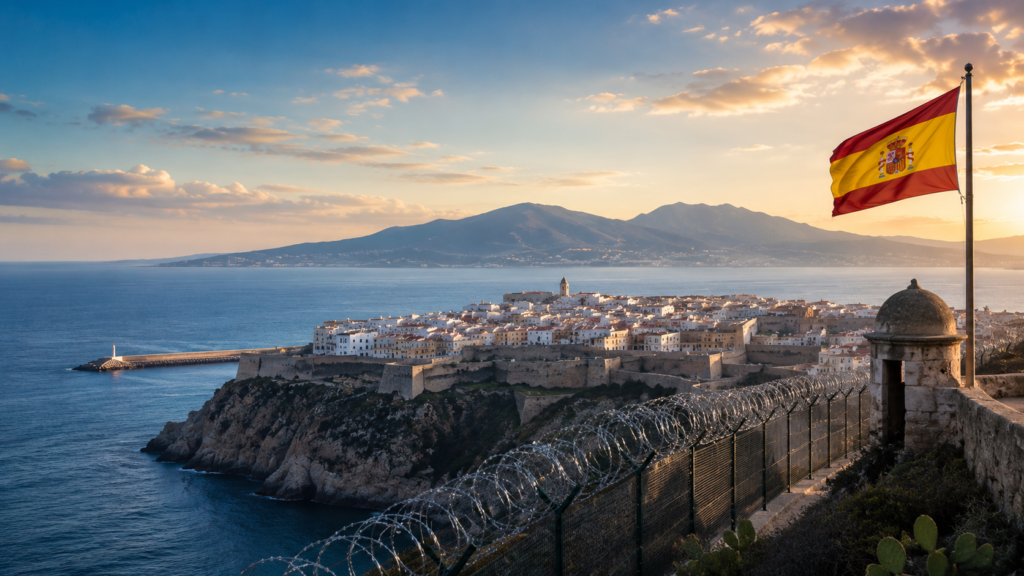
Ceuta Explained: Why This Tiny Spanish City in Africa is at the Centre of Europe’s Migration Crisis
Why is it in News?
The Spanish city of Ceuta, located on the northern coast of Africa, recently witnessed a major migration crisis as nearly 60,000 migrants crossed from Morocco seeking entry into Europe. The incident has intensified discussions on illegal migration, asylum laws, European border security, refugee protection and the long-standing sovereignty dispute between Spain and Morocco.
For UPSC aspirants, this topic connects World Geography, International Relations, Security, Human Rights and International Law.
Where is Ceuta?
Ceuta is one of the most geographically unique cities in the world.
Although it lies on the African continent, it is an autonomous city of Spain and therefore part of the European Union (EU).
It is located on the northern coast of Morocco, overlooking the Strait of Gibraltar, which connects the Atlantic Ocean with the Mediterranean Sea.
Along with Melilla, Ceuta forms the only land border between the European Union and Africa.
This unique location makes it one of Europe’s most sensitive border regions.
Why Does Spain Own a City in Africa?
Ceuta has changed hands several times throughout history. It was ruled by the Carthaginians, Romans, Arabs and Portuguese before coming under Spanish control.
Under the Treaty of Lisbon (1668), Portugal formally recognized Spanish sovereignty over Ceuta.
Today, Ceuta is an Autonomous City of Spain, enjoying local self-government while defence, foreign affairs and national security remain under the Spanish Government.
However, Morocco continues to claim Ceuta, arguing that since the city is geographically located in Africa, it should naturally form part of Moroccan territory.
Spain rejects this claim, maintaining that Ceuta has been under Spanish sovereignty for centuries and its residents are Spanish citizens.
This disagreement remains one of the longest-running territorial disputes in Europe and North Africa.
Understanding Sovereignty
The dispute over Ceuta revolves around one important concept—sovereignty.
Sovereignty means the legal authority of a country to govern its own territory without interference from any other country.
Since Spain exercises complete administrative, legal and political control over Ceuta, it considers the city an integral part of its territory.
Morocco, however, believes the historical and geographical realities support its claim.
Is Ceuta Really an Enclave?
Ceuta is commonly described as a Spanish enclave in North Africa.
However, technically it is not a complete enclave because it is bordered by Morocco on land but also has access to the Mediterranean Sea.
From a geographical perspective, it is more accurately described as a coastal (semi-) enclave.
Interestingly, from Spain’s perspective, Ceuta is also an exclave because it is physically separated from mainland Spain by the sea.
This distinction is important for Geography Optional and interviews, although UPSC generally follows the commonly accepted term “Spanish enclave.”
Why is Ceuta Strategically Important?
Despite covering a very small area, Ceuta holds enormous geopolitical importance.
It is located beside the Strait of Gibraltar, one of the world’s busiest maritime chokepoints.
A maritime chokepoint is a narrow sea passage through which a large volume of international trade and naval traffic passes.
Thousands of commercial ships carrying oil, natural gas, manufactured goods and food supplies pass through this route every year.
Because of this location, Ceuta plays a crucial role in:
- Maritime trade
- Naval security
- Border surveillance
- Migration management
- European security
Its strategic importance far exceeds its geographical size.
Why Are So Many Migrants Trying to Reach Ceuta?
The answer lies in geography.
Since Ceuta is European Union territory, crossing into the city effectively means entering Europe.
Many migrants from Africa view Ceuta as one of the shortest and most accessible routes to Europe in search of safety, employment and better living conditions.
Several factors drive this migration.
Push Factors
People leave their home countries because of:
- Poverty
- Unemployment
- Armed conflicts
- Political instability
- Climate-related challenges
Pull Factors
Europe attracts migrants because of:
- Better employment opportunities
- Higher living standards
- Better education and healthcare
- Greater political stability
This combination of push and pull factors makes Ceuta one of Europe’s busiest migration gateways.
Migrants, Refugees and Asylum Seekers: Know the Difference
These terms are often confused but have different meanings.
A migrant is someone who voluntarily moves to another country, usually for employment, education or better opportunities.
A refugee is forced to flee because of war, violence or persecution and cannot safely return home.
An asylum seeker is a person who has requested protection in another country but whose refugee claim is still under examination.
This distinction is extremely important because international law provides special protection to refugees and asylum seekers.
What is the Principle of Non-Refoulement?
One of the cornerstones of international refugee law is the principle of Non-Refoulement.
It means that a country cannot forcibly return a refugee or asylum seeker to a place where they face persecution, torture or serious threats to life.
This principle forms the foundation of the 1951 Refugee Convention and plays a central role in Europe’s asylum policies.
Human Smuggling vs Human Trafficking
Migration crises often create opportunities for organized crime.
It is important to distinguish between two different offences.
Human Smuggling involves illegally helping people cross international borders in exchange for money.
Human Trafficking, on the other hand, involves recruiting or transporting people through force, fraud or coercion for exploitation such as forced labour or sexual exploitation.
While smuggling is primarily a crime against border laws, trafficking is a serious violation of human rights.
The Geopolitics Behind the Crisis
The Ceuta crisis is not merely about migration.
It is also about geopolitics—the influence of geography on international politics.
Morocco and Spain have different positions regarding Ceuta’s sovereignty. At times, migration management itself becomes a diplomatic tool, with border controls influencing political negotiations.
The issue is also linked to the broader Western Sahara dispute, where Spain’s historical role and Morocco’s territorial claims continue to shape bilateral relations.
This demonstrates how geography, history and politics are deeply interconnected.
Why is Ceuta Important for India?
India has no direct territorial interest in Ceuta.
However, developments in the region remain important because:
- The Strait of Gibraltar is a critical global maritime trade route.
- Disruptions can affect international shipping and energy prices.
- India closely studies European migration policies and border management practices.
- The region provides valuable lessons on balancing border security with humanitarian obligations.
For India’s policymakers, Ceuta offers insights into migration governance, international cooperation and strategic maritime security.
UPSC Perspective
This topic is relevant for multiple General Studies papers.
| GS Paper | Relevance |
|---|---|
| GS-I | World Geography, Political Geography |
| GS-II | International Relations, Refugees, Human Rights |
| GS-III | Border Security, Internal Security, Maritime Security |
| Essay | Migration, Globalization, International Cooperation |
Prelims Facts
- Ceuta is an Autonomous City of Spain located in North Africa.
- Along with Melilla, it forms the only land border between the European Union and Africa.
- The Strait of Gibraltar connects the Atlantic Ocean and the Mediterranean Sea.
- Ceuta is commonly described as a Spanish enclave, although geographically it is more accurately a coastal (semi-) enclave.
- The principle of Non-Refoulement is a key feature of the 1951 Refugee Convention.
Conclusion
The Ceuta migration crisis is far more than a border incident. It highlights the complex relationship between geography, migration, sovereignty, international law and geopolitics. A small city occupying a strategic position between Europe and Africa has become a focal point for debates on refugee protection, border security and diplomatic relations.
For UPSC aspirants, the real takeaway is not simply locating Ceuta on a map but understanding how geographical location can shape international politics, migration patterns and global security. It is a classic example of how a tiny territory can have an outsized influence on world affairs.
Key Takeaways
- Ceuta is a Spanish autonomous city located in North Africa.
- It is one of the European Union’s external land borders with Africa.
- The city occupies a strategic position near the Strait of Gibraltar, a major maritime chokepoint.
- The migration crisis involves issues of refugee protection, asylum, border security and international law.
- The dispute between Spain and Morocco illustrates how geography continues to shape international relations and global politics.