UNESCO World Heritage Sites Explained: Why the New UNESCO Inscriptions Are in News and Why They Matter
Why is it in News?
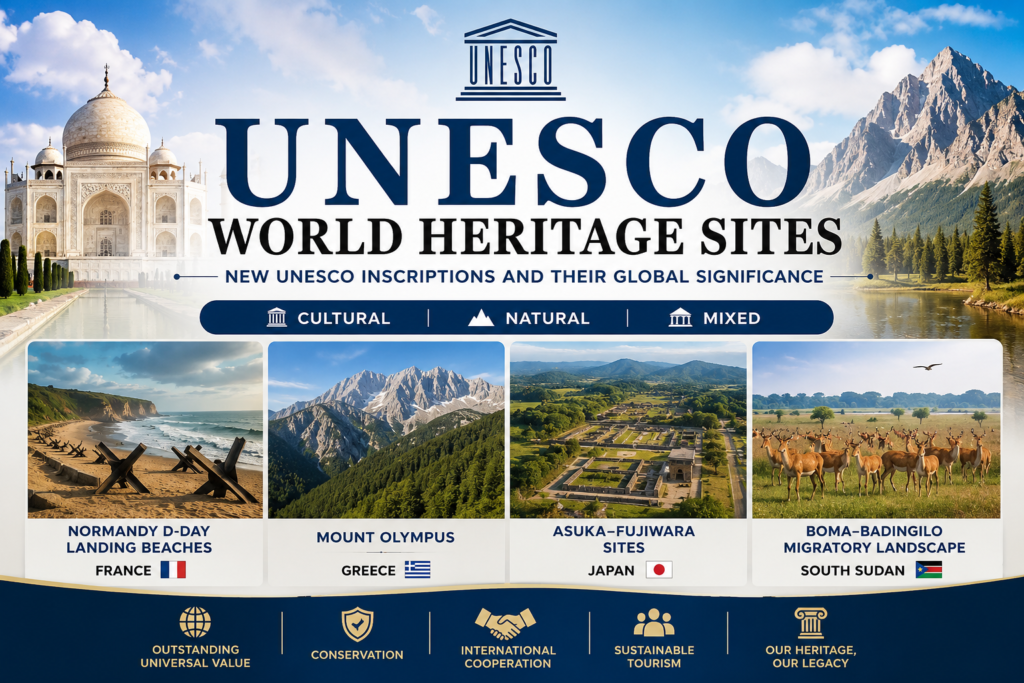
The UNESCO World Heritage Committee has recently inscribed several new Cultural, Natural and Mixed World Heritage Sites, including:
- Normandy D-Day Landing Beaches (France)
- Mount Olympus (Greece)
- Asuka–Fujiwara Archaeological Sites (Japan)
- Boma–Badingilo Migratory Landscape (South Sudan)
These additions have expanded the global list of places considered to possess Outstanding Universal Value (OUV).
For UPSC aspirants, this is much more than a current affairs update. It connects Art & Culture, Geography, Environment, International Organisations, Biodiversity, Modern History and Conservation.
But before learning about these new sites, let us first understand what UNESCO World Heritage Sites actually are and why they are so important.
Why Does the World Need UNESCO?
Imagine that a magnificent temple built over a thousand years ago is destroyed in a war.
Or a rainforest that contains thousands of rare species disappears due to climate change.
Or an ancient archaeological city is lost forever because of uncontrolled urban development.
These losses would not belong to one country alone.
They would be losses for all humanity.
This realization led to the creation of UNESCO (United Nations Educational, Scientific and Cultural Organization) after the Second World War.
Its mission is simple:
To protect humanity’s shared cultural and natural heritage so that future generations can experience and learn from it.
What is UNESCO?
UNESCO is a specialized agency of the United Nations established in 1945 with headquarters in Paris, France.
Unlike organizations that provide loans or military assistance, UNESCO focuses on preserving and promoting:
- Education
- Science
- Culture
- Heritage
- Freedom of Expression
- International Cooperation
One of its most well-known responsibilities is protecting places that are considered important not just for one nation, but for the entire world.
UPSC Fact Box
| Feature | Details |
|---|---|
| Full Form | United Nations Educational, Scientific and Cultural Organization |
| Established | 1945 |
| Headquarters | Paris, France |
| Parent Organization | United Nations |
What is a World Heritage Site?
Suppose India has the Taj Mahal.
Legally, it belongs to India.
It is maintained by Indian authorities.
But millions of people from across the world visit it every year because it represents one of humanity’s greatest architectural achievements.
In such cases, the international community agrees that the monument deserves protection not only for one country, but for future generations across the globe.
This is the idea behind a World Heritage Site.
Definition
A World Heritage Site is a place recognized by UNESCO because it possesses Outstanding Universal Value (OUV) and is considered important for all humanity.
These places may be:
- Historic monuments
- Ancient cities
- Archaeological sites
- National parks
- Forests
- Mountains
- Wildlife habitats
The Most Important Keyword: Outstanding Universal Value (OUV)
Every UPSC aspirant should remember this term because it is the foundation of the entire World Heritage Programme.
What is Outstanding Universal Value?
Outstanding Universal Value means that a site is so exceptional that its importance extends beyond national boundaries.
It is considered valuable for the entire world.
For example,
The Taj Mahal belongs to India.
However, its architectural excellence and historical significance make it part of humanity’s shared heritage.
Similarly,
Kaziranga National Park is located in Assam, but its biodiversity is considered globally important.
This is why both qualify for UNESCO recognition.
Easy Way to Remember
National Importance → Important for one country
Outstanding Universal Value → Important for the entire world
Heritage is More Than Just Monuments
When people hear the word “heritage”, they usually think of forts or temples.
However, heritage is much broader.
It includes everything inherited from previous generations that deserves preservation for the future.
UNESCO recognizes three major categories of World Heritage.
Cultural Heritage
These are places created or significantly shaped by human civilization.
Examples include:
- Taj Mahal
- Red Fort
- Hampi
- Pyramids of Egypt
These sites showcase human creativity, architecture, history and civilization.
Natural Heritage
These are areas of exceptional natural beauty or ecological significance.
Examples include:
- Kaziranga National Park
- Sundarbans National Park
- Great Barrier Reef
Their importance lies in biodiversity, geology, ecosystems and natural processes.
Mixed Heritage
Some places are extraordinary because they combine both cultural and natural significance.
These are called Mixed Heritage Sites.
One of the newest examples is Mount Olympus in Greece.
It is culturally significant because Greek mythology describes it as the home of Zeus and the Olympian gods.
At the same time, it is ecologically important because of its alpine ecosystems, endemic species and remarkable biodiversity.
Quick Comparison
| Cultural Heritage | Natural Heritage | Mixed Heritage |
|---|---|---|
| Human-created | Nature-created | Combination of both |
| Taj Mahal | Kaziranga National Park | Mount Olympus |
Does UNESCO Own These Sites?
This is one of the biggest misconceptions.
The answer is No.
Even after UNESCO recognition:
- The monument remains under the country’s ownership.
- Territorial sovereignty does not change.
- National laws continue to apply.
For example,
The Taj Mahal remains under the Government of India.
UNESCO only recognizes its global importance.
Remember
UNESCO grants recognition—not ownership.
How Does a Place Become a World Heritage Site?
Many people imagine that UNESCO officials travel around the world selecting monuments they like.
The process is actually much more scientific.
It follows several stages.
Step 1: Identification
A country identifies a site with exceptional cultural or natural importance.
Step 2: Tentative List
The site is first placed on the country’s Tentative List.
Think of this as a waiting list of future nominations.
Only sites on this list can be formally nominated.
Step 3: Nomination Dossier
The country prepares a detailed application explaining:
- Historical importance
- Cultural or ecological significance
- Maps
- Conservation plans
- Legal protection
- Management strategy
This document is called the Nomination Dossier.
Step 4: Expert Evaluation
Independent expert organizations evaluate the proposal.
ICOMOS
Evaluates:
- Monuments
- Archaeological sites
- Historic cities
- Cultural landscapes
IUCN
Evaluates:
- National parks
- Mountains
- Forests
- Biodiversity
- Wildlife habitats
Step 5: Final Decision
The UNESCO World Heritage Committee reviews the expert reports and decides whether the site deserves inscription.
Only after approval does the site become an official World Heritage Site.
India’s Role in the UNESCO Process
India actively participates in the World Heritage Programme.
The Archaeological Survey of India (ASI), under the Ministry of Culture, acts as the nodal agency for preparing nomination dossiers and coordinating with UNESCO.
The ASI also plays a major role in conserving many of India’s protected monuments.
Organizations at a Glance
| Organization | Role |
|---|---|
| UNESCO | Overall World Heritage Programme |
| World Heritage Committee | Final decision on inscription |
| ICOMOS | Evaluates Cultural Heritage |
| IUCN | Evaluates Natural Heritage |
| ASI | India’s nodal agency for nominations |
Why Does UNESCO Recognition Matter?
Being inscribed as a World Heritage Site is much more than receiving an international title.
It helps:
- Preserve history and biodiversity.
- Promote sustainable tourism.
- Encourage scientific research.
- Improve international cooperation.
- Strengthen conservation efforts.
- Increase global awareness.
However, recognition also comes with responsibility.
Countries must ensure that these sites remain protected for future generations.
The Newly Inscribed UNESCO World Heritage Sites: Why the World is Celebrating Them
Every year, countries across the world nominate culturally and ecologically significant places for inclusion in the UNESCO World Heritage List.
However, only a handful of them successfully make it to the final list after a rigorous scientific and cultural evaluation.
This year, four remarkable sites from France, Greece, Japan and South Sudan have joined this prestigious list. Each of them tells a unique story—of war and peace, mythology, ancient civilizations and wildlife conservation.
Let’s explore why these sites were chosen.
Normandy D-Day Landing Beaches (France): Where the Course of World War II Changed
When people hear the term D-Day, they often associate it with military history.
But what exactly happened?
On 6 June 1944, during the Second World War, the Allied Forces launched Operation Overlord, one of the largest amphibious military operations in history.
Thousands of soldiers from the United States, United Kingdom, Canada and other Allied nations crossed the English Channel and landed on the beaches of Normandy in northern France to begin the liberation of Western Europe from Nazi occupation.
The operation was extremely risky and resulted in heavy casualties, but it ultimately changed the course of World War II.
The UNESCO inscription includes the famous landing beaches:
- Omaha Beach
- Utah Beach
- Gold Beach
- Juno Beach
- Sword Beach
along with important military locations such as Pointe du Hoc, German bunkers, coastal fortifications and remnants of artificial harbours built during the invasion.
Why did UNESCO recognize these beaches?
The recognition is not about celebrating war.
Instead, it honours the courage and sacrifice of millions who fought for freedom and democracy while reminding future generations about the importance of peace, international cooperation and reconciliation.
Mount Olympus (Greece): Where Mythology Meets Biodiversity
For thousands of years, Mount Olympus has occupied a special place in human imagination.
According to Greek mythology, it was believed to be the home of Zeus and the Twelve Olympian Gods.
Although mythology belongs to the realm of belief rather than historical fact, it has profoundly influenced Western philosophy, literature and art.
However, mythology is only one part of the story.
Mount Olympus is also Greece’s highest mountain, rising to 2,918 metres, and supports an extraordinary range of ecosystems.
Its slopes contain:
- Dense forests
- Alpine meadows
- Rare orchids
- Endemic plant species
- Rich wildlife habitats
Because of differences in altitude and climate, the mountain supports multiple ecological zones within a relatively small area.
Why is Mount Olympus a Mixed Heritage Site?
Unlike most World Heritage Sites, Mount Olympus satisfies both major categories.
It has:
- Outstanding cultural value because of its association with ancient Greek civilization and mythology.
- Outstanding natural value because of its exceptional biodiversity and ecological richness.
This rare combination earned it recognition as a Mixed World Heritage Site.
Asuka–Fujiwara (Japan): The Birthplace of Japan’s Early State
Long before Tokyo became Japan’s capital, political power was concentrated in the Asuka and Fujiwara regions.
Located in present-day Nara Prefecture, these archaeological sites preserve the remains of Japan’s earliest centralized state between the 6th and 8th centuries CE.
This period marked a turning point in Japanese history.
Inspired by Chinese administrative systems, Japan gradually developed:
- Planned capitals
- Organized government institutions
- Buddhist temples
- Imperial palaces
- Formal road networks
The UNESCO inscription includes 19 archaeological sites, preserving buried palace foundations, administrative complexes, royal tombs and early Buddhist monuments.
These remains illustrate how Japan transformed from scattered clans into a sophisticated imperial state.
Their influence later shaped famous Japanese capitals such as Nara and Kyoto.
Boma–Badingilo Migratory Landscape (South Sudan): One of Nature’s Greatest Wildlife Spectacles
Unlike the previous sites, this inscription celebrates the wonders of nature.
The Boma–Badingilo Migratory Landscape is South Sudan’s first UNESCO World Heritage Site and protects one of the largest remaining land mammal migrations on Earth.
Every year, millions of animals move across vast grasslands and wetlands in search of food and water.
The migration includes species such as:
- White-eared kob
- Tiang antelope
- Mongalla gazelle
These animals travel through an extensive wildlife corridor connecting Boma National Park and Badingilo National Park.
Such migrations are essential because they:
- Maintain healthy ecosystems.
- Support predator-prey relationships.
- Preserve genetic diversity.
- Sustain grassland biodiversity.
Protecting these migration routes has become increasingly important as climate change, habitat fragmentation and human activities threaten wildlife worldwide.
UNESCO and India: A Shared Responsibility
India is one of the world’s richest countries in terms of cultural and natural heritage.
From the Taj Mahal and Hampi to Kaziranga National Park and the Western Ghats, India’s World Heritage Sites represent centuries of history, architecture and biodiversity.
The Archaeological Survey of India (ASI), under the Ministry of Culture, acts as the nodal agency responsible for preparing India’s nominations and coordinating with UNESCO.
Before any Indian site can become a World Heritage Site, it must first be placed on India’s Tentative List, followed by the preparation of a detailed Nomination Dossier. Independent experts from ICOMOS and IUCN then evaluate the proposal before the World Heritage Committee takes the final decision.
Why is UNESCO Recognition Important?
A UNESCO inscription is not merely a prestigious international title.
It creates opportunities for:
Better Conservation
Recognition encourages governments to strengthen legal protection and scientific conservation of heritage sites.
Sustainable Tourism
Well-managed tourism generates employment, supports local communities and increases awareness about heritage conservation.
Scientific Research
Archaeologists, historians, ecologists and conservationists gain greater opportunities to study globally significant sites.
International Cooperation
Countries exchange expertise, conservation techniques and best practices to protect heritage for future generations.
Challenges in Protecting World Heritage
Despite international recognition, many heritage sites face growing threats.
Some of the major challenges include:
- Climate change
- Air and water pollution
- Unplanned urbanization
- Illegal construction
- Overtourism
- Armed conflicts
- Inadequate funding for conservation
Protecting heritage today therefore requires balancing development with conservation, ensuring that tourism and economic growth do not destroy the very sites they depend upon.
UPSC Perspective
This topic has relevance across multiple papers.
| GS Paper | Relevance |
|---|---|
| GS-I | Art & Culture, Ancient History, Geography |
| GS-II | UNESCO, International Cooperation, Cultural Diplomacy |
| GS-III | Biodiversity Conservation, Sustainable Development, Environment |
| Essay | Heritage, Tourism, Global Cooperation, Conservation |
Prelims Facts
- UNESCO was established in 1945 and is headquartered in Paris, France.
- The World Heritage Convention was adopted in 1972.
- A World Heritage Site must possess Outstanding Universal Value (OUV).
- ICOMOS evaluates Cultural Heritage Sites.
- IUCN evaluates Natural Heritage Sites.
- The Archaeological Survey of India (ASI) is India’s nodal agency for UNESCO nominations.
- UNESCO recognition does not transfer ownership or sovereignty of a site to UNESCO.
Frequently Asked Questions (FAQs)
Does UNESCO own World Heritage Sites?
No. Ownership and sovereignty remain with the country where the site is located.
What is the difference between Cultural, Natural and Mixed Heritage?
Cultural Heritage represents human creativity, Natural Heritage represents exceptional natural ecosystems, while Mixed Heritage combines both cultural and natural significance.
Why is Mount Olympus classified as a Mixed Heritage Site?
Because it possesses exceptional cultural importance through Greek mythology and outstanding natural value through its biodiversity and alpine ecosystems.
Can a country lose a World Heritage Site?
Yes. In rare cases, UNESCO may remove a site from the World Heritage List if its Outstanding Universal Value is permanently damaged.
Key Takeaways
- UNESCO protects places of Outstanding Universal Value (OUV) for the benefit of all humanity.
- The World Heritage Convention (1972) provides the legal framework for heritage conservation.
- The newly inscribed sites highlight four different dimensions of heritage—history (France), mythology and biodiversity (Greece), archaeology (Japan), and wildlife conservation (South Sudan).
- UNESCO recognition does not change national ownership but strengthens global conservation efforts.
- Protecting heritage requires international cooperation, scientific conservation, responsible tourism and community participation.
Conclusion
The latest expansion of the UNESCO World Heritage List reminds us that humanity’s greatest treasures are not confined by national borders. Whether it is the beaches that witnessed the liberation of Europe, a mountain celebrated in mythology, the archaeological remains of an ancient civilization, or one of the world’s largest wildlife migrations, each site tells a story that belongs to all humankind.
For India, this development also highlights the importance of preserving its own extraordinary cultural and natural heritage. As urbanization, climate change and tourism continue to reshape the world, the challenge is no longer simply identifying heritage sites but ensuring that they are protected with the same care and responsibility for generations yet to come. For UPSC aspirants, this topic is a perfect example of how history, geography, culture, environment and international cooperation come together in contemporary current affairs.