JAIN COSMOLOGY, LITERATURE, SECTS, ART & ARCHITECTURE, CONTRIBUTION AND LEGACY OF JAINISM | Part 3
Introduction
The historical development of Jainism cannot be understood solely through the lives of the Tirthankaras or its philosophical doctrines. Over more than two millennia, Jainism evolved into a rich intellectual and cultural tradition that produced an elaborate cosmology, a vast body of literature, magnificent temples, unique artistic traditions and a lasting influence on Indian society. Its monks, scholars, merchants and patrons contributed significantly to the preservation of learning, the development of regional languages, architecture, sculpture and ethical thought.
Unlike many ancient religions that declined after the disappearance of royal patronage, Jainism survived because of its strong monastic organisation, merchant support and disciplined religious community. Although numerically small, the Jain community exercised an influence on Indian civilization far greater than its population.
Jain Cosmology
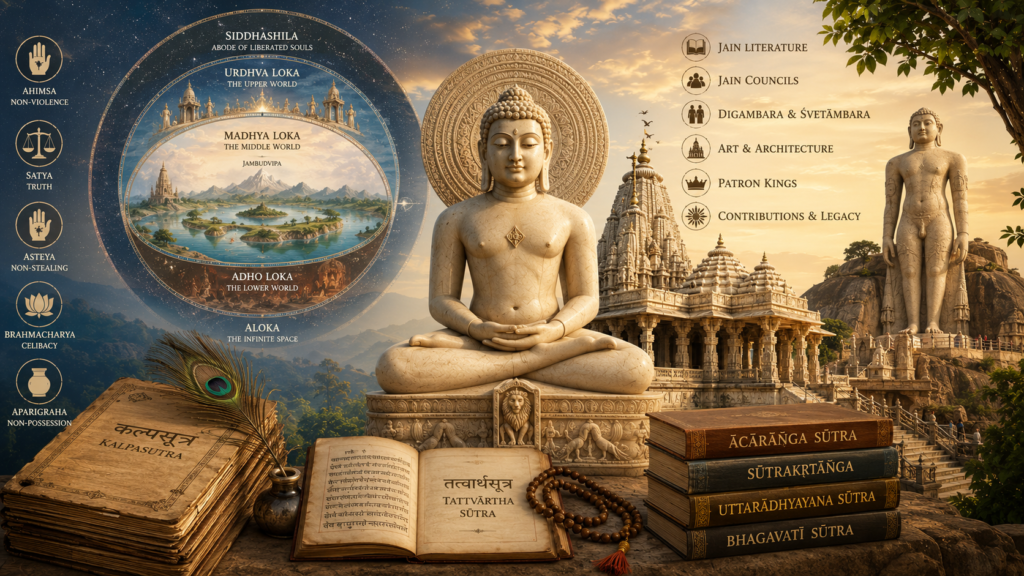
One of the most distinctive aspects of Jain philosophy is its explanation of the universe, known as Jain Cosmology. Unlike mythological creation stories, Jain cosmology describes the universe as eternal, uncreated, and self-regulated. It has no beginning and no end. No supreme deity created it, nor will it ever be destroyed. Everything functions according to natural laws and the operation of karma.
This view distinguishes Jainism from traditions that believe in a creator God. According to Jain philosophy, the universe exists independently and continues through eternal cycles of change.
The Shape of the Universe
Jain texts describe the universe (Loka) as having the shape of a standing human figure, known as the Lokapurusha or Cosmic Man.
This is a symbolic representation rather than a physical map.
The universe is divided into three regions:
- Upper World (Urdhva Loka) – the abode of heavenly beings.
- Middle World (Madhya Loka) – the realm of humans, animals and plants.
- Lower World (Adho Loka) – the region of hell beings.
Beyond these three regions lies Aloka, an infinite empty space where no living beings exist.
Only within the Loka do living beings undergo birth, death and rebirth.
Urdhva Loka (Upper World)
The upper region is inhabited by celestial beings known as Devas. These beings enjoy immense happiness and long lives as a result of their accumulated good karma. However, they are not eternal gods and are not creators of the universe. When the merit of their karma is exhausted, they too must be reborn.
At the very top of the universe lies Siddhashila, the abode of liberated souls (Siddhas). Souls that attain Moksha reside here forever in a state of infinite knowledge, bliss and purity.
Madhya Loka (Middle World)
The Middle World is the only realm where liberation is possible. Humans, animals, birds, insects and plants live here. According to Jain philosophy, a human birth is extremely valuable because only human beings possess the opportunity to attain Kevala Jnana and ultimately Moksha.
This belief explains why Jain ethics place such great importance on human conduct and self-discipline.
Adho Loka (Lower World)
The lower region consists of several levels inhabited by Naraka beings. Souls are reborn here due to the accumulation of severe negative karma. Like heavenly existence, life in the hells is also temporary. After exhausting the consequences of their karma, these souls are reborn elsewhere.
Thus, neither heaven nor hell is permanent in Jainism.
Time in Jain Cosmology
Jainism presents one of the most elaborate theories of cyclical time found in Indian philosophy.
Time has neither a beginning nor an end. It moves continuously through endless cycles.
These cycles are divided into two halves:
- Utsarpini (Ascending Cycle)
- Avasarpini (Descending Cycle)
Each complete cycle consists of these two halves, repeating endlessly.
Utsarpini
The word Utsarpini means ascending or progressive.
During this period:
- happiness gradually increases,
- human lifespan increases,
- morality improves,
- physical stature becomes greater,
- society becomes more prosperous.
Civilisation moves towards perfection.
Avasarpini
Avasarpini means descending or declining.
During this period:
- morality declines,
- lifespan decreases,
- human height becomes smaller,
- violence increases,
- spiritual awareness declines,
- suffering becomes more common.
According to Jain tradition, we are presently living in the fifth phase of the Avasarpini cycle, an age marked by moral decline and increasing attachment to material life.
The Six Eras
Each half-cycle is divided into six successive eras (Ara). These eras differ in terms of happiness, morality, lifespan and physical characteristics of human beings. The first eras are periods of immense prosperity and virtue, while the later eras witness gradual degeneration.
The appearance of the twenty-four Tirthankaras is associated with specific stages within these cosmic cycles.
Jain Literature
Jainism possesses one of the richest literary traditions in India. Jain monks and scholars composed works on religion, philosophy, logic, grammar, mathematics, astronomy, medicine, ethics, poetry and history. Their writings played a major role in preserving classical Indian learning and promoting regional languages.
The earliest Jain scriptures were transmitted orally for several centuries before being compiled in written form.
Agamas
The most important canonical scriptures of the Śvetāmbara tradition are collectively known as the Agamas.
The word Agama means that which has come down through tradition.
According to Jain belief, these scriptures preserve the teachings of Mahavira as remembered by his disciples.
Traditionally, the Agamas were divided into several groups, the most important being the Angas.
The Twelve Angas
The Angas formed the principal canonical literature of the Śvetāmbara tradition. They dealt with:
- philosophy,
- ethics,
- monastic discipline,
- cosmology,
- stories,
- religious practices.
According to tradition, the twelfth Anga (Drishtivada) was gradually lost.
As a result, the surviving Jain canon is considered incomplete.
Important Jain Texts
Among the most important works of Jain literature are:
Ācārāṅga Sūtra
This text describes the conduct expected of Jain monks and explains the practice of non-violence in great detail.
Sūtrakṛtāṅga
Deals with philosophical debates and critiques of rival schools of thought.
Uttarādhyayana Sūtra
Contains sermons attributed to Mahavira and discusses ethical conduct, renunciation and spiritual discipline.
Bhagavatī Sūtra
One of the most detailed Jain texts, dealing with philosophy, cosmology and dialogues associated with Mahavira.
Kalpasūtra
Perhaps the most famous Jain text.
Compiled traditionally by Bhadrabahu, it contains:
- the biographies of Tirthankaras,
- especially Mahavira,
- monastic rules,
- historical traditions.
Even today, it is publicly recited during the Jain festival of Paryushana.
Tattvārtha Sūtra
The Tattvārtha Sūtra, composed by Acharya Umasvati (Umasvami) around the early centuries CE, occupies a unique place in Jain literature because it is accepted by both Digambara and Śvetāmbara traditions.
It systematically presents the entire philosophy of Jainism, including:
- soul,
- karma,
- cosmology,
- ethics,
- liberation.
Its opening statement,
“Samyak Darśana Jñāna Cāritrāṇi Mokṣamārgaḥ”
(“Right Faith, Right Knowledge and Right Conduct constitute the path to liberation”)
summarises the essence of Jain philosophy.
Languages of Jain Literature
Jain scholars made remarkable contributions to several Indian languages.
Early scriptures were composed primarily in:
- Ardhamagadhi Prakrit
- Shauraseni Prakrit
Later works appeared in:
- Sanskrit,
- Apabhramsha,
- Kannada,
- Tamil,
- Gujarati,
- Rajasthani.
Jain monks played a crucial role in the development of medieval Kannada and Gujarati literature.
Jain Councils
Like Buddhism, Jainism also held religious councils to preserve and organize its sacred teachings. These councils were convened primarily because the original teachings of Mahavira were transmitted orally. Famines, migrations of monks, and the passage of time threatened the preservation of these teachings, making systematic compilation necessary.
Unlike Buddhist councils, however, Jain councils eventually contributed to the emergence of two major sects of Jainism.
First Jain Council
The first major Jain council was held at Pataliputra around the third century BCE, traditionally during the reign of Chandragupta Maurya.
According to Jain tradition, a severe famine struck Magadha for nearly twelve years. During this crisis, Acharya Bhadrabahu, accompanied by a group of monks, migrated to southern India, particularly Karnataka. Another group of monks remained in Magadha under the leadership of Sthulabhadra.
As many monks who possessed knowledge of the sacred texts either migrated or died during the famine, there was concern that Mahavira’s teachings might gradually disappear.
The council at Pataliputra attempted to collect and preserve these teachings.
Although the scriptures were not yet written down, efforts were made to organise the oral tradition.
This migration later became one of the important reasons behind the division of Jainism into the Digambara and Śvetāmbara sects.
Second Jain Council
The second major Jain council was held at Vallabhi in present-day Gujarat around the fifth century CE.
It was presided over by Acharya Devardhigani Kshamashramana.
By this time, considerable differences had emerged regarding the preservation of scriptures.
The council undertook the task of compiling and writing down the Jain canonical texts.
The Śvetāmbara Agamas were formally codified during this council.
The Digambara monks, however, did not accept these texts as authentic. They argued that the original teachings had already been lost long before and that no surviving text could claim to be the complete words of Mahavira.
This disagreement remains one of the principal doctrinal differences between the two sects.
The Emergence of the Digambara and Śvetāmbara Traditions
One of the most important developments in Jain history was the emergence of two major sects:
- Digambara
- Śvetāmbara
The division was gradual rather than sudden and developed over several centuries.
The migration during the famine, geographical separation, differences in monastic discipline and disagreements regarding scriptures all contributed to this division.
Although both sects accept Mahavira as the twenty-fourth Tirthankara and agree upon the essential principles of Jain philosophy, they differ on several questions relating to monastic practice, scripture and iconography.
Meaning of Digambara
The word Digambara consists of two Sanskrit words:
- Dik – direction
- Ambara – clothing
Thus,
Digambara means “one who is clothed by the directions (sky-clad).”
According to Digambara tradition, complete renunciation requires complete freedom from all possessions, including clothing.
Consequently, Digambara monks traditionally remain unclothed as a symbol of absolute detachment.
Meaning of Śvetāmbara
The word Śvetāmbara means:
- Śveta – white
- Ambara – clothing
Thus,
Śvetāmbara means “those who wear white garments.”
Śvetāmbara monks wear simple white robes while maintaining the ideals of renunciation.
Major Differences Between Digambara and Śvetāmbara
| Digambara | Śvetāmbara |
|---|---|
| Monks traditionally remain unclothed | Monks wear white robes |
| Original Agamas considered lost | Agamas accepted as authentic scriptures |
| Women cannot attain liberation without male rebirth (traditional view) | Women are capable of attaining liberation |
| Mahavira remained unmarried according to tradition | Mahavira was married before renunciation |
| Images are generally nude and without ornamentation | Images may be clothed and ornamented |
Despite these differences, both sects accept:
- Ahimsa,
- Karma,
- Moksha,
- Tirthankaras,
- Ratnatraya,
- Mahavratas.
Jain Monastic Order
Mahavira organised his followers into a disciplined religious community known as the Sangha.
The Jain Sangha consisted of four groups:
- Monks (Sadhus)
- Nuns (Sadhvis)
- Laymen (Shravakas)
- Laywomen (Shravikas)
This fourfold organisation enabled Jainism to spread across different regions of India while maintaining strong links between ascetics and householders.
Monks devoted themselves entirely to spiritual practice, while lay followers supported the monastic community through food, shelter and donations.
Jain Art and Architecture
Although Jainism emphasises renunciation, it has produced some of the finest artistic achievements in Indian history.
Most Jain monuments were constructed through the patronage of wealthy merchant communities rather than imperial rulers.
The guiding principles of Jain architecture include:
- simplicity,
- symmetry,
- intricate stone carving,
- spiritual symbolism,
- geometric precision.
Jain temples are remarkable for their highly polished marble, elaborate ceilings and detailed sculptures.
Features of Jain Temple Architecture
Most Jain temples include:
- Garbhagriha (sanctum) containing the image of a Tirthankara.
- Mandapa (pillared hall) for devotees.
- Shikhara or superstructure depending on regional style.
- Richly carved pillars and ceilings.
- Marble sculptures with calm meditative expressions.
Unlike Hindu temples, Jain temples generally avoid scenes of warfare or divine intervention and instead focus on meditation, renunciation and spiritual perfection.
Important Jain Monuments
Dilwara Temples
Located near Mount Abu (Rajasthan), the Dilwara Temples are among the finest examples of marble architecture in the world.
Constructed between the eleventh and thirteenth centuries CE, they are famous for:
- exquisitely carved marble ceilings,
- ornamental pillars,
- geometric precision,
- delicate sculptures.
The principal temples include:
- Vimal Vasahi
- Luna Vasahi
Ranakpur Temple
Situated in Rajasthan, the Ranakpur Jain Temple is dedicated to Adinatha (Rishabhanatha).
It is renowned for:
- 1,444 intricately carved marble pillars,
- no two pillars being exactly alike,
- remarkable architectural symmetry.
It represents one of the greatest achievements of medieval Indian temple architecture.
Shravanabelagola
Located in Karnataka, Shravanabelagola is one of the holiest Jain pilgrimage centres.
Its most famous monument is the colossal statue of Bahubali (Gommateshwara).
The monolithic statue, carved from a single block of granite, rises over 17 metres in height and is one of the tallest free-standing stone statues in the world.
Every twelve years, it becomes the centre of the Mahamastakabhisheka ceremony, during which the statue is ceremonially bathed with milk, saffron, sandalwood and other sacred substances.
Udayagiri–Khandagiri Caves
Near Bhubaneswar in Odisha lie the twin hills of Udayagiri and Khandagiri, containing rock-cut caves associated with Jain monks.
These caves were developed during the reign of King Kharavela of the Mahameghavahana dynasty.
The caves served as meditation chambers and monastic residences and preserve valuable inscriptions relating to Jain history.
Ellora Jain Caves
The northernmost group of caves at Ellora (Maharashtra) belongs to the Jain tradition.
These caves date mainly to the ninth century CE and display magnificent carvings, pillars and sculptures reflecting the artistic excellence of medieval Jain patrons.
Jain Sculpture
The most common subjects of Jain sculpture are the Tirthankaras.
Their images possess several distinctive features:
- seated in Padmasana or standing in Kayotsarga posture,
- calm facial expression,
- absence of violent symbolism,
- meditative appearance,
- emphasis on spiritual detachment.
Each Tirthankara is identified by a specific Lanchhana (symbol), such as:
- Bull – Rishabhanatha
- Snake – Parshvanatha
- Lion – Mahavira
Patronage of Jainism
Although Jainism never enjoyed continuous imperial patronage on the scale of Buddhism during the Mauryan period or Hinduism under the Guptas, it received the support of numerous kings, local rulers, merchant guilds and wealthy trading communities. This patronage enabled Jainism to flourish in different regions of India and contributed significantly to the development of literature, architecture and education.
Royal patronage was particularly important because Jain monks themselves practised strict renunciation and depended largely on donations from lay followers. The alliance between the monastic community and prosperous merchant groups became one of the strongest foundations of Jainism.
Bimbisara
King Bimbisara of Magadha was a contemporary of both Mahavira and the Buddha. Although Buddhist literature associates him primarily with Buddhism, Jain traditions also suggest that he maintained cordial relations with Jain monks and respected Mahavira’s teachings.
His reign reflects the religious pluralism of sixth century BCE India, where rulers often extended patronage to multiple religious traditions simultaneously.
Ajatashatru
Ajatashatru, the son of Bimbisara, continued this policy of religious tolerance. Both Buddhist and Jain traditions claim his patronage. His reign witnessed the expansion of Magadha into the most powerful kingdom of northern India, providing favourable conditions for the spread of new religious ideas.
Chandragupta Maurya
One of the most important royal patrons of Jainism was Chandragupta Maurya.
According to Jain tradition, towards the end of his life Chandragupta abdicated the throne in favour of his son Bindusara and became a disciple of Acharya Bhadrabahu.
During the severe famine in Magadha, he accompanied Bhadrabahu to southern India and finally settled at Shravanabelagola in present-day Karnataka.
Jain tradition further states that Chandragupta observed Sallekhana, the voluntary fasting unto death undertaken under strict spiritual discipline.
Although historians debate certain details of this account, the association of Chandragupta Maurya with Jainism remains one of the most significant traditions in Jain history.
Kharavela
Among all royal patrons of Jainism after Mahavira, Kharavela occupies a special place.
He ruled the kingdom of Kalinga during the first century BCE.
The primary source of information about him is the famous Hathigumpha Inscription at Udayagiri near Bhubaneswar.
The inscription records:
- military campaigns,
- public works,
- patronage of religion,
- restoration of Jain institutions.
Kharavela supported Jain monks and sponsored the excavation of the Udayagiri and Khandagiri caves.
For UPSC, Hathigumpha Inscription + Kharavela + Udayagiri–Khandagiri is a very high-yield combination.
Western Ganga Dynasty
The Western Gangas of Karnataka were among the greatest patrons of Digambara Jainism.
Their most enduring contribution is the colossal statue of Bahubali (Gommateshwara) at Shravanabelagola, commissioned by the general and minister Chamundaraya around the tenth century CE.
This monument remains one of the greatest achievements of Indian sculpture.
Rashtrakutas
The Rashtrakutas extended generous patronage to Jain scholars and architects.
Many Jain caves at Ellora and several literary works in Kannada flourished under their rule.
Their support helped transform Karnataka into one of the principal centres of Digambara Jainism.
Hoysalas
The Hoysalas also patronised Jainism, although they supported Hinduism as well.
Several beautifully carved Jain temples in Karnataka belong to this period.
Spread of Jainism
The spread of Jainism followed trade routes, urban centres and regions dominated by merchant communities.
Unlike Buddhism, Jainism did not spread extensively outside the Indian subcontinent. However, within India it developed strong regional centres that continue to flourish today.
Eastern India
Jainism originated in the eastern Gangetic plains.
Its earliest centres included:
- Vaishali
- Rajagriha (Rajgir)
- Pataliputra
- Champa
These regions formed the original area of Mahavira’s preaching.
Western India
From the early centuries CE onward, western India became one of the strongest centres of Jainism.
Important regions included:
- Gujarat
- Rajasthan
Merchant communities played a major role in financing temples, monasteries and educational institutions.
Many of the greatest Jain temples, including Dilwara and Ranakpur, were constructed in western India.
Southern India
Southern India became another major centre of Jainism after the migration associated with Bhadrabahu.
Karnataka emerged as the heartland of Digambara Jainism.
Important centres include:
- Shravanabelagola
- Karkala
- Moodbidri
Several dynasties, including the Western Gangas, Rashtrakutas and Hoysalas, supported Jain institutions.
Northern India
Jainism also flourished in parts of:
- Uttar Pradesh
- Madhya Pradesh
- Delhi
Several important medieval temples and pilgrimage centres developed in these regions.
Contribution of Jainism
The influence of Jainism extends far beyond religion. It has shaped Indian civilization in multiple fields.
Religious Contribution
Jainism established one of the most rigorous ethical systems in world history.
Its emphasis on:
- Ahimsa,
- truth,
- non-stealing,
- celibacy,
- non-possession,
provided an alternative to ritual-centred religion.
The Jain emphasis on individual responsibility profoundly influenced later religious traditions.
Philosophy
Jain philosophy enriched Indian intellectual life through several original doctrines.
Anekantavada
The doctrine of the multiplicity of viewpoints.
According to this principle, reality is extremely complex and cannot be understood from only one perspective.
Different viewpoints reveal different aspects of truth.
This doctrine encouraged intellectual tolerance and philosophical dialogue.
Syadvada
Syadvada teaches that every statement is conditional.
Truth depends upon perspective and context.
Rather than insisting upon absolute certainty, Jain philosophers advocated careful and qualified reasoning.
Nayavada
Nayavada explains that every judgement represents only a partial standpoint.
Complete truth requires the consideration of multiple viewpoints.
Together, these three doctrines constitute one of the most sophisticated systems of epistemology in Indian philosophy.
Ethical Contribution
The Jain doctrine of Ahimsa became one of India’s greatest moral ideals.
Centuries later, Mahatma Gandhi openly acknowledged the influence of Jain thought, particularly through the teachings of Shrimad Rajchandra, on his own philosophy of non-violence.
Although Gandhi’s philosophy also drew from Hinduism, Buddhism and Christianity, Jainism played a significant role in shaping his understanding of Ahimsa.
Literature
Jain monks produced extensive works in:
- Prakrit,
- Sanskrit,
- Kannada,
- Tamil,
- Gujarati,
- Apabhramsha.
Many regional literary traditions owe much to Jain scholars.
Art and Architecture
Jain architecture represents one of the highest achievements of Indian stone craftsmanship.
The temples at:
- Dilwara,
- Ranakpur,
- Shravanabelagola,
demonstrate extraordinary mastery in sculpture and architecture.
Education
Jain monasteries became important centres of learning.
Monks studied:
- philosophy,
- grammar,
- logic,
- mathematics,
- astronomy,
- medicine.
This helped preserve classical knowledge during the medieval period.
Trade and Economy
Many Jain communities were engaged in trade, banking and commerce.
Their economic prosperity enabled them to finance:
- temples,
- libraries,
- educational institutions,
- charitable works.
Decline of Jainism
Although Jainism survived, it gradually declined in comparison with Hinduism and Buddhism.
Several factors contributed to this decline.
Limited Missionary Activity
Unlike Buddhism, Jainism did not undertake large-scale missionary expansion beyond India.
Its influence therefore remained geographically limited.
Strict Asceticism
The severe discipline expected of monks made Jainism difficult for many ordinary people to adopt completely.
Revival of Hinduism
From the Gupta period onward, the revival of devotional Hinduism attracted large sections of society.
The Bhakti movement later strengthened this trend.
Loss of Royal Patronage
The decline of supportive dynasties weakened many Jain institutions.
Nevertheless, merchant communities ensured the survival of the religion.
Internal Division
The emergence of Digambara and Śvetāmbara traditions introduced organisational differences, although the essential philosophy remained common.
Jainism and Buddhism: A Comparison
Jainism and Buddhism arose in the same historical context and share several similarities, yet they differ significantly in philosophy.
| Jainism | Buddhism |
|---|---|
| Founded on the teachings of the Tirthankaras | Founded on the teachings of Gautama Buddha |
| Believes in an eternal soul (Jiva) | Rejects the concept of an eternal soul (Anatta) |
| Karma is conceived as subtle material particles binding the soul | Karma is primarily understood as intentional action and its consequences |
| Extreme emphasis on Ahimsa | Ahimsa is important but interpreted more moderately |
| Liberation through severe austerity and self-discipline | Liberation through the Middle Path |
| Twenty-four Tirthankaras in the present time cycle | One historical Buddha, with belief in past and future Buddhas |
Legacy of Jainism
The contribution of Jainism cannot be measured merely by the number of its followers.
Its lasting legacy lies in its ethical ideals, philosophical depth and cultural achievements.
Jainism demonstrated that:
- compassion is stronger than violence,
- self-discipline is greater than power,
- truth is discovered through humility,
- liberation depends upon individual effort rather than divine intervention.
Its influence continues to be visible in Indian philosophy, vegetarian traditions, environmental ethics, animal welfare movements and the constitutional values of compassion and non-violence.
Conclusion
From the teachings of the Tirthankaras to its sophisticated philosophy of karma, from the magnificent marble temples of Mount Abu to the colossal Bahubali of Shravanabelagola, Jainism represents one of the richest intellectual and cultural traditions of India.
Its doctrines of Ahimsa, Aparigraha, Anekantavada and self-discipline continue to inspire humanity even today. More than a religion, Jainism is a comprehensive philosophy of life that seeks the purification of the soul through ethical conduct, knowledge and disciplined effort.
For students of Indian history, Jainism provides invaluable insights into the religious transformations of ancient India, the evolution of Indian philosophy, the development of temple architecture, and the enduring importance of non-violence in Indian civilization.