
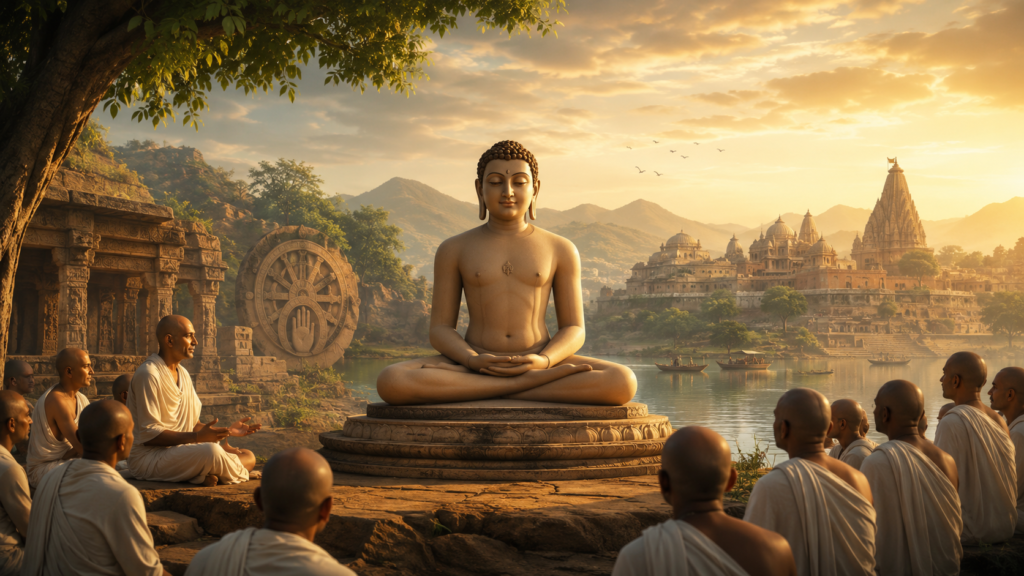
JAINISM: ORIGIN, HISTORICAL BACKGROUND AND LIFE OF MAHAVIRA
Introduction
Jainism is one of the oldest surviving religious and philosophical traditions of India. It represents an important stream of the Śramaṇa movement, which emerged in the middle of the first millennium BCE as an alternative to the ritualistic traditions associated with the Vedic religion. The central concern of Jainism is not the worship of a creator God but the liberation of the individual soul (Jīva) from the cycle of birth and death through self-discipline, ethical conduct, knowledge and austerity.
The religion places Ahimsa (non-violence) at the centre of its philosophy. Unlike many other religious traditions, Jainism extends the principle of non-violence to every form of life, including animals, plants and microscopic organisms. It teaches that every living being possesses a soul and therefore deserves equal respect and compassion.
Jainism is also one of the most influential philosophical traditions of India. Its ideas of Anekāntavāda (multiplicity of viewpoints), Syādvāda (the doctrine of conditional predication), Aparigraha (non-possession) and ethical self-restraint have influenced Indian philosophy, politics, literature, architecture and social thought for more than two thousand years.
For UPSC aspirants, Jainism is not merely a religious topic. Questions are frequently asked from its philosophy, history, literature, architecture, symbols, councils and terminology. A proper understanding of Jainism also helps in comparing it with Buddhism and the Vedic tradition.
Historical Background
The rise of Jainism cannot be understood without examining the political, economic, social and religious conditions of sixth century BCE India.
Historians often describe this period as one of the greatest intellectual revolutions in Indian history. It witnessed the emergence of several new religious and philosophical traditions, including Jainism, Buddhism and the Ajivika movement.
The sixth century BCE was a period of profound transformation. Society was changing rapidly, old institutions were being questioned and new economic forces were reshaping political life.
Political Conditions
During the Later Vedic period, tribal political organisations gradually evolved into territorial states.
By the sixth century BCE, northern India contained sixteen major states, collectively known as the Mahajanapadas.
Among these, Magadha emerged as the most powerful kingdom due to its strategic location, fertile land, iron resources and efficient administration.
The growth of large kingdoms created more complex political structures, taxation systems and administrative institutions.
These changes encouraged the search for new ethical and political ideas that could provide moral guidance in an increasingly organised society.
Economic Conditions
One of the most significant developments of this period was the Second Urbanisation.
The first urban civilisation of India had developed during the Indus Valley Civilization. After its decline, large urban centres became less prominent for several centuries.
Around the sixth century BCE, towns and cities once again began to flourish, particularly in the Middle Gangetic Plains.
Several factors contributed to this development:
- Widespread use of iron technology increased agricultural productivity.
- Agricultural surplus supported artisans, merchants and administrators.
- Trade expanded rapidly.
- Guilds (Shrenis) emerged as powerful economic institutions.
- Punch-marked coins facilitated commercial transactions.
- Market towns developed along trade routes.
This expanding commercial economy produced new social groups, especially merchants (Vaishyas), who often preferred religious traditions that emphasised ethical conduct rather than costly sacrificial rituals.
Social Conditions
The social structure of Later Vedic society had become increasingly rigid.
The varna system became more hierarchical.
Religious authority was concentrated largely in the hands of Brahmins.
Many rituals required expensive sacrifices that ordinary people could not afford.
Animal sacrifice formed an important component of several Vedic rituals.
At the same time, urban society encouraged greater social mobility and interaction among different occupational groups.
Merchants, craftsmen and urban communities sought religious teachings that were practical, ethical and open to wider participation.
Jainism addressed many of these concerns through its emphasis on:
- non-violence,
- personal responsibility,
- equality of souls,
- moral discipline,
- rejection of animal sacrifice.
Religious Conditions
The religious atmosphere of sixth century BCE India was highly dynamic.
The dominant Vedic tradition focused primarily on:
- sacrifices (Yajnas),
- ritual purity,
- priestly authority,
- worship of Vedic deities.
Alongside this tradition, several independent thinkers began questioning these practices.
Many philosophers argued that:
- rituals alone could not bring liberation,
- knowledge and self-discipline were more important,
- ethical conduct should replace ritual sacrifice.
These reformist traditions collectively came to be known as the Śramaṇa traditions.
Among them, Jainism became one of the most organised and influential schools.
The Śramaṇa Tradition
Understanding the Śramaṇa movement is essential for understanding Jainism.
The Sanskrit word Śramaṇa is derived from the root śram, meaning to exert, to strive, or to undertake spiritual effort.
A Śramaṇa was a person who renounced worldly life and devoted himself to meditation, austerity, ethical discipline and the search for liberation.
Unlike the Vedic household ideal, the Śramaṇa path emphasised:
- renunciation,
- celibacy,
- meditation,
- asceticism,
- self-control,
- freedom from attachment.
The major Śramaṇa traditions included:
- Jainism
- Buddhism
- Ajivikas
Although these traditions differed philosophically, they shared several common features.
They questioned:
- the authority of the Vedas,
- ritual sacrifices,
- hereditary priestly monopoly,
- animal sacrifice as a means of religious merit.
Origin of the Word “Jain”
The word Jain is derived from the Sanskrit word Jina.
The term Jina literally means:
“The Conqueror.”
However, the conquest referred to here is entirely spiritual.
A Jina is not a military conqueror or political ruler.
Instead, a Jina is one who has conquered:
- anger,
- pride,
- greed,
- attachment,
- ego,
- passions,
- karmic bondage.
The followers of a Jina are known as Jains.
Who is a Tirthankara?
One of the most important concepts in Jainism is that of the Tirthankara.
The word is composed of two Sanskrit terms:
- Tirtha – a ford or crossing place across a river.
- Kara – maker or creator.
Thus,
Tirthankara means “the maker of a crossing.”
The expression is symbolic.
According to Jain philosophy, worldly existence (Samsara) is like a vast ocean of repeated birth and death.
A Tirthankara establishes the path by which souls can cross this ocean and attain liberation.
A very important distinction must be remembered.
A Tirthankara does not liberate others through divine grace.
Instead, a Tirthankara:
- discovers the path,
- teaches the path,
- establishes the religious community (Tirtha),
- inspires others to follow the path.
Liberation depends entirely upon the individual’s own effort.
Difference Between Jina and Tirthankara
Although these terms are closely related, they are not identical.
A Jina is any individual who has conquered inner passions and attained spiritual perfection.
A Tirthankara is a Jina who also re-establishes the path of liberation for the world.
Therefore,
Every Tirthankara is a Jina, but the emphasis of a Tirthankara lies in his role as a universal teacher.
Arihant (Arhat)
Another important term in Jain philosophy is Arihant.
The word literally means:
“Destroyer of enemies.”
The enemies referred to are not external enemies.
They are internal enemies such as:
- anger,
- pride,
- deceit,
- greed,
- attachment.
An Arihant has attained Kevala Jnana (Perfect Knowledge) but continues to live in the world, teaching others.
Every Tirthankara is an Arihant, but not every Arihant is regarded as a Tirthankara.
Kevala Jnana
The Sanskrit word Kevala means absolute or complete.
Jnana means knowledge.
Therefore,
Kevala Jnana = Perfect Knowledge or Omniscience.
According to Jain philosophy, when all obscuring karmas are destroyed, the soul acquires complete and direct knowledge of reality.
A person who has attained this state is known as a Kevalin.
Kevala Jnana is one of the most important milestones on the path to liberation.
Moksha
The ultimate objective of Jainism is Moksha.
Moksha means complete freedom from:
- birth,
- death,
- suffering,
- karmic bondage,
- rebirth.
A liberated soul rises to the highest region of the universe, known in Jain cosmology as Siddhashila, where it exists forever in a state of infinite knowledge, bliss and purity.
Unlike many religious traditions, Jainism teaches that liberation is achieved entirely through self-effort, not through divine intervention.
Did Mahavira Found Jainism?
This is one of the most frequently misunderstood aspects of Jain history.
From the historical perspective, Mahavira was the twenty-fourth Tirthankara.
According to Jain tradition, twenty-three Tirthankaras had already appeared before him.
Therefore, Jainism was not founded by Mahavira.
Rather, Mahavira reorganised, revitalised and systematised an already existing religious tradition.
This distinction is important for UPSC.
Instead of writing:
“Mahavira founded Jainism.”
A better and historically accurate statement is:
Mahavira was the twenty-fourth Tirthankara who reorganised and strengthened the Jain tradition.
The Twenty-Four Tirthankaras
Jain tradition recognises twenty-four Tirthankaras in the present time cycle.
Among them, three are particularly important from the examination point of view:
- Rishabhanatha (Adinatha) – First Tirthankara
- Parshvanatha – Twenty-third Tirthankara
- Mahavira – Twenty-fourth Tirthankara
Rishabhanatha occupies a special place in Jain tradition as the first spiritual teacher of the present age.
Parshvanatha is regarded as a historical figure who lived before Mahavira and preached four major vows.
Mahavira expanded these teachings and organised the Jain community into a more structured religious order.
Sources for the Study of Jainism
Our knowledge of Jainism comes from a variety of literary and archaeological sources.
The most important literary sources include:
- Jain Agamas
- Kalpasutra
- Tattvartha Sutra
- Uttaradhyayana Sutra
- Bhagavati Sutra
Archaeological evidence includes:
- inscriptions,
- sculptures,
- cave complexes,
- temple architecture,
- coins,
- copper plate grants.
Chinese travellers and inscriptions of various dynasties also help reconstruct the historical development of Jainism.
Timeline
| Period | Event |
|---|---|
| c. 8th–7th century BCE (traditional) | Life of Parshvanatha |
| 6th century BCE | Rise of the Śramaṇa movements |
| 599 BCE (Jain tradition) | Birth of Mahavira |
| Around age 30 | Renunciation |
| After prolonged austerities | Attainment of Kevala Jnana |
| 527 BCE (Jain tradition) | Nirvana of Mahavira |
Conclusion
Jainism emerged during a period of profound political, economic and religious transformation in ancient India. It offered an ethical alternative to ritual-centred religion by placing responsibility for liberation upon the individual. Through the teachings of the Tirthankaras, especially Mahavira, Jainism developed into one of India’s most influential philosophical traditions, centred on non-violence, self-discipline and the purification of the soul.
The concepts introduced in this chapter—Śramaṇa, Jina, Tirthankara, Arihant, Kevala Jnana and Moksha—form the intellectual foundation of Jainism. A proper understanding of these ideas is essential before studying Jain philosophy, the doctrine of karma, the Seven Tattvas, the Six Dravyas, the Four Gatis and the broader Jain worldview.