India–Venezuela Relations: Strengthening Energy Security Through Strategic Partnership
Why is it in News?
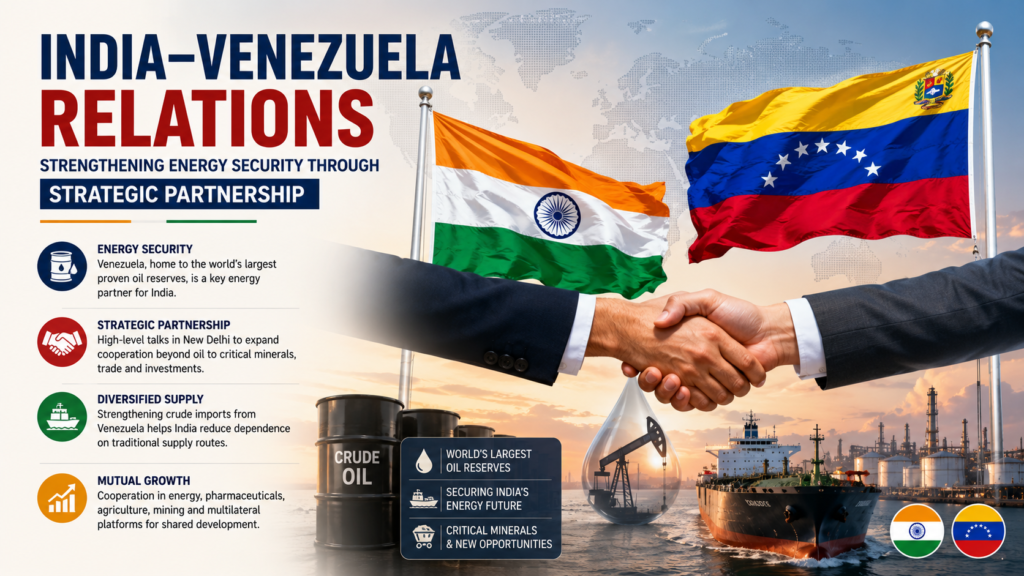
India and Venezuela recently held high-level bilateral talks in New Delhi aimed at transforming their relationship from a purely commercial oil trade partnership into a broader strategic cooperation framework.
The discussions, led by Prime Minister Narendra Modi and Venezuela’s Acting President Delcy Rodríguez, focused on energy security, oil imports, critical minerals, investments, and long-term economic cooperation. The engagement comes at a time when India is actively diversifying its energy sources amid geopolitical tensions and disruptions in traditional supply routes.
For UPSC aspirants, this topic is important under International Relations, Energy Security, India’s Foreign Policy, South-South Cooperation, and Global Energy Markets.
India–Venezuela Relations: An Overview
India and Venezuela established diplomatic relations in:
1959
Over the decades, the relationship has evolved from limited engagement to a significant partnership centered on:
- Energy cooperation
- Trade
- Investments
- Multilateral diplomacy
Both countries are important members of the developing world and support greater cooperation among Global South nations.
About Venezuela
Venezuela is a South American country located on the northern coast of the continent.
Capital
Caracas
Neighboring Countries
- Colombia
- Brazil
- Guyana
Coastline
Caribbean Sea and Atlantic Ocean
Currency
Bolívar
Why is Venezuela Important?
Venezuela possesses:
The World’s Largest Proven Crude Oil Reserves
Estimated at approximately:
303 Billion Barrels
These reserves are larger than those of:
- Saudi Arabia
- Iran
- Iraq
This makes Venezuela a crucial player in global energy markets.
Core Pillars of India–Venezuela Relations
1. Energy Security
Energy cooperation forms the backbone of bilateral relations.
India is one of the world’s largest energy consumers and imports over 80% of its crude oil requirements.
Venezuela helps India:
- Diversify oil imports.
- Reduce dependence on West Asian suppliers.
- Enhance long-term energy security.
2. Strategic Oil Supply
Historically, Venezuela has supplied heavy crude oil to Indian refineries.
These supplies act as a safeguard against disruptions in other regions.
This became particularly important after geopolitical tensions affected traditional energy routes.
3. Economic Cooperation
Trade relations extend beyond oil.
Major Indian Exports to Venezuela
- Pharmaceuticals
- Medical equipment
- Agrochemicals
- Textiles
- Engineering goods
- Machinery
Venezuelan Exports to India
- Crude oil
- Minerals
- Metals
- Wood products
4. South-South Cooperation
Both countries advocate stronger cooperation among developing nations.
They support:
- Multilateralism
- Equitable global governance
- Development partnerships
Cooperation in International Forums
India and Venezuela often coordinate positions in various international organizations.
Major Platforms
- United Nations
- Non-Aligned Movement
- International Solar Alliance
Both countries emphasize:
- Multipolarity
- Sustainable development
- Global South representation
Why is Venezuela Becoming Important for India Again?
The renewed focus on Venezuela is linked to recent geopolitical developments.
Strait of Hormuz Disruptions
Strait of Hormuz
is one of the world’s most important oil transit routes.
Historically, a significant portion of India’s crude oil imports passed through this corridor.
Regional conflicts and maritime tensions have highlighted the risks of excessive dependence on a single route.
India’s Energy Diversification Strategy
To reduce vulnerability, India is diversifying its energy sources.
This includes increasing imports from:
- Venezuela
- Russia
- United States
- Latin America
- Africa
Venezuela has emerged as a key beneficiary of this strategy.
Rise of Venezuelan Oil Imports
Recent data indicates a sharp increase in India’s imports from Venezuela.
April 2026
Approximately:
283,000 Barrels Per Day (BPD)
May 2026
Imports surged to:
427,000 BPD
making India one of the largest importers of Venezuelan crude.
June 2026
Projected imports remain high at:
Around 380,000 BPD
indicating sustained demand.
Role of Indian Companies
Several Indian companies are actively involved in Venezuela’s energy sector.
ONGC Videsh Limited (OVL)
ONGC Videsh Limited
holds:
40% Stake
in the:
San Cristóbal Oil Field
This is one of India’s most significant overseas energy investments.
Dividend Recovery Efforts
India and Venezuela are working toward resolving pending payments of approximately:
USD 500 Million
owed to OVL from its investment in the San Cristóbal project.
Expansion of Energy Investments
India is exploring opportunities to expand participation in:
Carabobo Project
located in the:
Orinoco Oil Belt
one of the largest hydrocarbon regions in the world.
Role of Private Sector
Reliance Industries Limited
has emerged as one of the major global buyers of Venezuelan crude oil.
Its:
Jamnagar Refinery
is particularly suited for processing heavy crude grades.
Public Sector Refiners
Indian public-sector companies are also increasing engagement.
These include:
- Indian Oil Corporation
- Bharat Petroleum Corporation Limited
- Hindustan Petroleum Corporation Limited
These firms are pursuing long-term procurement agreements to reduce market risks.
Beyond Oil: Critical Minerals Cooperation
Recent discussions have expanded beyond hydrocarbons.
Venezuela has invited Indian investment in:
Critical Minerals
including:
- Gold
- Diamonds
- Bauxite
- Strategic minerals used in electronics
This aligns with India’s efforts to secure critical mineral supply chains for future industries.
Why Are Critical Minerals Important?
Critical minerals are essential for:
- Electric vehicles
- Renewable energy
- Semiconductors
- Batteries
- Electronics manufacturing
Access to these resources is becoming a strategic priority globally.
Significance for India
The strengthening of India–Venezuela ties offers several benefits.
Energy Security
Diversified oil sources reduce supply risks.
Strategic Autonomy
Broader energy partnerships strengthen India’s foreign policy flexibility.
Investment Opportunities
Indian companies gain access to major overseas assets.
Critical Mineral Access
Supports India’s green energy and manufacturing ambitions.
Global South Leadership
Strengthens India’s engagement with Latin America and developing nations.
Challenges in the Relationship
Despite growing cooperation, some challenges remain.
Financial Sanctions
International sanctions can complicate transactions.
Payment Mechanisms
Banking restrictions may affect settlements.
Political Instability
Domestic developments in Venezuela can influence investments.
Logistical Costs
Long-distance transportation raises shipping expenses.
Way Forward
To strengthen long-term cooperation, both countries should focus on:
Alternative Payment Systems
Developing local-currency and sanction-resistant settlement mechanisms.
Expanding Energy Cooperation
Increasing participation in upstream and downstream projects.
Diversifying Trade
Moving beyond oil to pharmaceuticals, agriculture, and minerals.
Strengthening Institutional Dialogue
Creating regular bilateral working groups.
Enhancing Private Sector Participation
Encouraging greater business-to-business cooperation.
UPSC Prelims Focus
Important Facts
| Feature | Details |
|---|---|
| Diplomatic Relations Established | 1959 |
| Capital of Venezuela | Caracas |
| Major Resource | Crude Oil |
| Proven Oil Reserves | ~303 Billion Barrels |
| Key Indian Investor | ONGC Videsh Limited |
| Important Oil Field | San Cristóbal |
| Major Oil Region | Orinoco Oil Belt |
Previous Year Question (UPSC Prelims 2014)
Which one of the following countries is a member of OPEC?
(a) Ecuador
(b) Peru
(c) Colombia
(d) Venezuela
Correct Answer: (d) Venezuela
Exam Keywords
- India–Venezuela Relations
- Energy Security
- Venezuela Oil Reserves
- ONGC Videsh
- San Cristóbal Oil Field
- Orinoco Oil Belt
- Critical Minerals
- South-South Cooperation
- Global South
- Strait of Hormuz
- Oil Diversification
- OPEC
- Energy Diplomacy
- Strategic Partnership
UPSC Syllabus Reference
GS Paper II & III – International Relations, Energy Security, India’s Foreign Policy, Global South Cooperation, Critical Minerals, and Economic Diplomacy.