
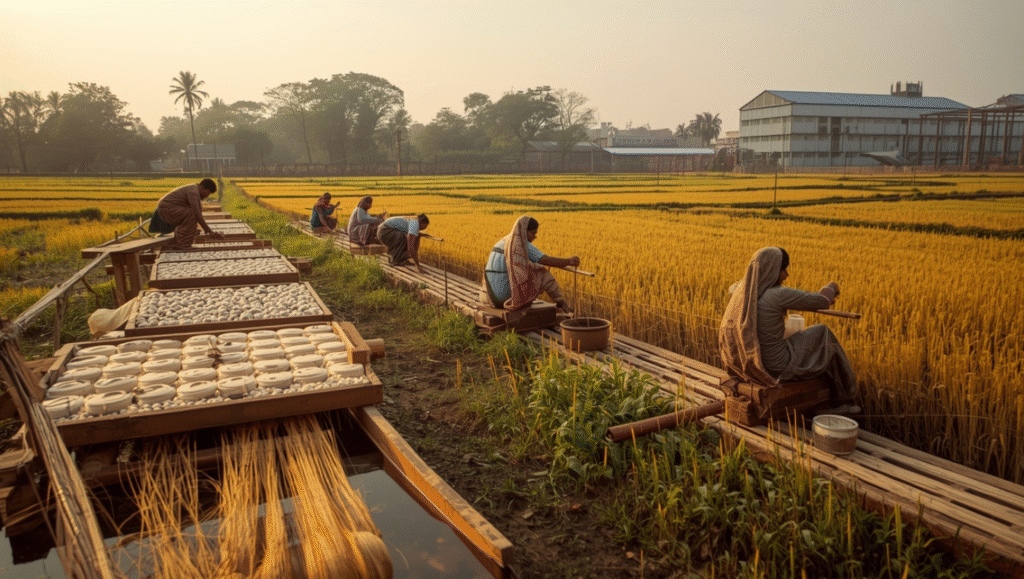
Gokak – Silk Textile Industry
Syllabus: Industries (UPSC Prelims)
The silk-linked textile presence in Gokak, Karnataka, is represented by Gokak Textiles Limited, an enterprise that began in 1887 and later evolved into a modern, vertically integrated unit. Though its early focus differed, the company now produces a wide range of yarns, including specialty varieties for domestic and export markets. Its location in Karnataka is significant because the state is the largest contributor to India’s silk sector, supported by extensive sericulture activity and strong institutional backing. Gokak’s operations sit within India’s broader silk landscape, which includes both mulberry and non-mulberry (Vanya) silks such as tasar, eri, and muga.
Sericulture in India
- Production: India is the world’s second-largest silk producer and the only country producing all five commercial silks: mulberry, tasar, oak tasar, eri, and muga.
- Leading state: Karnataka accounts for more than 70 percent of India’s raw silk output and is renowned for Mysore silk.
- Other states: Andhra Pradesh, West Bengal, Tamil Nadu, and Assam also contribute significantly.
Economic and social significance
- Employment: Nearly 9.76 million people rely on sericulture and silk-related activity, especially in rural and semi-urban areas.
- Foreign exchange: Silk remains an important export commodity.
- Government support: Schemes such as Silk Samagra under the Central Silk Board provide technical assistance, financial support, and market linkages to strengthen the sector.
Key aspects of Gokak’s textile industry
- Historical significance: Textile production in Gokak, Karnataka, dates back to 1887.
- Vertical integration: Gokak Textiles Limited manages multiple stages of production in-house.
- Product range: Yarns from 2s to 60s, including single, multi-fold, and specialty counts.
- Modernization: Operations have been continually upgraded.
- Ownership: Acquired by the Shapoorji Pallonji Group in 2002–03.
Key terms for UPSC
- Sericulture: Breeding of silkworms and production of silk.
- Mulberry silk: The dominant variety, produced by worms that feed on mulberry leaves.
- Vanya silk: Wild, non-mulberry silks such as tasar, eri, and muga.
- Central Silk Board: A statutory body under the Ministry of Textiles responsible for the development and regulation of India’s silk industry.