Revival of Coral Reefs in the Gulf of Mannar
Syllabus: Environment (UPSC GS III)
Source: The Hindu
Context:
Coral reefs in the Gulf of Mannar, Tamil Nadu, are showing revival after two decades of scientific restoration efforts.
Coral Reefs – An Overview
- Coral reefs are marine ecosystems made of calcium carbonate secreted by corals.
- Called the “rainforests of the sea” because they:
- Support nearly 25% of marine biodiversity
- Protect coastlines from erosion
- Provide livelihoods via fisheries and eco-tourism
- The Gulf of Mannar has reefs spread across 21 islands, rich in species like Acropora, Montipora, and Porites.
Why Did Coral Reefs Decline?
Human-Induced Causes
- Coral mining (1960s–1990s)
- Overfishing, destructive gear, pollution
- Coastal development and sedimentation
Climate Change Causes
- Rising sea surface temperatures → mass bleaching events (2010, 2016)
- Ocean acidification reducing coral resilience
Restoration Efforts in Gulf of Mannar
- Led by SDMRI (Suganthi Devadason Marine Research Institute) & Tamil Nadu Forest Department since 2002.
- Methods Used:
- Artificial substrates: concrete frames, clay pots, cement slabs
- Artificial reef modules: Triangular (TARs) & Perforated Trapezoidal (PTARs)
- 20 coral species transplanted, with fast-growing Acropora showing best results
- Scale:
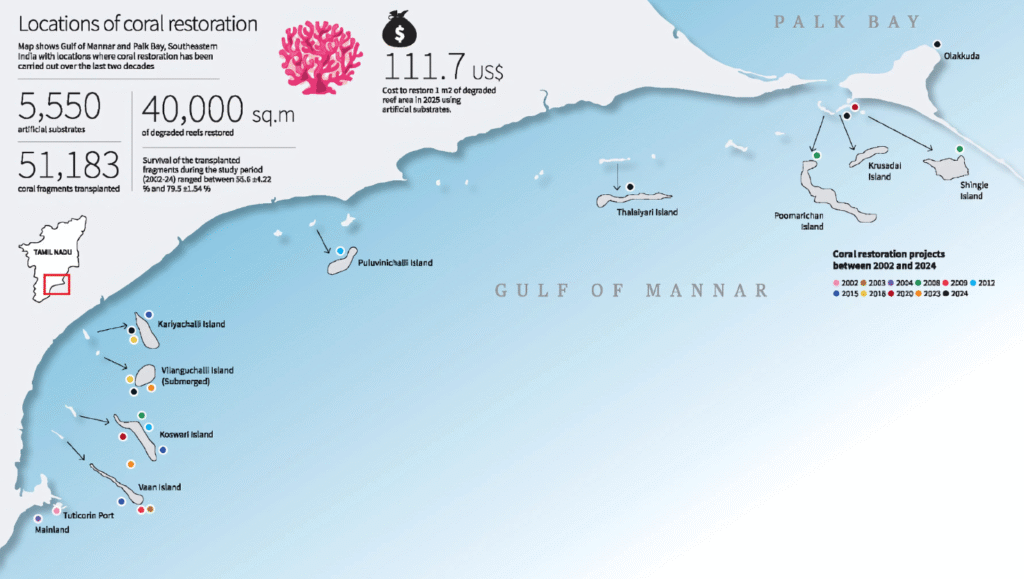
- 51,183 coral fragments transplanted on 5,550 substrates
- Restored ~40,000 sq. m of degraded reefs
Outcomes of Restoration
- Survival Rate: 55–79%, some species up to 89%
- Biodiversity: Coral recruits in TARs rose from 1.23 (2004) to 24.77 (2020)
- Fish Density: Increased from 14.5 (2006) to 310 (2020) per 250 m²
Ongoing Challenges
- Repeated bleaching due to rising sea temperatures
- High cost and labour intensity of coral transplantation
- Over-dependence on Acropora risks genetic imbalance
- Continued threats: plastic pollution, coastal projects, and mass tourism
Way Forward
- Scale up restoration across other reef sites (Andaman, Lakshadweep, Lakpat)
- Community role: Train local fishing communities as reef guardians
- Technology use: AI, drones, and remote sensing for monitoring
- Assisted evolution: Develop heat-resistant coral strains
- Global partnerships: Strengthen ties under SDG-14 & Paris Agreement for funding and technology
Conclusion
The revival of reefs in the Gulf of Mannar highlights how science, community efforts, and policy support can restore fragile ecosystems. It serves as a model for climate adaptation and biodiversity conservation, ensuring India’s reefs remain an ecological treasure and a source of livelihood.