
Cyclone Montha
Syllabus: Geography – Climatology / Disaster Management (UPSC Prelims)
Source: ITV
Context
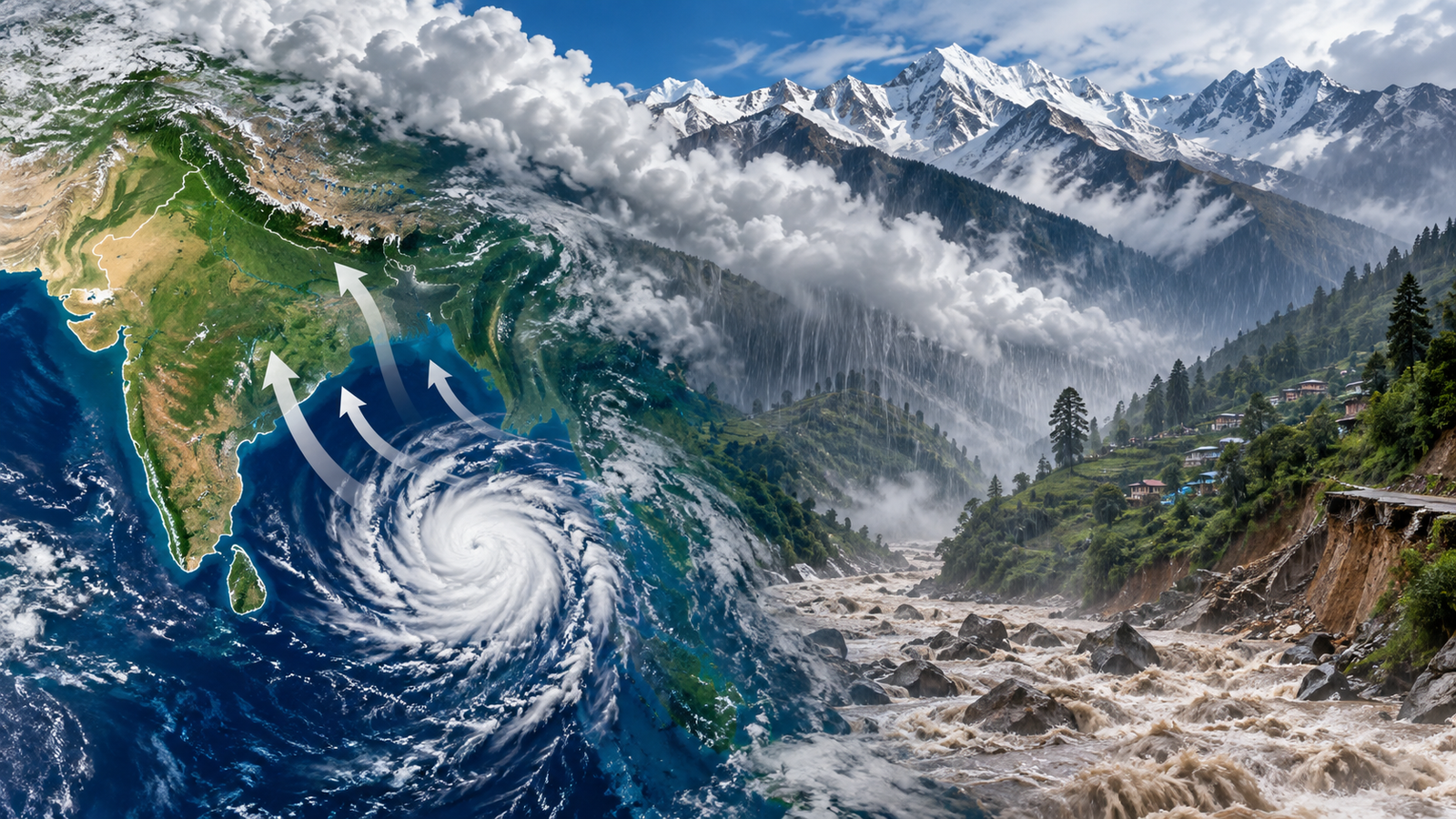
The India Meteorological Department (IMD) has issued a high alert for Andhra Pradesh and Odisha as Cyclone Montha is expected to make landfall between Machilipatnam and Kalingapatnam, near Kakinada. The cyclone is likely to bring heavy rainfall, strong winds, and possible flooding along India’s east coast.
About Cyclone Montha
What is it?
Cyclone Montha is a tropical cyclonic storm developing over the southeast Bay of Bengal. It is expected to intensify into a Severe Cyclonic Storm (SCS) as it moves towards the coast, affecting Andhra Pradesh, Odisha, and nearby regions with intense rain and winds.
Origin
The system began as a deep depression over the southeast Bay of Bengal.
It strengthened due to:
- Warm ocean temperatures above 26°C,
- Low vertical wind shear, and
- High humidity — all favourable conditions for cyclone formation.
These factors combined to create a rotating low-pressure system drawing in moist air, which fuels the storm’s intensification.
How Cyclones Form
- Low-Pressure Zone: Warm ocean waters heat the air, causing it to rise and create a low-pressure area.
- Condensation & Energy Release: Rising moist air condenses, releasing latent heat, which powers the storm.
- Coriolis Effect: Earth’s rotation makes winds spiral—anticlockwise in the Northern Hemisphere and clockwise in the Southern Hemisphere.
- Development Stages:
- Disturbance → Depression → Deep Depression → Cyclonic Storm → Severe Cyclone → Super Cyclone
(classified by increasing wind speeds).
- Disturbance → Depression → Deep Depression → Cyclonic Storm → Severe Cyclone → Super Cyclone
Naming of Cyclones
Responsible Body:
Cyclones in the North Indian Ocean are named by member countries of the WMO/ESCAP Panel on Tropical Cyclones (PTC) — a joint initiative of the World Meteorological Organization (WMO) and the UN Economic and Social Commission for Asia and the Pacific (ESCAP).
Member Countries (13):
India, Bangladesh, Myanmar, Oman, Pakistan, Sri Lanka, Thailand, Maldives, Iran, Qatar, Saudi Arabia, UAE, and Yemen.
Naming Process:
- Each country submits 13 names to the panel.
- The IMD maintains the list and assigns names sequentially as new cyclones form.
- The current list (2020) contains 169 names in total.
- “Montha” was proposed by Thailand.
Significance
- Enhances preparedness for coastal states prone to cyclones.
- Highlights the importance of early warning systems, disaster management, and community resilience.
- Reinforces the role of IMD and regional cooperation under WMO/ESCAP in mitigating cyclone impacts.
Conclusion
Cyclone Montha underscores the need for strong coastal preparedness, timely alerts, and resilient infrastructure in India’s eastern coastal regions. While natural, such events are becoming more frequent and intense due to climate change and warming seas, calling for enhanced adaptation and regional cooperation.