Nobel Prize in Physics 2026: IceCube, Neutrinos and Neutrino Astronomy Explained
Why in News?
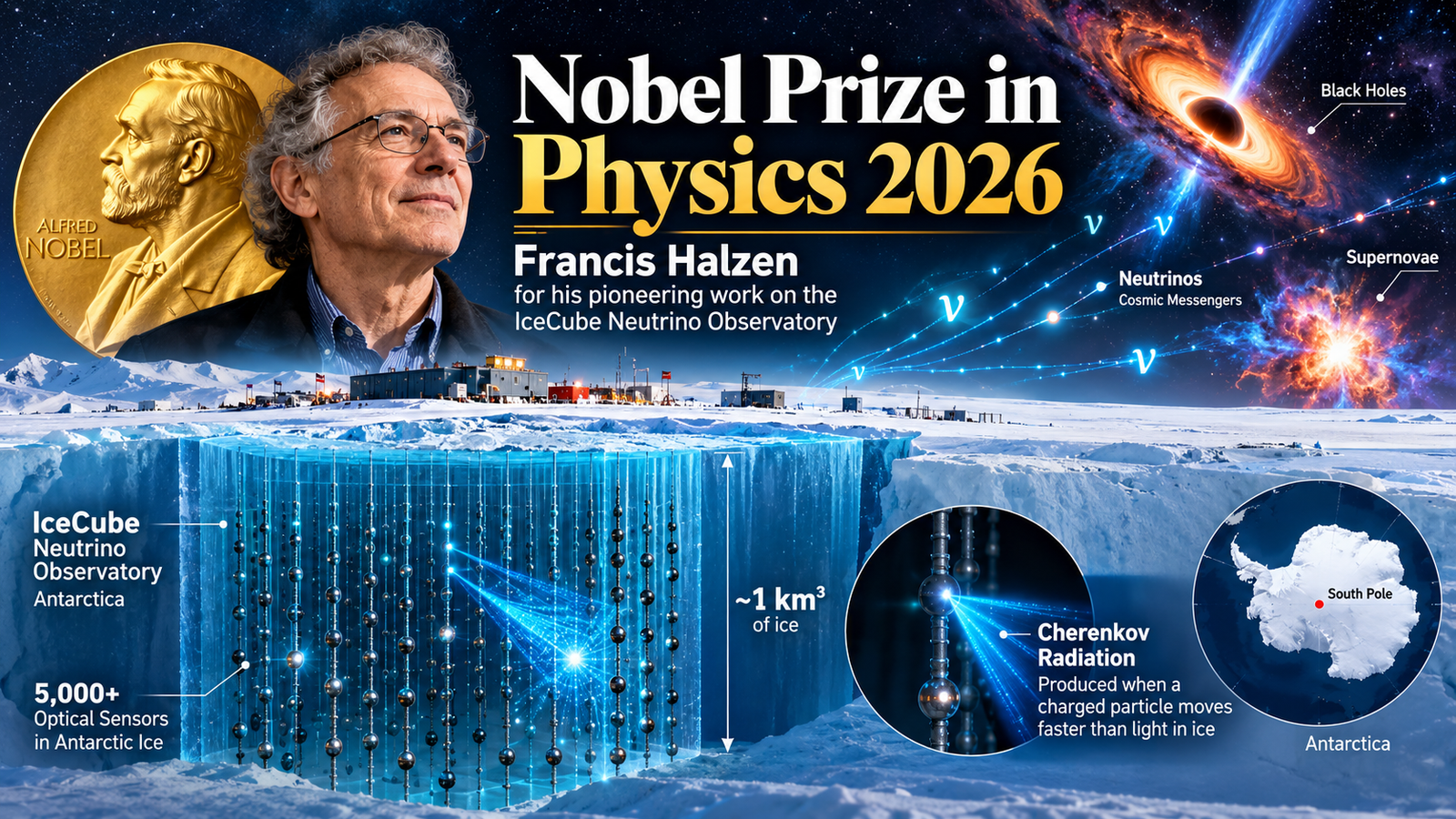
The 2026 Nobel Prize in Physics has been awarded to Francis Halzen for his pioneering work in developing the IceCube Neutrino Observatory in Antarctica.
The observatory uses a huge volume of Antarctic ice to detect extremely elusive particles called neutrinos. These particles can travel enormous distances through matter and carry information from some of the most violent events in the Universe.
The award is important not only for particle physics but also for the development of a new field of astronomy called neutrino astronomy.
In simple terms:
Traditional astronomy looks at the Universe mainly through light and other electromagnetic signals. Neutrino astronomy tries to study the Universe using neutrinos as cosmic messengers.
This gives scientists a new way to investigate phenomena such as exploding stars, black holes and other extreme astrophysical environments.
Who is Francis Halzen?
Francis Halzen is a Belgian-American physicist and professor at the University of Wisconsin–Madison.
He played a central role in developing the idea of using the Antarctic ice sheet as a gigantic detector for high-energy neutrinos.
Halzen first proposed the concept in 1988. After years of research, engineering and logistical challenges, the IceCube Observatory was completed at the South Pole.
His work transformed a seemingly simple idea—
“Can Antarctic ice be used as a giant particle detector?”
—into one of the world’s most important neutrino observatories.
What is a Neutrino?
This is the most important concept in the article.
Simple Explanation
A neutrino is an extremely light subatomic particle that has no electric charge and interacts with ordinary matter only very weakly.
Because of this weak interaction, neutrinos can travel through enormous amounts of matter without being stopped.
They are therefore often called “ghost particles.”
English Definition
A neutrino is a nearly massless, electrically neutral elementary particle that interacts primarily through the weak nuclear force and gravity.
Neutrinos are part of the Standard Model of particle physics.
Why Are Neutrinos So Difficult to Detect?
Imagine throwing a ball at a wall.
The ball will almost certainly hit the wall.
Neutrinos are completely different.
They can pass through enormous amounts of matter because their interaction with matter is extremely weak.
That means:
Neutrino → Matter → Usually passes through
Only occasionally does a neutrino interact with an atom.
This creates a major scientific challenge:
If neutrinos almost never interact with matter, how can we detect them?
The answer is:
Use an enormous detector.
This is why IceCube uses approximately one cubic kilometre of Antarctic ice and thousands of optical sensors.
Where is the IceCube Observatory Located?
IceCube is located near the:
Amundsen–Scott South Pole Station
in Antarctica.
The detector is embedded deep beneath the Antarctic ice.
It instruments approximately one cubic kilometre of ice, with sensors extending to depths of roughly 1,450–2,450 metres.
The location is not accidental.
Antarctic ice has several properties that make it extremely useful:
- enormous volume
- high optical clarity
- low background light
- stable environment
- ability to contain a huge detector without constructing a conventional tank
Why Use Ice as a Detector?
Building a conventional detector of this size would be extremely expensive and technically difficult.
Instead, scientists can use naturally occurring Antarctic ice as the detection medium.
When a high-energy neutrino interacts with the ice, it can produce charged particles.
These particles can move through the ice and produce a faint flash of light known as Cherenkov radiation.
IceCube’s optical sensors detect this light.
The basic process is:
Neutrino enters ice
↓
Rare interaction with matter
↓
Charged secondary particle produced
↓
Charged particle travels through ice
↓
Cherenkov light produced
↓
Optical sensors detect light
↓
Scientists reconstruct neutrino direction and energy
This is the fundamental principle behind IceCube.
What is Cherenkov Radiation?
This is an important technical term.
Hinglish
Jab koi charged particle kisi medium, jaise water ya ice, mein us medium mein light ki speed se faster travel karta hai, toh ek characteristic light emission produce hoti hai. Isse Cherenkov radiation kehte hain.
Important:
The particle is not travelling faster than light in vacuum.
It is travelling faster than the speed of light in that particular medium.
English Definition
Cherenkov radiation is electromagnetic radiation emitted when a charged particle travels through a medium faster than the phase velocity of light in that medium.
This phenomenon allows IceCube to detect otherwise invisible neutrino interactions.
How Does IceCube Detect Neutrinos?
IceCube contains thousands of sensors called:
Digital Optical Modules (DOMs)
The main detector contains about 5,160 optical modules installed on vertical strings in the Antarctic ice.
These sensors detect tiny flashes of Cherenkov light.
Scientists analyse:
- timing of the light
- intensity
- pattern
- location of detected signals
From these signals they can estimate:
Direction of the neutrino
and
Energy of the neutrino
This can help scientists determine where the neutrino came from.
Why Are Neutrinos Useful for Astronomy?
This is the real significance of the Nobel-winning research.
Light can be blocked, absorbed or scattered.
High-energy photons can also be affected by interactions with matter and radiation fields during their journey.
Neutrinos behave differently.
Because they interact so weakly with matter, they can escape from extremely dense and violent environments and travel enormous distances with relatively little alteration.
Therefore, neutrinos can carry information directly from places that electromagnetic astronomy may struggle to observe.
Neutrinos as Cosmic Messengers
Think of the Universe as sending different kinds of messages.
Light
Tells us about electromagnetic processes.
Gravitational Waves
Tell us about violent movements of massive objects such as merging black holes or neutron stars.
Cosmic Rays
Provide information about extremely energetic particles.
Neutrinos
Can provide information about the physical processes producing high-energy particles deep inside or around extreme astrophysical objects.
This combination is called:
Multimessenger Astronomy
What is Multimessenger Astronomy?
Hinglish
Agar hum Universe ke kisi event ko samajhne ke liye sirf light nahi, balki neutrinos + gravitational waves + cosmic rays + electromagnetic radiation jaise multiple signals ko combine karte hain, toh ise multimessenger astronomy kehte hain.
English Definition
Multimessenger astronomy is the study of astronomical phenomena using multiple independent cosmic messengers, including electromagnetic radiation, gravitational waves, neutrinos and cosmic rays.
It provides a more complete picture of cosmic events.
What Can Neutrinos Tell Us?
High-energy neutrinos can provide information about:
- supernovae
- exploding stars
- black holes
- neutron stars
- gamma-ray bursts
- active galaxies
- cosmic-ray acceleration
- extreme astrophysical environments
IceCube has detected astrophysical neutrinos and helped identify likely cosmic sources. Its research has also identified neutrino sources within and beyond the Milky Way.
What is Neutrino Astronomy?
Hinglish
Neutrino astronomy mein scientists Universe ko neutrinos ke through study karte hain.
Traditional telescope:
Light → Information about Universe
Neutrino telescope:
Neutrinos → Information about Universe
English Definition
Neutrino astronomy is the study of astronomical objects and cosmic phenomena through the detection and analysis of neutrinos arriving from space.
It is a relatively new branch of astronomy.
Why Can Neutrinos Travel Such Long Distances?
There are three important properties.
No Electric Charge
Neutrinos are electrically neutral.
Therefore, magnetic fields do not deflect them in the same way they deflect charged cosmic rays.
Very Weak Interaction
They rarely interact with matter.
Therefore, they can travel through dense regions that would absorb or scatter other particles.
Very Small Mass
Neutrinos have extremely small masses.
Their properties allow them to travel over cosmic distances while carrying information about their sources.
Neutrinos and the Standard Model
The Standard Model of Particle Physics is the leading theoretical framework describing fundamental particles and three of the four fundamental interactions.
It includes:
- quarks
- leptons
- gauge bosons
- Higgs boson
Neutrinos belong to the lepton family.
There are three known neutrino flavours:
- electron neutrino
- muon neutrino
- tau neutrino
What is a Neutrino Flavour?
Hinglish
Flavour yahan taste nahi hai.
Particle physics mein flavour particle ki different types ya identities ko describe karta hai.
Neutrinos ki three known flavours hain:
Electron neutrino
Muon neutrino
Tau neutrino
English Definition
Neutrino flavour refers to the type of neutrino associated with the charged lepton produced in its weak interaction: electron, muon or tau.
Neutrino Oscillation
One of the most fascinating properties of neutrinos is that they can change from one flavour to another while travelling.
This is called:
Neutrino Oscillation
For example:
Muon neutrino
↓
travels through space
↓
may later be detected as a different flavour.
English Definition
Neutrino oscillation is the quantum-mechanical phenomenon in which a neutrino changes from one flavour to another as it propagates.
This discovery showed that neutrinos have non-zero mass.
That was an important result because the simplest original version of the Standard Model treated neutrinos as massless.
Why is Neutrino Mass Important?
The discovery of neutrino oscillations demonstrated that neutrinos have mass.
This is important because it indicates that the Standard Model, in its simplest form, is incomplete.
Therefore, neutrino physics may provide clues about:
- physics beyond the Standard Model
- the origin of particle masses
- new particles
- new interactions
- the early Universe
This makes neutrinos important not only for astronomy but also for fundamental physics.
IceCube and the South Pole
The location of IceCube provides an interesting Geography connection.
Location
South Pole, Antarctica
Environment
- extremely cold
- thick continental ice sheet
- isolated location
- long polar night
- difficult logistics
The detector is buried beneath the ice, while the surface laboratory receives and processes the data.
The Antarctic environment therefore becomes part of a global scientific infrastructure.
Why Antarctica?
Antarctica offers an extraordinary natural laboratory.
For IceCube specifically, the deep Antarctic ice provides:
- huge detection volume
- excellent optical clarity
- low background light
- stable conditions
The detector uses the ice itself rather than constructing a conventional detector vessel.
This creates an excellent example of how natural geographical conditions can be utilised for advanced scientific research.
IceCube Upgrade
IceCube is not a static facility.
In 2026, the IceCube Upgrade was successfully deployed, adding new sensors and calibration instruments to improve the detector’s performance.
The upgrade adds more than 600 new and enhanced light sensors and calibration instruments and is expected to improve measurements of neutrinos and cosmic phenomena.
This will help scientists:
- better characterise the Antarctic ice
- reconstruct neutrino events more accurately
- study neutrino properties
- improve cosmic-ray measurements
- analyse previously collected data
What is IceCube-Gen2?
The next major step is IceCube-Gen2.
It is planned as a much larger next-generation neutrino observatory.
The proposed facility would instrument around:
8 km³ of Antarctic ice
and dramatically increase neutrino detection capability.
The planned system would combine:
- optical sensors
- surface detectors
- radio detectors
This would expand the range of neutrino energies and improve the ability to study the high-energy Universe.
IceCube vs IceCube-Gen2
| Feature | IceCube | IceCube-Gen2 |
|---|---|---|
| Location | South Pole, Antarctica | South Pole, Antarctica |
| Instrumented volume | ~1 km³ | ~8 km³ |
| Main technology | Optical sensors | Optical + surface + radio |
| Purpose | Neutrino astronomy and particle physics | Expanded high-energy neutrino astronomy |
| Sensors | ~5,160 DOMs | Much larger sensor network |
| Scientific goal | Detect and study cosmic neutrinos | Greatly expand sensitivity and energy range |
The Gen2 design aims for substantially higher sensitivity and neutrino detection rates.
Why is the Nobel Prize Significant?
The Nobel recognition highlights a major change in how humanity studies the Universe.
For centuries, astronomy was primarily based on electromagnetic radiation.
Then came:
Radio astronomy
X-ray astronomy
Gamma-ray astronomy
Gravitational-wave astronomy
And now:
Neutrino astronomy
Each new messenger has revealed aspects of the Universe that were difficult or impossible to observe through conventional visible-light astronomy.
Traditional Astronomy vs Neutrino Astronomy
| Traditional Electromagnetic Astronomy | Neutrino Astronomy |
|---|---|
| Uses electromagnetic radiation | Uses neutrinos |
| Includes visible light, radio, X-rays etc. | Detects neutrino interactions |
| Can be affected by absorption/scattering | Neutrinos interact very weakly |
| Often studies emitted electromagnetic signals | Can probe extreme environments |
| Conventional telescopes | Large particle detectors |
The two approaches are not competitors.
They are complementary.
Neutrinos and Black Holes
Black holes themselves do not emit light from inside their event horizons.
However, their surrounding environments can be extremely energetic.
Matter falling into or interacting around black holes can generate powerful radiation and high-energy particles.
Neutrinos produced in such extreme environments can escape and travel towards Earth.
Therefore, neutrinos can provide additional information about the physics surrounding black holes.
Neutrinos and Supernovae
A supernova is an enormous stellar explosion or catastrophic stellar event.
Such events can produce huge numbers of neutrinos.
Neutrino detection can therefore provide information about the internal processes occurring during stellar explosions.
This is important because neutrinos can escape from regions where electromagnetic radiation may be delayed or absorbed.
Thus:
Supernova
→ produces neutrinos
→ neutrinos travel through space
→ IceCube detects interaction
→ scientists study the source
Why is this Relevant to India?
The Nobel-winning work has direct relevance to India’s growing capabilities in:
- particle physics
- astrophysics
- astronomy
- neutrino research
- underground laboratories
- scientific instrumentation
India has a major neutrino research programme centred around the proposed India-based Neutrino Observatory (INO).
The INO project has been associated with research on neutrino properties, particularly neutrino oscillations.
This creates an important UPSC connection:
Nobel-winning neutrino research → global neutrino science → India’s neutrino research capabilities
India-Based Neutrino Observatory
The proposed India-based Neutrino Observatory (INO) is a major scientific project designed primarily to study neutrinos and their properties.
The project has been associated particularly with the study of:
Neutrino oscillations
and
neutrino mass hierarchy
It is important not to confuse INO with IceCube.
IceCube
Antarctica
Primarily uses natural Antarctic ice.
INO
India
Designed as an underground neutrino research facility.
This comparison is useful for Prelims.
What is the Neutrino Mass Hierarchy?
Hinglish
Neutrino mass hierarchy ka matlab hai neutrino ke different mass states ka relative ordering kya hai.
Scientists know that neutrinos have different mass states, but determining their exact ordering is an important research question.
English Definition
Neutrino mass hierarchy refers to the ordering of the neutrino mass eigenstates and whether the lightest state belongs to the normal or inverted hierarchy.
This remains an important question in neutrino physics.
Nobel Prize and India’s Scientific Ecosystem
The Nobel recognition also demonstrates the importance of:
- long-term basic research
- international collaboration
- large scientific infrastructure
- advanced detectors
- data-intensive science
- interdisciplinary research
A major scientific breakthrough often requires decades of investment.
Halzen’s original concept dates back to 1988, while the IceCube observatory was completed more than two decades later.
This is an important lesson for science policy:
Basic research may take decades to produce major scientific breakthroughs, but its long-term returns can transform entire fields.
Challenges in Neutrino Astronomy
Extremely Weak Interactions
Neutrinos rarely interact with matter.
Therefore, detection is difficult.
Huge Detector Requirements
A large detection volume is required.
Extreme Environment
Antarctica creates major logistical challenges.
High Data Complexity
Researchers must distinguish genuine neutrino events from background signals.
High Cost
Large scientific infrastructure requires international collaboration and long-term funding.
Significance for Science and Technology
The IceCube programme contributes to several areas:
Particle Physics
Understanding neutrino properties.
Astrophysics
Studying extreme cosmic environments.
Astronomy
Opening a new observational window.
Data Science
Processing large volumes of detector data.
Instrumentation
Developing sensitive optical detectors and calibration systems.
Earth Science
Studying the physical properties of Antarctic ice.
The IceCube programme is therefore an excellent example of interdisciplinary science.
UPSC Prelims Perspective
Important Facts
2026 Nobel Prize in Physics
→ Francis Halzen
Major contribution
→ Development of IceCube Neutrino Observatory
Location
→ Antarctica, near South Pole
Detector medium
→ Antarctic ice
Main particles
→ High-energy neutrinos
Approximate detector volume
→ 1 km³
Sensors
→ More than 5,000 optical sensors
Key phenomenon
→ Cherenkov radiation
Scientific field
→ Neutrino astronomy
Next generation
→ IceCube-Gen2
Proposed Gen2 volume
→ About 8 km³
Prelims Practice Question
Consider the following statements regarding neutrinos and IceCube:
- Neutrinos are electrically neutral elementary particles.
- IceCube uses Antarctic ice as the detection medium.
- IceCube detects neutrinos directly through electromagnetic radiation emitted by the neutrinos themselves.
- Neutrino oscillation refers to the change of neutrinos from one flavour to another.
Which of the statements given above are correct?
Answer: 1, 2 and 4 only
Explanation
Statement 1 — Correct
Neutrinos have no electric charge.
Statement 2 — Correct
IceCube uses Antarctic ice as its detection medium.
Statement 3 — Incorrect
Neutrinos are not detected through light emitted directly by the neutrino. Their interactions can produce charged secondary particles, which generate Cherenkov light detected by optical sensors.
Statement 4 — Correct
Neutrino oscillation is the change between neutrino flavours.
UPSC Mains Connection
GS Paper III
Syllabus Linkage
Science and Technology — developments and their applications and effects in everyday life.
The topic can also be connected with:
- space science
- particle physics
- astronomy
- scientific research
- frontier technologies
- international scientific collaboration
Possible Mains Question
“Neutrino astronomy has opened a new observational window into the Universe. Explain the principle behind IceCube and discuss its significance for modern science.”
Answer Framework
Introduction
The 2026 Nobel Prize in Physics recognises Francis Halzen’s pioneering role in developing IceCube, a cubic-kilometre neutrino observatory in Antarctica.
Body
Explain:
Neutrinos
→ neutral, weakly interacting particles
IceCube
→ Antarctic ice + optical sensors
Detection
→ neutrino interaction → charged particle → Cherenkov radiation → sensors
Importance
→ extreme cosmic sources
→ neutrino astronomy
→ multimessenger astronomy
→ particle physics
→ possible new physics
India
→ neutrino research
→ INO
→ scientific infrastructure
Challenges
→ weak interactions
→ high cost
→ extreme environment
Conclusion
Neutrino astronomy complements electromagnetic and gravitational-wave observations and may reveal aspects of the Universe that conventional astronomy cannot fully explain.
Geography Optional Connection
This topic has an interesting Physical Geography and Scientific Geography connection.
Antarctica as a Natural Laboratory
The Antarctic ice sheet provides the physical medium required for IceCube.
Polar Environment
Extreme cold and thick ice are not merely geographical features; they become part of advanced scientific infrastructure.
Human–Environment Interaction
Scientists have adapted technology to an extreme polar environment.
Scientific Location
The location of IceCube demonstrates how physical geography can influence the location of scientific infrastructure.
A useful conceptual chain:
Antarctic Environment
↓
Thick, clear ice
↓
Large natural detection medium
↓
IceCube
↓
Neutrino Astronomy
This is an excellent example of linking Geography + Science & Technology.
Important Keywords
Neutrino
English Definition: Nearly massless, electrically neutral elementary particle that interacts very weakly with matter.
Neutrino Astronomy
English Definition: Study of astronomical phenomena through neutrinos arriving from cosmic sources.
Cherenkov Radiation
English Definition: Light emitted when a charged particle travels through a medium faster than light travels through that medium.
Neutrino Oscillation
English Definition: Quantum-mechanical change of a neutrino from one flavour to another.
Multimessenger Astronomy
English Definition: Study of cosmic phenomena using multiple messengers such as light, gravitational waves, neutrinos and cosmic rays.
IceCube
English Definition: A cubic-kilometre neutrino observatory embedded in Antarctic ice near the South Pole.
Digital Optical Module
English Definition: A light-sensitive detector used by IceCube to detect Cherenkov photons generated by particle interactions.
Standard Model
English Definition: The leading theory describing known elementary particles and three fundamental interactions.
One-Page Revision Notes
NOBEL PHYSICS 2026
Laureate: Francis Halzen
Core work: IceCube Neutrino Observatory
Location: Antarctica
Near: Amundsen–Scott South Pole Station
Detector: ~1 km³ Antarctic ice
Sensors: >5,000 optical sensors
NEUTRINO
→ Electrically neutral
→ Extremely small mass
→ Weak interaction with matter
→ Can travel enormous distances
→ Cosmic messenger
ICECUBE
Neutrino
↓
Interaction with ice
↓
Charged secondary particle
↓
Cherenkov light
↓
Optical sensor
↓
Direction + Energy
↓
Cosmic source
WHY IMPORTANT?
Traditional astronomy
→ Light
Neutrino astronomy
→ Neutrinos
Multimessenger astronomy
→ Light + Neutrinos + Gravitational Waves + Cosmic Rays
KEY COSMIC SOURCES
→ Supernovae
→ Black-hole environments
→ Neutron stars
→ Gamma-ray bursts
→ Active galaxies
INDIA CONNECTION
→ India-based Neutrino Observatory
→ Neutrino oscillations
→ Neutrino mass hierarchy
FUTURE
IceCube-Gen2
→ ~8 km³
→ Much greater sensitivity
→ Wider energy range
→ Next-generation neutrino astronomy
Conclusion
The 2026 Nobel Prize in Physics recognises a fundamental change in humanity’s ability to observe the Universe.
Francis Halzen’s work on the IceCube Neutrino Observatory transformed Antarctic ice into a giant particle detector and helped establish neutrino astronomy as a powerful new way of studying the cosmos.
Neutrinos are particularly valuable because they can travel through matter and across cosmic distances with little interaction. When detected on Earth, they can provide information about extreme astrophysical environments that may be difficult to study through electromagnetic signals alone.
The broader lesson is equally important:
Every new cosmic messenger gives humanity a new way to understand the Universe.
From visible light to radio waves, X-rays, gravitational waves and now high-energy neutrinos, modern astronomy is increasingly becoming a multimessenger science.
For UPSC, remember the core chain:
Neutrino → IceCube → Antarctic Ice → Cherenkov Radiation → Neutrino Astronomy → Multimessenger Astronomy → New Window to the Universe.