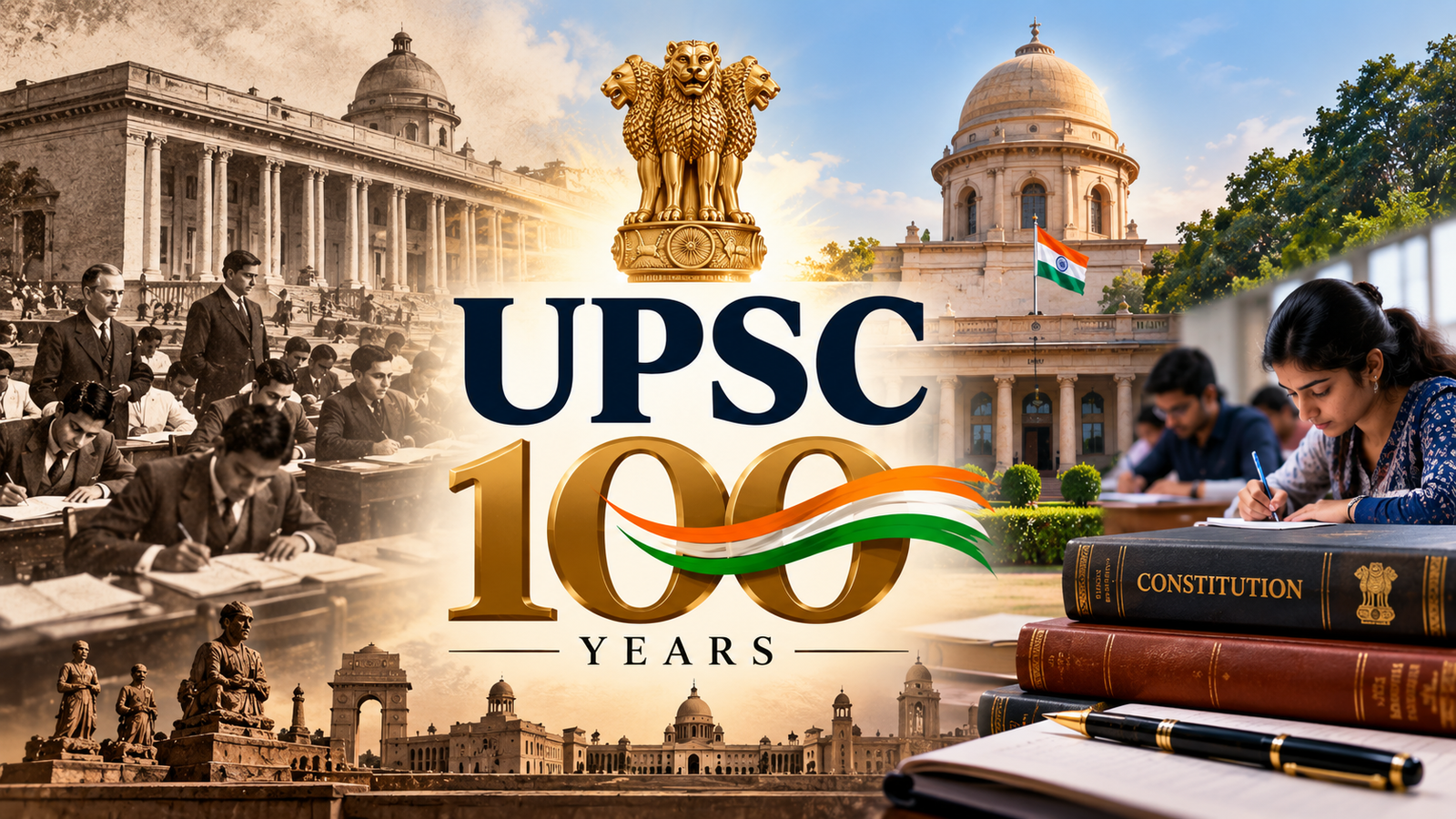
UPSC Completes 100 Years: From Public Service Commission to Constitutional Body
UPSC Current Affairs | Polity & Governance | GS Paper II
Why in News?
The Union Public Service Commission (UPSC) completed 100 years of its institutional journey on 1 October 2026.
The journey began with the establishment of the first Public Service Commission in India on 1 October 1926. Over the next century, the institution evolved from a limited advisory body under colonial rule into an independent constitutional body responsible for recruitment to several important services under the Union Government.
The centenary celebrations in 2026 have also brought attention to the future of civil-service recruitment, including technology, examination security, transparency, accessibility and the changing requirements of public administration.
The UPSC’s centenary is therefore important not only as a historical event but also as a topic connected with Indian Constitution, constitutional bodies, civil services, governance and administrative reforms.
UPSC: Basic Meaning
UPSC stands for Union Public Service Commission.
It is a constitutional body established under Article 315 of the Constitution of India.
Its broad purpose is to assist in the recruitment of suitable candidates to various civil services and posts under the Union and to advise the government on certain matters relating to recruitment, appointments, promotions and disciplinary matters.
Constitutional Body
A constitutional body is an institution that derives its existence and authority directly from the Constitution.
Examples include:
- Election Commission of India
- Union Public Service Commission
- Finance Commission
- Comptroller and Auditor General of India
- State Public Service Commissions
Since UPSC is created by the Constitution, its position is different from an ordinary statutory body created by an Act of Parliament.
Historical Evolution of UPSC
The present UPSC is the result of a long institutional evolution.
A useful way to remember its history is:
1855 → 1922 → 1924 → 1926 → 1937 → 1950 → 2026
Beginning of Merit-Based Civil Service Recruitment
The modern competitive principle in civil-service recruitment developed during British rule.
In 1855, open competitive examination was introduced for recruitment to the Indian Civil Service.
Initially, the examination was conducted in London, which created major practical difficulties for Indian candidates.
The system gradually changed and the demand for greater Indian participation in public services increased.
ICS Examination in India
In 1922, the Indian Civil Service examination was held in India for the first time at Allahabad, along with the examination in London.
The Indian examination centre was later shifted to Delhi in 1928.
This was an important step towards making higher civil-service recruitment more accessible within India.
Lee Commission, 1924
The Royal Commission on the Superior Civil Services in India, popularly known as the Lee Commission, submitted its report in 1924.
The Commission recommended the establishment of a Public Service Commission in India.
This recommendation became an important institutional milestone in the development of an organised recruitment system.
Public Service Commission, 1926
On 1 October 1926, the first Public Service Commission was established in India.
It was headed by Sir Ross Barker, who became its first Chairman.
The Commission was initially a relatively limited and advisory institution. Its powers were much narrower than those of the present UPSC.
Therefore, an important examination point is:
Sir Ross Barker was the first Chairman of the Public Service Commission established in 1926, not the first Chairman of the UPSC in its present constitutional form.
Federal Public Service Commission, 1937
The Government of India Act, 1935 provided for a Federal Public Service Commission and Provincial Public Service Commissions.
With the coming into effect of the relevant provisions of the 1935 Act on 1 April 1937, the Public Service Commission became the Federal Public Service Commission.
UPSC After Independence
After India became a Republic and the Constitution came into force on 26 January 1950, the Federal Public Service Commission became the Union Public Service Commission.
The Constitution gave Public Service Commissions a protected constitutional position under Part XIV.
Thus, the institutional journey can be understood as:
Public Service Commission, 1926 → Federal Public Service Commission, 1937 → Union Public Service Commission, 1950
The UPSC itself notes this institutional evolution in its historical records.
Constitutional Position of UPSC
The constitutional provisions relating to Public Service Commissions are contained in:
Part XIV — Services Under the Union and the States
More specifically:
Articles 315–323 — Public Service Commissions
| Article | Subject |
|---|---|
| Article 315 | Public Service Commissions for the Union and States |
| Article 316 | Appointment and term of office of members |
| Article 317 | Removal and suspension of a member |
| Article 318 | Conditions of service of members and staff |
| Article 319 | Restrictions on holding further offices |
| Article 320 | Functions of Public Service Commissions |
| Article 321 | Power to extend functions |
| Article 322 | Expenses of Public Service Commissions |
| Article 323 | Reports of Public Service Commissions |
This group of Articles is extremely important for UPSC and HPPSC examinations.
Article 315: Creation of Public Service Commissions
Article 315 provides for:
- A Public Service Commission for the Union
- A Public Service Commission for each State
It also allows two or more States to have a Joint State Public Service Commission, subject to the constitutional procedure.
The Union Public Service Commission can also, with the approval of the President and at the request of a State Governor, serve some or all of the needs of a State.
Prelims Point
Do not confuse:
UPSC = Union level
SPSC = State level
Joint State PSC = Common commission for two or more States
Composition and Appointment
Under Article 316, the Chairman and other members of UPSC are appointed by the President of India.
For a State Public Service Commission, the Chairman and members are appointed by the Governor of the State.
Another important constitutional provision is that, as nearly as may be, one-half of the members of every Public Service Commission should be persons who have held office for at least ten years under the Government of India or a State Government.
Important Prelims Trap
Remember:
UPSC members → President appoints
State PSC members → Governor appoints
However, appointment by the President or Governor does not mean that the Commission functions under their day-to-day control.
The Constitution provides safeguards intended to preserve its independence.
Tenure of UPSC Members
Under Article 316, a member of UPSC holds office for a term of six years or until attaining the age of 65 years, whichever is earlier.
For a State Public Service Commission, the corresponding age limit is 62 years.
Quick Revision
UPSC → 6 years / 65 years
SPSC → 6 years / 62 years
Whichever comes earlier.
Removal of UPSC Members
The Constitution provides special safeguards for the removal of members of Public Service Commissions.
Under Article 317, the Chairman or another member of UPSC can be removed from office by the President.
In the case of removal on the ground of misbehaviour, the President must refer the matter to the Supreme Court.
The Supreme Court conducts an inquiry according to the prescribed procedure.
If the Supreme Court, after inquiry, reports that the member ought to be removed, the President may pass the removal order.
This is an important safeguard for institutional independence.
Why is this important?
If members could be removed easily by the government, the Commission could face pressure while conducting recruitment.
Therefore, constitutional safeguards seek to protect:
- Impartiality
- Merit-based recruitment
- Institutional independence
- Public confidence
Restrictions After Leaving Office
Article 319 places restrictions on the future employment of members of Public Service Commissions.
For example, the Chairman of UPSC is not eligible for further employment under the Government of India or the Government of a State after leaving office.
There are also specific restrictions applicable to other members depending upon whether they served on UPSC or a State PSC.
The purpose is to reduce the possibility of conflicts of interest and protect the independence of the Commission.
Functions of UPSC
The major functions of UPSC are provided under Article 320.
These include:
Recruitment
UPSC conducts examinations and selection processes for recruitment to various civil services and posts under the Union.
The Civil Services Examination (CSE) is the most prominent example.
Other examinations conducted by UPSC include examinations for services such as:
- Indian Forest Service
- Engineering Services
- Combined Defence Services
- National Defence Academy and Naval Academy
- Combined Medical Services
- Civil Services
The exact examination structure and services recruited through UPSC can change according to government requirements and notifications.
Advising on Recruitment Methods
UPSC is consulted regarding:
- Methods of recruitment
- Principles to be followed in making appointments
- Promotions
- Transfers in certain service-related contexts
- Suitability of candidates for appointments
Disciplinary Matters
The Commission may also be consulted on certain disciplinary matters affecting persons serving under the Union.
This is why UPSC is not merely an examination-conducting institution.
Its constitutional role is wider.
Is UPSC Only an Examination Body?
No.
This is one of the most important conceptual points.
For many aspirants, UPSC is primarily associated with the Civil Services Examination.
However, constitutionally, UPSC has a broader advisory and recruitment-related role.
Its functions include matters related to:
Recruitment + Appointments + Promotions + Disciplinary Matters + Recruitment Rules and related consultation
Therefore:
UPSC is a constitutional recruitment and advisory institution, not merely an examination-conducting agency.
Independence of UPSC
Why did the Constitution provide a separate constitutional status to Public Service Commissions?
The basic idea is to ensure that recruitment to public services is based on merit, fairness and objective procedures, rather than political or personal influence.
Important safeguards include:
Constitutional Status
The Commission derives its authority directly from the Constitution.
Security of Tenure
Members have a fixed constitutional tenure subject to the provisions of the Constitution.
Difficult Removal Process
Removal for misbehaviour involves an inquiry by the Supreme Court.
Financial Independence
Under Article 322, the expenses of UPSC, including salaries, allowances and pensions of members and staff, are charged on the Consolidated Fund of India.
This means that these expenses are not subject to annual voting by Parliament in the same manner as ordinary voted expenditure.
This is an important institutional safeguard.
Reporting to Parliament
Under Article 323, UPSC submits an annual report to the President.
If the government does not accept the Commission’s advice in certain cases, the reasons for such non-acceptance are required to accompany the report when it is laid before Parliament.
This creates an element of legislative accountability.
UPSC and the Principle of Merit-Based Recruitment
One of the central ideas behind Public Service Commissions is merit-based recruitment.
Merit-Based Recruitment
Meaning: Selection of candidates primarily on the basis of objectively assessed qualifications, abilities and performance rather than personal connections or patronage.
A professional civil service is important because government officials are responsible for:
- Policy implementation
- Public administration
- Law and order
- Development programmes
- Revenue administration
- Welfare delivery
- Disaster management
- Regulatory functions
- National security-related administration
Therefore, the quality and impartiality of recruitment directly influence the quality of governance.
UPSC at 100: Recent Examination Reforms
The centenary year has also highlighted how recruitment is changing with technology.
The UPSC has increasingly adopted digital tools to improve security, transparency, accessibility and efficiency.
Face Authentication
One of the major recent developments is the use of real-time face authentication.
During the Civil Services Preliminary Examination 2026, face authentication was implemented across 2,072 examination venues.
The system matched the candidate’s live image with the photograph submitted during the application process.
The objective is to prevent impersonation and strengthen examination integrity.
The technology was developed with technical support from the National e-Governance Division (NeGD) under the Ministry of Electronics and Information Technology.
The 2026 examination saw nearly 5.49 lakh candidates appear, out of more than 8.19 lakh applicants.
Universal Registration Number
The UPSC also introduced a Universal Registration Number (URN) through its revamped online application system.
The idea is to provide a persistent identity for candidates across UPSC examinations.
This can reduce repetitive registration requirements and help streamline the examination application process.
Why is this important?
It represents a shift from:
One examination → one registration
towards:
One candidate → persistent digital identity
This is an example of the broader Digital Governance approach.
Randomised Interview Boards
UPSC has also introduced randomisation of interview boards in certain examinations.
The purpose is to reduce the possibility of predictable allocation patterns and strengthen perceptions of fairness and transparency in the interview process.
This reflects the larger objective of protecting the credibility of the recruitment system.
Examination Security and Question Paper Confidentiality
The UPSC has also emphasised strict confidentiality in question-paper preparation.
Question papers are prepared through a controlled process involving question banks and multiple experts.
The principle of “need to know” is used so that no single individual has complete knowledge of the final question paper.
This is important because examination integrity depends not only on the final examination hall but also on:
Question creation → moderation → selection → printing/digital security → transportation → examination → evaluation
Technology and the Future of Civil Services Recruitment
The UPSC centenary discussions have highlighted three broad principles:
Trust
Public confidence is essential for the legitimacy of a recruitment institution.
Transparency
Candidates should have confidence that recruitment procedures are fair and objective.
Technology
Digital tools can improve:
- Candidate authentication
- Examination security
- Accessibility
- Communication
- Data management
- Application processing
- Monitoring
However, technology also creates new challenges.
These include:
- Data privacy
- Cybersecurity
- Algorithmic bias
- Digital exclusion
- Reliability of facial recognition
- Protection of candidate data
Therefore, technology should strengthen institutional fairness rather than replace human oversight.
Why UPSC Matters for Governance
The importance of UPSC goes beyond examinations.
A modern state requires a professional public administration capable of dealing with complex issues such as:
- Climate change
- Artificial Intelligence
- Digital governance
- Public health
- Internal security
- Disaster management
- Urbanisation
- Economic transformation
- Social welfare
- International relations
The civil servant of the 21st century therefore requires more than factual knowledge.
Modern public administration increasingly requires:
Analytical ability + Ethical judgment + Problem-solving + Technological awareness + Constitutional values + Public service orientation
This explains why examination and recruitment reforms remain important even after 100 years.
UPSC and Constitutional Values
The constitutional position of UPSC is closely connected with broader democratic principles.
A professional civil service is expected to function within the framework of:
- Constitutional supremacy
- Rule of law
- Equality
- Impartiality
- Accountability
- Political neutrality
- Public interest
- Responsiveness
Thus, the Public Service Commission can be viewed as part of the institutional architecture that supports a professional and impartial public administration.
UPSC vs State Public Service Commission
This comparison is important for both UPSC and HPPSC aspirants.
| Feature | UPSC | State PSC |
|---|---|---|
| Constitutional basis | Article 315 | Article 315 |
| Level | Union | State |
| Chairman appointed by | President | Governor |
| Member age limit | 65 years | 62 years |
| Main recruitment domain | Union services/posts | State services/posts |
| Annual report submitted to | President | Governor |
| Relevant constitutional provisions | Articles 315–323 | Articles 315–323 |
Important for HPPSC Aspirants
For Himachal Pradesh aspirants, the Himachal Pradesh Public Service Commission (HPPSC) is the State-level counterpart.
The same constitutional framework of Public Service Commissions applies, but the recruitment functions and examinations relate to the requirements of the State.
Therefore, UPSC and HPPSC should be studied together when preparing the constitutional framework of Public Service Commissions.
UPSC and HPPSC: A Useful Conceptual Link
The UPSC centenary is directly relevant to HPPSC preparation because both institutions belong to the constitutional framework of Public Service Commissions.
For HPPSC aspirants, the topic can be linked with:
Article 315 → State PSC
Article 316 → Appointment and tenure
Article 317 → Removal
Article 320 → Functions
Article 322 → Expenses
Article 323 → Reports
This makes the UPSC centenary a useful revision opportunity for the entire constitutional framework of PSCs.
Challenges Before Public Service Commissions
Despite the institutional safeguards, recruitment systems must continuously adapt.
Balancing Speed and Accuracy
Recruitment should be timely, but faster recruitment should not reduce quality or fairness.
Technology and Privacy
Digital authentication can improve security but must be accompanied by strong data-protection and cybersecurity safeguards.
Changing Skill Requirements
Civil services increasingly require knowledge of:
- Artificial Intelligence
- Data governance
- Climate change
- Cybersecurity
- Behavioural economics
- Emerging technologies
Recruitment systems therefore need to assess capabilities relevant to contemporary governance.
Maintaining Public Trust
The credibility of a recruitment institution depends heavily on public confidence in:
- Confidentiality
- Fairness
- Transparency
- Evaluation
- Grievance redressal
Accessibility
Technology should improve accessibility for candidates, including Persons with Benchmark Disabilities (PwBD) and candidates from geographically remote areas.
Significance for UPSC Examination
The centenary of UPSC can be connected with several areas of the Civil Services syllabus.
UPSC Prelims
Focus on:
- Article 315
- Articles 315–323
- Appointment of UPSC Chairman and members
- Tenure
- Age limit
- Removal procedure
- Article 320
- Article 322
- Article 323
- Constitutional vs statutory body
- Joint State Public Service Commission
- Recent examination reforms
- Face authentication
- Universal Registration Number
UPSC Mains GS Paper II
The topic can be linked with:
Constitutional Bodies
Statutory, regulatory and various quasi-judicial bodies
Civil services in a democracy
Transparency and accountability
E-governance
Institutional reforms
Role of civil services in a changing society
Mains Answer Framework
Possible Question
“The constitutional status and institutional safeguards of the Union Public Service Commission are essential for maintaining merit-based recruitment and an impartial civil service.” Discuss.
Introduction
The Union Public Service Commission is a constitutional body established under Article 315 of the Constitution. Its institutional journey from the Public Service Commission of 1926 to the present constitutional body reflects India’s evolution towards professional and merit-based public administration.
Body
Discuss:
- Articles 315–323
- Appointment and tenure safeguards
- Removal procedure
- Financial safeguards
- Advisory functions
- Recruitment role
- Parliamentary accountability
- Importance of impartial recruitment
- Recent technological reforms
- Challenges related to privacy, cybersecurity and accessibility
Conclusion
The centenary of UPSC is not merely a historical milestone. It provides an opportunity to examine how a constitutional recruitment institution can preserve its core values of merit and fairness while adapting to the technological and administrative requirements of 21st-century governance.
Prelims Facts to Remember
UPSC was established as the first Public Service Commission in India in 1926.
1 October 1926 is the foundational date of its institutional journey.
Sir Ross Barker was the first Chairman of the Public Service Commission.
The Lee Commission recommended the establishment of a Public Service Commission.
The Government of India Act, 1935 provided for the Federal Public Service Commission.
The Federal Public Service Commission became the UPSC on 26 January 1950.
UPSC is a constitutional body.
Its constitutional framework is contained in Articles 315–323.
Article 315 deals with Public Service Commissions.
Article 316 deals with appointment and tenure.
Article 317 deals with removal and suspension.
Article 320 deals with functions.
Article 322 deals with expenses.
Article 323 deals with reports.
UPSC members are appointed by the President.
The UPSC Chairman and members have a maximum age limit of 65 years, subject to the six-year tenure rule.
State PSC members have a maximum age limit of 62 years.
UPSC expenses are charged on the Consolidated Fund of India.
Important Keywords
Constitutional Body
An institution created directly by the Constitution and whose powers and structure are constitutionally recognised.
Public Service Commission
An institution responsible for recruitment-related functions and advising the government on specified matters concerning public services.
Merit-Based Recruitment
Selection based on objectively assessed ability and performance rather than personal connections or patronage.
Constitutional Safeguards
Legal and institutional protections designed to preserve the independence and impartiality of a constitutional institution.
Impersonation
A situation in which one person unlawfully appears in an examination in place of another candidate.
Face Authentication
A biometric verification process that compares a person’s live facial image with an authorised photograph or identity record.
Institutional Independence
The ability of an institution to perform its constitutionally assigned functions without improper external pressure.
Civil Services
Government services responsible for carrying out public administration and implementing laws and policies.
UPSC in One Timeline
1855 — Open competitive examination for Indian Civil Service introduced
1922 — ICS examination held in India for the first time at Allahabad
1924 — Lee Commission recommends Public Service Commission
1 October 1926 — First Public Service Commission established
Sir Ross Barker — First Chairman
1935 — Government of India Act provides for Federal Public Service Commission
1 April 1937 — Federal Public Service Commission comes into effect
26 January 1950 — Federal Public Service Commission becomes UPSC
2025–26 — Increasing use of digital examination reforms
24 May 2026 — Face authentication implemented at scale in Civil Services Preliminary Examination
1 October 2026 — UPSC completes 100 years
One-Line Revision
UPSC evolved from the Public Service Commission established in 1926 into a constitutionally protected institution under Articles 315–323, serving as a key mechanism for merit-based recruitment to Union public services.
Conclusion
The completion of 100 years of UPSC’s institutional journey in 2026 marks an important milestone in India’s administrative history.
Its evolution from the Public Service Commission of 1926, through the Federal Public Service Commission, to the constitutionally protected UPSC of independent India reflects the gradual institutionalisation of merit-based public recruitment.
The next phase of public-service recruitment will have to balance two objectives: preserving institutional trust and constitutional values while adopting modern technology and new methods of assessment.
For UPSC and HPPSC aspirants, the centenary is particularly relevant because it connects constitutional bodies, civil services, meritocracy, administrative reforms, digital governance and institutional independence in a single topic.
In short: UPSC@100 is not only about the history of an examination. It is about the evolution of India’s public-service recruitment system and its role in democratic governance.