India–US Bilateral Trade Agreement 2026: Tariffs, Trade Negotiations, Strategic Partnership and India’s Interests
Why in News?
India and the United States are continuing negotiations for a Bilateral Trade Agreement (BTA) in 2026.
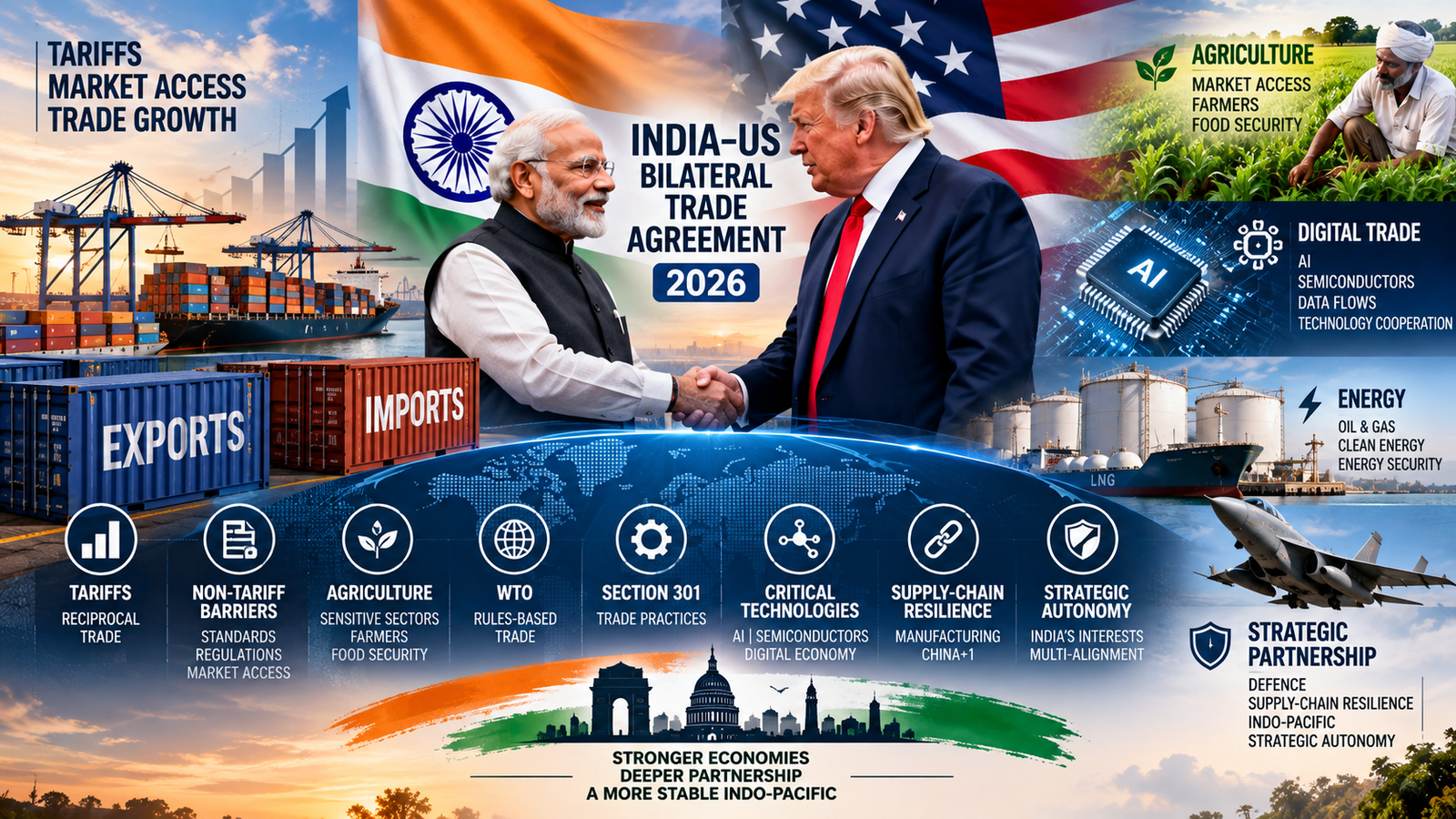
The issue has gained renewed importance because Indian Commerce and Industry Minister Piyush Goyal is visiting the United States from September 29 to October 5, 2026, with talks aimed at advancing an interim trade agreement. Prime Minister Narendra Modi and US President Donald Trump also spoke on September 30 and reviewed cooperation in trade, defence, energy and critical technologies.
The trade negotiations are taking place against the background of:
- US tariff measures
- India’s export interests
- agricultural market access
- non-tariff barriers
- digital trade
- supply-chain resilience
- energy cooperation
- critical and emerging technologies
- India’s trade deficit/surplus relationship with the US
- India’s continued trade and energy engagement with Russia
This makes the India–US BTA an important topic for UPSC GS Paper II, GS Paper III and HPPSC.
What is a Bilateral Trade Agreement?
Simple Meaning
Hinglish: Do countries ke beech trade ko easier banane ke liye tariffs, market access, standards, services aur other trade rules par agreement.
English definition: A bilateral trade agreement is an agreement between two countries that establishes mutually negotiated rules and market-access conditions for trade and related economic activities.
A BTA can cover:
- tariffs
- goods
- services
- investment
- digital trade
- intellectual property
- standards
- customs procedures
- rules of origin
- non-tariff barriers
- supply chains
India–US Trade Relationship
The United States is one of India’s most important economic partners.
The relationship extends beyond merchandise trade and includes:
- goods
- services
- investment
- technology
- defence
- energy
- pharmaceuticals
- electronics
- digital services
- critical technologies
Therefore, the proposed BTA should not be understood simply as a tariff agreement.
It is part of a broader effort to deepen the economic dimension of the India–US Comprehensive Global Strategic Partnership.
India–US BTA: Background
India and the US launched negotiations towards a broader Bilateral Trade Agreement in 2025.
In February 2026, both countries announced a framework for an Interim Agreement as part of the broader BTA negotiations.
The framework covered:
- reciprocal tariffs
- Indian tariff reductions
- US market access
- non-tariff barriers
- rules of origin
- digital trade
- supply-chain resilience
- strategic technology cooperation
- energy purchases
- investment and economic-security cooperation
The broader BTA is intended to go beyond the interim arrangement.
Interim Agreement vs Bilateral Trade Agreement
This distinction is important.
Interim Agreement
An interim arrangement is intended to address important trade issues relatively quickly while negotiations on the broader agreement continue.
BTA
The BTA would provide a more comprehensive framework covering a wider range of economic and trade issues.
Therefore:
Interim Agreement ≠ Final Comprehensive BTA
This distinction is important for UPSC Prelims.
What Was Agreed in the February 2026 Framework?
The United States and India announced a framework containing several important elements.
Tariff Commitments
The US framework stated that the United States would apply an 18% reciprocal tariff rate on originating goods from India under the proposed interim arrangement, subject to the conditions specified in the framework.
India agreed to reduce or eliminate tariffs on a range of US industrial and agricultural products.
The framework also envisaged further tariff adjustments for specified products if the interim agreement were successfully concluded.
Why are Tariffs Important?
What is a Tariff?
Hinglish: Imported goods par government dwara lagaya gaya tax.
English definition: A tariff is a tax imposed on imported goods.
Example:
Suppose an imported product costs:
$100
If a country imposes a:
20% tariff
the importer may have to pay:
$20
in tariff.
The tariff can affect:
- import prices
- consumer prices
- competitiveness
- domestic producers
- trade flows
What is a Reciprocal Tariff?
Simple Meaning
Hinglish: A tariff structure linked to the trade treatment that one country believes it receives from another country.
English definition: A reciprocal tariff is a tariff policy designed to reflect or respond to the trade barriers or tariff treatment imposed by a trading partner.
The US framework with India used the language of reciprocal trade.
This is important because it shifts the discussion from simply:
“What tariff does India impose?”
to a broader assessment of:
tariffs + non-tariff barriers + market access + trade practices.
India’s Tariff Position
India has historically maintained relatively higher tariffs in several sectors compared with many developed economies.
The government has also used tariffs as instruments of:
- revenue generation
- domestic industry protection
- industrial policy
- import management
- strategic manufacturing promotion
However, high tariffs can also increase the cost of imported inputs.
Therefore, trade policy involves a balance between:
Consumer interests
Domestic producers
Export competitiveness
Government revenue
Strategic industrial policy
What are Non-Tariff Barriers?
This is one of the most important concepts in the India–US trade negotiations.
Simple Meaning
Hinglish: Aise trade restrictions jo direct customs duty nahi hote, lekin imports ko difficult ya costly bana sakte hain.
English definition: Non-tariff barriers are regulatory, administrative or procedural measures that can restrict or affect international trade without being conventional tariffs.
Examples include:
- import licensing
- technical standards
- sanitary and phytosanitary requirements
- certification requirements
- quantitative restrictions
- testing requirements
- local regulations
India–US BTA and Non-Tariff Barriers
The February 2026 framework identified several areas where the two countries intended to address non-tariff barriers.
India agreed to address certain long-standing US concerns involving:
- medical devices
- ICT goods
- agricultural products
- import licensing
- standards and conformity assessment
The United States also committed to preferential market access in sectors of Indian interest.
This shows that modern trade agreements are not limited to customs duties.
Agriculture: A Sensitive Issue
Agriculture is one of the most politically sensitive areas in India–US trade negotiations.
The US seeks greater market access for products such as:
- agricultural commodities
- food products
- animal feed
- fruits
- nuts
- vegetable oils
The February framework listed several US agricultural and food products for tariff reductions by India.
Why is Agriculture Sensitive for India?
Indian agriculture supports a very large population and involves millions of farmers.
Trade liberalisation can create:
Potential opportunities
- cheaper inputs
- greater export opportunities
- access to new markets
- technology and investment
Potential concerns
- import competition
- price pressure on farmers
- impact on small producers
- food security considerations
- concerns regarding genetically modified products and agricultural standards
Therefore, agricultural trade policy must balance:
Consumer welfare + farmer interests + food security + export competitiveness.
India’s Dairy Sector
Dairy is particularly sensitive because of:
- large number of small producers
- rural employment
- food security
- cultural preferences
- concerns regarding import competition
This is why agricultural market access often becomes one of the most difficult components of trade negotiations.
Energy Dimension
Energy is becoming increasingly important in India–US economic relations.
The February 2026 framework stated that India intends to purchase substantial quantities of US energy products over the following five years, alongside aircraft, technology products and other goods.
The energy relationship can include:
- crude oil
- LNG
- coal
- nuclear cooperation
- energy technology
- clean-energy technologies
The Russia Factor
One of the most important geopolitical dimensions of India–US trade relations in 2026 is India’s continued purchase of Russian crude oil.
India has repeatedly emphasised the importance of:
energy security
while the United States has taken measures targeting countries involved in Russian energy trade.
In September 2026, India warned that new US measures related to purchases of Russian oil could affect bilateral relations.
This creates a major intersection between:
Trade Policy
Energy Security
Strategic Autonomy
India–US Relations
India–Russia Relations
What is Strategic Autonomy?
Hinglish
Strategic autonomy ka matlab hai India apne national interests ke according foreign policy decisions le sake, bina kisi ek major power ke pressure mein completely align hue.
English definition
Strategic autonomy is the ability of a state to make independent foreign-policy and strategic decisions according to its national interests.
India’s approach often involves maintaining relationships with multiple major powers simultaneously.
For example:
US + Russia + Europe + Japan + Middle East + Global South
This is sometimes described as multi-alignment.
Trade and Geopolitics
The India–US BTA demonstrates that trade is increasingly connected with geopolitics.
Trade negotiations today can involve:
- technology
- supply chains
- energy
- national security
- sanctions
- investment screening
- export controls
- critical minerals
- semiconductors
- digital infrastructure
Therefore, the distinction between:
economic policy
and
foreign policy
is becoming less rigid.
This is called geoeconomics.
What is Geoeconomics?
Hinglish
Countries economic tools ko strategic objectives achieve karne ke liye use karte hain.
English definition
Geoeconomics refers to the use of economic instruments to pursue geopolitical and strategic objectives.
Examples include:
- tariffs
- sanctions
- export controls
- investment restrictions
- technology restrictions
- trade agreements
- supply-chain partnerships
India–US Trade and Supply Chains
Supply-chain resilience has become a major pillar of India–US economic cooperation.
The February framework specifically included cooperation on:
- supply-chain resilience
- economic security
- innovation
- investment reviews
- export controls
The objective is to create more resilient and trusted supply chains, especially in strategic sectors.
Why Supply-Chain Resilience Matters
The COVID-19 pandemic, geopolitical tensions and disruptions in global shipping demonstrated the risks of excessive dependence on a limited number of suppliers.
Strategic sectors include:
- semiconductors
- pharmaceuticals
- critical minerals
- batteries
- electronics
- telecommunications
- defence technologies
India is trying to become an important node in diversified global supply chains.
This connects directly with:
China+1 Strategy
and
Atmanirbhar Bharat.
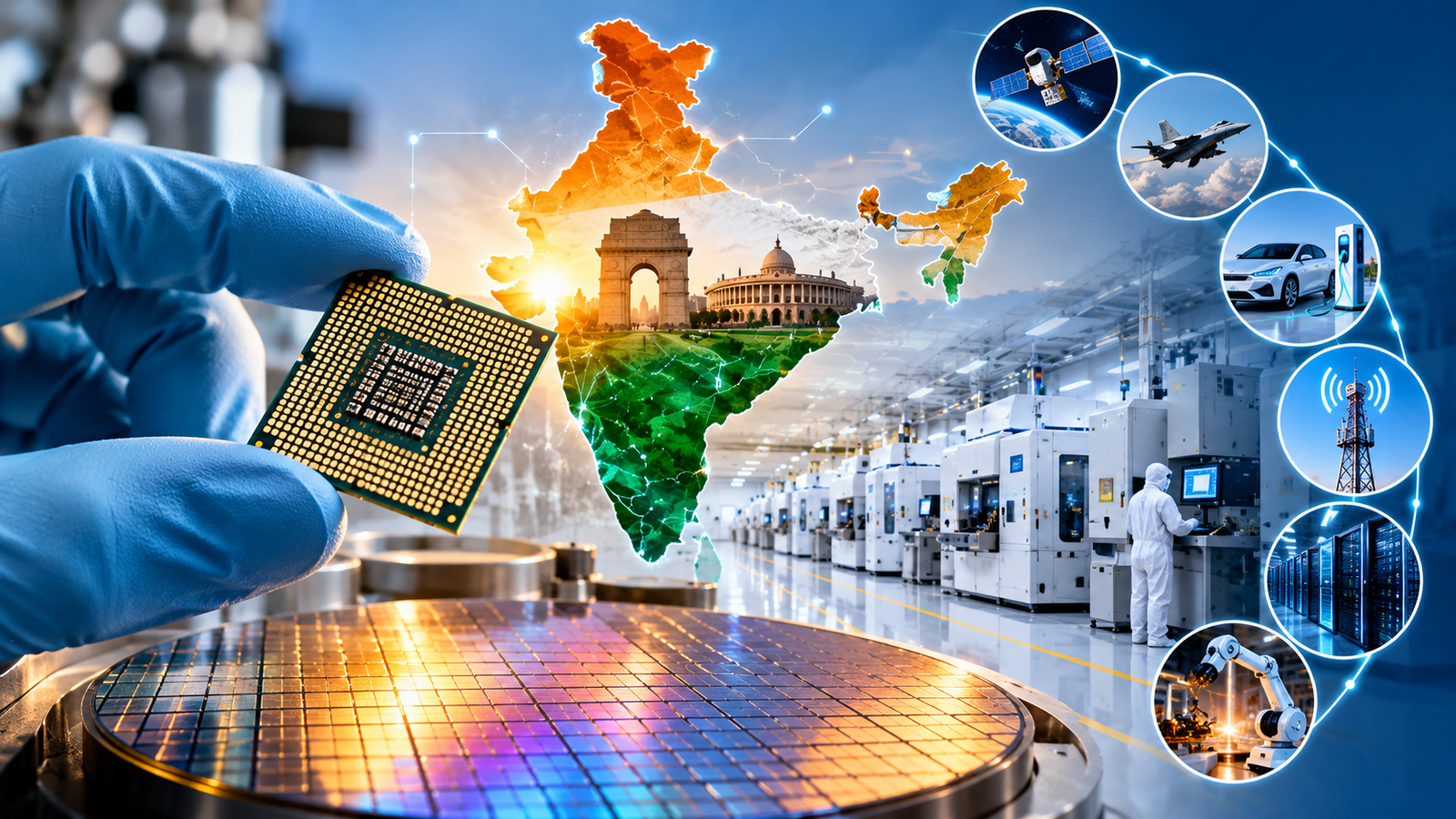
India–US BTA and Critical Technologies
The trade relationship increasingly overlaps with technology cooperation.
Important areas include:
- Artificial Intelligence
- semiconductors
- data centres
- GPUs
- telecommunications
- advanced manufacturing
- aerospace
- defence technologies
The February framework specifically mentioned increased trade in technology products, including GPUs and equipment used in data centres.
Why GPUs Matter
GPU
Graphics Processing Unit
Originally developed primarily for graphics processing, GPUs are now critical for:
- Artificial Intelligence
- Machine Learning
- data centres
- scientific computing
- high-performance computing
Therefore:
Trade in GPUs → AI infrastructure → Digital economy → Strategic technology
This is why technology trade is increasingly viewed through a national-security lens.
India–US Trade and Digital Economy
Digital trade is another major component of the negotiations.
It can include:
- digital services
- electronic commerce
- data flows
- digital taxation
- cybersecurity
- technical standards
- cross-border digital transactions
The February framework stated that the two countries intended to develop ambitious digital trade rules as part of the broader BTA.
Why Digital Trade Matters to India
India is a major exporter of:
- IT services
- business-process services
- software
- digital services
Therefore, access to the US market is particularly important for India’s services economy.
Potential issues include:
- data governance
- cross-border data flows
- digital taxation
- privacy
- cybersecurity
- artificial intelligence regulation
India–US Trade: The Section 301 Issue
One of the major developments in 2026 was the US Section 301 investigation involving India and other economies.
What is Section 301?
Section 301 is a provision of US trade law that allows the United States to investigate and potentially respond to what it considers unfair foreign trade practices.
In June 2026, the US proposed additional tariffs in relation to an investigation concerning measures to prevent imports produced with forced labour.
In July, the final US measure placed India in a 10% additional tariff tier, lower than the initially proposed 12.5%. The Indian government stated that around 45% of India’s exports to the US remained outside the scope of that additional Section 301 duty, although other tariffs could still apply to particular products.
Important: Do Not Mix Different US Tariffs
For UPSC, this is a major conceptual trap.
US tariffs affecting Indian products can arise from different legal instruments and policy measures.
For example:
Section 301
Concerns trade practices and related investigations.
Section 232
Concerns tariffs imposed on certain products on national-security grounds.
Therefore:
Section 301 ≠ Section 232
They have different legal bases and policy objectives.
What are Rules of Origin?
Hinglish
Rules of origin determine ki product actually kis country ka maana jayega.
English definition
Rules of origin are criteria used to determine the country of origin of a product for trade-policy purposes.
They are important because preferential tariffs should generally benefit products genuinely produced or sufficiently processed within the participating countries.
Why Rules of Origin Matter in India–US Trade
Suppose:
A product is manufactured in Country A,
but routed through Country B,
and then exported to the United States.
Without proper rules of origin, companies could potentially use Country B as a route to obtain preferential treatment.
Therefore, rules of origin help prevent:
Trade diversion
and
Tariff circumvention.
India–US BTA and Trade Diversion
A trade agreement can change incentives for businesses.
If tariffs become lower between India and the US, companies may:
- shift production
- establish factories
- source components differently
- redirect exports
- diversify supply chains
This can increase India’s attractiveness as a manufacturing location.
Potential Benefits for India
A successful BTA could potentially support:
Export Growth
Lower trade barriers can improve market access for Indian exporters.
Manufacturing
Greater integration with US supply chains could attract investment.
Technology
Trade and investment can support technology transfer and collaboration.
Employment
Export-oriented manufacturing and services can create jobs.
Supply-Chain Diversification
India could gain from companies diversifying production beyond existing hubs.
Services
Indian IT and professional services could gain from improved market access.
Potential Concerns for India
Trade agreements can also create adjustment pressures.
Import Competition
Domestic producers may face stronger competition.
Agriculture
Sensitive agricultural sectors could face import pressure.
MSMEs
Smaller businesses may struggle to compete with larger foreign firms.
Trade Deficit
Greater imports without equivalent export growth can affect the trade balance.
Standards
Different technical and regulatory standards can increase compliance costs.
Strategic Dependence
Excessive dependence on any single market or technology ecosystem can create vulnerabilities.
Trade Balance vs Overall Economic Relationship
A common mistake is to judge a trade relationship only through the trade balance.
A country may run a merchandise trade deficit with another country while benefiting from:
- services exports
- investment
- technology
- supply-chain integration
- employment
- capital flows
Therefore, UPSC answers should examine the broader economic relationship, not only one trade-balance number.
India’s Negotiating Interests
India’s broad interests include:
- preferential access for Indian exports
- protection of sensitive agricultural sectors
- opportunities for MSMEs
- greater services access
- technology cooperation
- resilient supply chains
- investment
- predictable trade rules
- protection of strategic policy space
The Indian government has also emphasised that trade agreements should deliver meaningful opportunities for domestic businesses, farmers, workers and consumers.
US Interests
The United States seeks greater access to the Indian market in areas including:
- agriculture
- industrial goods
- medical devices
- ICT products
- energy
- other sectors of commercial interest
The US also places emphasis on:
- reciprocal trade
- non-tariff barriers
- digital trade
- supply chains
- economic security
- trade-related regulatory issues.
The February framework reflects these priorities.
India–US Trade and WTO
The bilateral negotiations must also be understood within the larger multilateral trading system.
The World Trade Organization is based on principles including:
- non-discrimination
- Most-Favoured-Nation treatment
- transparency
- predictable trade rules
India has continued to emphasise a rules-based, inclusive and WTO-centred global trading framework in its trade diplomacy.
This creates an important UPSC theme:
Bilateral trade agreements vs multilateral trade governance
What is MFN?
Hinglish
MFN ka matlab hai generally ek WTO member ko kisi trading partner ko diya gaya trade advantage baaki WTO members ko bhi dena hota hai, subject to permitted exceptions.
English definition
Most-Favoured-Nation (MFN) is a WTO principle requiring members to extend a trade advantage granted to one member to other WTO members, subject to recognised exceptions.
India–US BTA and Free Trade Agreements
India has increasingly expanded its trade-agreement network.
Recent agreements and negotiations involve partners and blocs including:
- UAE
- Australia
- EFTA
- UK
- European Union
- New Zealand
- Canada
- GCC
- Mercosur
This reflects a broader Indian strategy of trade diversification.
The objective is not simply to increase the number of FTAs but also to make greater use of market access created through them.
Why India Wants Trade Diversification
Dependence on a limited number of markets creates vulnerability.
Diversification can provide:
- alternative export markets
- alternative sources of imports
- stronger bargaining power
- supply-chain resilience
- investment opportunities
This becomes especially important during geopolitical tensions.
India–US Relationship Beyond Trade
The BTA should be studied within the broader strategic relationship.
India and the United States cooperate in:
Defence
- defence technology
- military exercises
- maritime security
- Indo-Pacific cooperation
Technology
- AI
- semiconductors
- quantum technology
- advanced telecommunications
Energy
- LNG
- oil
- nuclear cooperation
- clean energy
Indo-Pacific
- maritime security
- Quad
- freedom of navigation
- regional connectivity
Space
- satellite cooperation
- Earth observation
- human spaceflight cooperation
Thus:
Trade → Technology → Defence → Energy → Indo-Pacific
form an interconnected strategic relationship.
India–US and China Factor
India–US economic cooperation is also influenced by broader changes in the global balance of power.
Both countries have an interest in:
- resilient supply chains
- reducing excessive concentration of strategic production
- strengthening technology ecosystems
- securing critical minerals
- developing advanced manufacturing
However, India does not seek to simply become part of an exclusive anti-China economic bloc.
India’s foreign policy continues to emphasise strategic autonomy and multi-alignment.
This distinction is important in UPSC answers.
What is the China+1 Strategy?
Hinglish
Companies China par complete manufacturing dependence kam karke additional production location kisi aur country mein establish karti hain.
English definition
The China+1 strategy is a supply-chain diversification approach in which firms maintain or reduce some production dependence on China while establishing additional manufacturing capacity in another country.
India seeks to benefit from this trend.
Way Forward for India
A successful India–US trade relationship should aim for:
Balanced Market Access
Open markets while protecting genuinely sensitive sectors.
Export Competitiveness
Improve Indian firms’ productivity rather than relying only on tariff protection.
MSME Support
Help smaller firms meet international standards.
Agricultural Safeguards
Protect vulnerable farmers while expanding agricultural exports.
Services Access
Seek greater opportunities for Indian professionals and service providers.
Technology Cooperation
Connect trade agreements with semiconductor, AI and advanced technology partnerships.
Supply-Chain Resilience
Use the relationship to diversify critical supply chains.
WTO Compatibility
Maintain India’s broader commitment to a rules-based multilateral trading system.
UPSC Prelims Perspective
Key Facts
| Topic | Fact |
|---|---|
| Agreement | India–US Bilateral Trade Agreement |
| Interim framework | Announced February 2026 |
| Broader negotiations | BTA |
| Important issue | Tariffs and market access |
| Additional US Section 301 tariff for India | 10% final tier in July 2026 |
| Initial Section 301 proposal | 12.5% |
| February framework US reciprocal tariff rate | 18% |
| Key areas | Goods, services, digital trade, supply chains |
| Sensitive sector | Agriculture |
| Important legal instrument | US Trade Act, Section 301 |
| Another US tariff mechanism | Section 232 |
| Strategic link | Technology + Energy + Defence + Supply Chains |
Important Keywords
Bilateral Trade Agreement
English: A trade agreement between two countries governing market access and related economic rules.
Reciprocal Tariff
English: A tariff policy designed to reflect or respond to the trade treatment imposed by a trading partner.
Non-Tariff Barrier
English: A regulatory or administrative measure that affects trade without being a conventional tariff.
Rules of Origin
English: Criteria used to determine the country of origin of a product.
Trade Diversification
English: Expanding the range of export markets and import sources to reduce excessive dependence on particular partners.
Supply-Chain Resilience
English: The ability of supply chains to withstand, adapt to and recover from disruptions.
Geoeconomics
English: The use of economic instruments to achieve geopolitical and strategic objectives.
Strategic Autonomy
English: The capacity of a state to make independent strategic decisions according to its national interests.
UPSC Mains Connection
GS Paper II
International Relations
Relevant areas:
- India–US relations
- bilateral agreements
- global trade governance
- WTO
- strategic partnerships
- Indo-Pacific
- economic diplomacy
GS Paper III
Indian Economy
Relevant areas:
- international trade
- tariffs
- exports
- manufacturing
- supply chains
- MSMEs
- agriculture
- technology
- investment
Possible UPSC Mains Question
Question
“India–US trade negotiations increasingly extend beyond tariffs to technology, supply chains, energy and economic security. Examine the significance and challenges of this transformation for India.”
Answer Framework
Introduction
Introduce the India–US BTA and the February 2026 interim framework.
Body
Discuss:
- tariff and market access
- non-tariff barriers
- agriculture
- services
- technology
- supply-chain resilience
- energy
- Russia factor
- China+1
- strategic autonomy
- WTO concerns
Challenges
- domestic adjustment
- farmer concerns
- MSMEs
- regulatory differences
- tariff uncertainty
- geopolitical tensions
Way Forward
- balanced market access
- stronger domestic competitiveness
- safeguards for sensitive sectors
- services liberalisation
- technology cooperation
- supply-chain diversification
- WTO-compatible trade policy
Conclusion
India should use trade diplomacy to expand market access and strategic partnerships while preserving domestic policy space and economic resilience.
Essay Themes
This topic can be used for essays on:
- Trade as an instrument of foreign policy
- Globalisation and strategic autonomy
- Geoeconomics in the 21st century
- Protectionism vs free trade
- Resilient supply chains in a fragmented world
- India’s rise as a manufacturing and technology power
HPPSC Perspective
For HPPSC/HPAS, focus on:
- India–US relations
- Bilateral Trade Agreement
- tariffs
- WTO
- Section 301
- Section 232
- non-tariff barriers
- agriculture and trade
- services exports
- strategic autonomy
- supply-chain resilience
- India–US strategic partnership
- energy security
- technology cooperation
The topic can also be connected with Himachal’s horticulture and agricultural exports, particularly when discussing how international trade agreements affect farmers, market access, standards and export competitiveness.
Common Confusions
BTA vs FTA
BTA: Any bilateral trade agreement; its scope can vary.
FTA: A specific type of trade agreement aimed at reducing/eliminating trade barriers between partners.
Tariff vs Non-Tariff Barrier
Tariff: Tax on imports.
Non-Tariff Barrier: Regulation or administrative requirement affecting trade.
Section 301 vs Section 232
Section 301: US trade-law mechanism concerning unfair or discriminatory trade practices.
Section 232: US mechanism used for certain national-security-based import measures.
Interim Agreement vs Final BTA
The interim framework is not the same thing as the fully concluded comprehensive BTA.
Trade Deficit vs Current Account Deficit
A trade deficit concerns the value of imports exceeding exports in the relevant trade measure.
A current account deficit is broader and includes trade in goods and services, income and transfers.
One-Page Revision
India–US BTA 2026
Core Issue
India + US → Bilateral Trade Agreement
↓
February 2026
Interim Agreement Framework
↓
Major Components
Tariffs
Market Access
Non-Tariff Barriers
Digital Trade
Supply Chains
Technology
Energy
↓
Indian Interests
Exports
MSMEs
Farmers
Services
Technology
Strategic Autonomy
↓
US Interests
Market Access
Agriculture
Industrial Goods
Digital Trade
Energy
Economic Security
↓
Strategic Context
China + Supply Chains + Russia + Indo-Pacific
↓
Key Challenge
Market Opening vs Domestic Policy Space
Final Conceptual Chain
India–US BTA
↓
Trade Liberalisation
↓
Market Access
↓
Exports + Investment
↓
Supply-Chain Integration
↓
Technology Cooperation
↓
Economic Security
↓
Strategic Partnership
But simultaneously:
Trade Liberalisation
↓
Import Competition
↓
Adjustment Pressure
↓
Need for Domestic Competitiveness
Conclusion
The India–US Bilateral Trade Agreement is evolving beyond a conventional tariff negotiation.
It increasingly connects trade, technology, energy, supply chains, investment and strategic security. The latest negotiations show that both sides are seeking greater market access while attempting to address regulatory and economic-security concerns.
For India, the central challenge is to obtain greater access to the US market while protecting sensitive domestic sectors, strengthening the competitiveness of Indian firms and preserving adequate policy space.
The larger lesson for UPSC is that 21st-century trade diplomacy is increasingly geoeconomic diplomacy: economic agreements are no longer separate from technology, energy, national security and foreign policy.
UPSC Memory Line:
India–US BTA = Tariffs + Market Access + Agriculture + Technology + Digital Trade + Energy + Supply Chains + Strategic Autonomy