Simbalbara National Park ESZ Row 2026: High Court Judgment, Wildlife Conservation and Local Livelihoods
Why in News?
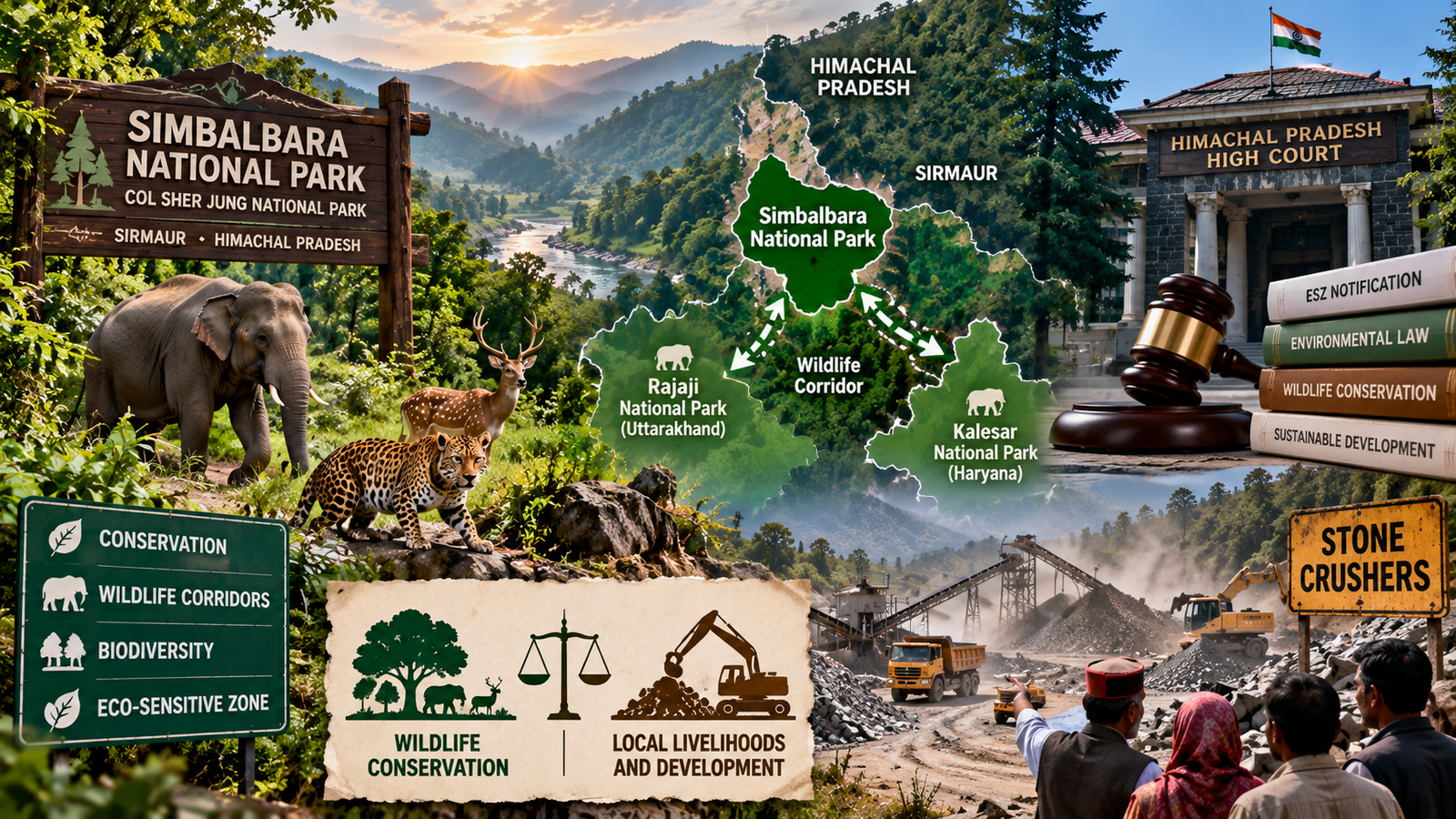
Simbalbara National Park in Himachal Pradesh’s Sirmaur district is in the news after the Himachal Pradesh High Court quashed the Eco-Sensitive Zone (ESZ) notification around the park.
The Court, in April 2026, set aside the 2022 ESZ notification after finding procedural deficiencies, including inadequate compliance with the prescribed consultation process. The case was brought by local residents and Gram Panchayats who had raised concerns about the impact of the ESZ on livelihoods and land-use activities.
The issue has gained fresh importance in September 2026 because stone crushers near the national park have reportedly resumed operations after the ESZ notification was quashed. The State government is yet to take a final decision on whether to challenge the judgment or initiate the process for a fresh ESZ notification.
This makes Simbalbara an important case study for:
- Environmental conservation
- Eco-Sensitive Zones
- Wildlife corridors
- Sustainable development
- Local livelihoods
- Environmental governance
- Judicial review
- Centre–State coordination
- Himachal Pradesh geography and environment
Where is Simbalbara National Park?
Simbalbara National Park, officially referred to as Col Sher Jung National Park, is located in Paonta Valley of Sirmaur district, Himachal Pradesh.
It lies close to the Himachal Pradesh–Haryana–Uttarakhand region and is part of a larger forest and wildlife landscape connecting protected areas across state boundaries.
The park is particularly important because of its ecological connection with:
- Rajaji National Park — Uttarakhand
- Kalesar National Park — Haryana
This connectivity makes Simbalbara more than an isolated protected area. It forms part of a broader wildlife landscape and corridor.
Simbalbara National Park: Basic Facts
| Feature | Details |
|---|---|
| Official name | Col Sher Jung National Park |
| Common name | Simbalbara National Park |
| District | Sirmaur |
| Region | Paonta Valley |
| State | Himachal Pradesh |
| Area | 27.88 sq km |
| Earlier status | Simbalbara Wildlife Sanctuary |
| National Park notification process | 2010 onward |
| Major vegetation | Sal and other dry deciduous/riverine vegetation |
| Important fauna | Leopard, sambar, chital, barking deer, nilgai, goral, wild boar etc. |
| Ecological connections | Rajaji and Kalesar landscapes |
| Current issue | ESZ notification quashed by Himachal Pradesh High Court |
The official Himachal Pradesh Forest Department management plan records the park’s area as 27.88 sq km and notes that the area was upgraded from the Simbalbara Wildlife Sanctuary after boundary rationalisation.
Why is Simbalbara Ecologically Important?
Simbalbara occupies a unique geographical position.
It lies near the transition between the Shivalik foothills, Punjab plains and the upper Gangetic landscape.
The Ministry of Environment’s earlier ESZ documentation described the area’s flora and fauna as showing affinities with:
- Western Himalayas
- Punjab plains
- Upper Gangetic plains
This gives Simbalbara a distinctive ecological character.
The Landscape is More Important than the Park Alone
One of the most important concepts for UPSC is:
Protected area conservation cannot always be limited to the legal boundary of a national park.
Wild animals move beyond protected-area boundaries in search of:
- food
- water
- breeding grounds
- seasonal habitats
- new territories
Therefore, surrounding landscapes can also be crucial.
This is particularly relevant in Simbalbara because the landscape is connected with protected areas in neighbouring states.
Wildlife Corridor
What is a Wildlife Corridor?
Hinglish: Wildlife corridor ek aisa natural landscape ya habitat connection hota hai jo animals ko ek habitat se doosre habitat tak move karne mein help karta hai.
English definition: A wildlife corridor is a habitat connection that enables animals to move between otherwise separated populations or habitats.
Why is Simbalbara a Corridor?
The Simbalbara landscape has been identified as important for movement of wildlife, including Asiatic elephants, between the broader landscapes of Uttarakhand and Haryana.
The High Court proceedings and subsequent reporting have highlighted this inter-state ecological connectivity.
This creates an important conservation principle:
Wildlife conservation is often a landscape-level issue rather than a boundary-level issue.
Tiger Connection
Simbalbara has also attracted attention because a tiger was recorded through camera trapping in February 2023.
This was significant because tiger presence in the landscape demonstrates that the region can function as part of a wider wildlife movement network.
Earlier reports also documented a tiger moving through the larger Rajaji–Simbalbara–Kalesar landscape.
UPSC Point
Do not conclude from a single tiger sighting that Simbalbara is a tiger reserve.
Simbalbara National Park is not a Tiger Reserve.
The tiger sighting is important because it highlights wildlife connectivity and habitat potential.
What is an Eco-Sensitive Zone?
An Eco-Sensitive Zone (ESZ) is an area around protected areas where certain activities are regulated to reduce pressure on ecologically sensitive habitats.
Simple Explanation
Think of a protected area as the core conservation space.
The surrounding ESZ acts as a:
protective transition zone
between the protected area and areas of intensive human activity.
Why are ESZs Created?
The broad objectives include:
- reducing pressure on protected areas
- regulating environmentally harmful activities
- protecting wildlife habitats
- maintaining ecological connectivity
- preventing uncontrolled industrialisation
- promoting sustainable development around protected areas
An ESZ does not automatically mean that every human activity becomes completely prohibited.
Different activities may be:
- prohibited
- regulated
- permitted subject to conditions
depending on the notification.
Legal Basis of ESZ
ESZ notifications are issued by the Central Government, primarily under powers provided by the Environment (Protection) Act, 1986 and the Environment (Protection) Rules, 1986.
The Ministry of Environment, Forest and Climate Change (MoEFCC) is the central ministry involved in the process.
The Simbalbara ESZ notification was also issued through the environmental regulatory framework under the Environment (Protection) Act.
The Simbalbara ESZ Notification
The final ESZ notification around Col Sher Jung National Park was issued in January 2022.
The notified ESZ covered approximately 31.24 sq km and included 19 villages spread across three Gram Panchayats:
- Bhatanwali
- Patalia
- Behral
The ESZ was intended to provide an additional layer of environmental protection around the national park.
What Activities Were a Concern?
The ESZ framework affected activities such as:
- mining
- stone crushing
- construction
- land-use changes
- industrial activities
- infrastructure-related activities
The exact regulatory treatment depends upon the activity and the provisions of the relevant notification.
The environmental concern was that intensive activities around the protected area could increase:
- habitat disturbance
- noise pollution
- air pollution
- fragmentation
- traffic pressure
- human–wildlife conflict
Why Did Local Residents Challenge the ESZ?
This is where the topic becomes important for governance and sustainable development.
Residents and local Gram Panchayats argued that the ESZ restrictions could affect:
- livelihood activities
- land use
- construction
- economic opportunities
- mining-related activities
The petition therefore brought two important interests into direct interaction:
Environmental protection
versus
Local livelihood and development concerns
The High Court’s judgment focused significantly on whether the legally prescribed process for creating the ESZ had been properly followed.
What Did the Himachal Pradesh High Court Decide?
The Himachal Pradesh High Court quashed the January 2022 ESZ notification around Col Sher Jung National Park.
The judgment was delivered in April 2026.
The Court found that the prescribed procedure had not been properly followed and emphasised the importance of consultation and procedural safeguards because ESZ declaration can have significant consequences for local residents.
Why Did Procedure Matter?
This is an important governance lesson.
Environmental regulation can directly affect:
- land use
- economic activity
- infrastructure
- livelihoods
- local communities
Therefore, environmental decision-making needs both:
ecological science
and
procedural legitimacy.
In the Simbalbara case, the Court found deficiencies in the process followed for the notification.
Earlier History of the ESZ Proposal
The Simbalbara ESZ issue did not begin in 2022.
An earlier draft notification had been issued in 2015.
The Ministry’s documents show that the proposed ESZ process had been under consideration for several years.
The earlier proposal covered an ESZ of approximately 31.24 sq km, extending up to 1.5 km around the protected area.
The subsequent process eventually resulted in the 2022 notification, which was later challenged before the High Court.
What Happened After the Court Judgment?
The consequences became more visible in 2026.
Reports in September 2026 state that stone crushers near Simbalbara have resumed operations after the ESZ notification was quashed.
The state government has not yet taken a final decision on whether to:
- challenge the High Court decision, or
- initiate a fresh ESZ notification process.
This has reopened the debate over how to balance environmental protection with economic activities around the park.
A New Regulatory Layer: NBWL Approval
Following the High Court judgment, the Himachal Pradesh Forest Department directed mining projects and stone-crusher operators within a 10-km radius of the protected area to obtain prior approval from the Standing Committee of the National Board for Wildlife (NBWL) before carrying out their activities.
This is important because the quashing of one ESZ notification does not mean that all environmental and wildlife-related laws cease to apply.
Different statutory and regulatory mechanisms can operate simultaneously.
What is the National Board for Wildlife?
The National Board for Wildlife (NBWL) is a statutory body under the Wild Life (Protection) Act, 1972.
It advises the Central Government on matters relating to wildlife conservation.
Its Standing Committee performs important functions related to wildlife clearances and protected-area-related proposals.
UPSC Trap
Do not confuse:
ESZ notification
with
Wildlife clearance under the Wildlife Protection Act.
They are related to conservation but arise from different legal mechanisms.
Simbalbara and Sustainable Development
The controversy illustrates a classic environmental governance problem:
How can development take place without destroying ecological systems?
If industrial activities are completely unrestricted, the protected area’s surrounding ecosystem may face increasing pressure.
If restrictions are imposed without adequate consultation and consideration of local livelihoods, social conflict may increase.
Therefore, sustainable environmental governance requires:
Conservation + Participation + Livelihood Security + Scientific Planning
Why Public Consultation Matters
Environmental governance increasingly recognises that local communities are important stakeholders.
Local people may possess:
- traditional ecological knowledge
- information about wildlife movement
- knowledge of local water systems
- knowledge of land-use patterns
- experience with human–wildlife conflict
At the same time, conservation regulations can directly affect their economic activities.
Therefore:
Participation is not merely a procedural formality.
It can improve both the legitimacy and practical effectiveness of conservation policy.
Simbalbara as a Case Study of Environmental Governance
The issue can be represented as:
Protected Area
↓
Ecologically Sensitive Landscape
↓
Local Communities
↓
Economic Activities
↓
Environmental Regulation
↓
Judicial Review
↓
Need for Balanced Conservation
This makes Simbalbara an excellent example for UPSC Mains answers on environmental governance.
Inter-State Ecological Connectivity
Another important feature is its location within a larger inter-state landscape.
Simbalbara
Himachal Pradesh
↓
Rajaji National Park
Uttarakhand
↓
Kalesar National Park
Haryana
The ecological processes do not stop at state boundaries.
Animals can move across administrative boundaries.
Therefore, conservation requires:
Inter-state coordination
rather than isolated state-level planning.
Why Landscape-Level Conservation Matters
Traditional conservation often focuses on protected areas.
Modern conservation increasingly recognises the importance of:
- wildlife corridors
- buffer landscapes
- ecological connectivity
- habitat mosaics
- human–wildlife interfaces
This is particularly important for wide-ranging species.
For example:
Elephants → large home ranges → movement across landscapes → need for corridors
Therefore, conservation planning must sometimes extend beyond individual protected areas.
Simbalbara and Human–Wildlife Conflict
When wildlife moves outside protected areas, interaction with human settlements can increase.
Potential consequences include:
- crop damage
- livestock loss
- property damage
- road accidents
- human injuries
- retaliatory killing of wildlife
Thus, protecting corridors can sometimes reduce conflict by maintaining natural movement routes.
But corridor conservation itself can affect land use and livelihoods.
This creates another governance challenge.
Major Environmental Concepts from the Issue
Eco-Sensitive Zone
Hinglish: Protected area ke around ek regulated zone jahan harmful activities ko control kiya jata hai.
English definition: A regulated area around protected ecosystems intended to reduce ecological pressure and promote compatible land use.
Wildlife Corridor
Hinglish: Aisa ecological connection jo animals ko different habitats ke beech move karne deta hai.
English definition: A habitat linkage that facilitates movement of wildlife between fragmented habitats.
Habitat Fragmentation
Hinglish: Jab ek large natural habitat roads, industries, settlements ya other development ke karan chhote isolated patches mein divide ho jata hai.
English definition: The division of continuous habitat into smaller, isolated patches due to human or natural processes.
Buffer Zone
Hinglish: Core protected area aur intensive human-use area ke beech ka transition region.
English definition: An area surrounding or adjoining a protected zone that helps reduce external pressures.
Sustainable Development
Hinglish: Aisa development jo present needs ko meet kare without future generations ki ability ko compromise kiye.
English definition: Development that meets present needs without compromising the ability of future generations to meet their own needs.
Simbalbara: Geography Perspective
Simbalbara is also important from a physical and biogeographical perspective.
The park lies in the Shivalik/foothill environment and has ecological characteristics influenced by neighbouring plains and Himalayan landscapes.
The official Himachal tourism description highlights an overlap of flora and fauna associated with the Western Himalayas, Punjab plains and Upper Gangetic plains. It also describes vegetation including dry mixed deciduous, Sal and riverine forests.
Important Geographical Idea
Ecotone
An ecotone is a transition zone between two ecological communities.
Such areas can show high ecological diversity because species from neighbouring ecosystems may coexist.
Simbalbara’s location makes it useful for understanding this type of ecological transition.
Prelims Perspective
Important Facts
| Topic | Fact |
|---|---|
| National Park | Col Sher Jung National Park |
| Common name | Simbalbara National Park |
| District | Sirmaur |
| Valley | Paonta Valley |
| Area | 27.88 sq km |
| Earlier status | Wildlife Sanctuary |
| Important landscape connections | Rajaji and Kalesar |
| Important fauna | Leopard, sambar, chital, nilgai, goral etc. |
| ESZ notification | January 2022 |
| ESZ area | 31.24 sq km |
| Villages in notified ESZ | 19 |
| Gram Panchayats | Bhatanwali, Patalia, Behral |
| High Court action | ESZ notification quashed in April 2026 |
| Current issue | Stone crushers reportedly resumed near the park |
The park’s 27.88 sq km figure comes from the Himachal Pradesh Forest Department’s management plan; the 31.24 sq km figure refers to the separate ESZ area. Do not confuse these two numbers.
UPSC Mains Connection
GS Paper III
Environment
Relevant themes:
- Environmental conservation
- Protected areas
- Wildlife conservation
- Environmental impact of development
- Human–wildlife conflict
- Sustainable development
- Biodiversity conservation
Governance Connection
The issue can also be linked to:
- public consultation
- environmental governance
- judicial review
- stakeholder participation
- Centre–State coordination
Possible UPSC Mains Question
“The Simbalbara National Park ESZ controversy highlights the difficult balance between ecological conservation and local livelihood concerns. Discuss.”
Answer Framework
Introduction
Introduce Simbalbara National Park and the 2026 High Court judgment.
Body
Discuss:
- ecological significance
- wildlife corridor
- ESZ concept
- local livelihood concerns
- procedural safeguards
- judicial review
- stone-crusher issue
- need for inter-state coordination
Way Forward
Suggest:
- fresh scientific assessment
- meaningful public consultation
- participatory Zonal Master Plan
- wildlife corridor mapping
- regulated rather than indiscriminate development
- strict monitoring of mining and stone crushing
- livelihood-sensitive conservation
- coordination among Himachal Pradesh, Haryana and Uttarakhand
Conclusion
Conservation should combine ecological security with participatory and legally sound environmental governance.
HPPSC Perspective
This topic is highly relevant for HPPSC/HPAS because it combines Himachal-specific geography, environment, wildlife and current affairs.
Focus especially on:
- Sirmaur district
- Paonta Valley
- Simbalbara National Park
- Col Sher Jung National Park
- area of the park
- Rajaji–Simbalbara–Kalesar landscape
- wildlife corridor
- ESZ
- 2022 ESZ notification
- 2026 Himachal Pradesh High Court judgment
- three Gram Panchayats
- 19 villages
- stone crushers
- National Board for Wildlife
- human–wildlife conflict
- sustainable development
Likely HPPSC Prelims Questions
Question
Consider the following statements regarding Simbalbara National Park:
- It is located in Sirmaur district.
- It is connected ecologically with protected areas in Haryana and Uttarakhand.
- It is located in the higher Himalayan zone of Himachal Pradesh.
Which of the statements given above is/are correct?
Answer: 1 and 2 only.
Question
The recent controversy concerning Simbalbara National Park is primarily associated with:
A. Construction of a new dam inside the park
B. Relocation of the national park
C. Eco-Sensitive Zone notification and its judicial quashing
D. Declaration of Simbalbara as a Tiger Reserve
Answer: C
Common Confusions
Simbalbara vs Kalesar
Simbalbara → Himachal Pradesh
Kalesar → Haryana
Simbalbara vs Rajaji
Simbalbara → Himachal Pradesh
Rajaji → Uttarakhand
National Park vs ESZ
National Park → legally protected core area.
ESZ → surrounding regulated landscape.
Park Area vs ESZ Area
National Park: 27.88 sq km
Notified ESZ: 31.24 sq km
These are not the same area.
One-Page Revision Notes
Simbalbara National Park
Location: Sirmaur, Himachal Pradesh
Valley: Paonta Valley
Area: 27.88 sq km
Earlier status: Wildlife Sanctuary
Important landscape: Rajaji–Simbalbara–Kalesar
Key fauna: Leopard, sambar, chital, nilgai, goral, wild boar
Ecological importance: Wildlife movement and biodiversity
ESZ Issue
2022: ESZ notification
Area: 31.24 sq km
Villages: 19
Gram Panchayats: Bhatanwali, Patalia, Behral
2026: Himachal Pradesh High Court quashed notification
Reason: Procedural deficiencies and inadequate stakeholder consultation
September 2026: Reports of stone crushers resuming
Current policy question: Fresh ESZ / appeal / alternative regulatory protection
The Bigger UPSC Concept
The Simbalbara case should not be memorised merely as a current-affairs fact.
It represents a larger environmental governance triangle:
Ecological Security
↕
Local Livelihoods
↕
Development
A sustainable solution must balance all three.
The case also demonstrates that environmental conservation requires not only scientific justification but also legally sound procedures, stakeholder participation and inter-governmental coordination.
Conclusion
The Simbalbara controversy is an important example of the challenges involved in protecting biodiversity in landscapes where conservation areas coexist with villages, infrastructure and economic activities.
The 2026 High Court judgment does not end the conservation question. Instead, it highlights the need for a fresh, scientifically informed and participatory approach to environmental regulation around the national park.
For UPSC and HPPSC, the key lesson is broader than Simbalbara itself:
Effective conservation requires ecological connectivity, community participation, lawful environmental governance and sustainable development to work together.
Memory Trick
SIMBALBARA = SIRMAUR + INTERSTATE CORRIDOR + MINING/CRUSHERS + BOUNDARY ESZ + ANIMAL MOVEMENT + LIVELIHOODS + BHC JUDGMENT + AREA 27.88