UN Security Council Reform 2026: India’s Case, G4, Veto and the Future of Global Governance
Why This Topic Matters
The reform of the United Nations Security Council (UNSC) has again gained importance in 2026 as countries continue negotiations on how to make the Council more representative of today’s geopolitical realities.
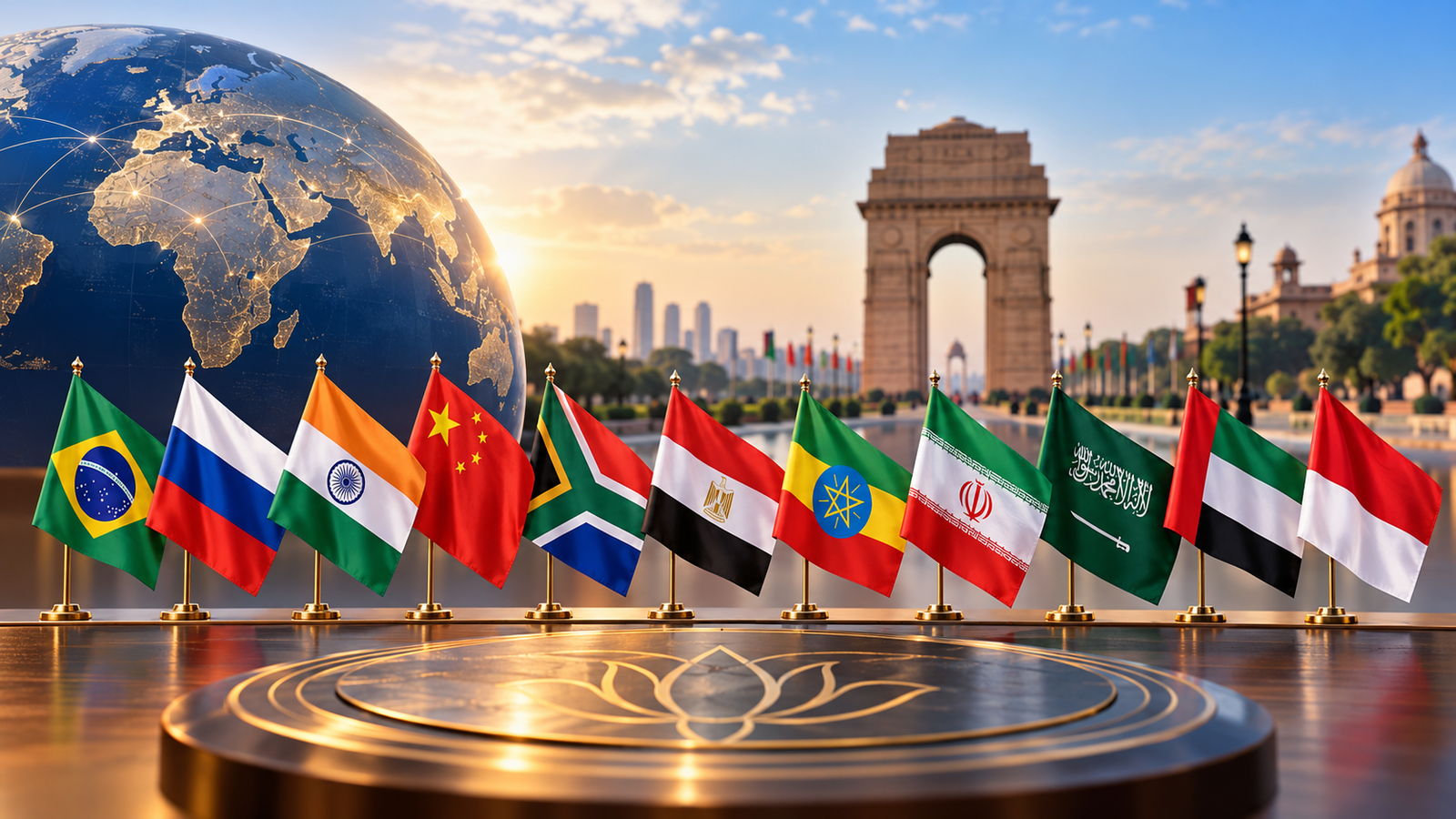
In September 2026, during the 18th BRICS Summit in New Delhi, India again highlighted the need for greater representation of the Global South in global decision-making institutions, including the UN Security Council. India and the UN Secretary-General also discussed the need to reform multilateral institutions during their September 2026 meeting.
At the United Nations, the Intergovernmental Negotiations (IGN) on Security Council reform continued during the 80th session of the General Assembly in 2026. Discussions have covered the size and composition of the Council, regional representation, veto, working methods and the relationship between effectiveness and representativeness.
For UPSC and HPPSC, this topic connects International Relations, Indian Foreign Policy, Global Governance, Multilateralism, UN institutions and India’s claim for a permanent seat.
First Understand: What is the UN Security Council?
The United Nations Security Council is the principal UN organ responsible for maintaining international peace and security.
It can:
- consider international conflicts and threats to peace
- recommend peaceful solutions
- impose sanctions
- authorise certain peacekeeping or enforcement actions
- establish international sanctions regimes
- authorise the use of force in certain circumstances under the UN Charter
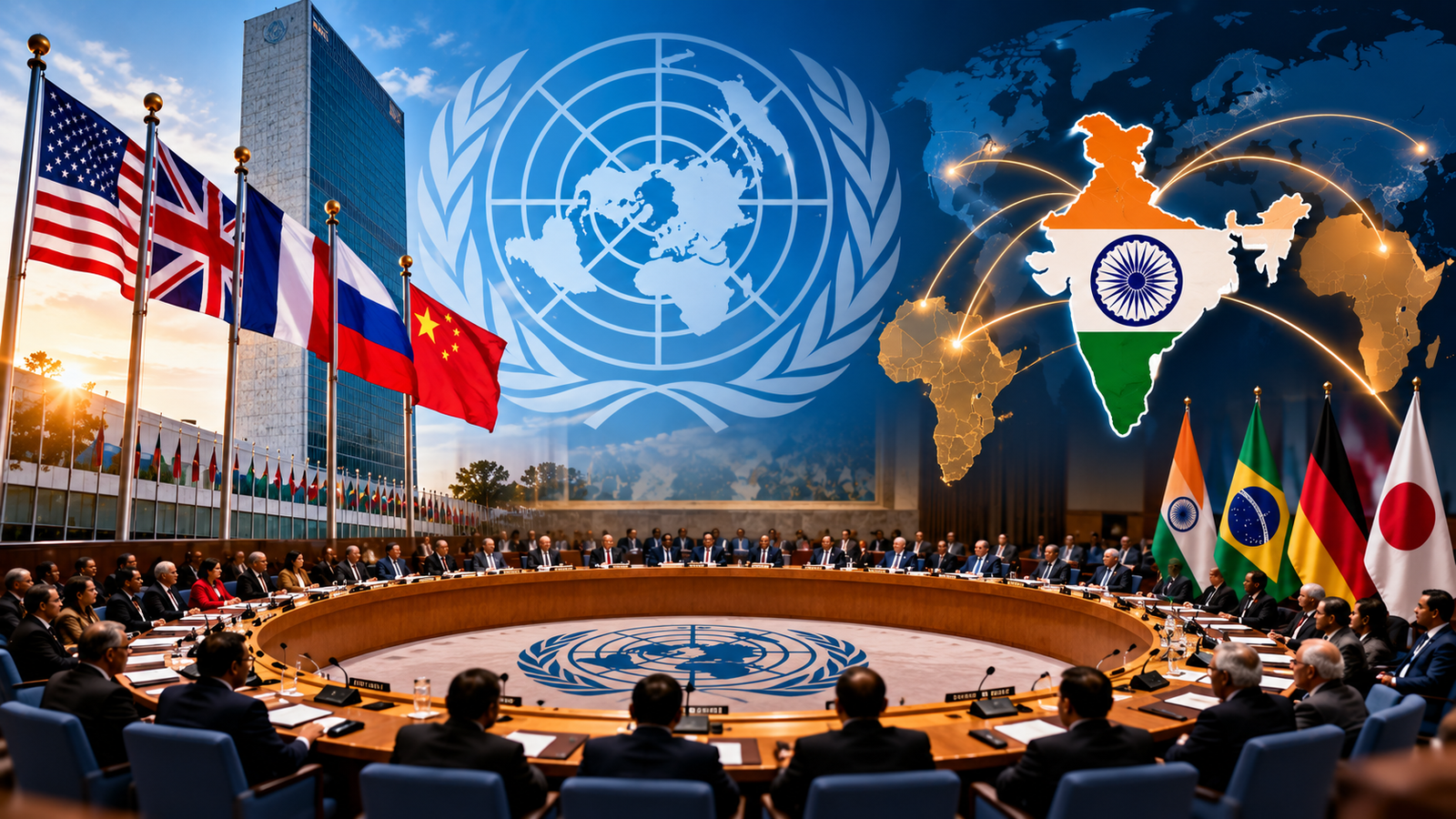
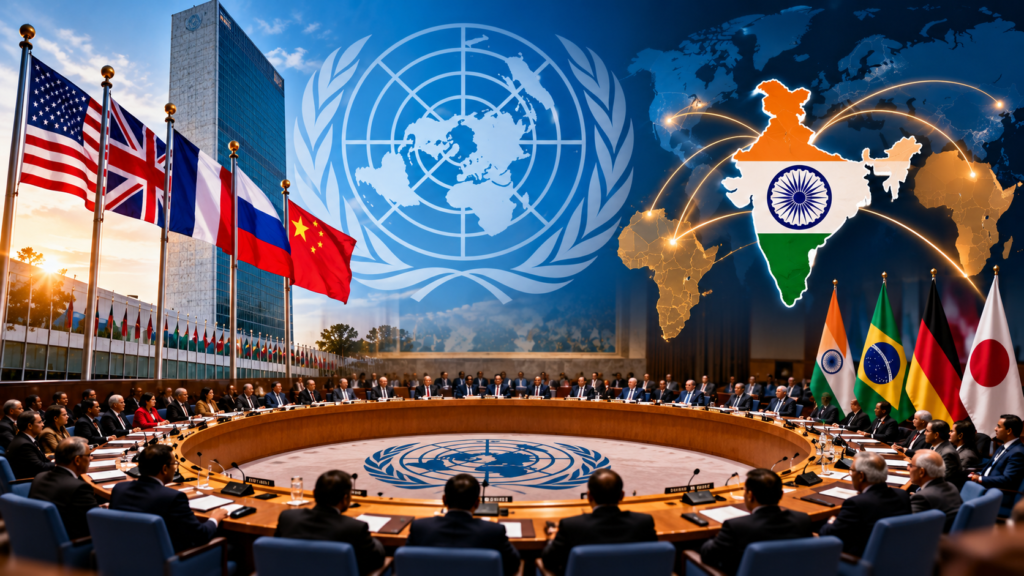
The Council currently has 15 members:
- 5 Permanent Members (P5)
- 10 Non-Permanent Members
The five permanent members are:
United States, Russia, China, France and United Kingdom.
The ten non-permanent members are elected by the UN General Assembly for two-year terms.
What is the Veto?
The veto is the special voting power of the five permanent members.
Under Article 27 of the UN Charter, substantive decisions require at least nine affirmative votes, including the concurring votes of the permanent members. A negative vote by a permanent member can therefore block adoption of a substantive resolution.
Important UPSC Point
A permanent member’s abstention is not the same as a veto.
If a P5 member abstains, a resolution can still pass if it receives the required nine affirmative votes.
Why is UNSC Reform Needed?
The central issue is that the geopolitical structure of 1945 is very different from that of the 21st century.
The UN was created after the Second World War. Since then:
- the number of UN members has increased substantially
- Asia, Africa and Latin America have gained greater political importance
- many developing countries have become important economic and diplomatic actors
- new security challenges have emerged
- global power has become more geographically dispersed
Yet the permanent membership of the Security Council remains unchanged.
This has created a debate over representativeness, legitimacy and effectiveness.
The Central Reform Questions
UNSC reform is not simply about adding countries.
There are several interconnected questions.
Who should become permanent members?
Countries such as India, Japan, Germany and Brazil have advocated permanent representation.
African countries have also demanded permanent representation for Africa.
How many members should the Council have?
There is disagreement over the appropriate size of an enlarged Council.
Should new permanent members receive veto power?
This is one of the most difficult issues.
How should regions be represented?
Africa, Asia-Pacific, Latin America and the Caribbean, and other underrepresented regions have different proposals.
Should only non-permanent membership be expanded?
Some countries favour expanding the Council without creating new permanent seats.
India’s Case for UNSC Reform
India has consistently supported comprehensive reform of the Security Council.
India’s position broadly focuses on:
- expansion of both permanent and non-permanent categories
- greater representation of developing countries
- stronger representation of Africa
- greater representation of the Global South
- making the Council more reflective of contemporary geopolitical realities
- improving the legitimacy and effectiveness of the UN
India has also repeatedly sought a permanent seat in an expanded Security Council.
Why Does India Claim Permanent Membership?
India’s argument is based on several factors.
Large Population
India represents a very large share of humanity.
A central argument is that a Council claiming to represent international peace and security should adequately reflect major population centres.
Major Economy
India has emerged as one of the world’s largest economies and an important participant in global economic governance.
Contribution to UN Peacekeeping
India has historically been one of the major contributors to UN peacekeeping operations.
This provides India with an important argument based on its contribution to international peace and security.
Longstanding UN Member
India was among the original members of the United Nations and has participated extensively in the UN system.
Global South Representation
India presents itself as an important voice of developing countries and the Global South.
This became particularly visible during India’s leadership of platforms such as the G20 and BRICS.
Strategic and Diplomatic Capability
India is an important actor in the Indo-Pacific, Indian Ocean region and wider international system.
Its foreign policy engagement spans:
- Indo-Pacific
- Global South
- BRICS
- G20
- Quad
- SCO
- Commonwealth
- UN system
The G4 Group
One of the most important groups in the UNSC reform debate is the G4.
It consists of:
- India
- Brazil
- Germany
- Japan
The four countries support each other’s aspirations for permanent membership.
The G4 has advocated expansion in both permanent and non-permanent categories.
In 2026, G4 discussions continued within the UN’s Intergovernmental Negotiations process.
The G4 Model
The G4 has proposed a larger Security Council with:
- new permanent members
- additional non-permanent members
- better geographical representation
A G4 statement in 2026 described a model involving six new permanent members:
- two from Africa
- two from Asia-Pacific
- one from Latin America and the Caribbean
- one from Western European and Others Group
It also proposed additional non-permanent seats.
Important
These are G4 proposals, not an adopted UN reform formula.
This distinction is important in UPSC answers.
Africa and UNSC Reform
Africa is central to the reform debate because the continent has no permanent seat on the Security Council.
The African Union has developed a common position on Security Council reform.
The African position broadly seeks:
- permanent African representation
- additional non-permanent representation
- meaningful participation in decision-making
- correction of historical underrepresentation
In April 2026, an African Model was formally transmitted to the co-chairs of the Intergovernmental Negotiations.
This is significant because India and the G4 have also supported stronger African representation.
The L.69 Group
Another important grouping is the L.69 Group.
It is a cross-regional coalition of developing countries supporting reform of the Security Council.
The group has pushed for:
- expansion of the Security Council
- greater representation of developing countries
- permanent and non-permanent representation
- greater participation of underrepresented regions
India has worked with the L.69 Group in the broader reform process.
What is the Intergovernmental Negotiations Process?
The Intergovernmental Negotiations (IGN) are the principal framework through which UN Member States discuss Security Council reform in the General Assembly.
The process focuses on issues such as:
- categories of membership
- regional representation
- size of an enlarged Council
- veto
- working methods
- relationship between the Council and General Assembly
The IGN continued during the 80th General Assembly session in 2026, with meetings held in February, April, May and June.
Five Major Reform Clusters
For exam purposes, remember these five broad areas.
Categories of Membership
Should there be:
- new permanent members?
- only additional non-permanent members?
- longer-term non-permanent seats?
Regional Representation
Which regions should receive additional representation?
Africa and Latin America are particularly important in this debate.
Veto
Should:
- the existing veto continue?
- new permanent members receive veto?
- veto use be restricted?
- new permanent members initially remain without veto?
Size of the Council
How large should an enlarged Council become while remaining effective?
Working Methods
This includes:
- transparency
- consultation
- accountability
- penholding
- relationship with wider UN membership
The 2026 co-chairs’ elements paper records both areas of convergence and continuing differences, particularly over permanent versus non-permanent expansion.
The Veto Problem
The veto is perhaps the most difficult aspect of reform.
The five existing permanent members have veto power.
The major question is:
If new permanent members are created, should they also receive veto power?
Different positions exist.
Some countries support equal rights for new permanent members.
Others oppose expanding veto power because they believe it could make the Council even less effective.
The 2026 IGN discussions specifically examined different approaches to veto reform, including possible limitations and different arrangements for new permanent members.
G4 Position on Veto
The G4 has shown some flexibility on the question.
A 2026 G4 statement proposed that new permanent members could initially refrain from exercising the veto, followed by a review after 15 years.
This is important because it demonstrates that the reform debate is not simply:
“New permanent members = immediate veto power.”
Different transitional arrangements have been proposed.
Why is Reform Difficult?
The biggest obstacle is that UNSC reform requires amendment of the UN Charter.
Article 108 provides that Charter amendments require:
- adoption by a two-thirds majority of the General Assembly
- ratification by two-thirds of UN members
- ratification by all five permanent members of the Security Council
Therefore, the existing P5 have a decisive role in the legal process of reform.
UPSC Trap
Do not write:
“Two-thirds of the General Assembly alone can reform the Security Council.”
That is incomplete.
The Charter amendment must ultimately satisfy the requirements of Article 108, including ratification by all P5.
1965 Reform: Important Historical Background
The Security Council has been expanded before.
Originally, it had:
11 members
It was later expanded to:
15 members
The 1963 amendment to Articles 23 and 27 increased the Council’s membership from 11 to 15 and increased the required affirmative votes from seven to nine.
The amendment entered into force in 1965.
This historical example is useful because it demonstrates that Security Council reform is legally possible.
However, today’s proposed reforms are much more politically complex because they involve questions about new permanent membership and veto power.
Why Does India Need UNSC Reform?
India’s argument can be understood through the concept of representative multilateralism.
Present Structure
1945 geopolitical structure
↓
Five permanent powers
↓
Limited representation of today’s Global South
Proposed Direction
Contemporary geopolitical realities
↓
Greater regional representation
↓
More inclusive Security Council
↓
More legitimate multilateral governance
UNSC Reform and Global South
The reform debate is closely connected with the rise of the Global South.
What is Global South?
The term broadly refers to developing and emerging countries, particularly in:
- Asia
- Africa
- Latin America
- parts of the Middle East and other developing regions
It is not simply a geographical term.
It is also used in discussions about:
- development
- global inequality
- representation
- international institutions
- climate finance
- technology
- trade
- global governance
During the 2026 BRICS Summit, India argued that global governance should provide greater representation to the Global South, including through reform of institutions such as the UN Security Council.
India, BRICS and UNSC Reform
The BRICS platform provides India with another diplomatic forum for discussing global governance reform.
The New Delhi BRICS Declaration 2026 called for a more representative and fairer international order and a strengthened multilateral system.
This connects three important concepts:
BRICS → Global South → Multilateral Reform
For UPSC, this connection is highly useful in International Relations answers.
UNSC Reform and India’s Foreign Policy
India’s position on UNSC reform reflects a broader foreign policy objective:
greater participation in global decision-making.
This connects with India’s approach towards:
- strategic autonomy
- multipolarity
- Global South diplomacy
- reform of global institutions
- rules-based international order
- multilateralism
India therefore does not view UNSC reform as only a question of obtaining a permanent seat.
It is also connected with the broader question:
Who gets to make global rules?
Arguments Supporting UNSC Reform
Supporters of reform generally point to:
Changed Global Power Structure
The distribution of economic and political power has changed substantially since 1945.
Representation
Large regions and populations remain underrepresented in permanent decision-making.
Legitimacy
Greater representation could strengthen the perceived legitimacy of the Council.
Global South
Developing countries seek greater participation in global governance.
Contemporary Security Challenges
Modern threats include:
- terrorism
- cyber threats
- climate-related security risks
- pandemics
- maritime security
- emerging technologies
The institutional structure needs to remain relevant to these challenges.
Challenges and Counter-Arguments
A balanced UPSC answer should also mention the challenges.
Larger Council
Increasing membership could make consensus and decision-making more difficult.
Veto Expansion
Adding more veto holders could potentially increase deadlocks.
Regional Rivalries
Different countries within the same region may disagree over who should receive permanent representation.
P5 Resistance
The existing permanent members have different interests regarding reform.
Multiple Reform Models
There is no universally accepted model.
Charter Amendment
The legal threshold under Article 108 makes reform difficult.
India and the Question of China
China is particularly relevant to India’s UNSC reform debate because China is:
- a current P5 member
- a major Asian power
- one of the countries whose position matters to any Charter amendment
For an exam answer, avoid oversimplification.
Instead of writing:
“China alone is blocking India’s permanent membership.”
write:
“India’s permanent-membership bid operates within a broader political and negotiating environment involving the positions of the P5 and competing reform models.”
This is more accurate and analytically sound.
India-France Support
India has received support from several countries for UNSC reform.
France has supported:
- expansion of the Security Council
- India’s permanent membership
- greater African representation
- discussions on regulating veto use in situations involving mass atrocities.
Such diplomatic support strengthens India’s international coalition-building around reform, although it does not itself change the UN Charter.
What is the Way Forward?
A workable reform process would require balancing three objectives:
Representation
↓
Effectiveness
↓
Legitimacy
An enlarged Council should represent contemporary geopolitical realities while remaining capable of taking timely decisions.
Possible areas of discussion include:
- expansion of both membership categories
- stronger regional representation
- greater African representation
- transparent selection mechanisms
- responsible use of veto
- improved working methods
- stronger General Assembly–Security Council interaction
- movement from broad statements toward text-based negotiations
The 2026 IGN discussions themselves indicate that Member States continue to debate these issues, with some convergence on enlargement but significant differences over the exact model.
India’s UNSC Reform: The Bigger Picture
The issue should not be studied merely as:
“Will India get a permanent seat?”
The larger issue is:
How should global governance institutions adapt to a changing international order?
This makes the topic relevant to:
- International Relations
- Global Governance
- Multilateralism
- India’s Foreign Policy
- Global South
- UN reforms
- Multipolarity
- Strategic Autonomy
UPSC Prelims Perspective
Key Facts to Remember
| Topic | Fact |
|---|---|
| UNSC members | 15 |
| Permanent members | 5 |
| Non-permanent members | 10 |
| Non-permanent tenure | 2 years |
| P5 | US, UK, France, Russia, China |
| Veto | Held by P5 |
| Current reform mechanism | Intergovernmental Negotiations |
| G4 | India, Brazil, Germany, Japan |
| Charter amendment | Article 108 |
| Substantive decision | 9 votes including concurring votes of P5 |
| Original UNSC size | 11 |
| Present UNSC size | 15 |
Important Keywords
Multilateralism
Hinglish: Multiple countries milkar international problems ko institutions aur rules ke through address karte hain.
English definition: A system in which multiple states cooperate through international institutions and agreed rules.
Multipolarity
Hinglish: Jab global power sirf ek ya do countries ke paas concentrated na hokar multiple major powers ke beech distributed ho.
English definition: An international system in which power is distributed among several major centres.
Global South
Hinglish: Developing aur emerging countries ka broad political-economic grouping.
English definition: A broad term referring mainly to developing and emerging countries seeking greater voice in global governance.
Veto
Hinglish: P5 ka special power jisse woh substantive UNSC resolution ko block kar sakta hai.
English definition: The special voting power of a permanent Security Council member to prevent adoption of a substantive resolution.
Permanent Member
Hinglish: UNSC ka aisa member jo continuously Council ka member hota hai aur veto power rakhta hai.
English definition: A Security Council member holding a permanent seat and veto power.
Intergovernmental Negotiations
Hinglish: UN Member States ke beech UNSC reform ke different aspects par formal political negotiations ka process.
English definition: The General Assembly process through which Member States negotiate Security Council reform.
UPSC Mains Connection
GS Paper II
International Relations
Relevant syllabus areas:
- Effect of policies and politics of developed and developing countries on India’s interests
- Important international institutions and agencies
- India and its neighbourhood
- Global groupings and agreements
- International organisations
Possible UPSC Mains Questions
Question
“The existing structure of the UN Security Council reflects the geopolitical realities of 1945 more than those of the 21st century.” Discuss the need for UNSC reform with special reference to India’s position.
Answer Framework
Introduction
Explain the role of UNSC and its present 15-member structure.
Body
Discuss:
- changing global power distribution
- underrepresentation of Global South
- India’s credentials
- G4
- African representation
- veto question
- competing reform models
- Article 108
- effectiveness versus representation
Conclusion
Emphasise the need for a more representative, legitimate and effective multilateral system.
Essay Themes
This topic can be connected with:
- Reforming global institutions for a changing world
- Multilateralism in a multipolar world
- Global South and global governance
- Power, representation and international institutions
- India’s role in shaping the emerging world order
HPPSC Perspective
For HPPSC, focus particularly on:
- UN Security Council composition
- P5 and veto
- India’s permanent membership demand
- G4
- Global South
- UN reforms
- India’s foreign policy
- BRICS and multilateralism
- Article 108 of UN Charter
- India-France support
- African representation
HPAS questions can combine current affairs + international organisations + India’s foreign policy.
One-Page Revision
UNSC Reform — 10 Things to Remember
UNSC → 15 members
P5 → US + UK + France + Russia + China
Non-Permanent → 10
Veto → P5
G4 → India + Brazil + Germany + Japan
Reform process → IGN
Major issue → Representation + Membership + Veto
India’s demand → Permanent membership in an expanded UNSC
Legal provision → Article 108
Core debate → Representation vs Effectiveness
Final Conceptual Chain
1945 UN Structure
↓
Changed Global Power Distribution
↓
Underrepresentation of Global South
↓
Demand for UNSC Reform
↓
G4 + African Model + L.69 + Other Proposals
↓
Debate over Membership + Regional Representation + Veto
↓
Intergovernmental Negotiations
↓
Need for Charter Amendment
↓
More Representative Global Governance
Conclusion
UN Security Council reform is ultimately a debate about the architecture of global governance.
For India, permanent membership is important, but the larger strategic objective is greater participation in institutions that shape international peace, security and global rules.
The 2026 reform discussions show that there is continuing international engagement on the issue, but significant differences remain over the size, composition, veto and regional distribution of an expanded Council. Therefore, the most useful way to understand the issue for UPSC is not merely as India’s quest for a permanent seat, but as a broader debate over representation, legitimacy, effectiveness and the future of multilateralism.
UPSC Memory Line:
UNSC Reform = Representation + Global South + G4 + Africa + Veto + Article 108 + Multilateralism