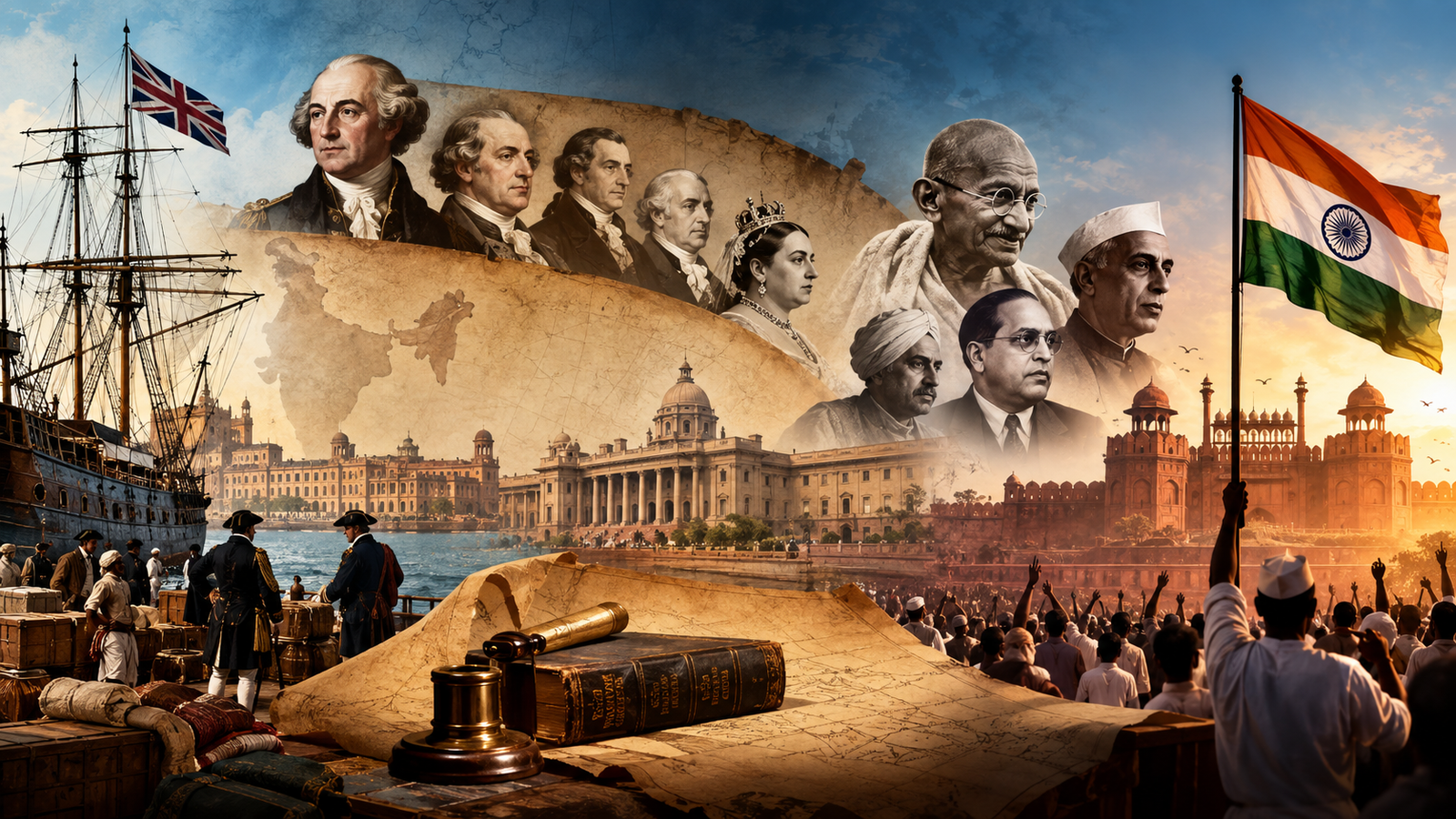
Historical Background of the Indian Constitution: From East India Company Rule to Independence (1600–1947)
The Constitution of India did not emerge suddenly in 1950. Its institutional foundations developed gradually over nearly two centuries of British rule. During this period, India moved through several constitutional stages: a private trading company became a territorial authority; the British Parliament began regulating it; Company rule was replaced by Crown rule; Indians were gradually associated with legislation; representative institutions and limited responsible government developed; provincial autonomy and federal ideas emerged; and finally British rule ended in 1947.
Understanding this journey is essential because many institutions and constitutional ideas of modern India—central administration, legislative councils, bicameralism, public service commissions, federal distribution of powers, provincial autonomy and responsible government—have roots in this historical evolution.
From a Trading Company to a Political Power: 1600–1765
The East India Company (EIC) received a Royal Charter in 1600 and initially came to India primarily for trade. At this stage, it was not established as a government or territorial ruler.
A decisive change occurred in 1765, when the Company acquired the Diwani of Bengal, Bihar and Orissa. Diwani broadly involved the right to collect revenue and administer civil justice. With these rights, the Company was no longer merely a commercial organisation; it had acquired significant territorial, administrative and political authority.
This created a fundamental constitutional problem: How could a private commercial corporation exercise political power over large territories without effective public accountability?
The British Parliament’s answer began with the Regulating Act of 1773.
The Regulating Act, 1773: Beginning of Parliamentary Control
The Regulating Act of 1773 was the first major step taken by the British Government to control and regulate the affairs of the East India Company. It also laid the foundation for central administration in British India.
The Governor of Bengal was redesignated as the Governor-General of Bengal, assisted by a four-member Executive Council. Warren Hastings became the first Governor-General of Bengal.
The Presidencies of Bombay and Madras were made subordinate to the Governor-General of Bengal in important matters, strengthening the process of centralisation.
The Act also provided for the establishment of a Supreme Court at Calcutta, which came into existence in 1774, consisting of one Chief Justice and three other judges.
Company servants were prohibited from engaging in private trade and accepting presents or bribes, while the Court of Directors was required to report important revenue, civil and military matters.
Thus, 1773 marks the beginning of a new phase:
Company’s territorial power → Parliamentary regulation and centralisation
A common examination trap must be avoided:
Warren Hastings was the first Governor-General of Bengal, not the first Governor-General of India.
Amending Act of 1781: Correcting the Defects of 1773
The Regulating Act created jurisdictional conflicts, particularly involving the Supreme Court. The Amending Act of 1781, also known as the Act of Settlement, was therefore enacted to rectify these defects.
Official actions of the Governor-General, his Council and Company servants received protection from the jurisdiction of the Supreme Court. Revenue matters were also excluded from the Court’s jurisdiction.
The Act recognised the importance of personal laws. Hindu defendants were to be governed by Hindu law and Muslims by Mohammedan law in relevant personal matters.
Appeals from Provincial Courts were to go to the Governor-General-in-Council rather than the Supreme Court.
The constitutional sequence therefore becomes:
1773 → Regulation
1781 → Rectification
Pitt’s India Act, 1784: The System of Dual Control
The Pitt’s India Act of 1784 made an important distinction between the Company’s commercial functions and its political functions.
Commercial affairs continued under the Court of Directors, while political affairs came under a newly created Board of Control.
This arrangement is commonly described as Double Government or Dual Control.
The Board of Control was empowered to supervise important civil, military and revenue matters. The Act also referred to Company territories as British possessions in India and strengthened the British Government’s control over Indian administration.
However, Pitt’s India Act did not abolish the East India Company or transfer the entire administration directly to the Crown. Company rule continued until 1858.
Act of 1786 and Lord Cornwallis
When Lord Cornwallis was appointed Governor-General of Bengal, he demanded two important powers.
First, he wanted authority to override his Council in special circumstances. Second, he wanted permission to simultaneously serve as Commander-in-Chief.
The Act of 1786 enabled these arrangements.
For quick revision:
1786 → Cornwallis → Override Council + Commander-in-Chief
Charter Act of 1793: Continuation and Extension
The Charter Act of 1793 continued the Company’s trade monopoly for another 20 years.
It also extended the overriding powers associated with Cornwallis to future Governors-General and Presidency Governors and strengthened the Governor-General’s control over Bombay and Madras.
This Act is therefore best understood as an Act of extension and continuation rather than fundamental constitutional restructuring.
Charter Act of 1813: Breaking the Company’s Trade Monopoly
The Charter Act of 1813 marked an important change in the Company’s commercial position.
Its trade monopoly in India was abolished, with important exceptions:
Trade in tea and trade with China remained under the Company’s monopoly.
The Act also asserted the sovereignty of the British Crown over Company territories, permitted Christian missionaries to operate in India and provided for the spread of western education.
The important commercial progression is:
1813 → Commercial monopoly partially broken
This process would be completed by the Charter Act of 1833.
Charter Act of 1833: The Great Centralising Act
The Charter Act of 1833 represented the final major step towards centralisation in British India.
The Governor-General of Bengal became the Governor-General of India, and Lord William Bentinck became the first Governor-General of India.
This distinction is extremely important:
Warren Hastings → First Governor-General of Bengal
William Bentinck → First Governor-General of India
The Governors of Bombay and Madras were deprived of their legislative powers, while the Governor-General of India acquired exclusive legislative authority for British India.
Another historic change involved the East India Company’s commercial character. Its remaining commercial activities were terminated, turning it essentially into an administrative body.
The Act also attempted to introduce an open competition principle for recruitment to the civil services, but the provision was not effectively implemented.
Therefore:
1813 → Company’s monopoly partially ended
1833 → Company’s commercial activities completely ended
Charter Act of 1853: Legislative–Executive Separation
The Charter Act of 1853 was the last Charter Act.
For the first time, the legislative and executive functions of the Governor-General’s Council were separated. Six new legislative councillors were added, creating a distinct legislative wing that functioned somewhat like a “mini-Parliament.”
The Act also introduced an open competition system for civil service recruitment, followed by the appointment of the Macaulay Committee in 1854.
This creates another highly important examination pair:
1833 → Open competition attempted
1853 → Open competition introduced
Unlike previous Charter Acts, the 1853 Act did not extend Company rule for another fixed period, indicating that Parliament could terminate the Company’s administrative role whenever it considered appropriate.
And that happened only a few years later.
Government of India Act, 1858: Company Rule Ends, Crown Rule Begins
The Revolt of 1857 fundamentally altered Britain’s approach towards governing India.
The Government of India Act, 1858, also associated with the idea of the Good Government of India, abolished the East India Company and transferred its governmental powers, territories and revenues to the British Crown.
The Governor-General of India was additionally designated as the Viceroy of India, representing the Crown.
Lord Canning became the first Viceroy of India.
The earlier system of dual control also ended. Both the Court of Directors and the Board of Control were abolished.
A new office, the Secretary of State for India, was established. He was assisted by a 15-member Council of India.
The constitutional transition can therefore be remembered simply:
1858 = Company OUT → Crown IN
Indian Councils Act, 1861: Indians Enter the Legislative Process
After the Revolt of 1857, the British increasingly recognised the need to associate Indians with administration and law-making.
The Indian Councils Act of 1861 marked the beginning of representative institutions by allowing Indians to be nominated as non-official members of the legislative process.
In 1862, Lord Canning nominated three Indians.
The Act was also significant for decentralisation. Legislative powers were restored to Bombay and Madras, reversing part of the centralising trend that had culminated in 1833.
It recognised the portfolio system, introduced by Lord Canning in 1859. Under this arrangement, individual members of the executive could take charge of particular departments.
The Viceroy was also empowered to issue ordinances during emergencies without the concurrence of the legislative council. Such ordinances could remain in force for six months.
Thus:
1861 = Representation + Decentralisation + Portfolio System + Ordinance
Indian Councils Act, 1892: From Representation to Participation
The Indian Councils Act of 1892 expanded the size and functions of legislative councils.
The number of additional non-official members increased, although the official majority was maintained.
Members received the right to discuss the budget and address questions to the executive.
The Act also introduced a limited form of indirect electoral participation. Various bodies could recommend individuals who were subsequently nominated to legislative councils.
Interestingly, the Act did not explicitly use the word “election.”
The constitutional evolution was moving forward:
1861 → Indians enter law-making
1892 → Their legislative participation expands
Indian Councils Act, 1909: Separate Electorates and Communal Representation
The Indian Councils Act of 1909 is popularly known as the Morley-Minto Reforms.
Lord Morley was the Secretary of State for India, while Lord Minto was the Viceroy.
The most consequential feature of the Act was the introduction of separate electorates for Muslims.
Under a separate electorate, members of a particular community elect representatives belonging to that community through a separate electoral arrangement.
The Act therefore institutionalised communal representation in Indian constitutional politics. Lord Minto became associated with the description “Father of Communal Electorate.”
Another important development was the entry of Indians into the Viceroy’s Executive Council. Satyendra Prasad Sinha became the first Indian member of the Viceroy’s Executive Council and served as Law Member.
The Centre continued to have an official majority, while provincial councils could have a non-official majority.
The evolution from 1861 to 1909 can be remembered as:
1861 → ENTRY
1892 → PARTICIPATION
1909 → COMMUNAL REPRESENTATION
Government of India Act, 1919: Towards Responsible Government
The next major stage was the Government of India Act, 1919, also known as the Montagu-Chelmsford Reforms.
Its background lay in the British Government’s declaration of 20 August 1917, which announced the objective of gradually introducing responsible government in India.
The Act was enacted in 1919 and came into force in 1921.
Its most distinctive feature was the introduction of Dyarchy in the Provinces.
What was Dyarchy?
Provincial subjects were divided into two categories:
Transferred Subjects
These were administered by the Governor with ministers who were responsible to the provincial legislature.
Examples included:
Education, agriculture, public health and local self-government.
Reserved Subjects
These were administered by the Governor with his Executive Council, which was not responsible to the legislature.
Examples included:
Police, finance, administration of justice, prisons and land revenue.
The easiest memory formula is:
Transferred = Ministers + Responsible
Reserved = Executive Council + Not Responsible
Bicameralism and Direct Elections
The 1919 Act introduced bicameralism at the Centre for the first time.
The Central Legislature now consisted of:
Council of State → Upper House
Legislative Assembly → Lower House
It also introduced direct elections, but this must not be confused with universal adult franchise. Voting rights remained restricted by property, taxation and other qualifications.
The principle of separate electorates was expanded beyond Muslims to include Sikhs, Indian Christians, Anglo-Indians and Europeans.
The Act also provided for a Public Service Commission, separation of provincial budgets from the Central budget, a High Commissioner for India in London, a statutory commission after ten years and the Chamber of Princes.
A useful memory formula is:
1919 = Devolution + Dyarchy + Direct Elections + Dual Houses
Simon Commission: Reviewing the 1919 System
The 1919 Act itself provided for a statutory review.
Accordingly, in 1927, the British Government appointed the Simon Commission, headed by Sir John Simon.
It had seven members, all of whom were British, leading to widespread political opposition and boycott in India.
Its major recommendations can be remembered through D-R-F-C:
D → Abolition of Dyarchy
R → Extension of Responsible Government in Provinces
F → Federation of British India and Princely States
C → Continuation of Communal Electorates
The constitutional process subsequently moved through:
Simon Commission → Three Round Table Conferences → White Paper → Joint Select Committee → Government of India Act, 1935
Communal Award and the Poona Pact
A parallel constitutional controversy concerned representation of the Depressed Classes.
In August 1932, British Prime Minister Ramsay MacDonald announced the Communal Award.
It continued separate electorates for existing communities and extended the system to the Depressed Classes.
Mahatma Gandhi opposed separate electorates for the Depressed Classes and began a fast while imprisoned at Yerawada.
An agreement involving Gandhi and Dr B.R. Ambedkar resulted in the Poona Pact.
The crucial distinction is:
Separate Electorate → A community elects its representatives through a separate electorate.
Reserved Seats + Joint Electorate → Seats are reserved for a particular category, but voting occurs within a common/joint electorate.
The Poona Pact adopted the second approach for the Depressed Classes.
Government of India Act, 1935: Provincial Autonomy and the Federal Idea
The Government of India Act, 1935 was one of the most extensive constitutional enactments of the British period and represented a major stage in the development of responsible government.
Proposed All-India Federation
The Act proposed an All-India Federation consisting of:
British Indian Provinces + Princely States
However, the federation never came into existence, primarily because the princely states did not join.
This distinction is extremely important:
Federation proposed ≠ Federation established
Three Legislative Lists
The Act divided legislative subjects into:
Federal List → 59 subjects
Provincial List → 54 subjects
Concurrent List → 36 subjects
Residuary powers were vested in the Viceroy/Governor-General.
For examinations, remember:
59 – 54 – 36 – Viceroy
Provincial Autonomy
One of the most important features of the 1935 Act was the abolition of dyarchy in the provinces.
In its place, the Act introduced provincial autonomy and responsible government. Ministers responsible to provincial legislatures became central to provincial administration within the constitutional scheme.
But the story of dyarchy did not end completely.
The 1935 Act proposed dyarchy at the Centre, dividing federal subjects into reserved and transferred categories.
However:
Central dyarchy never came into operation.
This creates a classic examination distinction:
1919 → Dyarchy introduced in Provinces
1935 → Provincial Dyarchy abolished; Dyarchy at Centre proposed but never implemented
Provincial Bicameralism under the 1935 Act
The 1919 Act had introduced bicameralism at the Centre.
The 1935 Act provided bicameralism in 6 of the 11 provinces:
Bengal, Bombay, Madras, Bihar, Assam and United Provinces.
Therefore:
1919 → Central Bicameralism
1935 → Bicameralism in 6/11 Provinces
Other Important Features of the 1935 Act
The Act expanded the franchise to approximately 14% of the population, although universal adult franchise was still far away.
It provided for Federal, Provincial and Joint Public Service Commissions.
It provided for the establishment of a Federal Court, which was set up in 1937.
It contained provision relating to the Reserve Bank of India, abolished the Council of India, separated Burma from India, and created Orissa and Sind as new provinces.
The 1935 Act can therefore be remembered through four broad pillars:
Federal Structure → Provincial Autonomy → Expanded Representation → New Institutions
Government of India Act 1919 vs 1935
These two Acts are frequently confused.
The simplest conceptual distinction is:
1919: Provincial Dyarchy introduced + Central Bicameralism + Direct Elections.
1935: Provincial Dyarchy abolished + Provincial Autonomy + Central Dyarchy proposed but never implemented + Bicameralism in six provinces + Federation proposed but never established.
In one line:
1919 took dyarchy to the Provinces; 1935 removed it from the Provinces and proposed it at the Centre.
Indian Independence Act, 1947: The End of British Rule
The final stage of British constitutional development came in 1947.
On 20 February 1947, British Prime Minister Clement Attlee announced that British rule would end and power would be transferred to responsible Indian hands by 30 June 1948.
Then came the Mountbatten Plan of 3 June 1947, which provided the political basis for partition.
The British Parliament subsequently enacted the Indian Independence Act, 1947.
From 15 August 1947, British rule in India ended.
The Act provided for the creation of two independent Dominions:
India and Pakistan
The office of the Viceroy was abolished.
The Constituent Assemblies of the two Dominions were empowered to frame and adopt their own constitutions and also to exercise legislative authority until new constitutional arrangements came into force.
The office of the Secretary of State for India was abolished, while British paramountcy over princely states lapsed.
Until India’s new Constitution came into force, the Government of India Act, 1935, as adapted, continued to provide the basic transitional constitutional framework.
Thus:
15 August 1947 → Independence
26 January 1950 → Constitution comes into force and India becomes a Republic
The Constitutional Journey: 1773–1947
The entire evolution can now be understood as a continuous constitutional process:
East India Company as trader
↓
Territorial and political power
↓
Parliamentary regulation
↓
Centralisation
↓
Crown Rule
↓
Indian representation
↓
Legislative participation
↓
Responsible government
↓
Provincial autonomy and federal idea
↓
Independence
This is far more important than merely memorising a list of Acts.
Important Constitutional “Firsts”
For quick revision, remember these associations:
Warren Hastings → First Governor-General of Bengal
Lord William Bentinck → First Governor-General of India
Lord Canning → First Viceroy of India
1773 → Beginning of Parliamentary regulation and central administration
1853 → First separation of legislative and executive functions in the Governor-General’s Council
1861 → Beginning of representative institutions through association of Indians with law-making
1909 → Separate electorate for Muslims
1919 → Bicameralism at Centre and direct elections
1935 → Provincial autonomy and proposed All-India Federation
1947 → End of British rule
A useful personal memory chain is:
Hastings = Bengal → Bentinck = India → Canning = Viceroy
Institutions: When Were They Created or Abolished?
Several institutions can be remembered through paired developments:
Board of Control → Created in 1784 → Abolished in 1858
Secretary of State for India → Created in 1858 → Abolished in 1947
Council of India → Created in 1858 → Abolished in 1935
Federal Court → Provided under the 1935 Act → Established in 1937
These created-versus-abolished combinations are particularly useful for objective examinations.
Conclusion: From Corporate Rule to Constitutional Self-Government
The constitutional history of British India was not a linear movement towards democracy; many reforms were limited, controlled and designed to preserve colonial authority. Nevertheless, successive enactments gradually created institutions and administrative structures that became important to India’s later constitutional development.
The Regulating Act of 1773 initiated Parliamentary control over the East India Company. The Charter Acts strengthened centralisation and transformed the Company’s role. The Government of India Act, 1858 replaced Company rule with Crown rule. The Councils Acts of 1861, 1892 and 1909 progressively expanded Indian participation, although the 1909 reforms institutionalised communal electorates.
The Government of India Act, 1919 introduced limited responsible government through provincial dyarchy, direct elections and bicameralism. The Government of India Act, 1935 went further by introducing provincial autonomy and proposing a federal constitutional structure. Finally, the Indian Independence Act, 1947 ended British rule and transferred constitutional authority into Indian hands.
The entire constitutional evolution can therefore be summarised in one powerful sequence:
Company Rule → Parliamentary Control → Crown Rule → Representation → Responsible Government → Provincial Autonomy and Federal Idea → Independence
This historical journey provides the essential background for understanding how the institutions, structures and principles of the Constitution of India evolved before the Constitution finally came into force on 26 January 1950.