India-Pakistan Relations: Historical Foundations, Strategic Faultlines, and Contemporary Dynamics
Why is it in News?
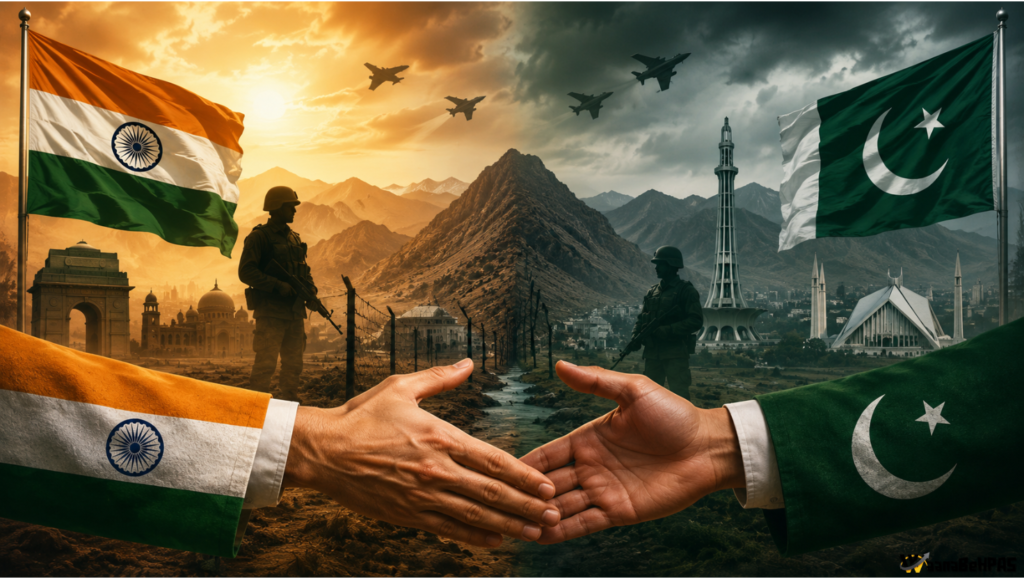
India-Pakistan relations are again in discussion because the relationship between the two countries is currently passing through a phase of severe tension and almost complete diplomatic freeze.
After important events such as:
- the 2019 Balakot Airstrikes, and
- the 2025 cross-border military escalation (Operation Sindoor),
both countries have stopped meaningful political dialogue and formal trade relations.
Even though official talks remain suspended, some recent back-channel communications and statements by strategic experts and political leaders have restarted debates in India regarding:
- whether India should re-engage with Pakistan,
- under what conditions talks should happen,
- and how peace and security can be balanced together.
For UPSC aspirants, Indo-Pak relations are extremely important for:
- International Relations (IR),
- Internal Security,
- Border Management,
- South Asian geopolitics,
- Nuclear security,
- and Current Affairs.
Understanding the Indo-Pak Bilateral Architecture
What does “Bilateral Architecture” mean?
The term bilateral architecture means the complete system through which two countries manage their relationship.
In the case of India and Pakistan, it includes:
- diplomatic relations,
- military communication,
- trade agreements,
- water-sharing treaties,
- peace talks,
- security arrangements,
- and international negotiations.
Simply speaking, it is the overall framework through which India and Pakistan interact with each other.
Which Ministry handles relations with Pakistan?
The:
- Ministry of External Affairs (MEA)
is the main ministry responsible for managing India’s relations with Pakistan.
The MEA:
- conducts diplomatic talks,
- handles embassies and high commissions,
- negotiates agreements,
- and represents India internationally.
Constitutional Basis of India’s Foreign Policy
India’s foreign policy is morally guided by:
Article 51 of the Directive Principles of State Policy (DPSP)
This Article says that India should:
- promote international peace,
- maintain good relations with other nations,
- encourage peaceful settlement of disputes,
- and respect international law.
This means India officially believes in peaceful coexistence and diplomacy.
However, national security and sovereignty always remain top priorities.
India’s Core Policy Towards Pakistan
India currently follows one major policy principle:
“Terror and talks cannot go together.”
What does this mean?
India believes that:
- meaningful peace talks cannot happen while terrorism continues,
- and Pakistan must first take strong action against terror groups operating from its soil.
Therefore:
- formal peace talks remain suspended,
- and future dialogue depends on improvement in security conditions.
Introduction to India-Pakistan Relations
India and Pakistan share one of the most complicated relationships in the world.
Since independence in 1947, the two countries have experienced:
- wars,
- border conflicts,
- terrorist attacks,
- diplomatic crises,
- military tensions,
- and occasional peace efforts.
At the same time, the two countries also share:
- common history,
- similar culture,
- languages,
- food habits,
- music,
- and deep civilizational connections.
This mixture of conflict and connection makes the relationship very complex.
Historical Foundations of India-Pakistan Relations
Partition of British India (1947)
The roots of Indo-Pak conflict began during the partition of British India in 1947.
What was Partition?
Partition means:
- the division of British India into:
- India, and
- Pakistan.
Pakistan was created mainly as a separate homeland for Muslims.
Two-Nation Theory
The demand for Pakistan was based on the:
- Two-Nation Theory
This theory was strongly promoted by:
- Muhammad Ali Jinnah,
- and the Muslim League.
What did the theory say?
It argued that:
- Hindus and Muslims were two separate nations,
- with different cultures, traditions, and political interests,
- therefore they needed separate countries.
Effects of Partition
Partition caused one of the biggest human tragedies in history.
Major consequences:
- Massive communal riots.
- Large-scale violence.
- Migration of nearly 12–15 million people.
- Death of lakhs of people.
- Deep hatred and mistrust between communities.
The emotional scars of Partition still influence India-Pakistan relations today.
Kashmir Issue: The Biggest Dispute
The:
- Kashmir issue
is considered the core problem in Indo-Pak relations.
How did the Kashmir dispute begin?
At the time of independence:
- Jammu & Kashmir was a princely state ruled by Maharaja Hari Singh.
The state had:
- a Muslim-majority population,
- but a Hindu ruler.
Initially, the Maharaja wanted to remain independent.
However, in October 1947:
- tribal militias supported from Pakistan invaded Kashmir.
As a result:
- the Maharaja requested military help from India,
- and signed the:
- Instrument of Accession,
which legally made Jammu & Kashmir part of India.
- Instrument of Accession,
India then sent troops to defend Kashmir.
This led to the:
- First Indo-Pak War (1947–48).
Result of the War
The war ended after UN intervention.
Kashmir got divided into:
- Indian-administered Kashmir,
- and Pakistan-administered Kashmir.
The border between them later became known as:
- the Line of Control (LoC).
The Kashmir issue remains unresolved even today.
Major Wars Between India and Pakistan
1. First Indo-Pak War (1947–48)
Cause:
- Conflict over Kashmir.
Result:
- Division of Kashmir.
- UN-mediated ceasefire.
2. Indo-Pak War of 1965
Cause:
Pakistan launched:
- Operation Gibraltar,
to infiltrate forces into Kashmir.
Result:
- Full-scale war between both countries.
- Ended through the:
- Tashkent Agreement.
3. Indo-Pak War of 1971
This war was linked to the crisis in:
- East Pakistan (present-day Bangladesh).
Why did the crisis happen?
People in East Pakistan were protesting against political discrimination by West Pakistan.
The Pakistani military launched harsh operations there, causing:
- large-scale killings,
- refugee crisis,
- and humanitarian disaster.
Millions of refugees entered India.
India eventually intervened militarily.
Result:
- Pakistan was defeated.
- Bangladesh was created.
Shimla Agreement (1972)
After the 1971 war:
India and Pakistan signed the:
- Shimla Agreement.
Main points:
- Both countries agreed to solve issues bilaterally.
- Ceasefire Line became the:
- Line of Control (LoC).
This agreement is still very important in India’s diplomatic position.
4. Kargil War (1999)
Pakistan-backed soldiers and infiltrators occupied strategic mountain positions in Kargil.
India launched military operations to remove them.
Importance of Kargil War:
It was:
- the first war between two nuclear powers after nuclear testing.
It showed how dangerous the Indo-Pak rivalry had become.
Nuclearization of South Asia
Nuclear Tests of 1998
In 1998:
- India conducted:
- Pokhran-II nuclear tests.
- Pakistan responded with:
- Chagai nuclear tests.
Both countries officially became nuclear weapon states.
Impact of Nuclear Weapons
Positive effect:
- Full-scale war became less likely because both sides fear nuclear destruction.
This is called:
- Nuclear Deterrence.
Negative effect:
- Smaller conflicts and proxy wars increased.
- Risk of accidental escalation became higher.
Major Structural Faultlines in Relations
1. Diplomatic Gridlock
What is diplomatic gridlock?
It means:
- diplomatic relations have become stuck or frozen.
After India removed:
- Article 370 in 2019,
Pakistan reacted strongly.
Pakistan:
- downgraded diplomatic relations,
- expelled the Indian High Commissioner,
- and suspended trade.
Since then:
- political dialogue remains very limited.
What was Article 370?
Article 370 gave:
- special autonomous status to Jammu & Kashmir.
In August 2019:
India removed this special status and reorganized the state into Union Territories.
Pakistan opposed this decision strongly.
2. Shift in India’s Military Strategy
Earlier, India mainly followed:
- defensive deterrence.
What is defensive deterrence?
It means:
- trying to prevent attacks mainly through defense and restraint.
Now India increasingly follows:
- punitive retaliation.
What is punitive retaliation?
It means:
- responding strongly to attacks in order to punish the attacker.
Examples:
- Surgical Strikes (2016)
- Balakot Airstrikes (2019)
Pakistan’s Strategy
Pakistan tries to balance India’s stronger conventional military power through:
- asymmetric warfare,
- support to non-state actors,
- and tactical nuclear weapons.
What is Asymmetric Warfare?
It means:
- weaker countries using indirect methods instead of direct military confrontation.
Examples:
- proxy groups,
- irregular fighters,
- terrorism,
- covert operations.
Tactical Nuclear Weapons (TNWs)
These are:
- small nuclear weapons designed for battlefield use.
Pakistan maintains a:
- “first-use policy.”
What is first-use policy?
It means Pakistan does not promise that it will use nuclear weapons only after being attacked first.
This increases strategic uncertainty.
Cross-Border Terrorism
Cross-border terrorism is the biggest obstacle to peace.
India accuses Pakistan-based groups such as:
- Lashkar-e-Taiba (LeT)
- Jaish-e-Mohammed (JeM)
of supporting attacks in India.
Major attacks include:
- 2001 Parliament Attack
- 2008 Mumbai Attacks
- 2016 Uri Attack
- 2019 Pulwama Attack
These attacks badly damaged trust between the two countries.
SAARC and Regional Problems
What is SAARC?
South Asian Association for Regional Cooperation is a regional organization of South Asian countries.
Members include:
- India,
- Pakistan,
- Bangladesh,
- Nepal,
- Sri Lanka,
- Bhutan,
- Maldives,
- and Afghanistan.
Aim:
- regional cooperation,
- economic development,
- and peace.
However, Indo-Pak tensions have almost paralyzed SAARC activities.
China-Pakistan Economic Corridor (CPEC)
What is CPEC?
China-Pakistan Economic Corridor is a major infrastructure and connectivity project between China and Pakistan.
India opposes CPEC because:
- it passes through:
- Pakistan-Occupied Kashmir (PoK),
which India considers its sovereign territory.
- Pakistan-Occupied Kashmir (PoK),
Indus Waters Treaty
The:
- Indus Waters Treaty (1960)
is one of the few successful agreements between India and Pakistan.
It was mediated by:
- the World Bank.
Main Features of the Treaty
India controls:
- Ravi,
- Beas,
- Sutlej.
Pakistan controls:
- Indus,
- Jhelum,
- Chenab.
However, India can use western rivers for:
- domestic purposes,
- irrigation,
- and hydroelectric projects under certain limits.
Contemporary Situation
Today, India-Pakistan relations are often described as:
- a “Cold Peace.”
Meaning:
There is:
- no full-scale war,
- but no normal friendship either.
Relations are characterized by:
- low trust,
- military alertness,
- limited communication,
- and restricted trade.
Humanitarian and Cultural Relations
Despite political tensions:
- people-to-people connections still exist.
Examples:
- music,
- films,
- sports,
- religious pilgrimages,
- shared language and culture.
Kartarpur Corridor
The:
- Kartarpur Corridor
allows Indian Sikh pilgrims to visit:
- Gurdwara Darbar Sahib in Pakistan,
without a visa.
It is considered an important confidence-building measure.
Way Forward
1. Continue Back-Channel Talks
What are back-channel talks?
These are:
- secret or informal discussions conducted quietly between officials.
Purpose:
- avoid escalation,
- manage crises,
- maintain communication.
2. Humanitarian Engagement
India can continue:
- medical visas,
- release of fishermen,
- religious pilgrimages,
- cultural exchanges.
These humanitarian measures can improve goodwill.
3. Strict Action Against Terrorism
Future peace talks should depend upon:
- visible and verifiable action against terror groups.
This remains India’s most important condition.
4. Revive Regional Cooperation
Improving regional trade and cooperation can:
- increase economic benefits,
- reduce hostility,
- and improve South Asian stability.
Conclusion
India-Pakistan relations are deeply influenced by:
- Partition,
- Kashmir dispute,
- terrorism,
- military rivalry,
- and geopolitical competition.
At the same time:
- geography,
- history,
- culture,
- and regional interdependence
make complete separation impossible.
The future of relations depends upon:
- political leadership,
- trust-building,
- counter-terror cooperation,
- diplomatic dialogue,
- and responsible military behavior.
For UPSC aspirants, Indo-Pak relations should be understood not only as a conflict story, but also as an important example of:
- diplomacy,
- security studies,
- regional politics,
- and international relations in South Asia