Cabinet Approves ₹37,500 Crore Package to Boost Coal Gasification
A Comprehensive HPPSC & UPSC-Oriented Strategic Article
Source: The Hindu
Syllabus Reference: GS III – Energy Security, Industrial Policy, Infrastructure, Environment, Science & Technology.
Why is it in News?
In a major move to strengthen India’s energy security, industrial self-reliance, and import substitution strategy, the Union Cabinet has approved a ₹37,500 crore financial incentive package to promote surface coal and lignite gasification projects.
This initiative aims to:
- Utilize India’s abundant coal reserves more efficiently
- Reduce dependence on imports of:
- LNG
- Methanol
- Ammonia
- Urea
- Synthetic Natural Gas (SNG)
- Promote cleaner industrial fuel alternatives
- Support Atmanirbhar Bharat
- Accelerate India’s target of 100 Million Tonnes (MT) coal gasification by 2030
This scheme is among the largest strategic interventions in India’s coal and industrial sectors.
Introduction
India is one of the world’s largest coal producers, possessing over 400 billion tonnes of coal reserves, yet it remains heavily dependent on imports for industrial chemicals, fertilizers, and gaseous fuels.
To address this contradiction, the government is repositioning coal from merely a fuel for thermal power plants into a source for:
- Fertilizers
- Petrochemicals
- Hydrogen
- Synthetic fuels
- Chemical feedstock
The approved ₹37,500 crore package is intended to create a domestic coal-to-chemicals ecosystem.
About Coal Gasification
Definition:
Coal gasification is a thermo-chemical process in which coal or lignite is converted into Syngas (Synthesis Gas) under controlled temperature, pressure, oxygen, and steam conditions.
Syngas primarily contains:
- Carbon Monoxide (CO)
- Hydrogen (H₂)
- Methane (CH₄) (small quantities)
Nodal Ministry
Ministry of Coal
Legal Framework
Governed under:
Mines and Minerals (Development and Regulation) Act, 1957
Scope
- Coal
- Lignite
Process Breakdown
1. Gasifier Vessel
Coal is heated under:
- High temperature
- High pressure
- Controlled oxygen
- Steam
2. Partial Oxidation
Unlike direct burning:
- Limited oxygen is used
- Coal is chemically broken down rather than combusted
3. Chemical Reactions
Produces:
- CO
- H₂
- CH₄
4. Cleaning Phase
Impurities removed:
- Sulfur
- Mercury
- Ash
- Particulate matter
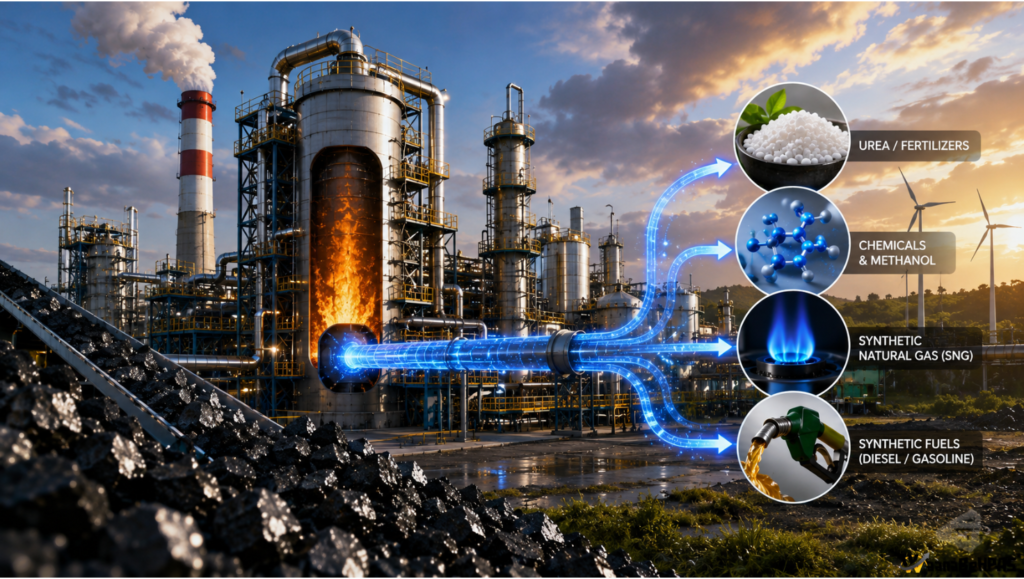
Final Products from Syngas
A. Power Generation
- Integrated Gasification Combined Cycle (IGCC)
B. Fertilizers
- Urea
- Ammonia
C. Chemicals
- Methanol
- Plastics
- Petrochemicals
D. Synthetic Fuels
- Coal-to-Liquid (CTL)
- Diesel
- Gasoline
E. Hydrogen Economy
- Industrial hydrogen
National Coal Gasification Target
Government Goal:
100 Million Tonnes (MT) by 2030
Current Package Targets:
Approximately 75 MT
The ₹37,500 Crore Financial Package
Total Outlay:
₹37,500 crore
Incentive Structure:
Government support:
- Up to 20% of plant and machinery cost
Maximum Incentive Limits:
Standard Project:
- ₹5,000 crore
SNG/Urea Projects:
- ₹9,000 crore
Single Entity:
- ₹12,000 crore overall cap
Additional Policy Support
30-Year Coal Linkage Extension
Provides:
- Long-term coal supply assurance
- Investor confidence
- Large-scale infrastructure certainty
Investment Potential
Expected to mobilize:
₹2.5–3 lakh crore
Employment Generation
Estimated:
~50,000 jobs
Significance and Benefits
1. Reducing Import Dependency
India’s substitutable import bill:
₹2.77 lakh crore (FY2025)
Major imported products:
- LNG
- Urea
- Methanol
- Ammonia
2. Enhanced Energy Security
By using domestic coal:
- Reduced forex burden
- Protection from geopolitical shocks
- Reduced West Asia vulnerability
3. Value Addition
Coal transformed into:
- SNG
- Urea
- DME
- Methanol
- Hydrogen
4. Cleaner Alternative
Compared to direct coal burning:
- Lower SOx emissions
- Lower NOx emissions
- Better pollutant control
- Potential carbon capture integration
5. Industrial Development
Supports:
- Steel sector
- Fertilizer sector
- Chemical manufacturing
- Hydrogen economy
Sectoral Benefits
Sustainable Power Generation
Syngas-based electricity systems improve efficiency.
Fertilizer Security
Supports domestic agriculture.
Critical Chemical Production
Reduces petrochemical dependence.
Low-Emission Steel Production
Useful in industrial decarbonization.
Key Challenges
1. High Capital Intensity
- Expensive technology
- Large infrastructure requirements
2. Water Requirement
Coal gasification is water-intensive.
Concern:
May stress:
- Coal-bearing regions
- Dry mining belts
3. Technical Complexity
Requires:
- Advanced gasifier systems
- Efficient purification
- Chemical synthesis expertise
4. Environmental Concerns
Although cleaner than combustion:
- Still fossil fuel dependent
- Carbon emissions remain
- Requires CCUS for sustainability
5. Technology Dependency
India still relies significantly on:
- Foreign expertise
- Imported gasification technology
Way Forward
A. Private Sector Participation
- Ease of doing business
- Global partnerships
- PPP models
B. Indigenous R&D
- Domestic gasification technologies
- Lower technology rents
- Strategic autonomy
C. Renewable Integration
- Green hydrogen blending
- Industrial decarbonization
D. Policy Stability
- Long-term incentives
- Coal linkage certainty
- Regulatory simplification
HPPSC Perspective
Why Important for Himachal Pradesh:
Although Himachal Pradesh is not coal-rich, this topic is vital because:
- National energy policy
- Industrial strategy
- Sustainable development
- Import substitution
- Economic geography
- UPSC/HPPSC GS III relevance
UPSC / HPPSC Exam Relevance
Prelims Important Facts:
- ₹37,500 crore package
- Ministry of Coal
- MMDR Act 1957
- 100 MT target by 2030
- Syngas components
- 30-year coal linkage
- IGCC technology
- SNG/Urea emphasis
Mains GS Paper III Themes:
- Energy security
- Industrial policy
- Import substitution
- Environmental sustainability
- Atmanirbhar Bharat
- Fossil fuel transition
Previous Year UPSC Linkage
UPSC Mains (2018):
“Access to affordable, reliable, sustainable and modern energy is essential to achieve SDGs.” Comment.
Relevance:
Coal gasification contributes to:
- Affordable energy
- Industrial growth
- Energy security
- Sustainable transition
UPSC Prelims (2020):
Thermal power and resource sustainability remain recurring themes.
Possible HPPSC/UPSC Questions
Prelims:
Coal gasification primarily produces:
(a) Biofuel
(b) Syngas
(c) Nuclear fuel
(d) Solar energy
Answer:
(b) Syngas
Mains:
“Coal gasification is central to India’s strategy for balancing energy security with industrial modernization, though environmental challenges remain.” Discuss.
Conclusion
The ₹37,500 crore coal gasification package represents a transformative policy initiative designed to:
- Strengthen India’s energy independence
- Reduce import bills
- Promote industrial growth
- Create fertilizers and chemicals domestically
- Enhance strategic autonomy
It reflects India’s broader strategy of:
“From fuel security to industrial sovereignty.”
However, long-term success depends on:
- Technological innovation
- Environmental safeguards
- Carbon capture
- Water management
- Indigenous R&D
Final Strategic Insight for HPPSC/UPSC
Coal gasification is not merely an energy reform—
It is a national industrial transformation strategy.
For aspirants, this topic is crucial for:
- Economy
- Environment
- Energy
- Governance
- Science & Technology
- International competitiveness