The Earth and the Universe: A Comprehensive UPSC Guide to Solar System, Earth’s Mechanics, and Time Geography
Syllabus: (UPSC Geography – Conceptual Foundation with Analytical Insights)
1. The Universe and the Solar System: Our Celestial Context
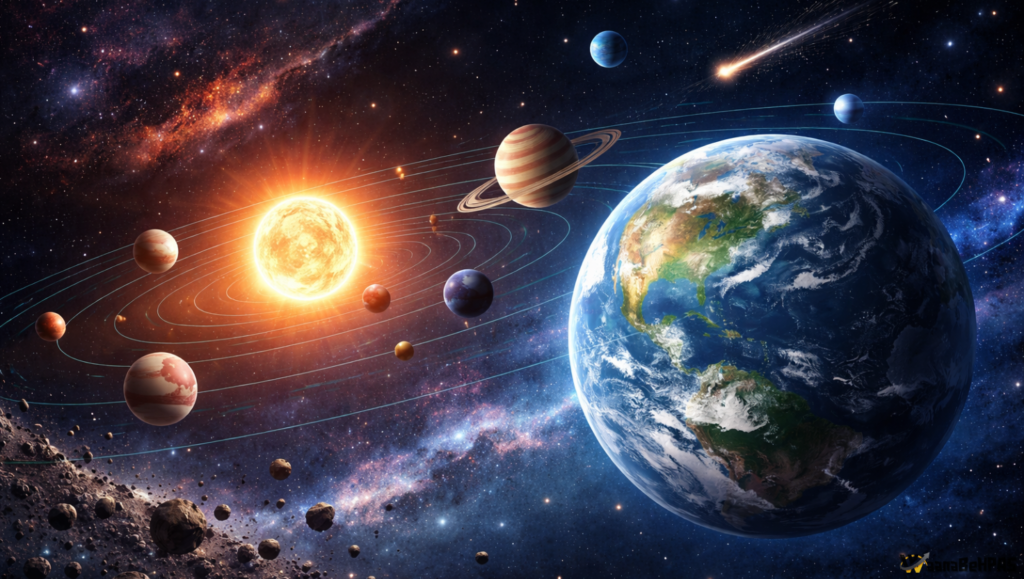
The universe is an immense system consisting of galaxies, stars, planets, and other celestial bodies. Our galaxy, the Milky Way, contains billions of stars, one of which is the Sun.
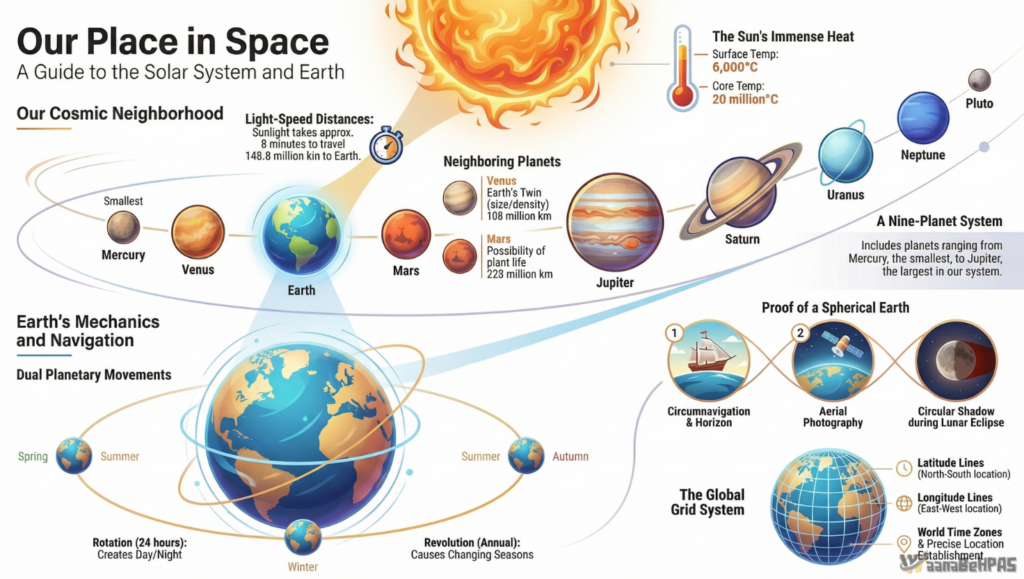
The Sun is the central source of energy for the solar system. It is nearly 300,000 times the size of Earth, with extremely high temperatures:
- Surface: ~6000°C
- Core: ~20 million°C
This energy travels at the speed of light (299,400 km/s) and takes about 8 minutes to reach Earth, forming the basis of all climatic and biological processes.
Solar System Overview
The solar system consists of the Sun and planets revolving in elliptical orbits. Planets do not emit light; they reflect sunlight.
Planets in order:
Mercury, Venus, Earth, Mars, Jupiter, Saturn, Uranus, Neptune
Key Planetary Features (UPSC Focus)
- Mercury: Closest to Sun; shortest revolution (88 days)
- Venus: Earth’s twin (size), but hostile atmosphere
- Earth: Only known life-supporting planet
- Mars: Possibility of past life; exploration focus
- Jupiter: Largest planet; gaseous composition
- Saturn: Prominent ring system
- Uranus: Rotates east to west (unique feature)
- Neptune: Cold outer planet
Analytical Insight
Earth’s uniqueness lies in its “Goldilocks Zone”—a distance from the Sun that allows liquid water and a stable atmosphere. This makes it fundamentally different from other planets.
2. The Geoid: Shape of the Earth and Its Evidence
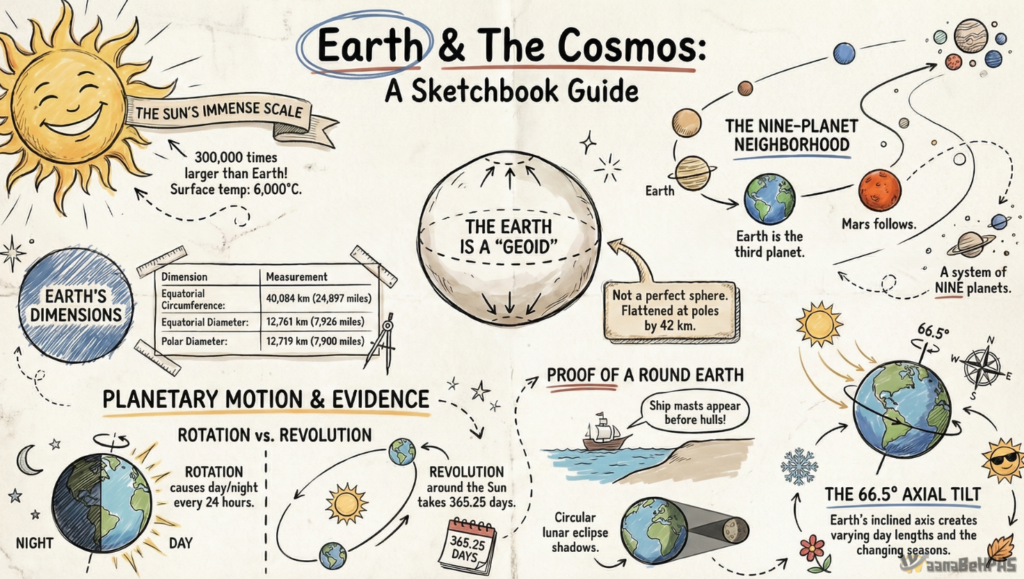
The Earth is not a perfect sphere. It is a Geoid (Oblate Spheroid)—slightly flattened at the poles and bulging at the equator.
Important Measurements (Prelims Data)
- Equatorial Diameter: 12,761 km
- Polar Diameter: 12,719 km
- Difference: 42 km
- Equatorial Circumference: 40,084 km
Evidence of Earth’s Sphericity
- Lunar Eclipse: Earth casts a circular shadow
- Circumnavigation: Travel in one direction returns to origin
- Ship Visibility: Mast appears before hull
- Circular Horizon: Expands with altitude
- Satellite Images: Direct visual proof
Analytical Insight
The geoid shape leads to unequal distribution of solar energy, forming the basis of climatic zones.
3. Earth’s Mechanics: Rotation and Revolution
The Earth is in continuous motion in space.
Rotation
- Occurs on its axis (West to East)
- Time: 24 hours
- Result: Day and Night
Revolution
- Movement around the Sun
- Time: 365¼ days
- Orbit: Elliptical
- Result: Seasons
Analytical Insight
The apparent movement of the Sun is an illusion caused by Earth’s rotation. The combination of rotation and revolution creates temporal and seasonal variations.
4. Axial Tilt, Seasons, and Solar Geometry
The Earth’s axis is tilted at 23½°, which is the primary cause of seasons.
Key Solar Events
- Summer Solstice (21 June)
Sun overhead at Tropic of Cancer
Longest day in Northern Hemisphere - Winter Solstice (22 December)
Sun overhead at Tropic of Capricorn
Shortest day in Northern Hemisphere - Equinoxes (21 March & 23 September)
Equal day and night globally
Temperature Logic
- Vertical rays (Tropics) → Concentrated heat → High temperature
- Oblique rays (Poles) → Spread heat → Low temperature
Advanced Concept: Twilight
- Twilight is the period of diffused light before sunrise and after sunset
- Short at equator, longer at higher latitudes
5. Spatial Framework: Latitude and Longitude
To locate places on Earth, a coordinate system is used.
Latitude
- Parallel lines running east-west
- Measure distance from Equator (0°)
- Average distance: 1° ≈ 111 km
Important latitudes:
- Equator (0°)
- Tropic of Cancer (23½° N)
- Tropic of Capricorn (23½° S)
- Arctic Circle (66½° N)
- Antarctic Circle (66½° S)
Longitude
- Meridians running north-south
- Measured from Prime Meridian (0°, Greenwich)
- Distance decreases towards poles
Analytical Insight
- Latitude → Climate and distance
- Longitude → Time calculation
6. Time, Time Zones, and International Date Line
The Earth rotates 360° in 24 hours:
- 15° = 1 hour
- 1° = 4 minutes
Standard Time
Countries adopt a central longitude to maintain uniform time.
Example:
- India uses 82½° E (IST)
Time Calculation Rules
- East → Add time
- West → Subtract time
International Date Line (IDL)
- Located near 180° longitude
- Crossing changes the date:
- Eastward → lose a day
- Westward → gain a day
Analytical Insight
Time zones are essential for global coordination, trade, and communication.
7. Great Circle Routes: Geometry of Navigation
A Great Circle is the largest circle that can be drawn on a sphere.
Key facts:
- Shortest distance between two points lies along a great circle
- Equator is the only latitude that is a great circle
- All longitudes form great circles in pairs
Practical Importance
Used in aviation and shipping to minimize:
- Distance
- Time
- Fuel consumption
Solar System: Key Features of the Sun and Planets
| Name | Type | Distance from Sun (km) | Orbital Period / Year Duration | Surface Conditions / Features | No. of Satellites | Key Physical Characteristics | Source |
|---|---|---|---|---|---|---|---|
| Sun | Star | 0 | — | Surface temp ~6000°C; core ~20,000,000°C; fiery gases | 9 planets revolve around it | ~300,000 times bigger than Earth; main energy source | 1 |
| Mercury | Planet | 57,600,000 | 88 days | Not specified | Not specified | Smallest and closest planet to Sun | 1 |
| Venus | Planet | 107,200,000 | Not specified | Not specified | Not specified | Known as Earth’s twin (similar size, mass, density) | 1 |
| Earth | Planet | 148,800,000 | 365¼ days | Supports life; 24-hour rotation (day & night) | 1 (Moon) | Geoid shape; axial tilt of 23½° (66½° to ecliptic) | 1 |
| Mars | Planet | 227,200,000 | Not specified | Dark patches; possible signs of plant life | Not specified | Fourth planet from Sun | 1 |
| Jupiter | Planet | 775,900,000 | Not specified | Gaseous (H, He, methane); ~ -128°C | 12 | Largest planet; light and dark bands | 1 |
| Saturn | Planet | 1,417,600,000 | 29½ years | Very cold | 9 | Prominent rings; second largest planet | 1 |
| Uranus | Planet | 2,852,000,000 | Not specified | Bluish-green appearance | 5 | Rotates east to west; 50× larger than Earth | 1 |
| Neptune | Planet | 4,468,800,000 | Not specified | Extremely cold | 2 | Similar to Uranus; outer planet | 1 |
| Pluto | Planet | 5,850,000,000 | 248 years | Extremely remote | Not specified | Distance varies (perihelion to aphelion) | 1 |
Conclusion
From the Sun’s immense energy to Earth’s axial tilt and rotation, the physical realities of the universe determine the functioning of our planet. Concepts like seasons, time zones, and climate patterns are direct outcomes of these fundamental processes.
For a UPSC aspirant, mastering these concepts is essential, as they form the foundation for advanced topics in geography, climatology, and environmental studies.
UPSC Value Addition
Prelims Focus
- Light year
- Geoid shape
- Solstice and equinox
- IST longitude
- International Date Line
Mains Enrichment Line
“Earth’s rotation, revolution, and axial tilt collectively regulate global climatic patterns, temporal variations, and spatial organization, forming the core of physical geography.”