LVM3-M5 Launch Vehicle and CMS-03 (GSAT-7R) Satellite
Syllabus: Science and Tech (UPSC Prelims)
Source: India Today
Context:
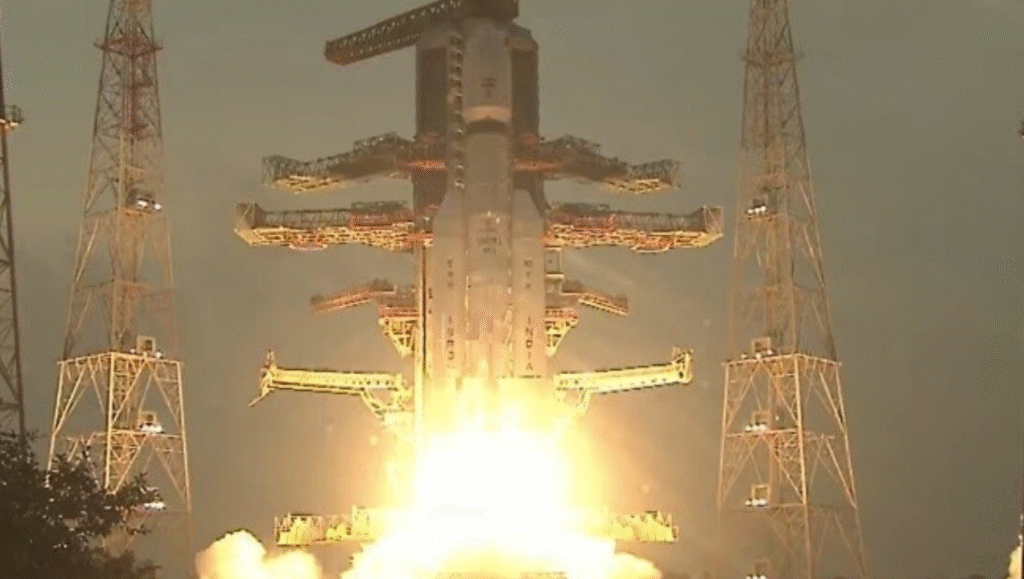
ISRO successfully launched India’s heaviest communication satellite, CMS-03 (GSAT-7R), using the LVM3-M5 rocket from Sriharikota.
About CMS-03 (GSAT-7R)
What it is:
CMS-03, also known as GSAT-7R, is a new-generation communication satellite developed by ISRO to boost India’s secure, high-speed communication systems for defence and strategic purposes.
Developed by:
Indian Space Research Organisation (ISRO) under the Department of Space using fully indigenous technology.
Aim:
- To strengthen communication for defence, maritime, and disaster management operations.
- To enhance broadband and satellite-based internet services across India and its oceanic regions.
Key Features:
- India’s heaviest indigenously built satellite, weighing 4,410 kg.
- Works on C, Ku, and Ka frequency bands for wide communication coverage.
- Provides secure and high-capacity links for strategic users.
- Has a 15-year mission life with advanced transponders and future 5G compatibility.
- Replaces older satellites from the GSAT-7 series.
About LVM3-M5 Launch Vehicle
What it is:
The Launch Vehicle Mark-III (LVM3), also known as “Baahubali”, is India’s most powerful three-stage rocket designed to carry heavy satellites into orbit.
Aim:
To make India self-reliant in launching large communication and space exploration missions without foreign assistance.
Key Features:
- Three-stage configuration:
- Two S200 solid boosters
- One L110 liquid stage
- One C25 cryogenic upper stage
- Weight: 641 tonnes; Height: 43.5 metres.
- Can launch 4,000 kg to GTO and 8,000 kg to LEO.
- Features an indigenous cryogenic engine (C25) developed by Vikram Sarabhai Space Centre.
- Successfully tested cryogenic re-ignition for deploying multiple satellites.
- Proven reliability — eight successful missions, including Chandrayaan-3 (2023) and CMS-03 (2025).
- Will also be used in Gaganyaan, India’s first human spaceflight mission.
Significance
- Strengthens India’s strategic communication and defence capabilities.
- Enhances digital connectivity and maritime communication.
- Reinforces India’s technological self-reliance in space launch and satellite manufacturing.
- Boosts indigenous innovation under the “Atmanirbhar Bharat” initiative.