VB-G RAM G Act, 2025: How India’s New Rural Employment Law Replaces MGNREGA
Why is it in News?
The Viksit Bharat – Guarantee for Rozgar and Ajeevika Mission (Gramin) Act, 2025, commonly known as the VB-G RAM G Act, came into force across rural India on 1 July 2026.
The new law replaces the two-decade-old Mahatma Gandhi National Rural Employment Guarantee Act (MGNREGA), 2005 and marks a major restructuring of India’s rural employment policy.
The new framework increases the statutory employment guarantee from 100 to 125 days per rural household and seeks to shift rural employment from a basic income-support programme towards a broader model combining wage security, durable asset creation, livelihood development, and climate resilience.
For UPSC aspirants, the topic is important under Rural Development, Employment, Inclusive Growth, Poverty Alleviation, Centre–State Relations, and Social Sector Schemes.
What is the VB-G RAM G Act, 2025?
The Viksit Bharat – Guarantee for Rozgar and Ajeevika Mission (Gramin) Act, 2025 is India’s new statutory framework for guaranteeing wage employment to rural households.
It replaces MGNREGA and seeks to align rural employment policy with the broader vision of:
Viksit Bharat @2047
The central idea is to combine:
- Employment security
- Rural infrastructure
- Livelihood development
- Natural resource management
- Climate resilience
Instead of treating public employment only as a relief measure during rural distress, the new framework aims to use labour-intensive public works for long-term rural transformation.
Nodal Ministry
The Act is administered by the:
Ministry of Rural Development
The Ministry is responsible for:
- Policy formulation
- Financial coordination
- Monitoring
- Digital governance
- Implementation guidelines
State governments and local institutions play a major role in actual implementation.
Legal Status
The VB-G RAM G Act is a:
Statutory Employment Guarantee
This means rural employment is provided under a law enacted by Parliament rather than merely through an executive welfare scheme.
The new framework continues the principle of a legal employment guarantee while changing its duration, funding architecture, planning system, and implementation priorities.
From MGNREGA to VB-G RAM G
MGNREGA was enacted in 2005 and became one of the world’s largest public employment programmes.
Its central objective was to provide:
100 Days of Guaranteed Wage Employment
to every rural household whose adult members volunteered to undertake unskilled manual work.
The new law increases this guarantee to:
125 Days of Wage Employment
per rural household in a financial year.
Who is Eligible?
The employment guarantee applies to:
Adult Members of Rural Households
who are willing to undertake:
Unskilled Manual Work
The programme is not limited only to:
- Below Poverty Line households
- Scheduled Castes
- Scheduled Tribes
- Backward Classes
Any eligible rural household can seek work under the statutory framework.
Key Features of the VB-G RAM G Act
Enhanced Employment Guarantee
The most significant change is the increase in guaranteed employment from:
100 Days under MGNREGA
to
125 Days under VB-G RAM G
This represents a 25% increase in the statutory employment guarantee.
The measure seeks to:
- Improve rural income security.
- Reduce seasonal unemployment.
- Strengthen household purchasing power.
- Provide support during economic and climatic shocks.
Agricultural Alignment
One of the major innovations under the new framework is closer coordination between rural public employment and the agricultural calendar.
States may notify an aggregated:
60-Day No-Work Period
during peak agricultural seasons such as:
- Sowing
- Transplantation
- Harvesting
The objective is to prevent public employment programmes from creating severe labour shortages during crucial farming periods.
The remaining part of the year can be used to provide the guaranteed employment.
Why is the 60-Day Period Important?
Rural labour demand changes significantly across seasons.
During peak agricultural periods:
- Farmers require more workers.
- Agricultural wages may rise.
- Labour shortages may affect cultivation.
During lean seasons:
- Farm employment falls.
- Rural workers face income insecurity.
The new system attempts to align public employment with this seasonal pattern.
Wage Framework
The new employment framework also seeks to strengthen rural wage security.
The rollout has been accompanied by a revised wage structure, including a national base floor intended to prevent extremely low wage rates.
However, actual notified wages may vary across states according to the applicable wage framework.
A stronger wage system can help:
- Improve rural purchasing power.
- Reduce distress migration.
- Support local consumption.
- Strengthen village economies.
New Fiscal Architecture
One of the most important changes concerns funding.
The new framework follows the structure of a:
Centrally Sponsored Scheme
The standard cost-sharing pattern is:
60:40
between the:
- Central Government
- State Governments
For North-Eastern and Himalayan states, the ratio is:
90:10
This represents an important change in the fiscal architecture of rural employment.
Why is the Funding Change Important?
Under the earlier MGNREGA framework, the Union Government bore a major share of expenditure, particularly the wage cost of unskilled manual labour.
The new cost-sharing model gives states a greater financial role.
Supporters argue that this may:
- Improve state ownership.
- Encourage better planning.
- Reduce wasteful expenditure.
Critics, however, fear that financially weaker states may face difficulty meeting their share.
This makes the issue important from the perspective of:
Fiscal Federalism
and
Centre–State Relations
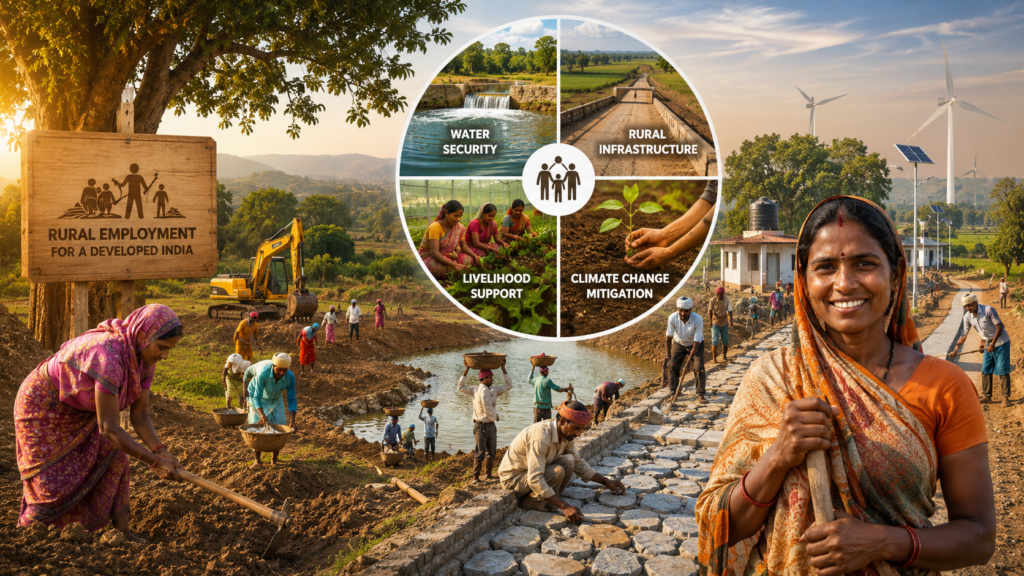
Shift Towards Productive Asset Creation
The new framework seeks to move beyond short-term employment generation.
Work is directed towards four major development pillars.
Water Security
Projects may include:
- Water harvesting structures
- Irrigation systems
- Groundwater recharge
- Pond restoration
- Watershed development
These assets can improve both agricultural productivity and climate resilience.
Core Rural Infrastructure
Employment may be linked with the construction and improvement of:
- Rural roads
- Drainage systems
- Community facilities
- Local infrastructure
Livelihood Support
The programme seeks to create assets that strengthen:
- Agriculture
- Animal husbandry
- Fisheries
- Rural enterprises
- Local livelihoods
Climate Change Mitigation and Resilience
Works may focus on:
- Drought-proofing
- Afforestation
- Soil conservation
- Flood management
- Restoration of degraded land
This makes rural employment an important tool for climate adaptation.
Integration with PM Gati Shakti
The new framework seeks greater integration of rural assets with broader infrastructure planning.
This includes coordination with the:
PM Gati Shakti National Master Plan
The objective is to reduce:
- Duplication of projects.
- Poorly located infrastructure.
- Fragmented planning.
Spatial planning can help ensure that employment-generated assets contribute to wider regional development.
Technology-Driven Governance
The new framework places strong emphasis on digital monitoring.
Important tools include:
Biometric Authentication
Used to verify workers and reduce ghost beneficiaries.
GPS-Based Tracking
Used to map project locations and monitor physical assets.
Digital Attendance
Helps record participation and workdays.
AI-Powered Data Audits
Can identify:
- Unusual payment patterns
- Duplicate records
- Financial irregularities
- Suspicious transactions
Benefits of Technology
Technology can potentially:
- Reduce leakages.
- Improve transparency.
- Strengthen real-time monitoring.
- Enable better asset mapping.
However, excessive dependence on digital systems may create exclusion risks in areas with:
- Poor internet connectivity.
- Biometric failures.
- Low digital literacy.
Therefore, strong offline grievance mechanisms remain necessary.
VB-G RAM G vs MGNREGA
| Feature | MGNREGA | VB-G RAM G |
|---|---|---|
| Employment Guarantee | 100 days | 125 days |
| Main Focus | Livelihood security | Employment + productive assets |
| Agricultural Calendar | No fixed national framework | Provision for state-notified no-work period |
| Funding Approach | Strong Central funding role | Fixed Centre–State sharing |
| Planning | Local public works | Greater infrastructure convergence |
| Technology | Digital monitoring | Biometrics, GPS and data analytics |
| Development Vision | Rural livelihood security | Viksit Bharat @2047 |
Why Was MGNREGA Important?
MGNREGA played a major role in India’s rural economy.
It provided:
Employment During Distress
Especially during droughts, economic slowdowns, and the COVID-19 crisis.
Support for Women
Women consistently formed a significant share of the workforce.
Rural Wage Support
The programme strengthened the bargaining power of rural workers.
Asset Creation
Millions of water conservation and land development works were created.
The new law will therefore be judged partly on whether it preserves these strengths.
Potential Benefits of the New Framework
Greater Employment Security
The increase to 125 days can provide additional income to rural households.
Better Rural Assets
Productivity-oriented works may generate long-term economic benefits.
Agricultural Coordination
Seasonal planning may reduce conflict between public employment and farm labour demand.
Climate Resilience
Water conservation and land restoration can help rural communities adapt to climate change.
Better Transparency
Technology can strengthen monitoring and reduce financial leakages.
Major Concerns
Financial Burden on States
The 60:40 funding pattern may create pressure on states with weak finances.
Risk to Demand-Driven Employment
A rural employment guarantee works best when people can seek work during periods of actual distress.
Rigid financial allocations could weaken this principle if funds are insufficient.
Digital Exclusion
Biometric or connectivity failures may prevent genuine workers from accessing employment or wages.
Agricultural No-Work Period
A fixed pause may create difficulties for landless workers if alternative farm employment is unavailable.
Centralisation of Planning
Excessive top-down infrastructure planning may weaken the role of Gram Sabhas and local communities.
Significance for Rural India
The transition represents a major change in India’s welfare architecture.
The new model attempts to combine:
Social Protection
with
Economic Productivity
The central policy question is whether India can transform a rural employment guarantee into a development programme without weakening its original role as a safety net for the poorest households.
Way Forward
Preserve the Right to Work
The employment guarantee should remain accessible whenever genuine rural distress emerges.
Protect State Finances
Special assistance may be needed for financially weaker states.
Strengthen Gram Sabhas
Local communities should remain central to identifying useful public works.
Prevent Digital Exclusion
No genuine worker should lose employment because of technological failure.
Ensure Timely Wage Payments
The success of the programme will depend on predictable and prompt payments.
Conduct Independent Social Audits
Community monitoring should complement AI and digital surveillance systems.
Conclusion
The VB-G RAM G Act, 2025 marks one of the most significant changes in India’s rural welfare architecture since the enactment of MGNREGA.
By increasing the employment guarantee from 100 to 125 days and linking rural work with water security, infrastructure, livelihoods, and climate resilience, the new law seeks to transform public employment into a tool for long-term rural development.
Its success, however, will depend on whether it can preserve the rights-based and demand-driven strengths of MGNREGA while improving asset quality, transparency, and rural productivity.
UPSC Prelims Focus
| Feature | Details |
| Full Name | Viksit Bharat – Guarantee for Rozgar and Ajeevika Mission (Gramin) |
| Abbreviation | VB-G RAM G |
| Came into Force | 1 July 2026 |
| Replaced | MGNREGA, 2005 |
| Employment Guarantee | 125 Days |
| Nodal Ministry | Ministry of Rural Development |
| Standard Funding Pattern | 60:40 |
| North-Eastern and Himalayan States | 90:10 |
| Broad Vision | Viksit Bharat @2047 |
Previous Year Question
UPSC Prelims 2011
Among the following, who are eligible to benefit from the Mahatma Gandhi National Rural Employment Guarantee Act?
(a) Adult members of only Scheduled Caste and Scheduled Tribe households
(b) Adult members of any backward community household
(c) Adult members of households below the poverty line
(d) Adult members of any rural household
Correct Answer:
(d) Adult members of any rural household
UPSC Syllabus Mapping
GS Paper II: Government Policies, Welfare Schemes, Centre–State Relations, Vulnerable Sections
GS Paper III: Inclusive Growth, Employment, Rural Development, Agriculture, Infrastructure and Climate Resilience
Essay: Welfare versus Development, Right to Work, Rural Transformation and Inclusive Growth