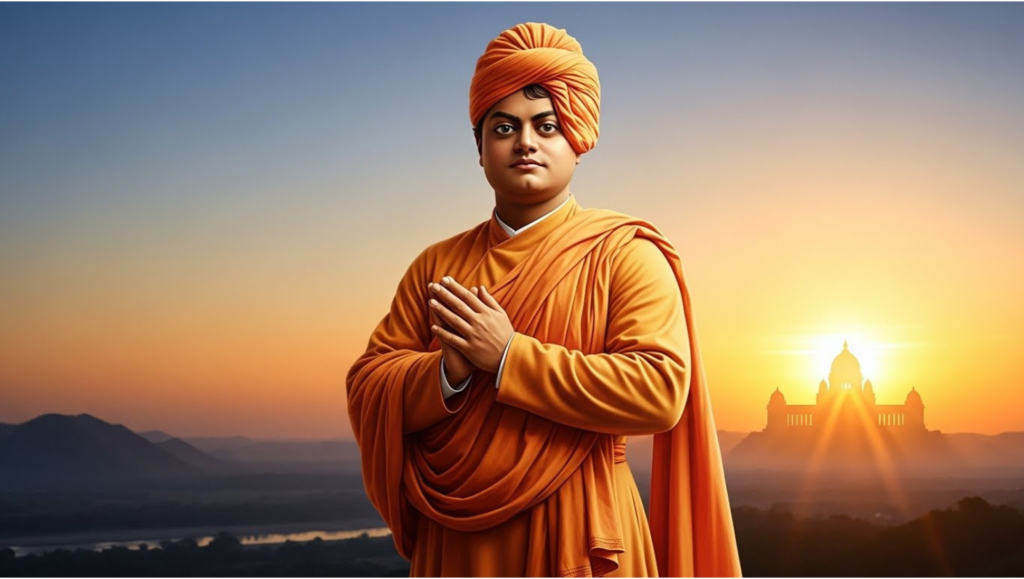
Swami Vivekananda (1863–1902): Spiritual Nationalist and Youth Icon of Modern India
Subject: Modern History, Person in News (Prelims)
Why in News?
Swami Vivekananda’s birth anniversary on 12 January is observed as National Youth Day, commemorating his role in awakening India’s spiritual, social and national consciousness.
Early Life and Intellectual Formation
- Born as Narendranath Datta on 12 January 1863 in Kolkata.
- Educated at Scottish Church College, where he studied:
- Western philosophy
- Science
- History
- Logic
- Influenced by rationalism and scientific inquiry, he refused blind faith and famously asked: “Have you seen God?”
- His meeting with Sri Ramakrishna Paramahamsa gave him spiritual clarity, leading to his transformation into Swami Vivekananda.
Core Philosophy
Vivekananda believed that spiritual strength must lead to social strength.
Key Ideas
- Strength of Character
- “Man-making education” instead of bookish learning.
- Atmano mokshartham jagat hitaya cha
- For one’s own salvation and for the welfare of the world.
- Practical Vedanta
- Religion must uplift the poor, not isolate monks from society.
India as He Saw It
During his travels across India (1888–1892), he saw:
- Extreme poverty
- Social inequality
- Loss of self-confidence among Indians
He believed:
India’s downfall was not due to lack of religion, but due to lack of self-respect, education, and social unity.
Chicago Parliament of Religions (1893)
His speech in the World’s Parliament of Religions, Chicago made him a global figure.
Its Importance
- Introduced Vedanta and Yoga to the West
- Established India as a spiritual civilization, not just a colony
- Promoted religious tolerance and pluralism
Famous line:
“Sisters and brothers of America…”
Received a standing ovation.
Socio-Religious Contributions
1. Universal Religion
- All religions are different paths to the same truth.
- Promoted inter-faith harmony.
2. Four Yogas
He simplified spiritual life through:
- Karma Yoga – Path of action
- Bhakti Yoga – Path of devotion
- Jnana Yoga – Path of knowledge
- Raja Yoga – Path of meditation
This made spirituality accessible to common people.
Ramakrishna Mission (1897)
Founded by Vivekananda in Kolkata.
Objectives
- Spread spiritual teachings
- Run schools, hospitals and relief work
- Serve the poor as “Daridra Narayana” (God in the poor)
The Mission is still active in:
- Education
- Healthcare
- Disaster relief
- Rural development
Major Works
- Raja Yoga
- Karma Yoga
- Jnana Yoga
- Bhakti Yoga
- Lectures from Colombo to Almora
These books explain how Indian philosophy applies to modern life.
National Youth Day (12 January)
Declared in 1984 to inspire youth.
Vivekananda’s youth message:
- Self-confidence
- Discipline
- Service to society
- Nation-building
His famous call:
“Arise, awake, and stop not till the goal is reached.”
Relevance for Modern India
| Area | Contribution |
|---|---|
| Education | Character-based, value-oriented learning |
| Nationalism | Spiritual foundation for freedom movement |
| Social reform | Equality, service to poor, dignity of labour |
| Constitutional values | Unity in diversity, tolerance |
| Youth empowerment | Leadership, courage, self-belief |
Conclusion
Swami Vivekananda transformed Indian spirituality into a tool for national awakening. He taught that a strong nation is built not only by laws and armies, but by strong, confident and compassionate citizens. His ideas continue to guide India’s journey towards Viksit Bharat and social harmony.
Also Check the aticle: https://wannabehpas.in/swami-vivekananda/