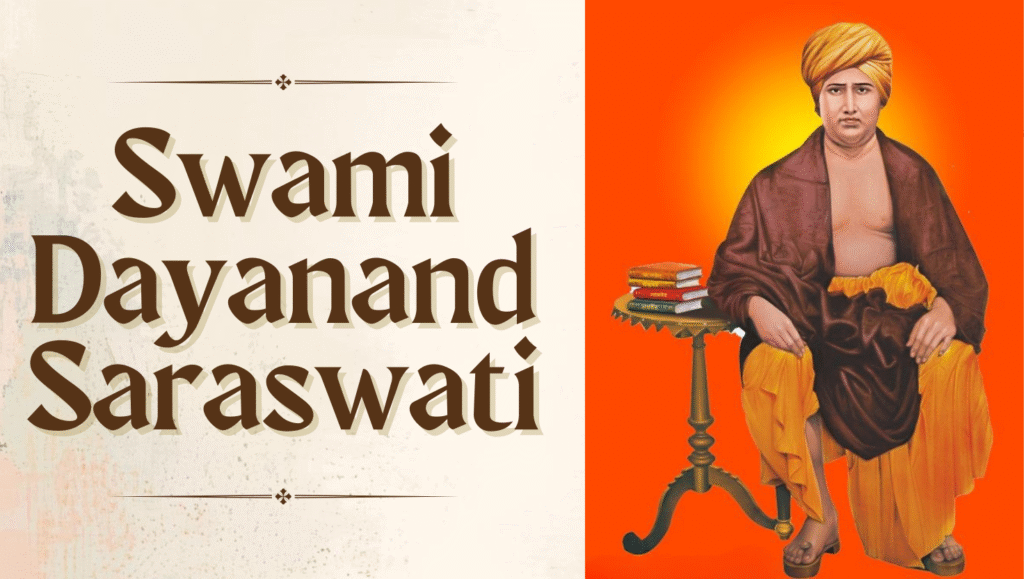
Dayanand Saraswati – Life, Philosophy, Reforms and Legacy
Syllabus: Modern History (UPSC Prelims)
Who he was:
Swami Dayanand Saraswati (1824–1883) was a major Hindu religious reformer of the 19th century and the founder of Arya Samaj1 (1875). He is regarded as one of the key figures of the Indian Renaissance who worked to purify Hinduism and bring society back to Vedic values.
Early Life
- Born as Mool Shankar Tiwari on 12 February 1824 at Tankara (Gujarat).
- Educated in Sanskrit and Vedic texts.
- At age 14, during Shivaratri, he questioned idol worship when he saw a mouse eating offerings kept before a Shiva idol.
- At 21, he left home and lived as a wandering ascetic, searching for spiritual truth.
Influences
- Deeply influenced by the Vedas.
- Studied under Swami Virajanand in Mathura, who shaped his anti-idolatry and rationalist ideas.
Major Contributions
- Founded Arya Samaj (1875) – to reform Hinduism based on the Vedas, reason, morality and equality.
- Educational work → promoted Vedic education + scientific learning.
- inspired the later creation of DAV Schools (1886).
- Social reforms: opposed caste-based discrimination, untouchability, superstition, child marriage; supported women’s rights and female education.
- Literary contributions: wrote Satyarth Prakash and commentaries on Vedas.
- Political impact: coined the slogan “Swaraj” (self-rule) in 1876. Influenced leaders like Lala Lajpat Rai, Subhas Chandra Bose etc.
Philosophy
- Monotheism → belief in one formless God (Om).
- Back to the Vedas → return to original Vedic ideals.
- Rationalism → religion should be based on reason, not blind ritual.
- Education → key to social and national progress.
Death
He died in 1883 at Jodhpur after being allegedly poisoned following his criticism of the Maharaja.
Legacy
Dayanand played a decisive role in modernising Hindu society. The Arya Samaj continues to promote Vedic values, social reform and education. He is remembered as one of the makers of modern India.
- Question Reference
(HPAS PYQ 2025) ↩︎