Urban Governance & Section 39A: Development, Ecological Stress, and Public Infrastructure Crisis in Goa
Introduction
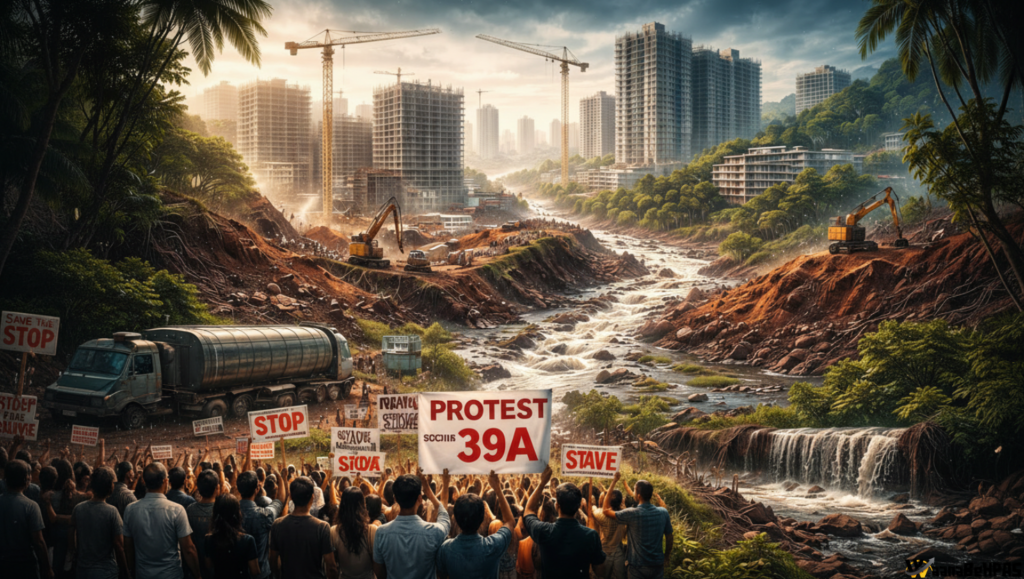
Recent protests over amendments to the Town and Country Planning (TCP) framework—particularly Section 39A—have triggered intense political and legal debate in Goa. At the heart of the controversy lies a deeper structural issue: the tension between rapid land conversion for real estate development and the sustainability of public infrastructure and fragile ecosystems.
For UPSC aspirants, this issue is highly relevant under:
- GS Paper II – Governance, Transparency, Federalism, 74th Constitutional Amendment
- GS Paper III – Urbanization, Infrastructure, Environment, Disaster Management
- Ethics & Public Administration – Public accountability and institutional integrity
I. Strategic Context: From Regional Planning to Piecemeal Zoning
Goa’s planning trajectory shifted significantly after:
- March 2023 notification of Section 17(2)
- Introduction of Section 39A under the TCP Act
Structural Shift:
Earlier Model:
- Regional Plan (RP) 2021 – Bulk zoning and long-term spatial coherence.
New Model:
- Plot-by-plot conversions.
- Executive-driven exemptions.
- Discretionary reclassification of land.
This shift has been described as “planning ad-hocism,” where land-use changes are increasingly individualized rather than regionally structured.
II. Velocity of Land Conversion: A Systemic Escalation
| Period | Land Converted | Strategic Implication |
|---|---|---|
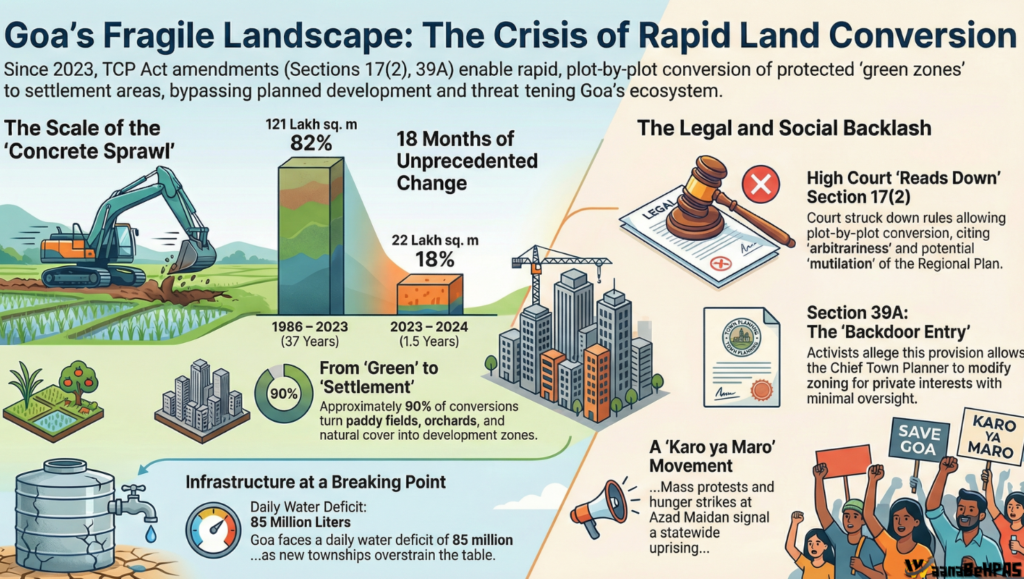
| 1986–2023 (37 years) | 121 lakh sq meters | Historical baseline |
| March 2023–Aug 2024 | 20 lakh sq meters | 18% of 37-year total in 18 months |
| Jan 2025 (official approvals) | 26.54 lakh sq meters | Accelerated trend |
The High Court of Bombay at Goa noted that over 353 approvals were processed under Section 17(2), indicating rapid administrative clearances.
Core Concern:
Infrastructure capacity has not expanded proportionately with zoning approvals, creating what experts term a “utility debt.”
III. Legal Volatility and Judicial Scrutiny
The High Court:
- Read down Section 17(2) rules.
- Declared 2023 implementing rules ultra vires.
- Observed absence of public interest in framing guidelines.
- Criticized undefined terms like “inadvertent error.”
While Section 39A remains operational, it is under scrutiny.
Governance Issue:
Government invoked “sub-judice” to withhold approval details, leading to allegations of opacity.
UPSC Link: Doctrine of reasonableness, separation of powers, judicial review.
IV. Sancoale Case Study: Infrastructure Failure in Practice
Sancoale exemplifies the urban stress resulting from land conversion.
Key Developments:
- 35 lakh sq meters reclassified for luxury township.
- FAR increased from 80 to 200 (150% rise).
- Massive increase in built-up density.
Infrastructure Consequences:
- Sewage Management Collapse
- Non-functional STPs.
- Raw sewage discharge into fields.
- Agricultural Degradation
- Paddy fields contaminated.
- Livelihood impact on local farmers.
- Public Cost Burden
- Post-facto infrastructure repair by PWD.
- Private gains, public expenditure.
This illustrates the “development first, infrastructure later” model.
V. Environmental Consequences: Hydro-Social Breakdown
Aquifer Depletion Mechanism
- Traditional shallow wells (10m depth).
- Luxury projects using deep borewells (100m depth).
- Lower aquifer suction → drying of upper aquifers.
Ecological Risks
- Hill-cutting in laterite soil.
- Landslide vulnerability (comparable to Wayanad 2024).
- Destruction of natural water recharge zones.
Case Example:
13 illegal borewells sealed in Morjim following land reclassification.
VI. Public Utilities Under Systemic Strain
Goa’s water capacity:
- Required: 645 MLD
- Available: 560 MLD
- Deficit: 85 MLD
Yet new high-density projects continue to receive approvals.
Pernem & Mopa Airport Region
- Deltin Town project projected water demand: 4.5 MLD.
- Infrastructure like link roads completed after airport inauguration.
This reflects structural planning misalignment.
VII. Socio-Political Mobilization: The “Enough is Enough” Movement
The agitation has evolved into a state-wide coalition involving:
- Former Chief Justice Ferdino Rebello
- Former CJI B.R. Gavai (support contextually referenced)
- Civil society leaders
Key Demands:
- Scrapping of Section 39A.
- Revocation of large-scale approvals.
- Institutional transparency.
- Accountability for police action against protestors.
The “Karo ya Maro” agitation reflects erosion of institutional trust.
VIII. Policy Dilemma: Development vs Sustainability
| Development Argument | Sustainability Argument |
|---|---|
| Investment & Tourism | Ecological Preservation |
| Real Estate Growth | Aquifer Protection |
| Ease of Doing Business | Democratic Consultation |
| Revenue Generation | Intergenerational Equity |
The challenge lies in balancing private land rights with collective ecological responsibility.
IX. Strategic Recommendations
1. Reinstate Transparent Zoning Protocols
- Mandatory public notice and objection hearings.
2. Independent Impact Assessments
- Environmental and infrastructure capacity audit before approvals.
3. GIS-Based Monitoring
- Geo-mapping of eco-zones and aquifers.
4. Infrastructure-Linked Permits
- No approval without verified existing utility capacity.
5. Strengthen Municipal Role
- Align with 74th Constitutional Amendment spirit.
6. Health-Centric Planning
- Integrate NITI Aayog’s “500 Healthy Cities Programme.”
X. Broader National Implications
Although centered in Goa, the Section 39A debate reflects:
- Urban governance crisis across Indian states.
- Risk of climate-induced disasters.
- Rising conflict between state governments and civil society.
- Fiscal strain from unfunded infrastructure mandates.
India’s urban population is projected to exceed 40% by 2030. Without systemic planning reforms, similar crises may replicate nationwide.
Conclusion
The Section 39A controversy is not merely a zoning dispute—it represents a governance crossroads. Rapid land conversion without infrastructure preparedness generates ecological fragility, fiscal liabilities, and democratic distrust. Sustainable urbanization requires predictable regulatory frameworks, transparent approvals, judicial oversight, and strong municipal autonomy.
For UPSC aspirants, this case exemplifies the interconnected nature of urban planning, environmental ethics, institutional accountability, and participatory democracy in India’s development trajectory.