Decoding and Constructing Ancient Indian History: Sources, Methods and Historical Traditions
Syllabus: UPSC – GS I (Indian History & Culture)
Introduction: Reconstructing the Past as an Intellectual Exercise
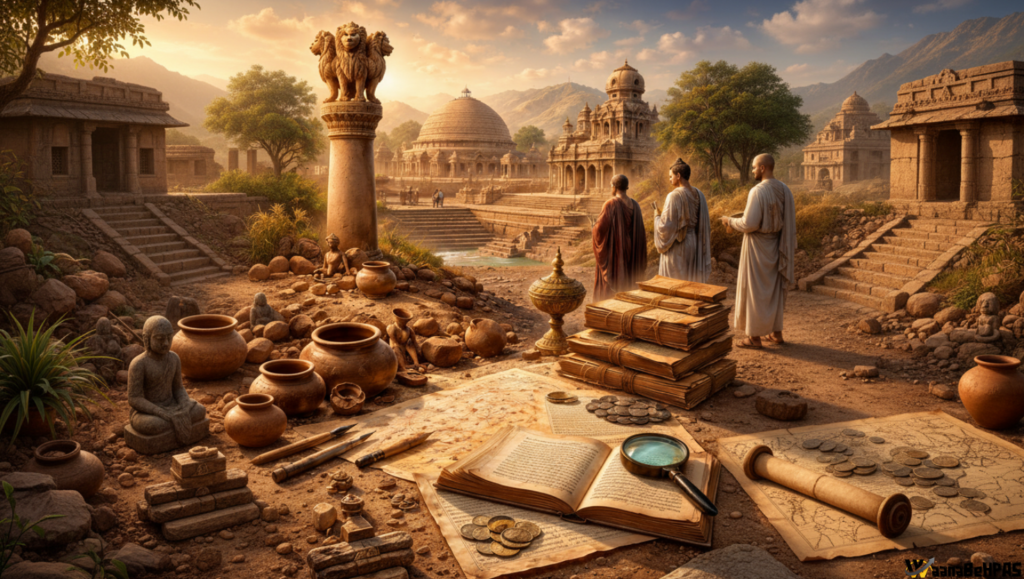
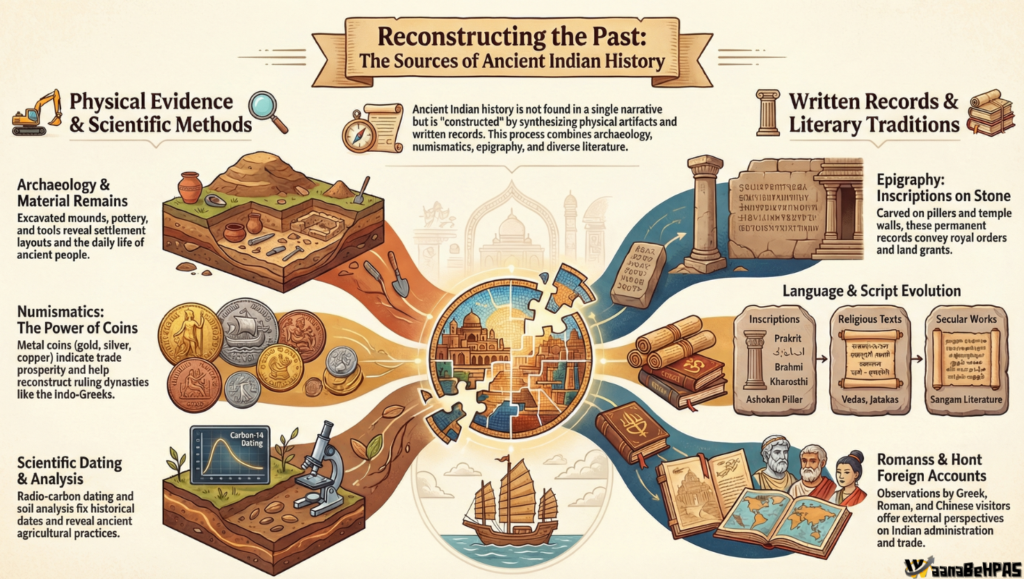
The reconstruction of Ancient Indian History is not based on a single continuous narrative like that of Greece or Rome. Instead, it resembles solving a complex puzzle where many pieces were never meant to fit a modern chronological framework. Early Indians prioritized the preservation of moral, social and cosmic truths over secular political chronology.
Therefore, historians must synthesize two major streams of evidence:
- Material Remains (Archaeology, Coins, Inscriptions) – the “objective skeleton”
- Literary Traditions (Religious & Secular Texts) – the “cultural soul”
By combining these, we achieve a 360-degree reconstruction of ancient Indian society — bridging what people believed with how they actually lived.
I. The Silent Witnesses: Archaeological Foundations
In the absence of continuous written history, physical remains provide the most reliable base.
1. Archaeology: The Scientific Backbone
Methods Used:
- Stratigraphy (layer-by-layer excavation)
- Vertical excavation → chronological sequence
- Horizontal excavation → complete cultural picture
- Radiocarbon dating
- Pollen analysis (climate/vegetation)
- Bone examination (animal domestication)
Contributions:
- Evidence of agriculture in Rajasthan & Kashmir (c. 6000 BCE)
- Discovery of Harappan urban centers (c. 2500 BCE)
- Settlement layouts, pottery, tools, dwellings
- Megalithic burials revealing social customs
UPSC Insight:
Archaeology acts as the objective check against exaggerated literary traditions.
2. Coins (Numismatics)
The study of coins is called Numismatics.
Features:
- Made of gold, silver, copper, lead, bronze, potin
- Found in hoards buried in earthen pots
- Early coins bear symbols; later ones mention rulers
Historical Importance:
- Indicate trade volume and economic prosperity
- Provide dynastic chronology
- Reflect religious symbols
- Show guild participation in minting
Examples:
- Indo-Greek coins help reconstruct 2nd–1st century BCE polity
- Gupta gold coins reflect economic prosperity
- Decline in coinage in post-Gupta period indicates commercial downturn
Coins provide economic reality and political chronology.
3. Inscriptions (Epigraphy & Paleography)
- Study of inscriptions → Epigraphy
- Study of scripts → Paleography
Medium:
- Rock edicts, pillars, seals
- Copper plates (land grants)
- Temple walls
Linguistic Evolution:
- Prakrit (3rd century BCE – Ashokan period)
- Brahmi & Kharosthi scripts
- Sanskrit widespread from 2nd century CE
- Regional languages later
Types:
- Royal edicts (Ashoka)
- Eulogies (Allahabad inscription of Samudragupta)
- Donative records (land grants)
- Administrative records
Importance:
- Fix chronology (Vikrama Samvat, Saka era, Gupta era)
- Reveal agrarian expansion
- Provide administrative details
- Record regnal years
James Prinsep’s decipherment (1837) of Ashokan inscriptions marked a turning point in Indian historiography.
II. The Sacred Library: Religious Literature as Cultural Mirror
Religious texts were often written on perishable materials (birch bark, palm leaves), yet they illuminate social structures through incidental references.
1. Vedic Literature
- Rig Veda (c. 1500–1000 BCE)
- Yajur, Sama, Atharva Vedas
- Brahmanas, Aranyakas, Upanishads
Contribution:
- Varna system
- Sabha & Samiti
- Pastoral to agrarian transition
2. Epics: Mahabharata & Ramayana
The Mahabharata evolved:
- 8,800 verses (Jaya)
- 24,000 verses (Bharata)
- 100,000 verses (Mahabharata)
They provide:
- Transition from tribal to territorial states
- Ethical codes
- Social institutions
Though mythological, they contain incidental historical truths.
3. Buddhist Literature
- Tripitaka
- Jataka tales (550+ births)
Written in Pali, they:
- Describe urban centers
- Mention artisans and merchants
- Reveal trade routes
- Reflect socio-economic conditions (5th–2nd century BCE)
These texts are invaluable for reconstructing the Mahajanapada period.
4. Jain & Puranic Traditions
- Jain texts: Useful for eastern UP & Bihar history
- Puranas: Dynastic genealogies and four Yugas
Though cyclical in view of time, Puranas preserve king lists up to Gupta period.
III. The Secular Record: Law, Polity and Society
Unlike religious texts, secular works aim at administration and governance.
1. Dharmashastras & Smritis
- Manusmriti and others
- Codified social duties and punishments
- Reflect social hierarchy
2. Arthashastra (Kautilya)
- Mauryan administration
- Revenue system
- Espionage
- Statecraft
Provides material for studying ancient polity and economy.
3. Sangam Literature (Tamil)
- Produced in early centuries CE
- Describes trade, social classes, warfare
- Corroborated by archaeology and Roman accounts
IV. Foreign Accounts: Anchors of Chronology
Foreign travelers provide fixed dates and external validation.
Greek & Roman Sources
- Megasthenes’ Indika
- Periplus of the Erythraean Sea
- Ptolemy’s Geography
- Pliny’s Naturalis Historia
Identification of “Sandrokottas” as Chandragupta Maurya fixes 322 BCE as a chronological anchor.
Chinese Travelers
- Fa-Hien (Gupta period)
- Hiuen Tsang (Harsha period)
They provide ethnographic details of:
- Social life
- Religious institutions
- Administration
V. Mythic vs Secular Historical Consciousness
| Feature | Religious Approach | Secular/Biographic Approach |
|---|---|---|
| View of Time | Cyclical (Yugas) | Chronological |
| Focus | Moral & Ritual | Political & Administrative |
| Value | Social norms | Fixed dates & events |
| Examples | Puranas, Epics | Harshacharita, Rajatarangini |
Kalhana’s Rajatarangini (12th century) is considered the first near-modern historical text in India.
VI. Did Ancient Indians Lack Historical Sense?
Common criticism: Lack of systematic chronology.
However:
- Dynastic lists in Puranas
- Use of eras
- Land grant records
- Biographical works
- Rajatarangini’s critical approach
Ancient India possessed historical awareness, though expressed differently.
Conclusion: The Multidisciplinary Lens
Ancient Indian history is reconstructed through:
- Archaeology – Objective evidence
- Inscriptions – Chronological backbone
- Coins – Economic indicators
- Religious texts – Cultural worldview
- Secular literature – Administrative details
- Foreign accounts – Chronological anchors
It is not found in a single “Great Book” but in the synthesis of fragmented voices.
3 Core Takeaways for UPSC
- History lies in incidental details.
- Archaeology verifies literary traditions.
- Foreign and secular sources fix dates.
UPSC Mains Practice Questions
- Discuss the role of archaeology in reconstructing Ancient Indian history. (15 marks)
- “Religious literature is a mirror of ancient Indian society.” Examine. (10 marks)
- Critically analyze the view that ancient Indians lacked historical sense. (15 marks)
- Evaluate the contribution of foreign accounts to Indian historiography. (10 marks)