Swami Krishnananda: Life, Philosophy and Legacy (UPSC-Oriented Analysis)
1. Introduction
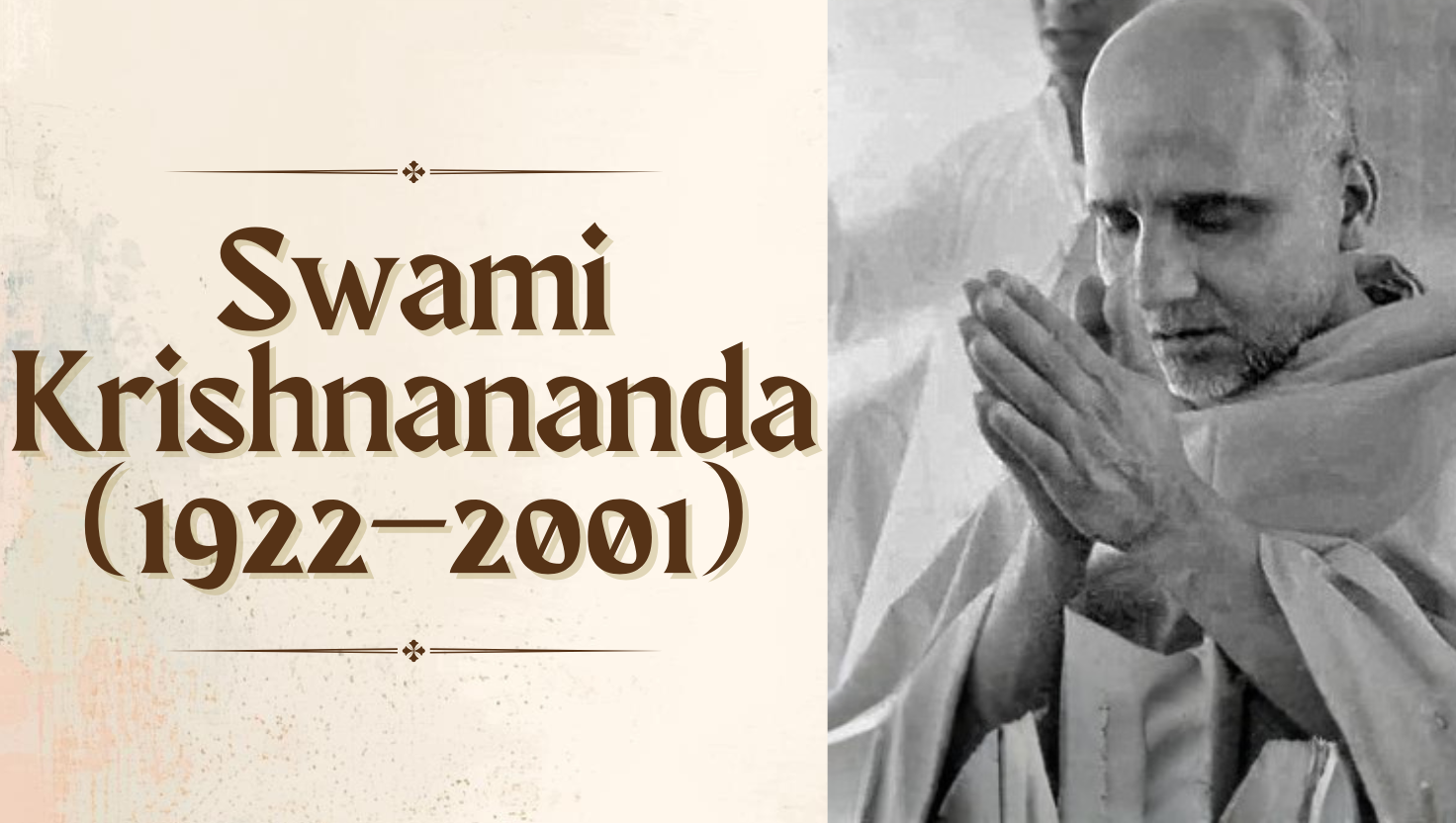
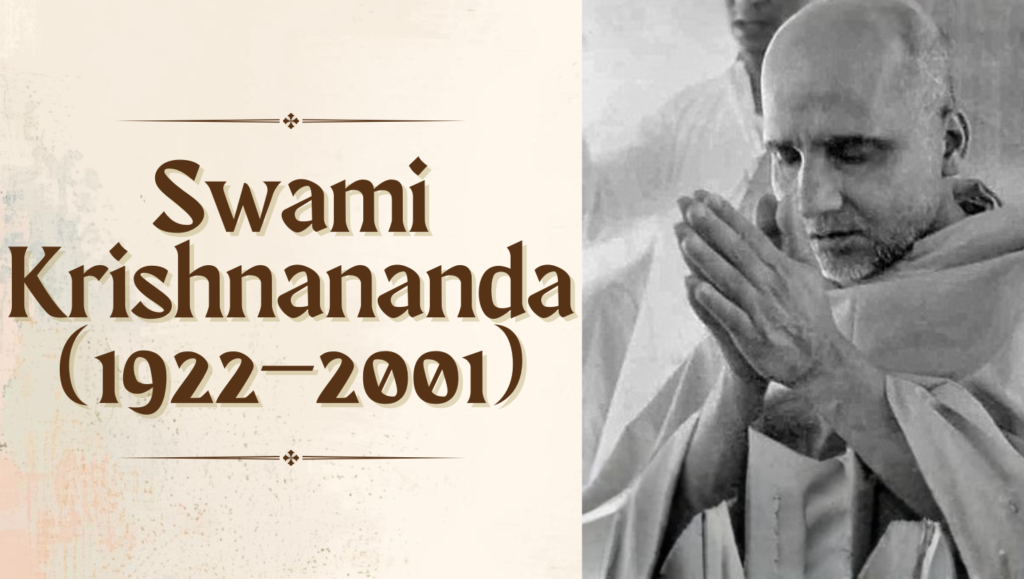
Swami Krishnananda (1922–2001) was one of the foremost exponents of Advaita Vedanta in 20th-century India. A direct disciple of Swami Sivananda, he combined deep metaphysical scholarship with long-term institutional leadership as the General Secretary of the Divine Life Society (1959–2001).
From a UPSC perspective, his life is significant for:
- The evolution of modern Hindu monastic institutions
- The synthesis of Jnana Yoga and Karma Yoga
- The global dissemination of Vedanta philosophy
- Institutional leadership rooted in spiritual ethics
2. Early Life and Intellectual Formation (1922–1944)
Birth and Background
- Born: 25 April 1922
- Birth name: Subbaraya
- Family: Orthodox South Indian Brahmin background
- Early exposure: Sanskrit scriptures, ritual tradition, Vedantic philosophy
Intellectual Brilliance
- Mastered Sanskrit at a young age.
- Developed proficiency in the Upanishads, Bhagavad Gita, and Brahma Sutras.
- Authored early philosophical works in his twenties, including The Realisation of the Absolute.
Analytical Note (UPSC Relevance)
His early training represents:
- Continuity of traditional gurukula-style scholarship
- Role of orthodox households in preserving classical knowledge traditions
- Intellectual foundation of modern Hindu reform movements
3. Rishikesh and Spiritual Transformation (1944–1946)
In 1944, Subbaraya left home for Rishikesh, marking the decisive shift from private scholarship to public spiritual mission.
Guru-Disciple Relationship
- Met Swami Sivananda.
- Immediately engaged in literary and editorial work.
- Recognized for extraordinary scriptural command.
Initiation into Sannyasa
- Date: 14 January 1946 (Makara Sankranti)
- New name: Swami Krishnananda
- Entered monastic life formally.
Importance in Indian Tradition
This reflects:
- Continuity of the Dashanami monastic tradition
- Institutionalization of Vedantic teaching in the modern period
- Role of Rishikesh as a global spiritual hub
4. Philosophical Contributions
Swami Krishnananda’s philosophy centers on samanvaya (harmonization) — reconciling apparently contradictory scriptural doctrines.
(A) Metaphysical Framework
| Concept | His Interpretation |
|---|---|
| Brahman | All-inclusive Absolute (Bhuma) |
| Knowledge (Jnana) | Collapse of subject-object duality |
| Ego | Concentrated form of Universal Consciousness |
| Liberation | Immediate identity with Brahman |
(B) Reconciliation of Doctrines
- Addressed monism vs. dualism debates in Vedanta.
- Treated contradictions in the Brahma Sutras as complementary perspectives.
- Emphasized “Cosmic Perception” — a total vision beyond intellectual fragmentation.
(C) Pedagogical Method
- Simplified complex metaphysics.
- Used analogies such as:
- Sun and Lens: Universal Consciousness focusing into ego.
- Bubble and Ocean: Individual merging into Absolute.
Comparative Insight
His Guru once remarked that “Many Shankaras are rolled into one Krishnananda,” implicitly comparing him to Adi Shankara — the systematizer of Advaita Vedanta.
5. Administrative Leadership (1959–2001)
Position
- General Secretary, Divine Life Society
- Tenure: 42 years
Governance Philosophy
He harmonized:
- Vyavaharika Satta (empirical reality)
- Paramarthika Satta (absolute reality)
Key Contributions
- Institutional Expansion
- Transformed the Society into a global Vedantic institution.
- Strengthened international branches.
- Publication Movement
- Promoted Yoga-Vedanta Forest Academy Press.
- Authored over 40 works on philosophy and meditation.
- Spiritualization of Administration
- Treated administration as Karma Yoga.
- Emphasized “Total Action” — work without ego.
UPSC Relevance
This case illustrates:
- Religious institutions as civil society actors.
- Spiritual leadership models in post-independence India.
- Ethical administration rooted in dharmic principles.
6. Clarification: Distinction from Political Namesake
It is essential not to confuse the spiritual leader with another historical figure:
Spiritual Figure
- Swami Krishnananda
- Philosopher and monastic
- Based in Rishikesh
Political Figure
- Krishna Nand Swami (Sindhi Gandhi1)
- Member of the 1st Himachal Pradesh Legislative Assembly (1952–1956)
- Associated with regional politics
This distinction is important for:
- Accurate historical referencing
- Avoiding conflation in modern political history studies
7. Concept of Liberation (Moksha)
In his later teachings, he emphasized Sadyo Mukti (Immediate Liberation).
Two Spiritual Paths
| Path | Description |
|---|---|
| Suka Marga (Bird’s Path) | Direct realization |
| Pipilika Marga (Ant’s Path) | Gradual spiritual evolution |
He maintained:
- Liberation is dissolution of ego.
- No “travel” after death for the realized soul.
- Moksha is instantaneous identity with Brahman.
8. Legacy and Contemporary Significance
(A) Philosophical Impact
- Modern interpreter of Advaita Vedanta.
- Reconciled traditional scriptural hermeneutics with modern rational inquiry.
(B) Institutional Impact
- Consolidated Divine Life Society as a global spiritual center.
- Preserved textual traditions through systematic publication.
(C) Broader Significance
For UPSC GS-I & GS-IV:
- Role of religion in shaping ethical leadership.
- Indian philosophical traditions in modern governance.
- Spiritual humanism and civil society engagement.
9. Conclusion
Swami Krishnananda represents a rare synthesis of:
- Scholar and administrator
- Mystic and logician
- Ascetic and institution-builder
His life demonstrates that profound metaphysical insight can coexist with administrative excellence. In modern Indian intellectual history, he stands as a bridge between classical Vedanta and contemporary global spirituality.
He attained Mahasamadhi on 23 November 2001, leaving behind a legacy that continues to influence seekers, scholars, and institutions worldwide.
- HP PYQ 2025
Q.22 ↩︎