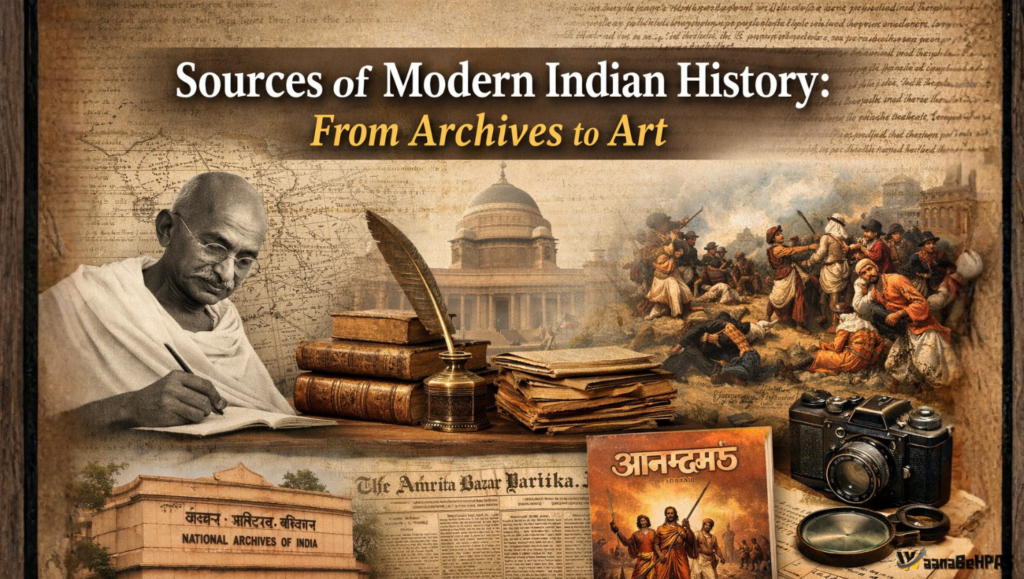
Sources of Modern Indian History for UPSC: Unlocking the Past
Syllabus: UPSC GS-I (Modern India)
Introduction: Why Sources Matter
The period from the mid-18th century to 1947 witnessed the transformation of India from a Mughal successor state to a British colony and finally to an independent nation. Reconstructing this complex journey requires a critical study of historical sources. These sources—official files, newspapers, memoirs, literature, and art—are the raw materials from which historians build narratives.
For a UPSC aspirant, understanding their nature, strengths, and biases is essential not only for factual accuracy but also for analytical interpretation in Mains answers.
Historical sources of Modern India can be broadly classified into:
- Primary Sources – contemporary records created during the period.
- Secondary Sources – later interpretations by historians.
1. Official and Archival Records: The Foundation
1.1 Primacy of Official Records
The British administration produced an enormous volume of systematic documentation. These records allow historians to trace:
- Decision-making processes of colonial rulers,
- Economic policies such as land revenue and trade,
- The psychology of policy makers,
- The evolution of nationalist resistance.
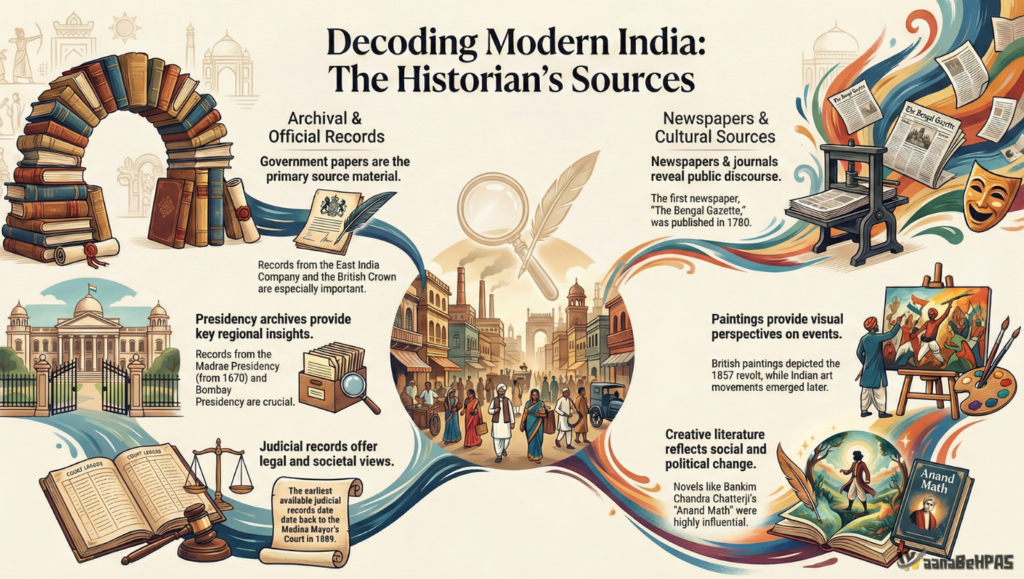
Records of the East India Company (1600-1857) and the Crown administration (post-1858) form the backbone of modern Indian historiography.
1.2 The Four Pillars of Archives
- Central Government Archives – National Archives of India, New Delhi
- State/Provincial Archives – records of British provinces and princely states
- Intermediate & Local Bodies – district collectors, municipalities
- Judicial Records – Mayor’s Courts, High Courts, law commissions
1.3 Key Government Collections
- Survey of India Records (from 1767, James Rennell): geography, roads, forests, settlements.
- Home Department Files (from 1907): crucial for studying the growth of nationalism and revolutionary movements.
- Revenue & Famine Commission Reports: economic impact of colonialism.
- Census Reports (from 1872): demography, caste, occupation.
Important Regional Archives
- Khalsa Darbar Records (1800-1849): Sikh polity under Ranjit Singh.
- Peshwa Daftar, Pune: richest source for Maratha history.
European Power Archives
- Portuguese records in Goa,
- Dutch records in Madras & Bengal,
- French archives from Puducherry/Chandernagore (Paris),
- Danish records of Tranquebar.
1.4 Published Official Sources
- Parliamentary Papers & Debates – British perception of India
- Royal Commission Reports – education, police, famines
- Gazettes – laws, regulations, notifications
UPSC Tip: Quote commissions like Hunter (Education), MacDonnell (Famine), or Simon (Reforms) to enrich answers.
2. Unofficial Sources: Voices Beyond the State
2.1 Private Papers & Memoirs
These provide the human dimension often missing in official files.
- Autobiographies:
- Gandhi – My Experiments with Truth
- Nehru – An Autobiography
- Surendranath Banerjea – A Nation in Making
- Letters & Diaries: Patel, Bose, Dadabhai Naoroji.
- Organizational Records: Indian National Congress papers at Nehru Memorial Library.
- Travel Accounts:
- Bishop Heber’s Journal
- Abbe Dubois – Hindu Manners and Customs
They illuminate social life, caste practices, gender relations, and early reactions to British rule.
2.2 Newspapers & Periodicals: The Pulse of the Nation
The press became the most vibrant arena of political debate.
- First paper: Bengal Gazette (1780) – James Hickey
- Nationalist press:
- Kesari – Bal Gangadhar Tilak
- Bande Mataram – Aurobindo
- The Hindu, Amrita Bazar Patrika, Bombay Chronicle, Al-Hilal
Nearly one-third of INC founders (1885) were journalists, showing the press–nationalism link.
Limitation: Newspapers reflect ideological bias—pro-Raj vs nationalist—hence require critical reading.
3. Literature and Art: The Creative Lens
3.1 Novels as Social Documents
The 19th-century novel mirrored social tensions and nationalism.
- Bankim Chandra – Anandamath: depiction of Sanyasi Revolt
- Premchand: peasant exploitation and rural India
- Tagore & Bharatendu Harishchandra: cultural awakening
These works reveal emotions of ordinary people beyond elite politics.
3.2 Paintings & Visual Sources
- Company Paintings: festivals, trades, attire—everyday life under colonialism.
- 1857 Revolt Paintings:
- Relief of Lucknow – Thomas Barker
- In Memoriam – Joseph Paton (British viewpoint)
- Bengal School of Art: Abanindranath Tagore, Nandalal Bose, Raja Ravi Varma—art as nationalism and cultural assertion.
3.3 Oral Traditions
Folk songs and legends help reconstruct tribal and peasant movements—Santhal, Munda, Indigo revolts.
4. Secondary Sources: Interpreting the Past
4.1 Major Schools of Historiography
| School | Focus | Thinkers |
|---|---|---|
| Nationalist | Freedom struggle, drain of wealth | Bipan Chandra, R.C. Majumdar |
| Marxist | Class, economy, peasantry | D.D. Kosambi, Irfan Habib |
| Cambridge | Elite competition | Anil Seal |
| Subaltern | Voices of marginalized | Ranajit Guha, Partha Chatterjee |
4.2 Standard UPSC Texts
- Bipan Chandra – India’s Struggle for Independence
- Spectrum – A Brief History of Modern India
- Sekhar Bandyopadhyay – From Plassey to Partition
5. Critical Evaluation for UPSC
Strengths of Sources
- Official records → administrative accuracy
- Press → public opinion
- Memoirs → personal insights
- Art & literature → social consciousness
Limitations
- Colonial bias in government files
- Censorship of press
- Elite dominance in narratives
- Need for cross-verification
How to Use in Answers
- Quote a source (e.g., Hunter Commission)
- Show multiple perspectives (British vs nationalist)
- Link to themes: economy, society, politics, culture.
Conclusion: Towards a Composite History
No single source can capture the complexity of Modern India. A balanced history emerges only when:
- Bureaucratic files are read with memoirs,
- Newspapers with folk memories,
- Paintings with economic data.
For UPSC, the ability to identify sources, evaluate bias, and synthesize perspectives converts information into analytical, high-scoring answers. Modern Indian history is therefore not merely a story of events, but a dialogue between diverse voices preserved in these rich sources.