The Revenue Deficit Grant (RDG) Controversy and the 16th Finance Commission: Himachal Pradesh in the Era of Compliance-Driven Fiscal Federalism
Syllabus: UPSC, HPPSC Prelims (HPGK – Current Affairs)
Context:
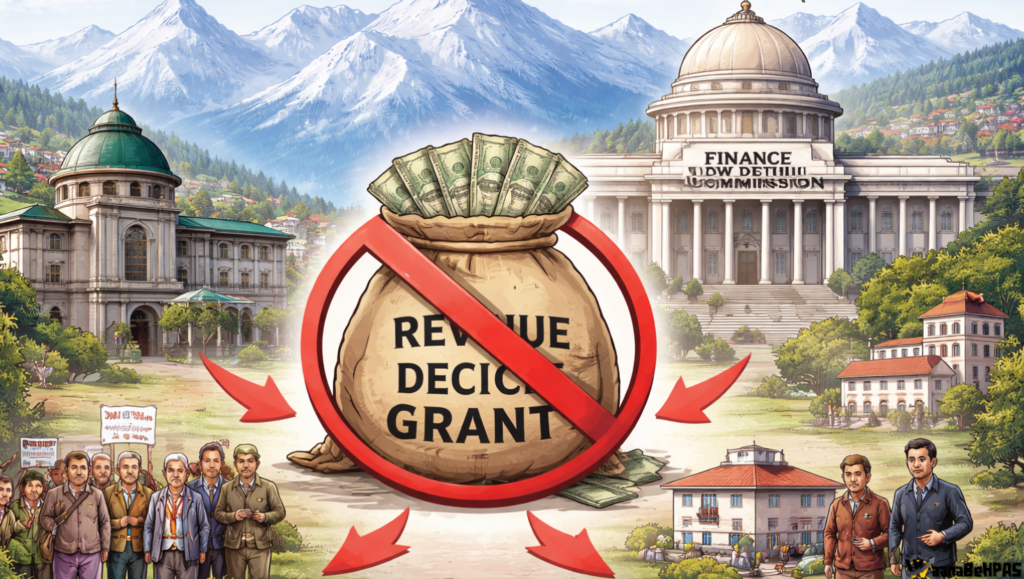
The Revenue Deficit Grant (RDG) controversy has emerged as one of the most significant fiscal and political issues in Himachal Pradesh during the 2026 Budget Session. The Himachal Pradesh Legislative Assembly recently passed a resolution opposing the discontinuation of RDG following the recommendations of the 16th Finance Commission. This issue has major implications for Centre–State financial relations, fiscal federalism, and hill-state economics, making it extremely important from an examination perspective.
1. Introduction: A Critical Fiscal Turning Point
The recent debate over the discontinuation of the Revenue Deficit Grant (RDG) has emerged as one of the most significant fiscal developments affecting Himachal Pradesh during the 2026 Budget Session. The Himachal Pradesh Legislative Assembly passed a resolution opposing the proposed withdrawal of RDG following the recommendations of the 16th Finance Commission (2026–31), reflecting deep concerns over the state’s fiscal sustainability.
This issue is not merely a routine grant dispute; it represents a structural shift in India’s fiscal federal architecture—from an entitlement-based transfer system to a compliance- and performance-driven framework. For a structurally revenue-deficit hill state like Himachal Pradesh, the discontinuation of RDG raises fundamental questions about fiscal equity, constitutional grants, and the future of cooperative federalism.
2. Understanding Revenue Deficit Grant (RDG): Concept and Constitutional Basis
2.1 Definition and Purpose
Revenue Deficit Grant is a post-devolution gap-filling grant recommended by the Finance Commission to states whose assessed revenue expenditure exceeds their revenue receipts even after tax devolution. It ensures that states can maintain a minimum level of administrative and developmental expenditure.
2.2 Constitutional Foundation
- Article 275: Provides for grants-in-aid to states in need of assistance
- Article 280: Mandates the Finance Commission to recommend distribution of taxes and grants
Historically, RDG functioned as a constitutional safety net under the Post-Devolution Revenue Deficit (PDRD) framework, especially for structurally weak states such as hill and northeastern states.
3. The 16th Finance Commission and the Paradigm Shift in Fiscal Transfers
3.1 From Entitlement to Compliance-Driven Federalism
The 16th Finance Commission, chaired by Dr. Arvind Panagariya, marks a watershed in India’s fiscal policy for the 2026–31 award period. Earlier Finance Commissions largely followed an entitlement-based logic, focusing on bridging historical fiscal gaps. In contrast, the 16th Finance Commission signals a transition toward a compliance-driven and performance-oriented fiscal framework.
This shift aims to:
- Promote fiscal sustainability
- Reward economic output
- Align state incentives with national macroeconomic goals
- Encourage fiscal discipline rather than structural dependence
4. Key Recommendations of the 16th Finance Commission (2026–31)
4.1 Retention of Vertical Devolution
The states’ share in the divisible pool of central taxes has been retained at 41 percent, ensuring continuity from the 15th Finance Commission.
4.2 Introduction of GDP-Based Performance Incentive
A major innovation is the introduction of a 10 percent weight for “Contribution to GDP” in horizontal devolution. This criterion rewards states that contribute more to national economic output, measured through the square root of GSDP.
4.3 Compliance Conditions for Grants
Local body grants are now conditional upon:
- Constitution of local bodies as per constitutional provisions
- Public disclosure of audited and provisional accounts
- Timely constitution of State Finance Commissions
4.4 Fiscal Discipline Roadmap
- Central fiscal deficit target: 3.5 percent of GDP
- State fiscal deficit cap: 3 percent of GSDP
- Inclusion of off-budget borrowings in debt calculations
- Greater fiscal transparency through CAG-certified disclosure of net tax proceeds under Article 279
These measures collectively establish what may be termed the “New Discipline” in Indian fiscal federalism.
5. Discontinuation of Revenue Deficit Grant: The Watershed Decision
5.1 Historical Continuity of RDG
Revenue Deficit Grants were consistently recommended by successive Finance Commissions up to the 15th Finance Commission (2021–26). Himachal Pradesh was among the major beneficiaries due to its structural revenue-expenditure imbalance.
Under the 15th Finance Commission:
- Total RDG to Himachal Pradesh (2021–26): approximately ₹37,000 crore
- Grants were gradually tapered but still significant
5.2 Rationale of the 16th Finance Commission
The 16th Finance Commission recommended the complete discontinuation of RDG for the 2026–31 period, affecting around 17 previously eligible states. The Commission’s reasoning includes:
- States possess untapped revenue potential
- Structural deficits partly result from fiscal policy choices
- Need to incentivize fiscal responsibility over dependency
This decision effectively dismantles a long-standing fiscal equalization mechanism.
6. Himachal Pradesh Assembly Resolution and Political Developments (2026)
During the Budget Session 2026, the Himachal Pradesh Assembly:
- Passed a resolution opposing the discontinuation of RDG
- Witnessed intense debates and political protests
- Highlighted the state’s structural financial vulnerability
Chief Minister Sukhvinder Singh Sukhu stated that the state may approach the Prime Minister to seek restoration or reconsideration of the grant, emphasizing that RDG is essential for maintaining fiscal stability in a hill state with limited revenue capacity.
The state government described the withdrawal as a threat to fiscal sustainability and development continuity.
7. Structural Fiscal Disabilities of Himachal Pradesh
7.1 Geographic and Administrative Constraints
Himachal Pradesh is characterized by:
- Mountainous terrain
- Dispersed population
- High infrastructure and service delivery costs
- Disaster vulnerability (landslides, snowfall, climate risks)
These factors significantly increase the cost of governance compared to plains states.
7.2 Limited Revenue Base
The state has:
- Small industrial base
- High dependence on tourism, horticulture, and hydropower
- Limited taxation capacity post-GST regime
Estimated fiscal structure:
- Own revenue capacity: ~₹41,950 crore (approximate range)
- Committed expenditure: ~₹48,000 crore
- Persistent structural deficit
This makes Himachal a chronically revenue-deficit state even after tax devolution.
8. Fiscal Shock Assessment: Impact of RDG Withdrawal on Himachal Pradesh
8.1 Budgetary Dependence
Approximately 12–13 percent of the state’s budget has historically depended on Revenue Deficit Grants, indicating high fiscal reliance.
8.2 Estimated Financial Gap
- Immediate fiscal gap: ~₹6,000 crore annually
- Potential cumulative withdrawal impact: ~₹37,000 crore over the award cycle
This creates a severe resource mismatch between committed liabilities and available revenue.
9. Potential Economic and Administrative Consequences
9.1 Subsidy Rationalization
Possible rollback or restructuring of subsidies in:
- Transport (HRTC)
- Electricity
- Water
- Public distribution and welfare schemes
9.2 Institutional and Workforce Rationalization
Policy discussions indicate:
- Abolition of long-vacant government posts
- Institutional downsizing
- Wage bill compression
- Possible delay in DA/DR payments
9.3 Pension and Borrowing Constraints
Fiscal tightening may push:
- Migration from Old Pension Scheme (OPS) to alternative pension structures
- Restrictions on borrowing capacity linked to fiscal discipline conditions
10. Horizontal Devolution Reforms and Their Implications for Hill States
10.1 Changed Criteria Weights (16th FC)
Key shifts include:
- Income Distance: Reduced weight
- Population (2011): Increased weight
- Demographic Performance: Recalibrated
- Contribution to GDP: Newly introduced (10%)
- Removal of Tax Effort criterion
The GDP weight structurally favours industrial and high-growth states, while hill states with ecological constraints and lower economic output risk relative fiscal disadvantage.
10.2 Forest and Ecology Criterion
Although the retention of a 10 percent weight for forest and ecology acknowledges environmental preservation costs, it may not fully compensate for high administrative expenditure in mountainous regions.
11. Federalism Debate: Cooperative vs Compliance Federalism
11.1 Traditional Cooperative Federalism
Earlier fiscal architecture emphasized:
- Unconditional support
- Equity-driven transfers
- Gap-bridging grants (like RDG)
11.2 Emerging Compliance Federalism
The 16th Finance Commission introduces:
- Conditional transfers
- Performance-linked incentives
- Fiscal transparency mandates
- Deficit caps and discipline enforcement
This transforms fiscal federalism into a more competitive and compliance-oriented system.
12. Broader Constitutional and Policy Concerns
12.1 Article 275 and Asymmetric Federal Realities
Critics argue that discontinuing RDG weakens the constitutional intent of assisting structurally disadvantaged states where uniform formulas cannot capture terrain-related expenditure disabilities.
12.2 Post-GST Revenue Constraints
After GST implementation:
- States lost independent taxation flexibility
- Increased dependence on central transfers
- Simultaneous end of GST compensation and RDG is seen as a “double fiscal shock”
13. Fiscal Transparency and the New Accountability Framework
The 16th Finance Commission has also emphasized:
- Disclosure of CAG-certified net tax proceeds
- Inclusion of off-budget borrowings in debt calculations
- Monitoring of unconditional cash transfers to prevent crowding out capital expenditure
While enhancing transparency, these measures restrict fiscal manoeuvrability for deficit states like Himachal Pradesh.
14. Strategic Policy Options for Himachal Pradesh and Similar States
14.1 Negotiated Fiscal Support
- Restoration or transitional RDG mechanism
- Special category-type compensatory grants
14.2 Institutional Federal Dialogue
- Activation of Inter-State Council (Article 263)
- Continuous Centre-State fiscal consultations
14.3 Floor Guarantee Mechanism
Ensuring that no state’s absolute fiscal transfers fall below 15th Finance Commission levels during transition.
15. Conclusion: RDG Controversy as a Test Case for India’s Fiscal Union
The discontinuation of Revenue Deficit Grant under the 16th Finance Commission represents a structural transformation in India’s fiscal federal system. While the shift toward compliance-driven federalism promotes efficiency, transparency, and fiscal discipline, it simultaneously exposes structurally vulnerable states like Himachal Pradesh to severe fiscal stress.
The Assembly resolution, political debate, and proposed intervention with the Union government underscore the gravity of the issue. For Himachal Pradesh, RDG is not merely a financial transfer but a foundational instrument enabling governance in a geographically challenging and economically constrained region.
The core policy challenge lies in balancing macroeconomic discipline with constitutional equity. If the compliance era is to sustain the integrity of India’s fiscal federalism, it must accommodate the structural disabilities of hill and border states while pursuing performance-driven reforms.