Reforming State Public Service Commissions (PSCs)
Syllabus: Polity (UPSC GS II)
Source: The Hindu
Context
The 2025 National Conference of State PSC Chairpersons will be held in Telangana on December 19–20. This is important because almost every year, State PSC exams face delays, paper leaks, court cases and result cancellations — creating a trust deficit among aspirants.
To restore credibility, structural and procedural reforms are necessary.
How PSCs evolved
| Event | Significance |
|---|---|
| Montagu–Chelmsford Reforms, 1918 | Recognised the need for independent recruitment free from political influence; supported merit-based entry of Indians. |
| First Public Service Commission (1926) | Established to regulate Union recruitment. |
| Government of India Act, 1935 | Provided for one PSC in each province. |
| Constitution of India (1950) | Continued the system under Articles 315–323, leading to present-day UPSC & State PSCs. |
The core idea during freedom struggle was self-rule through merit-based civil services — and PSCs are an outcome of that demand.
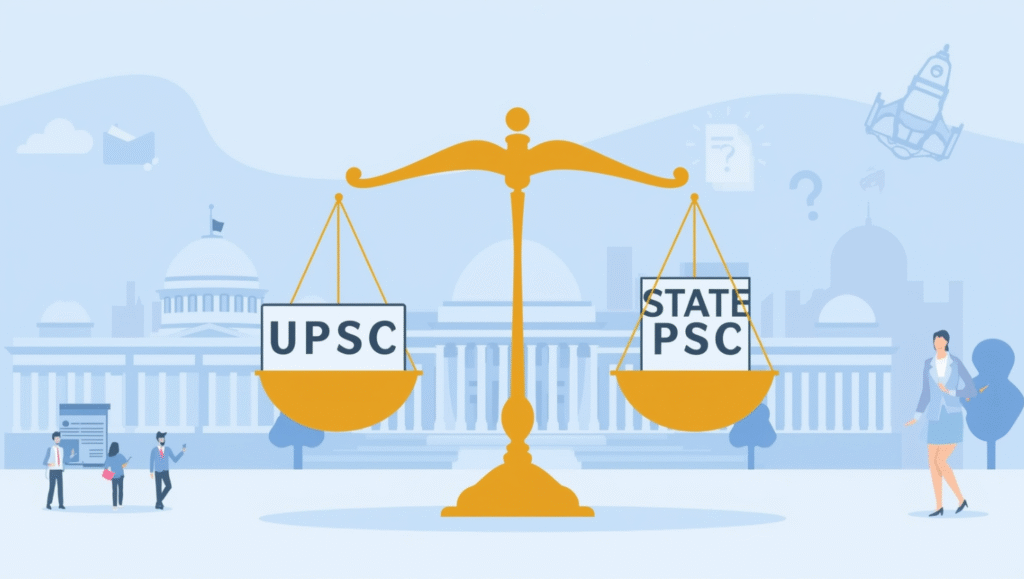
Structural Difference: UPSC vs State PSCs
| Aspect | UPSC | State PSCs |
|---|---|---|
| Appointment | Merit-based, experienced members, limited political influence | Often political nominations, no clear qualification criteria |
| Administrative Support | Has dedicated ministry (Department of Personnel & Training – DoPT) | No similar dedicated ministry in most States |
| Manpower Planning | Regular recruitment calendar & exam cycle | Irregular vacancy notifications and exam delays |
| Academic Expertise | Access to national panel of experts | Limited to local experts only |
| Reliability | Strong transparency + confidentiality | Frequent litigation, result disputes, question paper errors |
Many States even delay recruitment due to lack of funds, extended retirement age policies and poor manpower planning.
Why State PSCs face recurring issues
- Syllabus not updated regularly, unlike UPSC.
- Limited academic pool — only State-level experts.
- Poor evaluation moderation → uneven marking, court cases.
- Complex reservation calculations (vertical + horizontal + zonal) → frequent errors.
- Translation issues cause ambiguity in regional language papers.
- Weak balance between secrecy & transparency → paper leaks, cancellations.
Result:
Aspirants often say they trust UPSC more than State PSCs. Credibility is declining, reforms are urgent.
Role of Ministry of Personnel, Public Grievances & Pensions (DoPT)
- Formulates national rules for recruitment & service conditions.
- Ensures regular vacancy notifications.
- Enables UPSC to conduct exams smoothly and on schedule.
States lack such structured mechanisms — which is why reforms must begin here.
How can State PSCs be reformed?
1. Create a State-level Personnel Ministry
- Prepare a 5-year recruitment calendar
- Notify vacancies annually like UPSC
- Ensure exams occur regularly and on time
2. Reform PSC Appointments (Constitutional Amendment Required)
- Minimum age: 55 years, Maximum age: 65 years
- Define clear qualifications:
| Member Type | Suggested Eligibility |
|---|---|
| Official Member | Must have served as Secretary or equivalent |
| Non-official Member | At least 10 years of professional practice (law, medicine, engineering etc.) |
- Opposition consultation for non-official appointments
- Maintain a state-based panel of high-integrity experts
3. Revise Syllabus Every 3–5 Years
- Put draft syllabus online for public feedback
- Align broadly with UPSC syllabus
- Region-specific topics (history/economy/geography) should be objective-type to avoid evaluation bias
4. Improve Exam Pattern & Question Setting
- Prelims → objective
- Mains → mix of objective + descriptive
- Use tech-assisted but human-verified translation for clarity
- Change question format regularly to reduce AI-based rote answering
5. Strengthen Institutional Leadership
- PSC Secretary should be a senior officer with exam management experience (e.g. school/board administration)
- Adopt UPSC’s balance of confidentiality + transparency
(quick redressal, minimal litigation)
Conclusion
State PSCs are an essential part of India’s federal governance. However, without reforms, delays and controversies will continue.
By improving appointment standards, syllabus revision, institutional capacity, and ensuring regular recruitment cycles, State PSCs can regain credibility and function like the UPSC — efficient, transparent and trusted.