
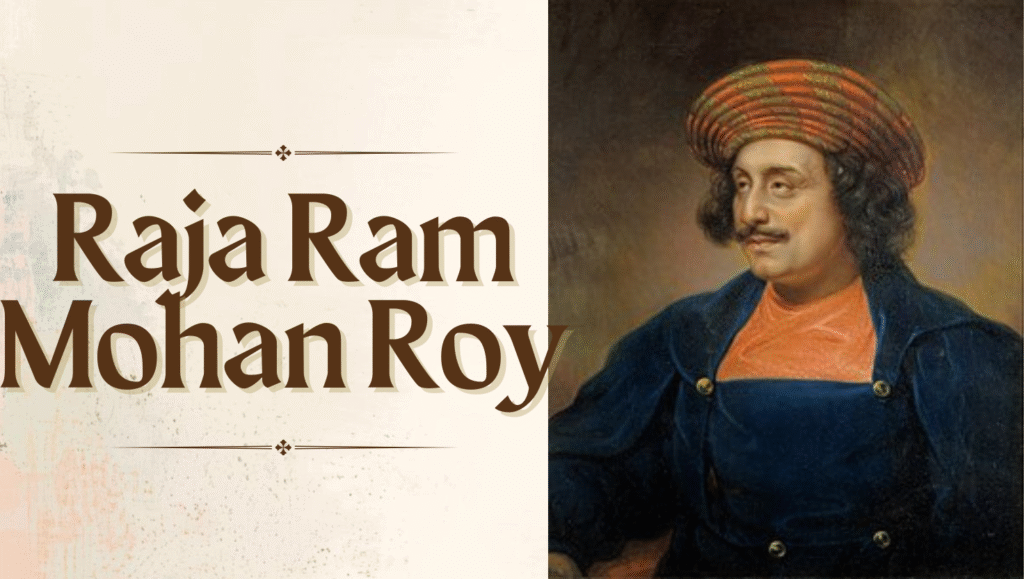
Raja Ram Mohan Roy – Life and Role in Reforms
Syllabus: Modern History (UPSC Prelims)
Raja Ram Mohan Roy (1772–1833) is widely known as the “Father of Modern India” and the “Father of Indian Renaissance.” He was a major socio-religious reformer who challenged regressive practices and laid the foundations of modern Indian society. He also founded Brahmo Samaj1 (1828).
Early Life
- Born on 22 May 1772 at Radhanagar in Bengal.
- Came from a traditional Brahmin family.
- Studied Sanskrit, Persian, Arabic and English.
- Worked with the East India Company till 1814, which exposed him to Western ideas and strengthened his reformist outlook.
Major Social Reforms
- Campaign against Sati → His efforts led to official abolition of Sati in 1829 (Regulation XVII) under Lord Bentinck.
- Opposed child marriage and polygamy.
- Supported women’s rights and female education.
- Founded Atmiya Sabha (1814) to discuss social issues and end blind ritualism.
Religious Reforms
- Advocated monotheism and rational religion.
- Criticised idol worship and superstition.
- Published Tuhfat-ul-Muwahhidin (1803) supporting monotheistic ideas.
- Published Precepts of Jesus (1820) highlighting ethical teachings.
- Founded Brahmo Samaj (1828) – against idol worship, promoting reason, morality and humanism.
Educational Initiatives
- Set up Anglo-Hindu School (1822) to teach Western sciences.
- Founded Vedanta College (1826) to blend Vedanta with modern learning.
- Strongly argued for English education to modernise Indian intellect.
Political Contributions
- Opposed arbitrary colonial policies.
- Demanded civil rights and freedom of press.
- Started journals like Samvad Kaumudi (Bengali), Mirat-ul-Akhbar (Persian).
- Criticised exploitative taxation by zamindars.
Ideology – Key Points
- Monotheism
- Social equality
- Women’s rights
- Modern education
- Rationalism
- Religious tolerance
Death
- Travelled to England in 1830 as representative of the Mughal Emperor.
- Died in Bristol in 1833 and was buried there.
- Question Reference
(HPAS PYQ 2025) ↩︎





1 thought on “Raja Ram Mohan Roy”
Pingback: Raja Ram Mohan Roy | The Untold Story You Need!