India’s National Counter-Terror Strategy — PRAHAAR
Syllabus: UPSC GS III – Internal Security
A Comprehensive Doctrinal & UPSC-Oriented Analysis (GS-3: Internal Security)
On 23 February 2026, the Ministry of Home Affairs unveiled PRAHAAR (Policy for Response Against Hostile Activities and Radicalisation) — India’s first publicly articulated National Counter-Terrorism Policy and Strategy. Its release, coming a day after the outline of the National Security Strategy (NSS), reflects a calibrated attempt to consolidate India’s internal security doctrine into a coherent, intelligence-led, whole-of-government framework.
For UPSC aspirants, PRAHAAR represents a landmark shift in India’s counter-terror architecture — from reactive, event-based policing to proactive disruption of systemic vulnerabilities, grounded in constitutional legitimacy and rule of law.
I. Strategic Genesis: Why PRAHAAR Now?
India’s counter-terror efforts historically evolved through:
- Ad hoc coordination among intelligence and police agencies,
- Post-incident strengthening of laws (e.g., UAPA amendments),
- Institutional innovation after major attacks (e.g., NIA post-26/11).
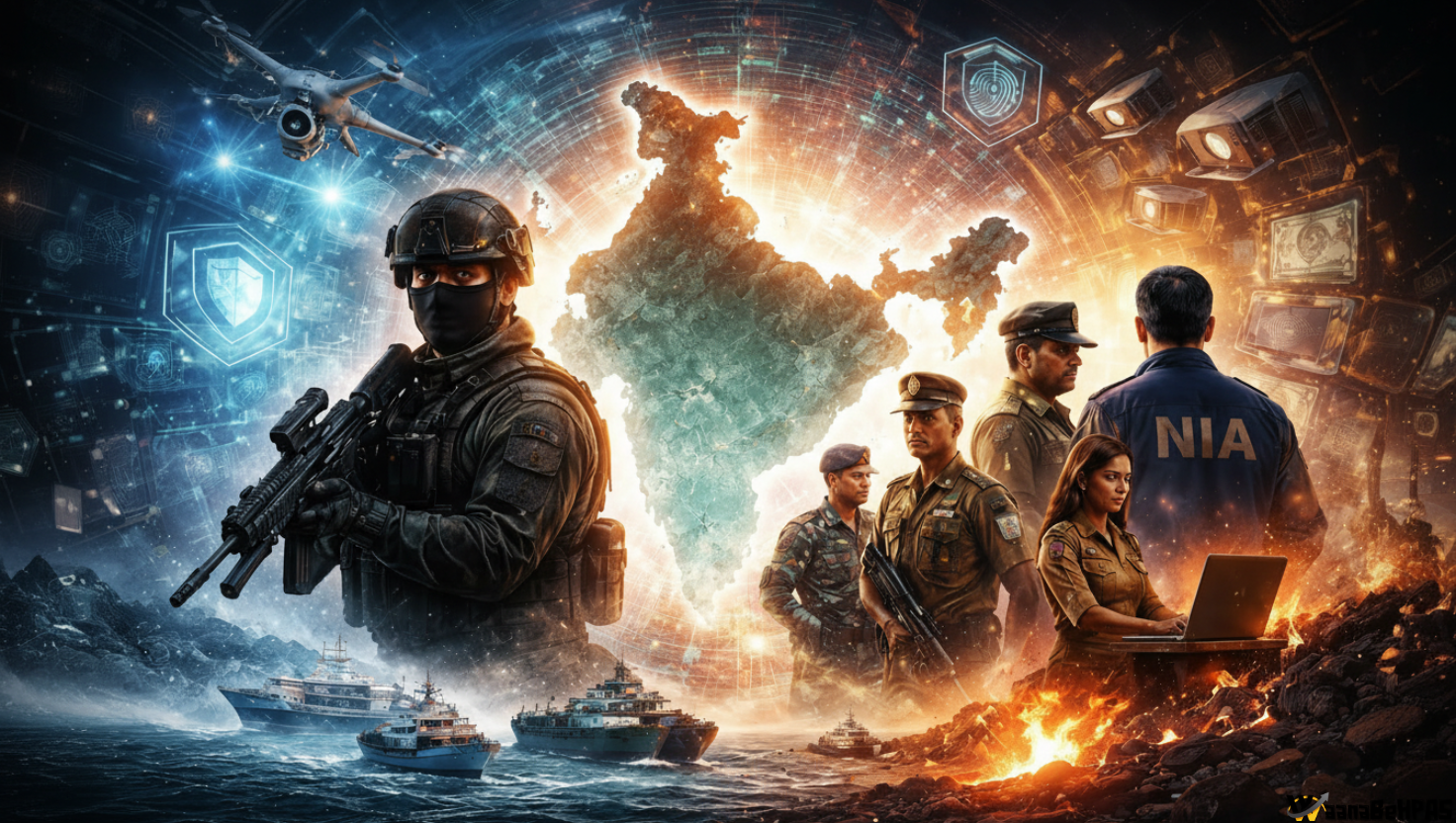
However, the hybridisation of threats — drones, encrypted apps, narco-terror funding, dark web propaganda, AI-driven radicalisation — exposed structural gaps.
The doctrine’s finalisation followed security shocks such as the Pahalgam terror attack (April 2025), which underlined:
- The speed of modern terror networks,
- The need for anticipatory intelligence fusion,
- Integration of kinetic and non-kinetic responses.
Thus, PRAHAAR formalises India’s:
- Zero-Tolerance Approach, and
- Whole-of-Government & Whole-of-Society model.
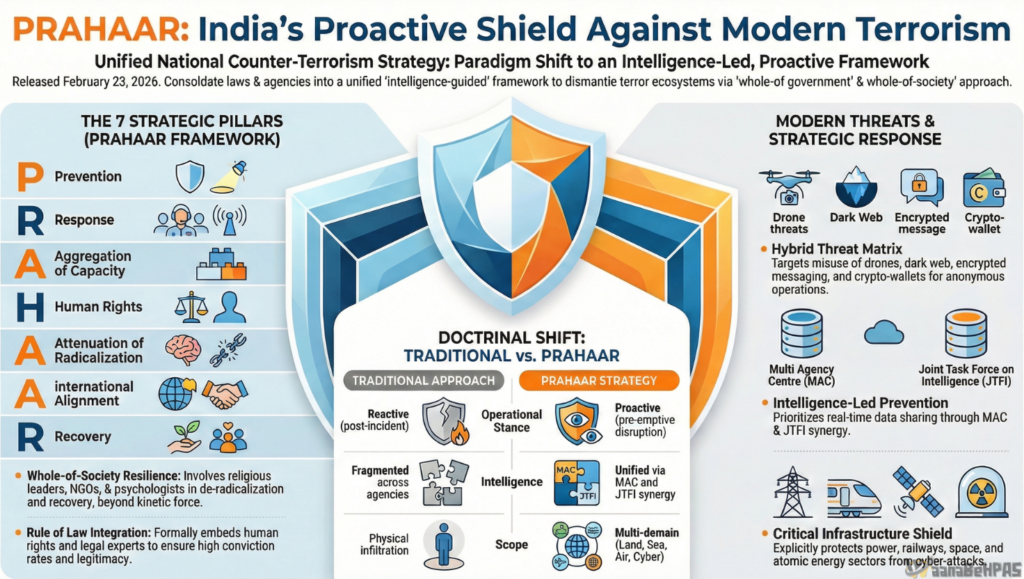
II. Deconstructing the PRAHAAR Framework: The Seven Pillars
The acronym “PRAHAAR” (meaning decisive strike) symbolises calibrated force within democratic constraints.
| Pillar | Core Objective | Intended Outcome |
|---|---|---|
| Prevention | Intelligence-led pre-emptive disruption | Early neutralisation of modules |
| Response | Swift, proportionate counter-action | Rapid termination of active threats |
| Aggregation | Centre–State capacity integration | Institutional synergy |
| Human Rights | Rule-of-law based enforcement | Normative legitimacy |
| Attenuation | Address radicalisation drivers | Shrinking recruitment pools |
| Alignment | Shape global counter-terror norms | Deny safe havens |
| Recovery | Societal & psychological resilience | Faster return to normalcy |
III. Hybrid Threat Matrix: Multi-Domain Recognition
PRAHAAR acknowledges that modern terrorism is no longer confined to physical insurgency.
1. Land Domain
- Cross-border infiltration.
- Over-Ground Worker (OGW) networks.
- Radicalisation hubs.
2. Maritime Domain
Lessons from the 2008 Mumbai attacks:
- Coastal surveillance gaps,
- Maritime smuggling of arms,
- Sea-borne infiltration.
3. Air & Drone Threats
- Weaponised drones in border states.
- Precision delivery of arms & narcotics.
4. Digital Domain
- Encrypted messaging apps,
- Online gaming chat recruitment,
- Cryptocurrency funding,
- AI-generated propaganda.
5. CBRNED Threat Profile
(Chemical, Biological, Radiological, Nuclear, Explosive, Digital)
Emerging vulnerabilities:
- Marine toxin threats (e.g., Tetrodotoxin case study),
- Cyber manipulation of critical infrastructure,
- Public health emergencies as hybrid warfare tools.
👉 UPSC Link: “Challenges to Internal Security through Communication Networks” (GS-3).
IV. Institutional Architecture: Intelligence Primacy Model
PRAHAAR operationalises coordination through strengthened institutions:
1. Multi Agency Centre (MAC)
- Real-time intelligence sharing.
2. Intelligence Bureau (IB)
Intelligence Bureau
- Central intelligence coordination.
3. National Investigation Agency (NIA)
National Investigation Agency
- Nodal investigative authority.
- ~92% conviction rate (legal deterrence).
4. National Security Guard (NSG)
National Security Guard
- Specialized urban counter-terror response.
5. Bureau of Police Research & Development (BPR&D)
Bureau of Police Research and Development
- SOP standardisation & training modernisation.
Key Reform:
Creation of Joint Anti-Terror Task Forces (Centre–State) to reduce the “golden hour” vulnerability during attacks.
V. Legal Backbone: Deterrence through Rule of Law
PRAHAAR is anchored in a robust statutory framework:
Core Laws:
- Unlawful Activities (Prevention) Act (UAPA)
- Prevention of Money Laundering Act (PMLA)
- Bharatiya Nyaya Sanhita (BNS)
- Bharatiya Nagarik Suraksha Sanhita (BNSS)
- Bharatiya Sakshya Adhiniyam (BSA)
Human Rights Integration:
- Protection of Human Rights Act
- International Covenant on Civil and Political Rights
- International Covenant on Economic, Social and Cultural Rights
This dual emphasis ensures:
- Hard-hitting disruption,
- Democratic legitimacy,
- Avoidance of communal polarization.
VI. Attenuation & Whole-of-Society Strategy
PRAHAAR recognises that terrorism thrives in enabling ecosystems.
1. Community Engagement
- Partnership with civil society & moderate religious leaders.
- Counter-narrative campaigns.
2. Socio-Economic Shield
- Skill development & education.
- Preventing youth radicalisation.
3. Prison De-Radicalisation
- Monitoring ideological indoctrination within correctional facilities.
👉 UPSC Angle: Link to “Role of civil society in national security”.
VII. International Dimension: Shaping Global Norms
Terror financing networks often intersect with:
- Golden Crescent,
- Golden Triangle,
- Narco-terror pipelines.
India leverages:
- Financial Action Task Force (FATF),
- United Nations Security Council 1267 Sanctions Committee,
to:
- Isolate state sponsors,
- Push for global designation of terror entities,
- Strengthen extradition & MLAT frameworks.
India’s positioning: Responsible Global Counter-Terror Leader.
VIII. Strategic Strengths of PRAHAAR
- Intelligence-led prevention over reactive response.
- Integrated federal coordination.
- Legal and normative legitimacy.
- Hybrid threat adaptability.
- Institutionalised resilience planning.
IX. Critical Gaps & Way Forward
1. Narco-Terror Synchronisation
Need deeper coordination between:
- Anti-narcotics agencies,
- Financial Intelligence Units.
2. Algorithmic & AI Warfare
- Clear operationalisation of digital monitoring.
- Balancing privacy vs surveillance.
3. External Deterrence Clarity
- Thresholds for cross-border retaliation.
- Integrating internal CT with external strategic doctrine.
4. Capacity & Resource Gaps
- State police modernisation.
- Cyber-forensics infrastructure.
X. Conclusion: Doctrinal Milestone in India’s Internal Security
PRAHAAR marks the transition from fragmented security responses to a consolidated counter-terror doctrine. It integrates:
- Intelligence primacy,
- Legal robustness,
- Technological adaptation,
- Societal resilience,
- International diplomacy.
For UPSC, PRAHAAR exemplifies how:
- Internal security intersects with governance,
- Federalism influences operational response,
- Rule of law balances coercive state power.
UPSC Mains Enrichment
Sample Question:
“Terrorism in the hybrid era requires a multi-domain doctrinal response rather than isolated kinetic action.” Examine in the light of India’s PRAHAAR strategy. (250 words)
Keywords to Use:
- Intelligence primacy
- Whole-of-Government
- CBRNED threats
- Normative legitimacy
- Radicalisation attenuation
- Federal security architecture