Constitutional Balance in a Technological Age: Pax Silica, Gubernatorial Discretion, and India’s Democratic Equilibrium
I. Introduction: Power, Technology, and Constitutional Morality
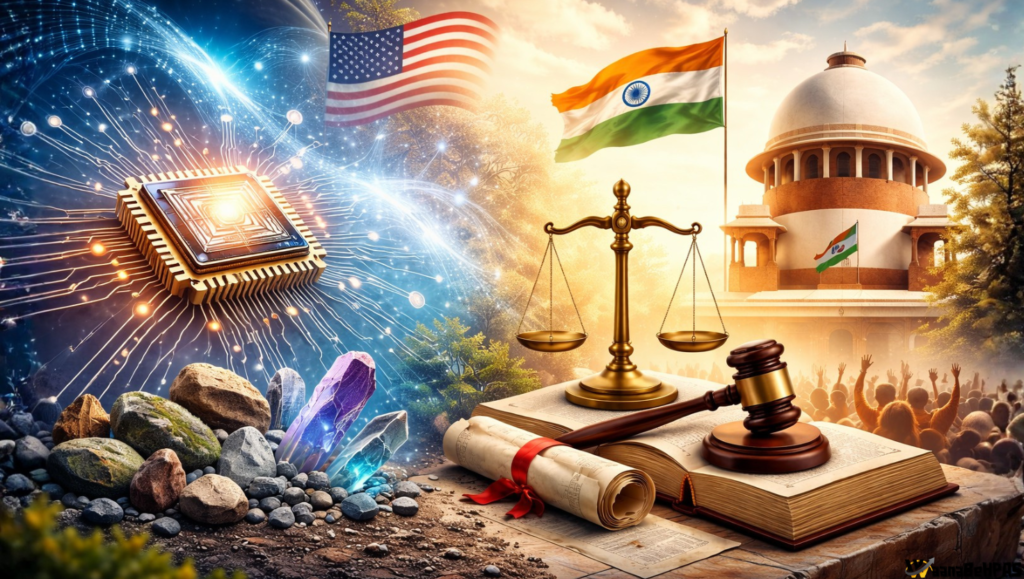
India stands at a critical juncture where global technological realignments intersect with domestic constitutional tensions. On one hand, India has joined the U.S.-led Pax Silica coalition, signaling a strategic pivot in AI infrastructure and critical mineral geopolitics. On the other, recurring constitutional standoffs between elected governments and Governors under Article 176 raise questions about federal balance and parliamentary propriety.
Both developments—though seemingly unrelated—share a common theme:
The need to preserve institutional balance while navigating power transitions.
For UPSC preparation, this synthesis spans:
- GS II – International Relations & Polity
- GS III – Technology, Economy & Security
- GS IV – Ethics & Constitutional Morality
- Essay – Power, Institutions, and Democratic Legitimacy
PART I
India and Pax Silica: Technology as the New Geopolitical Currency
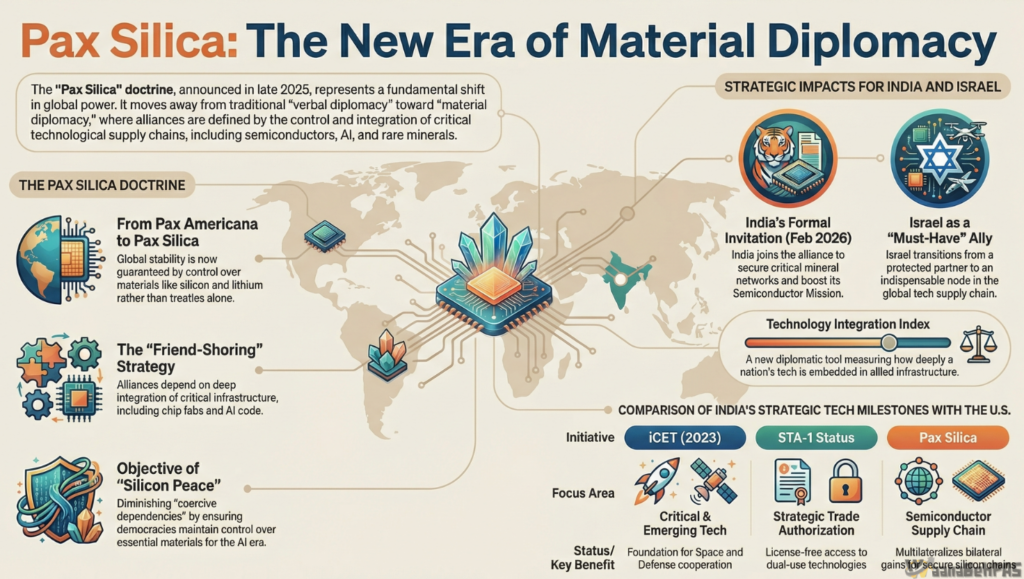
II. Pax Silica: Silicon Geopolitics Replacing Oil Geopolitics
The U.S.-led Pax Silica coalition seeks to:
✔ Secure critical mineral supply chains
✔ Strengthen semiconductor ecosystems
✔ Coordinate AI infrastructure
✔ Reduce technological dependence on concentrated geographies
In the 21st century, microchips and minerals are strategic assets equivalent to oil reserves in the 20th century.
India’s participation marks a transition from passive market participant to active technology stakeholder.
III. Strategic Significance for India
1️⃣ International Relations
- Reinforces India–U.S. strategic convergence
- Strengthens democratic tech alliances
- Aligns with Indo-Pacific strategic balancing
Yet, India maintains Strategic Autonomy — engaging in partnerships without bloc alignment.
2️⃣ Economic & Technological Implications
India gains:
- Integration into global semiconductor value chains
- Investment in AI infrastructure
- Strengthened mineral diplomacy (Africa, Latin America)
This complements domestic initiatives such as:
- Semiconductor Mission
- Production Linked Incentive (PLI) schemes
- Digital India
3️⃣ National Security Dimension
Control over:
- Advanced AI chips
- Rare earth elements
- High-performance computing
Directly affects:
- Cyber warfare capability
- Defence modernization
- Strategic deterrence
Tech sovereignty now defines national sovereignty.
IV. Risks and Challenges
⚠ Managing relations with China
⚠ Avoiding technological dependency
⚠ Scaling domestic R&D
⚠ Building fabrication infrastructure
The goal must be:
Partnership without dependency.
PART II
Gubernatorial Discretion and the Sanctity of Article 176
V. The Constitutional Bedrock: Article 176
Article 176 mandates the Governor to address the State Legislature:
- At the first session of each calendar year
- After general elections
Key Constitutional Principles:
✔ Mandatory Delivery – No discretion in timing
✔ Cabinet Authorship – Text prepared exclusively by the Council of Ministers
✔ Ceremonial Role – Governor acts on “aid and advice” under Article 163
The address is not a personal speech, but a declaration of the elected government’s roadmap.
VI. Case Study I: Tamil Nadu Standoff
The standoff involved:
- Refusal to read government-prepared text
- Allegations of factual inaccuracies
- Walkouts from the Assembly
- Legislative resolution to record Cabinet-approved text
This reflects a breakdown of convention and raises questions about:
- Limits of gubernatorial discretion
- Parliamentary decorum
- Federal equilibrium
VII. Case Study II: Kerala Policy Address Controversy
In Kerala:
- Selective omission of Cabinet-approved content
- Removal of references critical of Union fiscal policy
- Executive rectification by Chief Minister
The controversy highlights:
- Tension between Union-appointed Governor and State Cabinet
- Conflict between discretion and duty
VIII. Article 163 vs Article 176: The Constitutional Boundary
Article 163 permits discretion only in limited cases (e.g., recommending President’s Rule, reserving bills).
Article 176 is not among those discretionary exceptions.
Therefore:
The Governor’s role in delivering the address is a constitutional obligation, not a discretionary privilege.
Failure to adhere undermines:
- Parliamentary accountability
- Federal harmony
- Democratic mandate
PART III
A Unifying Theme: Institutional Balance in Transition
Though Pax Silica and gubernatorial controversies operate in different domains, they share common structural concerns:
| External Sphere | Internal Sphere |
|---|---|
| Tech power competition | Constitutional power friction |
| Supply chain resilience | Federal balance |
| Strategic autonomy | Cabinet supremacy |
| Institutional trust among allies | Institutional trust within Union |
Both require:
✔ Clear boundaries of authority
✔ Codified accountability
✔ Ethical leadership
✔ Institutional transparency
PART IV
Reform Pathways
A. In Global Tech Strategy
- Invest in indigenous semiconductor fabs
- Expand critical mineral acquisition
- Strengthen AI R&D institutions
- Build resilient digital infrastructure
B. In Constitutional Governance
- Codify Cabinet precedence in Article 176 addresses
- Standardize rectification mechanisms in Assembly rules
- Reinforce Speaker’s prerogative
- Clarify discretionary boundaries under Article 163
PART V
Ethical Dimension: Unity of Means and Ends
Whether in technology alliances or legislative addresses, legitimacy depends on constitutional morality.
- Tech alliances must not compromise sovereignty.
- Governors must not compromise democratic mandate.
- Institutions must operate within defined boundaries.
Gandhian philosophy reminds us:
Means shape ends.
If institutions distort procedure, outcomes lose legitimacy.
UPSC Examination Relevance
GS II
- India–U.S. relations
- Federalism & Governor’s role
- Separation of powers
- Constitutional bodies
GS III
- Critical minerals strategy
- Semiconductor ecosystem
- AI & digital security
GS IV
- Integrity in public office
- Non-partisanship
- Ethical statecraft
Essay Themes
- “Technology as the New Axis of Power”
- “Constitutional Morality in Federal Governance”
- “Balancing Autonomy and Alliance in the 21st Century”
Conclusion: Preserving Balance in an Age of Flux
India’s future will be shaped by:
- Its ability to secure technological sovereignty externally
- Its ability to preserve constitutional equilibrium internally
Pax Silica represents the reordering of global power through silicon.
The Article 176 controversies represent the testing of constitutional discipline within federalism.
In both arenas, the lesson is clear:
Institutions must be strengthened before power can be exercised safely.
A technologically ambitious India must remain constitutionally grounded.
Only then can strategic expansion coexist with democratic integrity.