The Presiding Officer Under Scrutiny
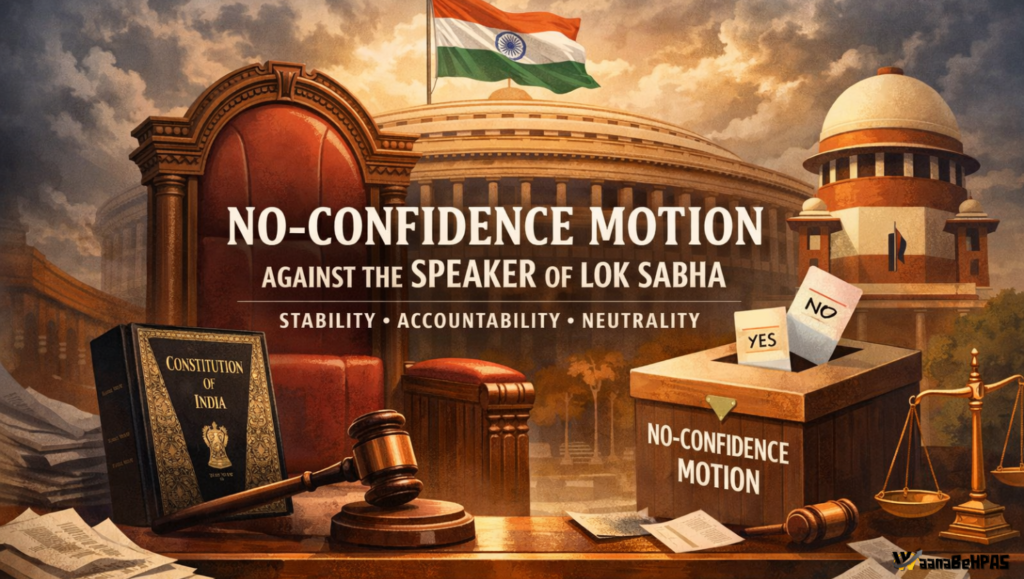
No-Confidence Motion & Removal of the Speaker of the Lok Sabha
Syllabus: (UPSC GS-2: Polity & Governance)
1. Constitutional Mandate: Pillars of the Speaker’s Office
The Speaker of the Lok Sabha occupies a position of high constitutional authority and institutional dignity. The office is designed as a neutral arbiter and guardian of parliamentary democracy, ensuring orderly functioning of the House.
- Article 93 – Election of Speaker
- Lok Sabha shall choose a Speaker and Deputy Speaker.
- Election date is fixed by the President of India.
- Ensures executive imprimatur at the initiation stage.
- Warrant of Precedence
- Ranks after President, Vice-President, and Prime Minister.
- Reflects constitutional importance.
- Article 94 – Vacation of Office
- Ceases to be MP.
- Resignation addressed to Deputy Speaker.
- Removal by resolution of House.
- Financial Independence
- Salary charged on the Consolidated Fund of India.
- Not subject to annual vote of Parliament.
- Shields Speaker from executive pressure.
2. Procedural Mechanics: Architecture of Removal
The removal process is deliberately stringent to prevent political instability. It combines constitutional safeguards under Article 94(c) with Lok Sabha Rules (200–203).
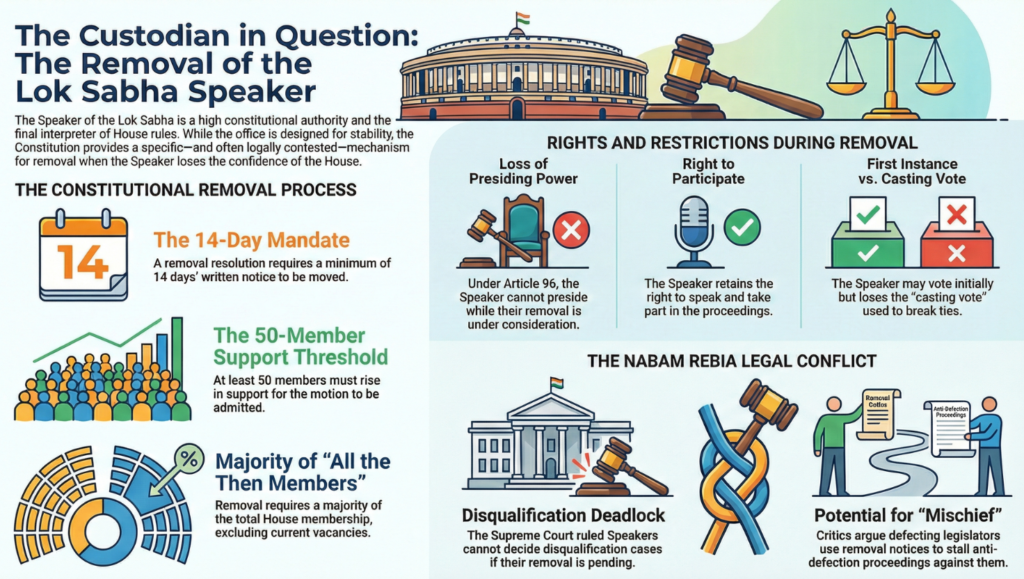
- 14-Day Notice Requirement
- Written notice to Secretary-General.
- Mandatory cooling-off period.
- Admissibility Standards (Rule 200A)
- Charges must be specific.
- No arguments, inferences, or defamatory content.
- Leave Stage (Rule 201)
- Mover cannot make a speech.
- Prevents political grandstanding.
- Minimum 50 members must rise in support.
- Admission Timeline
- Must be disposed of within 10 days after leave granted.
3. Absolute Majority Requirement: The Strategic Safeguard
Removal of the Speaker requires a higher threshold than ordinary legislation, ensuring stability of the presiding office.
- Article 94(c) requires:
- Majority of all the then members.
- Equivalent to Effective Majority.
- Total membership minus vacancies.
- Contrast with Article 100
- Ordinary decisions → majority of members present and voting.
- Removal → absolute majority of House strength.
- Strategic Impact
- Prevents removal during thin attendance sessions.
- Ensures settled will of entire House.
4. Status of Speaker During Removal (Article 96)
A constitutional dichotomy arises: the Speaker cannot preside but retains rights as a Member of Parliament. This reflects principles of natural justice.
- Cannot Preside
- Deputy Speaker or another member presides.
- Right to Defend
- May speak and participate in debate.
- Debate restricted to specific charges.
- Voting Rights Inverted
| Feature | Normal Session | During Removal |
|---|---|---|
| Presiding Power | Speaker presides | Cannot preside |
| Right to Speak | Limited | Full right to defend |
| Initial Vote | No | Yes |
| Casting Vote | Yes (in tie) | No |
- Prevents conflict of interest.
- Preserves democratic rights of Speaker as MP.
5. Powers of the Speaker: Why the Office Matters
The removal debate often arises due to the extensive procedural and quasi-judicial powers vested in the Speaker.
- Conduct of Proceedings
- Maintains order.
- Decides admissibility of motions.
- Money Bill Certification (Article 110)
- Final authority on classification.
- Subject to limited judicial review.
- Anti-Defection Authority
- Decides disqualification under Tenth Schedule.
- Acts as tribunal.
- Casting Vote
- Breaks tie to maintain continuity.
6. Nabam Rebia Case: Judicial Limits on Speaker’s Powers
The landmark decision of the Supreme Court of India in Nabam Rebia (2016) reshaped the balance between Speaker’s powers and removal proceedings.
- Speaker cannot decide disqualification petitions while removal notice pending.
- Ensures Speaker must enjoy confidence of House before acting as adjudicator.
- However, defectors may file removal notice to stall proceedings.
- This issue surfaced prominently during the 2022 Maharashtra political crisis involving the split in Shiv Sena.
- The matter has been referred to a larger Constitution Bench for reconsideration.
7. Historical Precedents: Political Signaling, Not Removal
Removal motions in Lok Sabha history have been rare and unsuccessful, often serving as symbolic protest rather than genuine attempts at removal.
- 1954 – G.V. Mavalankar
- 1966 – Hukam Singh
- 1987 – Balram Jakhar
All motions failed, reinforcing institutional stability and demonstrating the high procedural threshold.
8. Comparative Perspective: India vs. United Kingdom
The Indian model is inspired by the British system but differs significantly in political neutrality and conventions.
- In the UK:
- Speaker resigns from party.
- Re-elected unopposed.
- Seen as “Man of the House”.
- In India:
- Speaker retains party affiliation.
- Contests elections on party ticket.
- Allegations of partisan bias more frequent.
Neutrality in India depends more on constitutional conventions than on explicit legal requirements.
9. Constitutional Morality & Emerging Judicial Trends
Recent judicial developments indicate a shift toward preventing procedural misuse while protecting legislative integrity.
- Emphasis on constitutional morality.
- Preventing tactical abuse of removal notice.
- Balancing stability of presiding office with Anti-Defection integrity.
- Larger Bench reconsidering scope of Nabam Rebia.
10. Key UPSC Takeaways
Prelims Focus
- Article 93 → Election.
- Article 94 → Removal (Effective Majority).
- Article 96 → Speaker’s role during removal.
- 14-day notice mandatory.
- 50-member support at leave stage.
Mains Focus
- Neutrality vs. Party Affiliation.
- Anti-Defection Law controversies.
- Judicial review of Speaker’s decisions.
- Institutional safeguards vs. political misuse.
- Comparative constitutional practices.
Conclusion
The removal mechanism of the Speaker is a carefully engineered constitutional safeguard balancing stability, accountability, and neutrality. While procedural thresholds protect the dignity of the office, evolving judicial scrutiny seeks to ensure that these safeguards are not weaponized for political maneuvering.
The Speaker remains the guardian of parliamentary democracy — a constitutional sentinel whose authority must be matched by impartiality and institutional integrity.