Martyrs’ Day (30 January): National Remembrance, Constitutional Culture, and Ethical Governance
Syllabus: UPSC Prelims, GS-I, Important Dates
Introduction: The Republic’s Moment of Collective Conscience
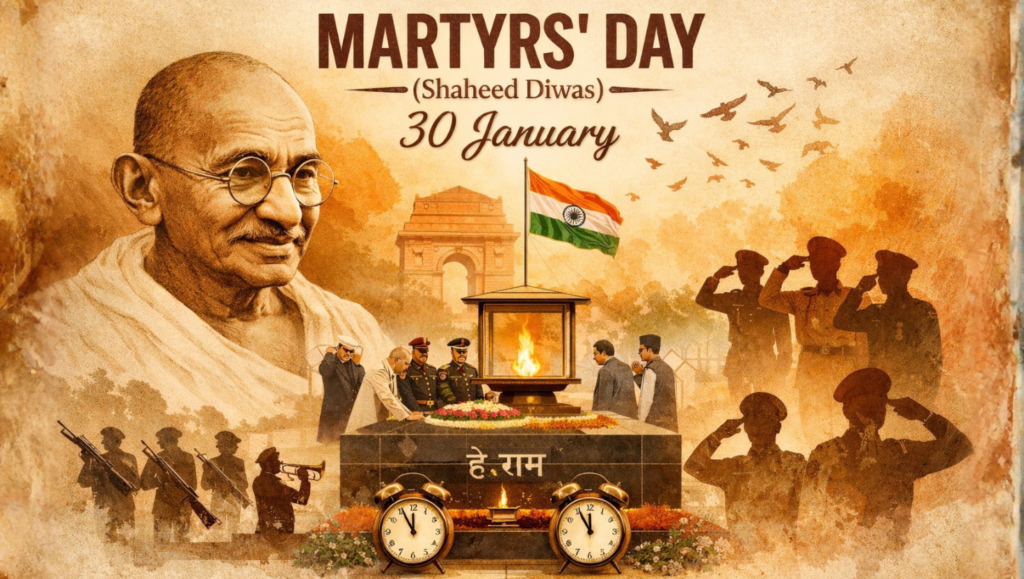
Martyrs’ Day—observed annually on 30 January and known variously as Shaheed Diwas or Sarvodaya Day—occupies a distinctive place in India’s civic calendar. More than a commemorative date, it functions as a constitutional ritual of remembrance, compelling the Republic to pause and reflect upon the sacrifices that secured its freedom.
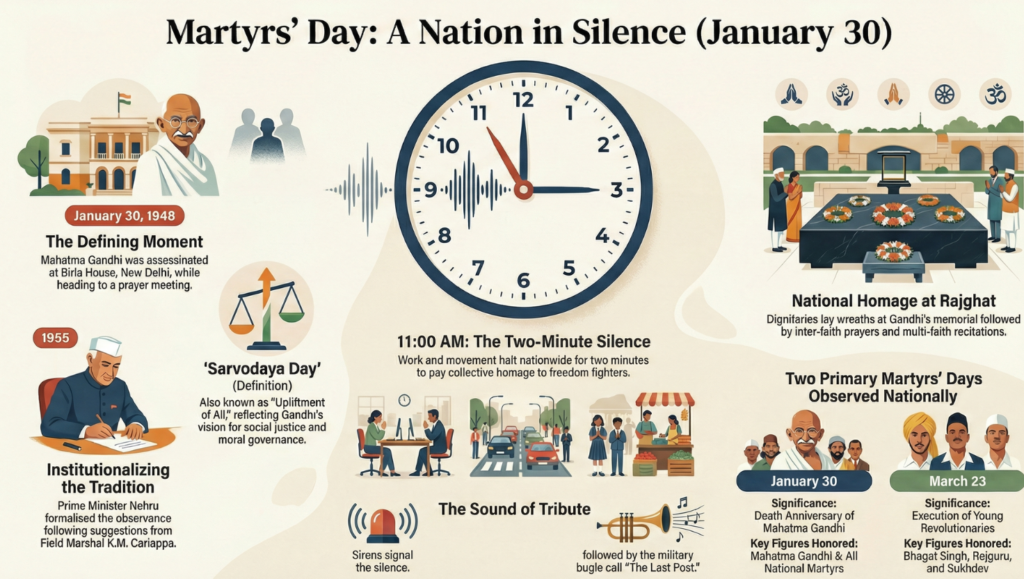
The observance commemorates the assassination of Mahatma Gandhi in 1948, while simultaneously honouring all freedom fighters who laid down their lives for India’s sovereignty. In recent years, institutions such as the Supreme Court of India have reinforced this ethos by halting proceedings and observing a two-minute silence at 11:00 AM, aligning judicial practice with nationwide homage.
For UPSC aspirants, Martyrs’ Day provides a rich lens through which to understand the interplay between history, civic culture, constitutional values, and administrative ethics.
Historical Origins: From Tragedy to National Tradition
On 30 January 1948, Gandhi was assassinated at Birla House in New Delhi while proceeding to a prayer meeting. The event shook the moral foundations of the newly independent nation. The leadership of the time institutionalised this date not merely as a mourning anniversary, but as a collective reaffirmation of the ideals that animated the freedom struggle.
Three Gandhian principles dominate the philosophical framework of Martyrs’ Day:
- Ahimsa (Non-violence): The strategic and moral cornerstone of India’s independence movement.
- Satya (Truth): The ethical compass for both personal conduct and public life.
- Sarvodaya (Upliftment of All): A vision of development rooted in the welfare of the weakest.
Through annual observances, these values are translated from abstract ideals into what scholars describe as a “constitutional culture of respect”—where remembrance reinforces democratic identity.
Institutional Observance: The Architecture of National Silence
The Two-Minute Silence Protocol
The Government of India traditionally issues standing instructions for a nationwide pause at 11:00 AM on Martyrs’ Day. The ritual follows a structured administrative choreography:
| Time | Action | Purpose |
|---|---|---|
| 10:59–11:00 | Commencement siren or signal | Alerts citizens to prepare |
| 11:00–11:02 | Complete silence | Suspension of work and movement |
| 11:02–11:03 | All-clear siren | Resumption of activity |
Such procedures transform remembrance into a shared national experience, cutting across geography and institutional boundaries.
Judiciary and Constitutional Memory
Courts across India—including the Supreme Court and High Courts—halt hearings during this period. Registry staff, judges, advocates, and litigants stand in silence wherever they are. This practice symbolically asserts that constitutional governance is rooted not only in statutes and judgments, but also in historical gratitude.
In UPSC terms, this reflects:
- Institutional reverence for national heritage,
- Civic symbolism within democratic systems,
- Soft instruments of nation-building.
State Ceremonies and the Symbolism of Raj Ghat
At the heart of national observance stands Raj Ghat, Gandhi’s samadhi on the banks of the Yamuna. Its austere black marble platform, inscribed with “Hey Ram,” embodies Gandhian simplicity and moral restraint.
High constitutional authorities—the President, Vice-President, Prime Minister, Defence Minister, and Service Chiefs—participate in wreath-laying ceremonies accompanied by military honours:
- The Last Post: Bugle call paying final respect.
- Reversed Arms: A symbolic gesture of mourning and humility.
Multi-faith prayer meetings held at the site reinforce India’s secular ethos and pluralism, reflecting Gandhi’s belief in communal harmony. These national rituals cascade downward into schools, district offices, and local communities, embedding remembrance within everyday civic education.
Plurality of Sacrifice: Many Martyrs, Many Dates
While 30 January is the primary national observance, India’s administrative and cultural calendar recognises multiple Shaheed Diwas across regions and services:
- 23 March: Bhagat Singh, Rajguru, and Sukhdev—revolutionary nationalism.
- 21 October: Police Martyrs’ Day—internal security forces.
- 19 May: Bhasha Shaheed Divas in Assam—linguistic identity.
- 15 February: Tarapur martyrs in Bihar.
- Birth or martyrdom anniversaries of figures like Rani Lakshmibai, Guru Tegh Bahadur, and Lala Lajpat Rai.
Such multiplicity reflects India’s federal and plural historical memory, where national unity is strengthened—not diluted—by regional narratives of sacrifice.
Internationally, neighbouring Nepal observes its own Martyrs’ Day commemorating resistance to authoritarian rule, highlighting the shared South Asian experience of democratic struggle.
Ethical Governance and Civil Services: GS-IV Perspective
Martyrs’ Day carries special significance for those in public administration. It reminds civil servants that freedom was secured not merely by arms, but by moral courage and public-spirited action.
Nyaya vs. Niti
Ethics discourse in governance distinguishes between:
- Niti: Mechanical adherence to rules.
- Nyaya: Justice-oriented application of authority.
Excessive proceduralism—such as denying welfare due to technical glitches—illustrates the danger of a “robotic bureaucracy.” Conversely, ethical governance demands interpretation of law in its spirit, especially in social welfare delivery.
Core Administrative Virtues
Martyrs’ Day symbolically reinforces the following civil-service attributes:
- Integrity & Objectivity: Transparent decision-making.
- Empathy & Compassion: Sensitivity toward the vulnerable.
- Intellectual Competence: Problem-solving in public interest.
- Accountability: Ownership of decisions.
As Swami Vivekananda famously observed, “Devotion to duty is the highest form of worship.” For administrators, ethical action becomes the living tribute to those who sacrificed for the Republic.
Conclusion: Silence as a Democratic Reminder
The two-minute silence on 30 January is not merely ceremonial—it is normative. It urges every citizen, and especially those in public office, to measure present conduct against the ideals of the freedom struggle.
Martyrs’ Day thus functions simultaneously as:
- A historical commemoration,
- A constitutional ritual,
- A civic lesson,
- And an ethical checkpoint for governance.
For UPSC preparation, the topic exemplifies how national symbols and public institutions nurture democratic culture, and how remembrance can translate into responsible citizenship and humane administration.