Kerala to be Renamed “Keralam”
Constitutional Authority, Administrative Workflow, and Strategic Significance

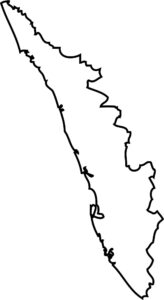

The Union Cabinet’s approval to rename the state of Kerala as “Keralam” marks a defining moment in India’s constitutional practice of territorial nomenclature. Far from a cosmetic alteration, the change reflects linguistic identity, federal consultation, administrative precision, and political calculation.
This article integrates the constitutional roadmap, administrative workflow, political context, and implementation challenges into one comprehensive framework—serving both as a governance explainer and a policy manual.
I. Strategic Context: Why Names Matter in a Federal Union
India is constitutionally described under Constitution of India as a “Union of States” (Article 1). The name of a state is not symbolic alone—it is embedded in:
- The First Schedule of the Constitution
- National and international legal documentation
- Census records and security databases
- Diplomatic communication
- State branding and identity
Renaming a state therefore represents:
- Linguistic restoration
- Cultural affirmation
- Administrative recalibration
- Political signaling
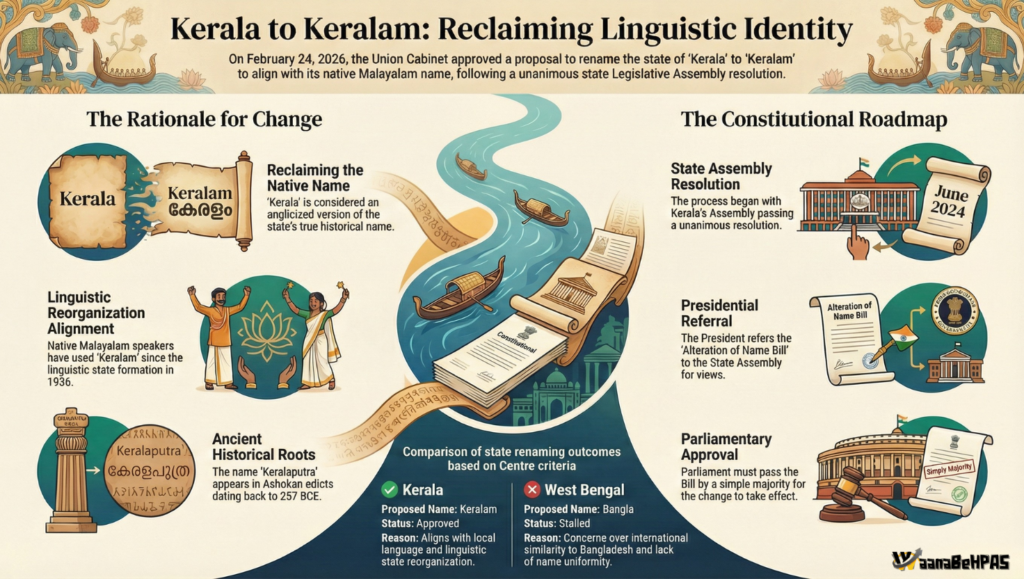
The transition from “Kerala” (an anglicized form) to “Keralam” (the Malayalam usage) is presented by its proponents as a rectification of colonial-era spelling and a reaffirmation of the “Aikya Kerala” (United Kerala) vision born during linguistic reorganization in 1956.
II. Constitutional Foundations: The Legal Architecture
The authority for renaming a state flows primarily from Article 3 of the Constitution.
Core Legal Provisions
| Constitutional Provision | Function | Administrative Implication |
|---|---|---|
| Article 1 | Lists India as a Union of States | First Schedule must be amended |
| Article 2 | Admission of new states | Not applicable in internal renaming |
| Article 3 | Alteration of name, area, boundaries | Primary mechanism |
| Article 4 | Exemption from Article 368 | Simple majority suffices |
The Critical Distinction
Unlike a constitutional amendment under Article 368, a state-name alteration:
- Does not require a two-thirds majority
- Does not require ratification by states
- Is passed by simple majority in Parliament
This establishes the Union’s plenary authority, while still preserving consultative federalism.
III. Case Study: Evolution of the Kerala (Alteration of Name) Bill, 2026
The procedural journey from resolution to Cabinet approval illustrates the administrative rigor required.
1. Initial Assembly Resolution (August 2023)
The Kerala Legislative Assembly passed a resolution seeking the name change.
However, it contained a technical flaw—it proposed changes across all languages listed in the Eighth Schedule.
The Union Ministry of Home Affairs clarified:
A name change primarily concerns the First Schedule (Territorial Identity), not multilingual constitutional listings.
2. Corrective Resolution (June 24, 2024)
The Assembly adopted a fresh, unanimous resolution—technically aligned with constitutional requirements.
3. Union Cabinet Approval (February 24, 2026)
The Union Cabinet, chaired by Narendra Modi, approved the proposal, clearing the path for the Kerala (Alteration of Name) Bill, 2026.
IV. Historical & Etymological Foundations of “Keralam”
The legitimacy of the name “Keralam” rests on deep historical grounding:
1. Ancient Epigraphy
Rock Edict II of Ashoka (257 BCE) refers to “Keralaputra.”
2. Linguistic Roots
Scholar Herman Gundert traced:
- Keram (Kannada form) from Cheram
- Cher = to join
- Alam = region
Thus, “Keralam” signifies the “joined region.”
3. Cultural Continuity
While “Kerala” dominated colonial records, “Keralam” remained standard in Malayalam literature and public discourse.
V. The Step-by-Step Administrative Workflow
Renaming a state involves an interlocking sequence of institutional approvals.
Phase 1: State Initiative
Unanimous Assembly resolution under Article 3.
Phase 2: MHA Examination
- Ministry of Home Affairs scrutiny
- Approval by Union Home Minister
- Concurrence from:
- Department of Legal Affairs
- Legislative Department
Phase 3: Cabinet Endorsement
Formal Union Cabinet approval.
Phase 4: Presidential Reference
The President refers the Bill to the State Legislature for its views within a specified period.
⚠ Important: The Assembly’s opinion is consultative, not binding.
Phase 5: Parliamentary Legislation
- Introduction of Bill on Presidential recommendation
- Passage by simple majority
- Presidential assent
- Gazette notification
Only after Gazette notification does the change legally take effect.
VI. Mandatory Inter-Departmental Clearances (NOC Matrix)
Before final implementation, several agencies must synchronize:
- Ministry of Railways – Station names, ticketing
- Department of Posts – Postal directories
- Survey of India – Official maps
- Intelligence Bureau – Security databases
- Registrar General of India – Census records
Failure to secure these clearances risks administrative fragmentation.
VII. Comparative Lens: Why Kerala Succeeded Where Others Stalled
The Case of West Bengal
West Bengal has attempted renaming multiple times (Bangla, Bongo, Bengal).
Reasons for Stalling:
- Multiple names across languages (rejected for lack of uniformity)
- Diplomatic objections due to similarity with Bangladesh
- Political friction between Centre and State
Kerala’s Success Factors:
| Kerala (Keralam) | West Bengal (Bangla) |
|---|---|
| Single uniform name | Multiple linguistic variants |
| No diplomatic conflict | International confusion risk |
| Broader alignment | Political contention |
This demonstrates that local consensus alone is insufficient—strategic clarity and national alignment matter.
VIII. Political Timing and Current Affairs Relevance
The decision comes ahead of the 2026 Kerala Assembly elections.
While supporters frame it as linguistic justice, critics argue timing carries electoral implications.
From a governance-exam perspective (UPSC/State PSC):
Key themes include:
- Federalism in practice
- Article 3 jurisprudence
- Centre-State consultation
- Linguistic identity politics
IX. Post-Approval Governance: The Downstream Challenge
Once notified:
1. Legal Documentation
- Amendment to First Schedule
- Gazette updates
2. Physical Infrastructure
- Road signage
- Government seals
- State emblems
3. Digital Governance
- UIDAI records
- Banking databases
- Tax platforms
- Court systems
4. International Branding
Foreign ministries, global institutions, and digital maps must update references.
X. The “Demonym Risk” and Strategic Communication
A subtle but important issue emerges:
If Kerala becomes Keralam, what are its people called?
Possible terms:
- Keralamite
- Keralamian
Public figures including Shashi Tharoor humorously noted these sound “like rare earth minerals or microbes.”
This is not trivial.
A lack of standardized demonym risks:
- Brand dilution
- Media inconsistency
- Diplomatic confusion
Policy Recommendation:
The state should formally declare a preferred English demonym early in the transition.
XI. Administrative Lessons for Senior Civil Servants
The Kerala-to-Keralam transition establishes a procedural benchmark:
- Constitutional clarity precedes political symbolism.
- Technical precision in drafting is essential.
- Inter-ministerial concurrence prevents downstream friction.
- International implications must be evaluated.
- Strategic communication is as vital as legal execution.
XII. Final Summary: From Resolution to Gazette
The renaming of Kerala to Keralam demonstrates the calibrated balance between:
- Union supremacy (Article 3 authority)
- Federal consultation (Presidential reference)
- Linguistic identity
- Administrative rigor
It affirms that territorial nomenclature in India is not merely semantic—it is constitutional statecraft.
As the Kerala (Alteration of Name) Bill, 2026 moves through Parliament, the transition stands as a case study in how India integrates regional linguistic pride into the national constitutional fabric—methodically, legally, and politically.