
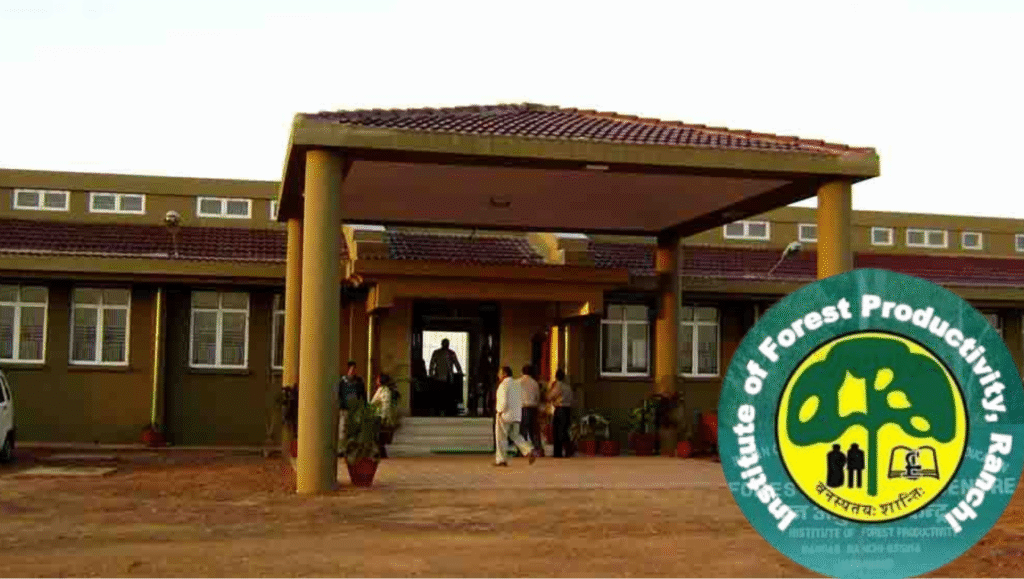
Institute of Forest Productivity (IFP), Ranchi – UPSC Notes
Syllabus: Indian Institutions (UPSC Prelims)
The Institute of Forest Productivity (IFP), located in Ranchi1, Jharkhand, is a regional forestry research institute under the Indian Council of Forestry Research and Education (ICFRE), Ministry of Environment, Forest & Climate Change (MoEFCC).
It plays an important role in scientific management of forests in the Eastern India region, especially Jharkhand, Bihar, West Bengal, and Odisha.
Mandate & Functions
1. Forest Productivity Research
- Focus on improving forest biomass productivity through silviculture and sustainable forest management.
- Research on fast-growing species, site-specific plantation models, and soil–plant relationships.
2. Non-Timber Forest Products (NTFPs)
- Studies on medicinal plants, gums, resins, lac, bamboo, and tendu leaves, crucial for tribal livelihoods.
- Development of sustainable harvesting techniques.
3. Forest Protection
- Research on forest pests, diseases, and invasive species affecting Eastern forest ecosystems.
- Development of biocontrol measures and forest health monitoring.
4. Agroforestry
- Promotes farm forestry and agroforestry models suited for small and marginal farmers of Eastern India.
- Works on species like gamhar, eucalyptus, teak, bamboo.
5. Tribal & Community-Centric Programs
- Supports livelihood enhancement through NTFPs and value-added processing.
- Capacity-building programs for forest-dependent communities.
6. Climate & Soil Research
- Studies on soil fertility, carbon sequestration, and climate-resilient forestry systems.
Training & Extension
- Training programs for State Forest Departments, NGOs, and community groups.
- Dissemination of best practices in forest management and NTFP processing.
- Collaboration with universities and research organisations.
- Question Reference
(HPAS PYQ 2025) ↩︎