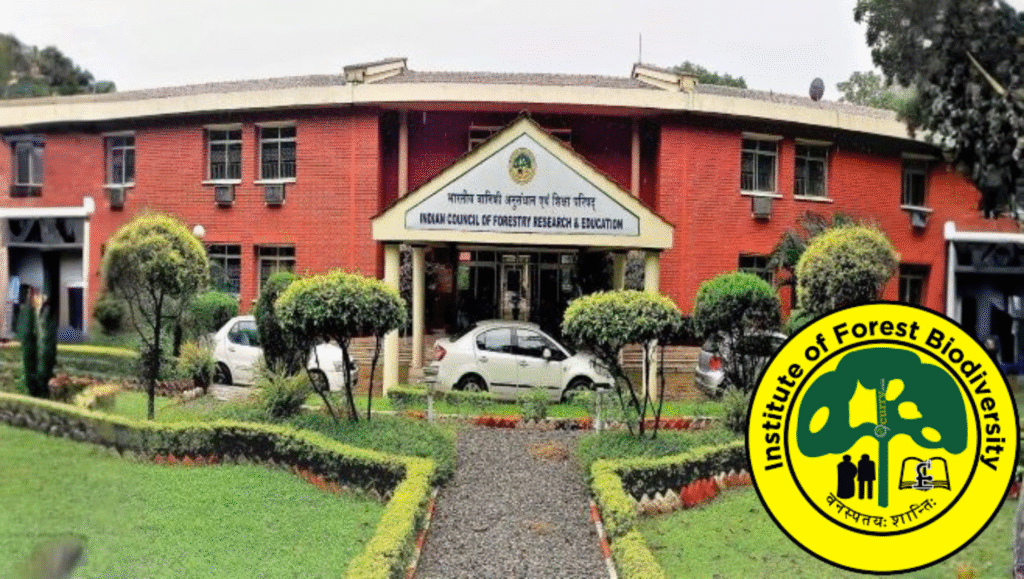
Institute of Forest Biodiversity (IFB), Hyderabad
Syllabus: Indian Institutions (UPSC Prelims)
Introduction
The Institute of Forest Biodiversity (IFB) is a premier research institute under the Indian Council of Forestry Research and Education (ICFRE), Ministry of Environment, Forest & Climate Change (MoEFCC).
It plays a key role in forest biodiversity research, especially for the Eastern Ghats region.
Background
- Established in December 2012, upgrading the earlier Forest Research Centre, Hyderabad.
- Functions as one of the regional institutes of ICFRE.
- Works closely with Central and State Forest Departments, forest-based industries, NGOs, and local communities.
Location
- Dulapally, Kompally (S.O.), Hyderabad1 – 500100, Telangana
- ~23 km from Secunderabad Railway Station
- ~65 km from Rajiv Gandhi International Airport
- Approx. 100-acre campus with laboratories, nurseries, germplasm facilities, field trial plots, and a field station (~60 acres) at Mulugu.
Mandate of IFB
IFB focuses on research, training, and extension in the following areas:
- Forest Biodiversity Assessment & Conservation
- Genetic resource evaluation of endemic and rare plants
- In-situ and ex-situ conservation (including nurseries, seed banks, tissue culture)
- Climate Change Impact Studies
- Forest Soil Studies, Pests, Diseases & Invasive Species
- Environmental Impact Assessment (EIA) related to forests
- Agroforestry and Livelihood Models for forest-dependent communities
- Documentation of flora of Eastern Ghats
- Restoration of degraded and stress-prone forest areas
Research Focus Areas
- Biodiversity documentation of Eastern Ghats (AP, Telangana; parts of Maharashtra & Goa)
- Conservation of rare/endangered/threatened (RET) plant species
- Development of propagation protocols for valuable species
- Seed science, genetic improvement, and nursery management
- Climate-resilient forestry practices
- Impact of development projects on biodiversity through EIA
- Community-based conservation and NTFP-based livelihood support
Institutional Infrastructure
- Molecular genetics lab
- Plant tissue culture lab
- Soil testing lab
- Seed testing and storage facilities
- Germplasm conservation units
- Arboreta and demonstration plots
- Training centre and library
Jurisdiction
Primary focus regions:
- Telangana
- Andhra Pradesh
- Eastern Ghats landscape
Extended activities: - Parts of Maharashtra and Goa
Training & Extension
- Conducts training for forest officers, students, researchers, and community groups.
- Awareness programmes on biodiversity, forest conservation, and sustainable NTFP use.
- Research dissemination to state forest departments & industries.
- Question Reference
(HPAS PYQ 2025) ↩︎