India’s Fisheries & Aquaculture
Syllabus: Economy (UPSC GS III)
Source: The Hindu
Context:
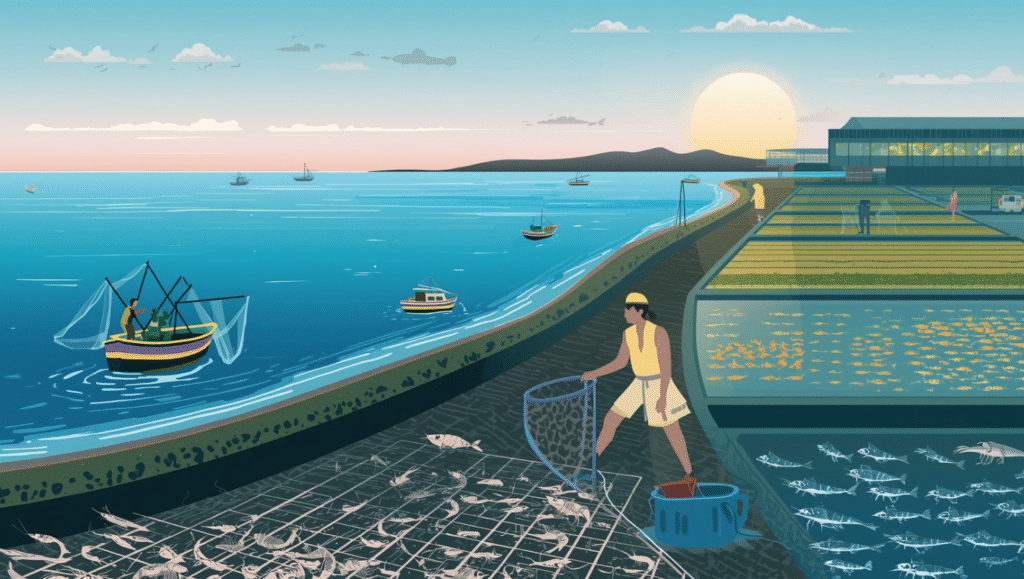
On World Fisheries Day 2025, the FAO highlighted India’s rapid rise in fisheries and aquaculture. India is now the world’s second-largest aquaculture producer, but sustainability challenges require stronger policies under “India’s Blue Transformation”.
India’s Fisheries & Aquaculture: Key Trends
Rapid Growth
- India’s fish production has grown from 4.4 million tonnes (1980s) to 17.54 million tonnes (2022–23) — a seven-fold increase.
- According to FAO SOFIA 2024, India produced 2.3 million tonnes of aquatic animals, ranking 2nd globally, after China.
Exports & Inland Growth
- Marine exports rose 8%, from USD 0.81 billion (Oct 2024) to USD 0.90 billion (Oct 2025).
- From 2013–14 to 2024–25, total production doubled from 96 to 195 lakh tonnes.
- Inland aquaculture grew 140%, becoming India’s main growth driver.
Livelihood Footprint
- The sector supports 30 million people.
- India has 3,477 coastal fishing villages, contributing 72% of total fish output.
Opportunities for India
Growing Global Seafood Market
- Competitiveness boosted by:
- Strong shrimp farming sector
- Lower GST (12% → 5%) on key fish products
- Access to U.S., EU, East Asian markets
Blue Economy Potential
- Sustainable Harnessing of EEZ Rules, 2025 opens deep-sea fishing for cooperatives and FPOs.
Digital Governance
- Platforms like:
- ReALCraft (vessel registration)
- NFDP
- National Traceability Framework
help India meet international quality standards.
Climate-Resilient Models
- FAO-supported pond systems in Andhra Pradesh show lower environmental impact and higher productivity.
Women’s Participation
- PMMSY offers 60% financial support to women for kiosks, processing units, and value-addition.
Government Initiatives
PM Matsya Sampada Yojana (PMMSY)
- Outlay: ₹20,312 crore (2020–26).
- Key assets created:
- 730 cold storages
- 26,348 transport units
- 6,410 fish kiosks
Climate-Resilient Coastal Fishermen Villages
- Upgrading 100 villages with better housing, disaster systems, and livelihood diversification.
EEZ Sustainable Harnessing Rules, 2025
- Digital Access-Pass through ReALCraft.
- Priority for cooperatives.
- Ban on destructive fishing techniques.
Marine Fisheries Census 2025
- Uses VyAS-NAV, BHARAT, SUTRA apps for geo-tagging:
- 2 million households
- 5,000 villages
Fisheries Infrastructure Development Fund (FIDF)
- Corpus: ₹7,522 crore
- 178 projects worth ₹6,369 crore sanctioned by July 2025.
Challenges in the Sector
1. Overfishing & Stock Decline
- High pressure on coastal species like sardines and mackerel.
2. Habitat Loss
- Seagrass degradation, sediment buildup, and harbour pollution affect fish breeding grounds.
3. Illegal, Unreported & Unregulated (IUU) Fishing
- Non-registered vessels fish beyond permitted zones, hurting small-scale fishers.
4. Post-Harvest Losses
- India loses 15–20% of produce due to poor handling, grading, and cold-chain gaps.
5. Credit & Insurance Barriers
- Small fishers struggle with:
- Repair loans
- Insurance
- Working capital
even under government schemes.
Way Forward
Science-Based Stock Management
- Enforce:
- Seasonal closures
- Mesh-size rules
- Zone-wise stock assessments
Expand Deep-Sea Fishing
- Modernise vessels, improve storage onboard, and train fishers for deeper waters.
Strengthen Traceability
- Implement national-level certification to meet EU and U.S. standards.
Improve Aquaculture Biosecurity
- Disease-free seed systems
- Hatchery certification
- Water quality monitoring
Build Climate-Resilient Infrastructure
- Smart harbours
- Early warning systems
- Cyclone-proof structures
- Climate-adaptive pond designs
Conclusion
India’s fisheries and aquaculture sector is growing rapidly and entering a phase of major transformation. With strong policies, scientific management, digital tools, and climate-resilient practices, India can build a sustainable and globally competitive blue economy. Ensuring the inclusion of small fishers and women is key for long-term sectoral success.