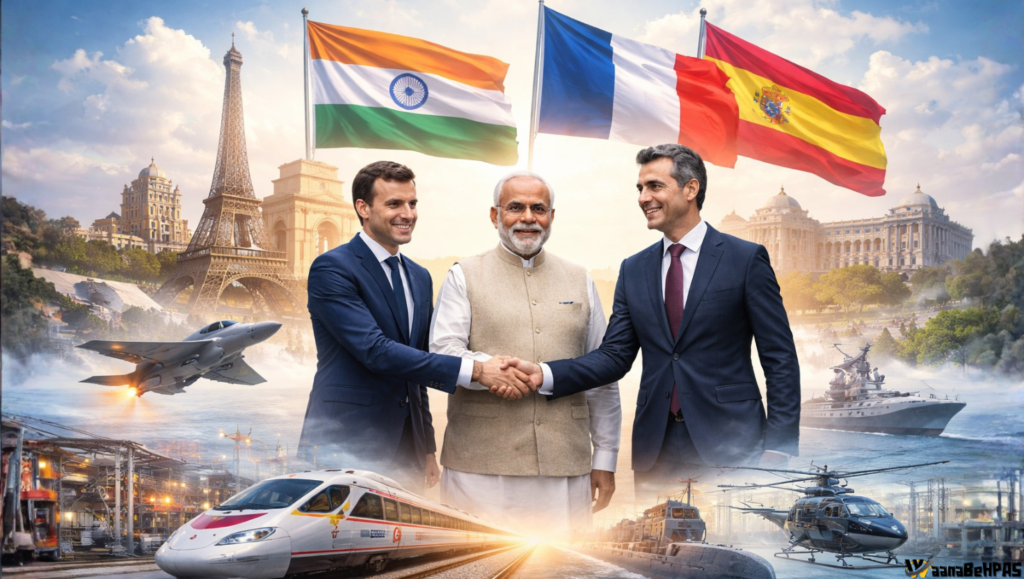
Strategic Recalibration 2026
India’s European Pivot & the Rise of the “Multipolar West”
Syllabus: (UPSC GS-II & GS-III Integrated Analysis)
Executive Context: From Non-Alignment to a “Multipolar West”
In 2026, India’s foreign policy marks a decisive evolution. Rather than viewing the West as a single bloc, New Delhi recognizes internal diversities within Europe and is strategically engaging middle powers such as France and Spain.
This recalibration—often described as India’s embrace of a “Multipolar West”—aims to:
- Safeguard strategic autonomy
- Secure high-technology sovereignty
- Build resilient supply chains
- Reduce dependency vulnerabilities
- Shape norms in emerging domains like AI
The diplomatic high point came in February 2026 when India elevated ties with France to a “Special Global Strategic Partnership” while revitalizing relations with Spain during the India-AI Impact Summit 2026.
India–France: The “Special Global Strategic Partnership”



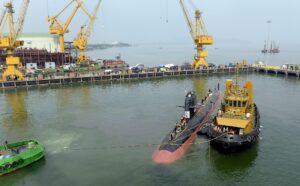
Structural Shift: From Buyer–Seller to Co-Developer
India and Emmanuel Macron formalized an upgrade in ties, anchored in the Horizon 2047 Roadmap—a 25-year blueprint aligned with India’s centenary of independence.
Defence & Industrial Breakthroughs
- AMCA Jet Engine Co-Development
- Collaboration between Safran and Defence Research and Development Organisation (DRDO).
- India to jointly own Intellectual Property (IP) — a historic departure from past licensing models.
- Airbus–Tata Helicopter Line (Vemagal, Karnataka)
- India’s first private-sector helicopter assembly facility.
- Missile Production
- BEL–Safran JV to produce HAMMER missiles domestically.
- Naval & Air Power
- Completion of Kalvari-class submarines.
- Contract for 26 Rafale-Marine jets.
Technology & Space Sovereignty
- Promotion of an AI “Third Way” — balancing innovation with ethical regulation.
- Collaboration on TRISHNA satellite.
- Institutional mechanisms:
- Annual Foreign Ministers Comprehensive Dialogue
- Joint Advanced Technology Development Group
- DRDO Technical Office in Paris
Strategic Significance (UPSC Lens)
| Dimension | UPSC Relevance |
|---|---|
| Strategic Autonomy | GS-II (IR) |
| Defence Indigenisation | GS-III (Security) |
| AI Governance | GS-III (S&T) |
| UNSC Reform Support | GS-II |
France emerges not merely as a supplier, but as a co-production partner, supporting India’s global ambitions including UNSC reform and Indo-Pacific stability.
India–Spain: Strategic Convergence Through Soft & Hard Power
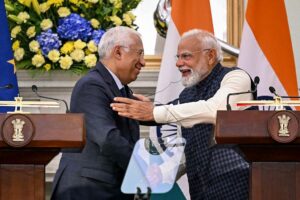

India’s engagement with Pedro Sánchez marks Spain’s rise as a complementary European pillar.
2026 Focus: “Year of Culture, Tourism & AI”
Strategic Sectors
- High-Speed Rail
- Collaboration with RENFE & ADIF.
- Boost to India’s transport modernization.
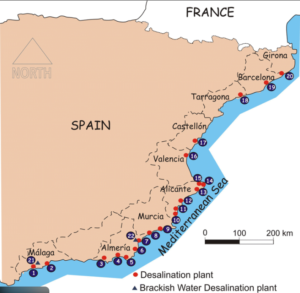
- Water & Urban Infrastructure
- Spanish expertise in desalination.
- Supports Smart Cities & AMRUT goals.
- Renewable Energy
- Wind and solar cooperation aligned with India’s 2047 energy transition.
- Academic Mobility
- Expansion of university linkages.
- Strengthened people-to-people ties.
The EU Dimension: FTA & Supply Chains
The India-EU FTA negotiations act as a force multiplier by:
- Improving market access
- Securing trusted supply chains
- Reducing overdependence on singular blocs
- Supporting critical mineral resilience
Competitive Defence Landscape: The “Firearm Trap”
India’s European pivot also reflects learning from past procurement constraints.
France vs Germany Model
- Germany’s restrictive export laws (e.g., Heckler & Koch episode) highlight risks of political leverage via export controls.
- The “value chain of spares” is crucial—without domestic control over Line Replacement Units (LRUs), operational readiness suffers.
🔎 Lesson:
Strategic autonomy requires control over IP and supply chains, not just purchase of platforms.
UPSC Analytical Integration: Domestic Governance as Foreign Policy Capital
Global stature depends on domestic institutional strength.
Case 1: Urban Governance Failures
- Karol Bagh drowning incident.
- Weak functional devolution under 74th Amendment.
- Need for:
- Risk registers
- Independent audits
- Binding safety commissions
Case 2: Aviation & Data Oversight
- IndiGo crisis revealed need for structured fare transparency.
- Data-driven regulation like U.S. DB1B model could enhance oversight.
🔑 Insight for UPSC:
India’s credibility in shaping AI ethics or global governance depends on domestic regulatory excellence.
UPSC Mains Answer Framework
Q: “Discuss the significance of India’s evolving engagement with European powers in ensuring strategic autonomy.”
Structure:
- Introduction – Multipolar West concept.
- India–France: Defence IP sharing, AI governance.
- India–Spain: Infrastructure, energy, people-to-people ties.
- EU FTA: Supply-chain resilience.
- Challenges: Export restrictions, spares dependency.
- Way Forward: Domestic governance strengthening.
Way Forward for Policymakers
✔ Embed private sector in global R&D chains
✔ Lead AI ethics coalitions (AI for Humanity model)
✔ Secure domestic LRU & component manufacturing
✔ Align domestic regulatory reforms with global ambitions
✔ Expand partnerships beyond transactional deals
Conclusion
India’s 2026 European recalibration marks a shift from symbolic non-alignment to structural strategic alignment. By deepening ties with France and Spain under a “Multipolar West” framework, India strengthens defence sovereignty, technological leadership and supply-chain resilience. Strategic autonomy now rests not merely on diplomacy, but on co-production, institutional depth and domestic governance excellence.