
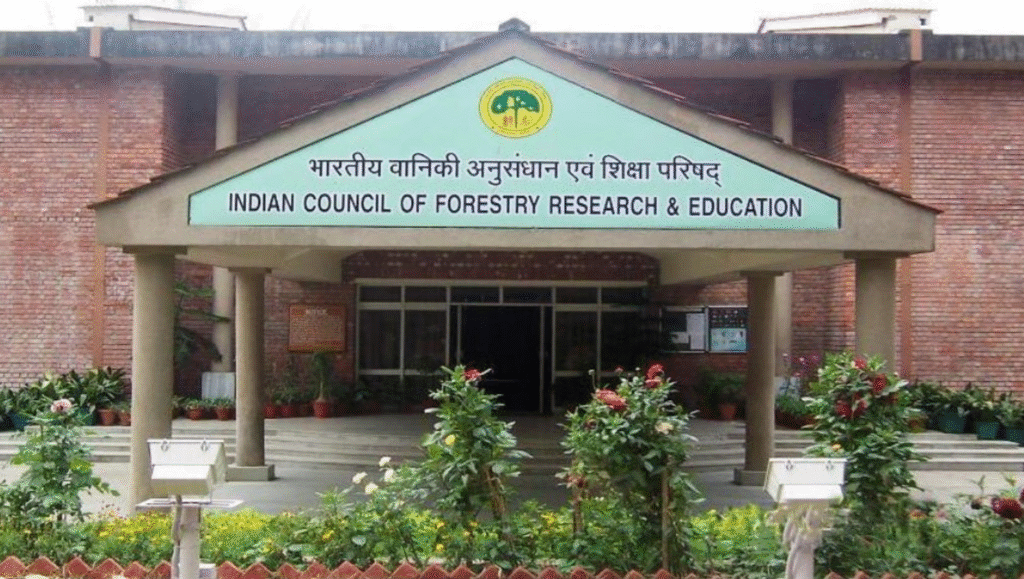
Indian Council of Forestry Research and Education (ICFRE)
Syllabus: Indian Institutions (UPSC Prelims)
The Indian Council of Forestry Research and Education (ICFRE) is the apex body for forestry research in India. It functions under the Ministry of Environment, Forest and Climate Change (MoEFCC) and leads India’s national forestry research system.
ICFRE promotes need-based, scientific forestry through research, education, extension, and technology dissemination across diverse ecological regions.
Objectives of ICFRE
- Promote and coordinate forestry education and research, and support application of research outcomes in the field.
- Develop and maintain a national library and information system for forestry and allied sciences.
- Act as a central repository and clearing-house of information related to forests, wildlife, and allied subjects.
- Strengthen forestry extension, including training, media-based outreach, and dissemination of best practices.
Organization Structure
ICFRE oversees 8 Regional Research Institutes and 4 Research Centres, each addressing forestry challenges in specific bio-geographical regions.
ICFRE Institutes – Key Highlights
1. Forest Research Institute (FRI), Dehradun
- India’s premier forestry research and education institute.
- Known for research in wood science, forest products, biodiversity, and climate-related forestry studies.
2. Institute of Forest Genetics and Tree Breeding (IFGTB), Coimbatore
- Established in 1988 under ICFRE.
- Mandate: Genetic improvement of tree species for afforestation, social forestry, and productivity enhancement.
- Supports national goals of increasing biomass production.
3. Institute of Wood Science and Technology (IWST), Bangalore
- Originated as Forest Research Laboratory (1938).
- Upgraded to IWST in 1988 by merging Sandal Research Centre and MFP unit.
- Focus Areas:
- Wood science and technology
- Sandalwood genetics, silviculture, and management
- Regional mandate for Karnataka, Andhra Pradesh, and Goa.
4. Tropical Forest Research Institute (TFRI), Jabalpur
- Established in 1973 (as FRI Regional Centre), became TFRI in 1988.
- Works on tropical forestry issues relevant to Central India, including NTFPs, biodiversity, and forest protection.
5. Rain Forest Research Institute (RFRI), Jorhat (Assam)
- Established in 1988 to support forestry research in the Northeastern states.
- Specializes in:
- Rainforest ecology
- Bamboo and cane research
- Biodiversity conservation
- Supports Arunachal Pradesh, Assam, Manipur, Meghalaya, Mizoram, Nagaland & Tripura.
6. Arid Forest Research Institute (AFRI), Jodhpur
- Focuses on afforestation, desertification control, and arid-zone forestry solutions.
7. Himalayan Forest Research Institute (HFRI), Shimla
- Originated in 1977 as Conifer Regeneration Centre.
- Conducts research on:
- Himalayan ecosystem conservation
- High-altitude silviculture
- Regeneration of Silver Fir, Spruce, and other conifers.
8. Institute of Forest Productivity (IFP), Ranchi
- Works on forest productivity enhancement in Eastern India.
- Research areas include agroforestry, silviculture, forest productivity, and tribal livelihood support.
Other Key Institution Under ICFRE Ecosystem
Indian Institute of Forest Management (IIFM), Bhopal
- A sectoral management institute combining forestry, social sciences, and management.
- Works closely with forest dwellers and communities through research and training.