National Security & India–Mexico Relations: Diaspora Protection Amid Strategic Partnership
Introduction
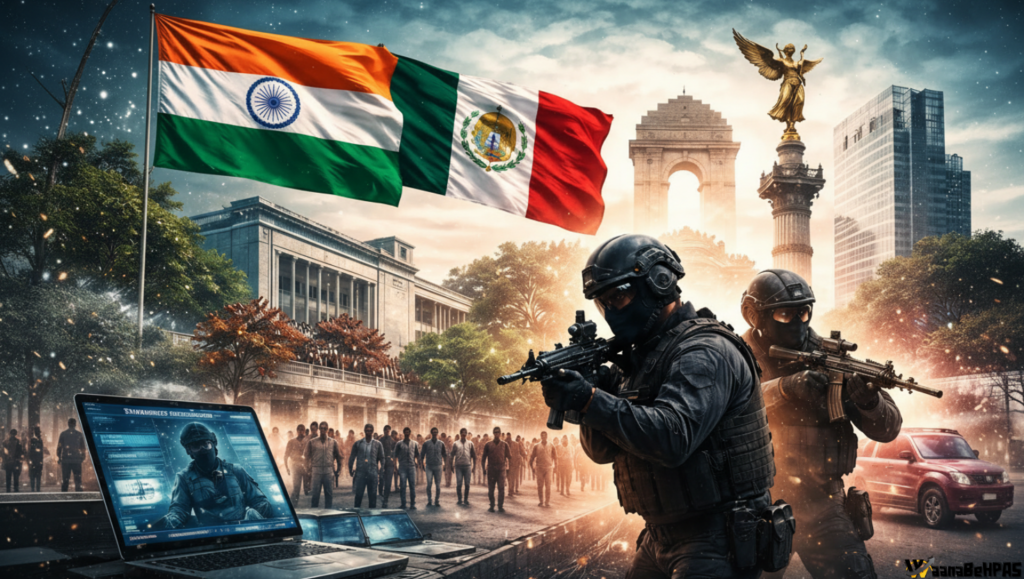
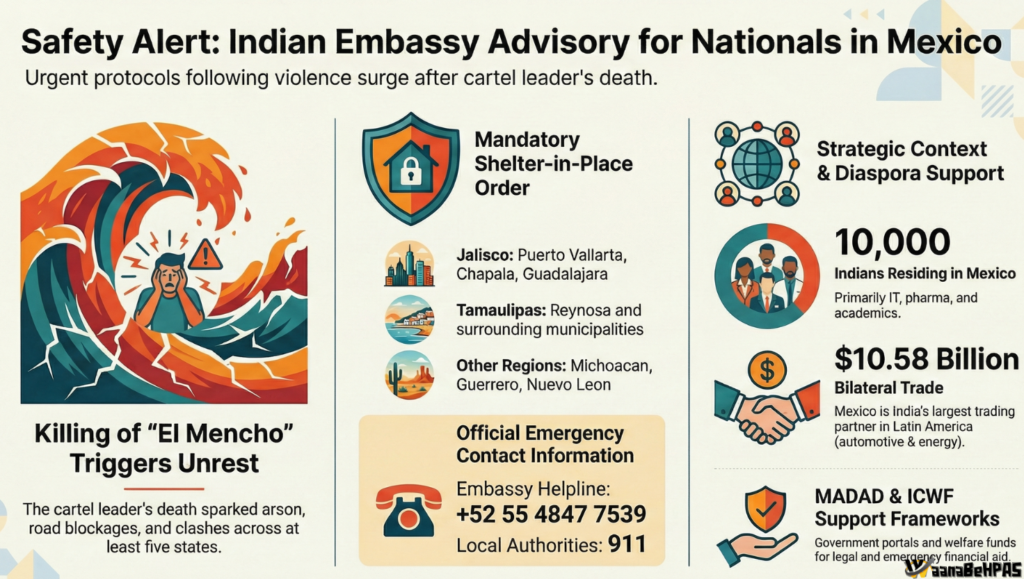
The February 2026 advisory issued by the Indian Embassy in Mexico, following the killing of cartel leader Nemesio “El Mencho” Oseguera Cervantes, highlights the intersection of national security, diaspora welfare, and strategic diplomacy. While immediate in nature, the advisory reflects the broader maturity of India–Mexico relations, which are steadily evolving toward a Comprehensive Strategic Partnership.
For UPSC aspirants, this issue integrates GS Paper II (India & World, Diaspora), GS III (Security, Transnational Crime), and Foreign Policy Strategy.
I. Historical Foundations: From Civilizational Synergy to Strategic Trust




India and Mexico share a deep historical relationship rooted in South–South cooperation.
Key Milestones:
- 1950: Mexico became the first Latin American nation to recognize India’s independence.
- 1960s Green Revolution Nexus:
- Mexican Sonora wheat varieties.
- Collaboration with CIMMYT (International Maize and Wheat Improvement Center).
- Contribution of Dr. Pandurang Khankhoje, symbolizing scientific bridge-building.
This early agricultural cooperation laid the foundation for long-term strategic trust.
II. Institutional Architecture: Toward a Comprehensive Strategic Partnership
India–Mexico ties have evolved from:
- 2007: “Privileged Partnership”
- 2015–16: Commitment to achieve “Strategic Partnership”
- 2025 (Diamond Jubilee): Opportunity to elevate ties to a Comprehensive Strategic Partnership
Recent high-level engagements include:
- PM Modi’s 2016 visit.
- 2024 mission by Finance Minister Nirmala Sitharaman.
- Trade & Investment Summit between CII and Mexico’s CCE.
- Regular coordination at UNGA and G20.
Under President Claudia Sheinbaum, Mexico’s policy orientation presents fresh opportunities for Global South alignment.
III. Economic Synergies: Nearshoring & Investment Leverage
Mexico is India’s largest trading partner in Latin America.
Trade Snapshot (2023–24)
| Indicator | India | Mexico |
|---|---|---|
| Total Trade | USD 10.58 Billion | |
| Indian Exports | USD 8.03 Billion | |
| Mexican Exports | USD 2.54 Billion | |
| Investment | ~USD 4 Billion (India in Mexico) | ~USD 810 Million (Mexico in India) |
Key Sectors:
- Pharmaceuticals (Dr. Reddy’s, Zydus)
- IT (TCS, Infosys)
- Auto components
- Crude oil imports from Mexico
Mexico’s USMCA position makes it a nearshoring gateway to North America, giving Indian firms strategic supply chain leverage.
IV. High-Tech Cooperation: Knowledge Sovereignty
Space and innovation are emerging pillars:
- ISRO–AEM cooperation on satellite applications.
- Crop monitoring and drought assessment.
- CSIR–AMEXCID Accelerator Fund (2023).
- Creation of Digital Corridors linking Bengaluru/Hyderabad with Guadalajara/Monterrey.
This reflects a shift from brain drain to brain circulation.
V. Security Crisis: The 2026 “El Mencho” Scenario


The killing of cartel leader Nemesio Oseguera triggered:
- Road blockades
- Arson
- Armed confrontations
- Infrastructure disruption
The Indian Embassy issued a “shelter-in-place” advisory for Indian nationals across affected regions including Jalisco, Tamaulipas, Michoacán, Guerrero, and Nuevo León.
Diaspora Context:
- ~10,000 Indians in Mexico.
- Strong presence in IT, pharma, business.
- Represented by Indian Association of Mexico (IAM).
VI. Consular Diplomacy: India’s “Safe Homecoming” Doctrine
This crisis reinforces India’s evolving citizen-centric diplomacy.
Core Components:
- Strategic Evacuation Preparedness
(Use of assets like C-17 aircraft if required) - Human Trafficking Deterrence
Monitoring illegal migration networks targeting North America. - Indian Community Welfare Fund (ICWF)
Legal, financial, and psychological support mechanisms.
This approach builds on precedents such as:
- Operation Ganga (Ukraine)
- Operation Kaveri (Sudan)
- Operation Ajay (West Asia crisis)
VII. Multilateral Diplomacy & Areas of Friction
UNSC Reform
- India: G-4 permanent seat aspiration.
- Mexico: “United for Consensus” group favoring non-permanent expansion.
- Managed via “agree to disagree” diplomacy.
Nuclear Policy
- Mexico supported India’s NSG bid in 2016.
- Recognition of India’s responsible nuclear credentials.
VIII. Strategic Assessment: Security and Diplomacy Convergence
The 2026 advisory demonstrates that:
- Foreign policy now includes real-time security monitoring.
- Embassies serve as crisis command centers.
- Diaspora protection enhances soft power.
- Bilateral ties must factor in internal security risks of partner countries.
Security volatility in Mexico does not weaken the partnership; instead, it underscores the need for institutionalized crisis coordination.
IX. Way Forward: Toward 2025 and Beyond
- Elevate to Comprehensive Strategic Partnership during Diamond Jubilee.
- Institutionalize migrant rehabilitation programs.
- Expand digital and innovation corridors.
- Align skill development with North American market needs.
- Strengthen intelligence-sharing on organized crime and trafficking.
Conclusion
The Indian Embassy’s 2026 advisory in Mexico reflects more than a crisis response—it signals the maturation of India’s foreign policy into a security-integrated, diaspora-centered framework. As India and Mexico move toward a Comprehensive Strategic Partnership, managing transnational crime risks and protecting overseas citizens will remain central pillars.
For UPSC aspirants, this episode illustrates how national security, economic diplomacy, multilateral negotiations, and diaspora welfare intersect in contemporary international relations.