
Strategic Convergence: India’s 77th Republic Day and the New Era of EU–India Relations
Syllabus: UPSC [GS-II (International Relations), GS-III (Economy, Security & Environment]
1. Executive Overview: A Diplomatic Milestone
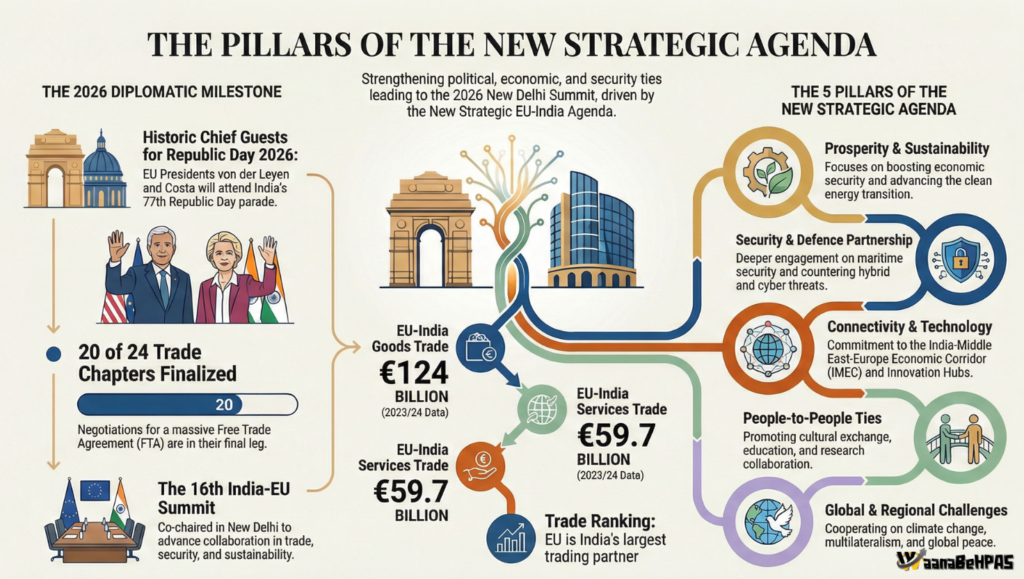
India’s 77th Republic Day (26 January 2026) has acquired exceptional geopolitical significance with the invitation to Ursula von der Leyen (President, European Commission) and António Costa (President, European Council) as Chief Guests. The visit coincides with the 16th India–EU Summit (27 January 2026) and the India–EU Business Forum, marking a decisive moment in the evolution of the partnership.
At a time when:
- global supply chains are fragmenting,
- the US trade posture is unpredictable, and
- Europe seeks reliable partners for de-risking from China,
the India–EU corridor is emerging as a new stabilising pillar of the rules-based international order. The Republic Day invitation therefore blends symbolism with hard economics and strategy.
Timeline
- 25 Jan: Arrival; ceremonial engagements
- 26 Jan: Republic Day parade at Kartavya Path
- 27 Jan: 16th India–EU Summit + Business Forum
2. Republic Day Diplomacy: What the Invitation Signals
The Chief Guest choice is India’s highest diplomatic signal. Inviting the EU as a bloc—only the second such instance after ASEAN in 2018—shows a conceptual shift:
India now treats the EU not as 27 separate states but as a cohesive geopolitical and regulatory power.
Why this matters for UPSC
- EU = India’s largest trading partner and a major source of FDI & technology
- Shared commitment to democracy, multilateralism, and maritime security
- Alignment on resilient supply chains and green transition
Ceremonial elements with political meaning
- Guard of Honour at Rashtrapati Bhavan – recognition of EU as strategic actor
- Rajghat visit – shared civilisational values
- Delegation talks – conversion of symbolism into agreements
3. Institutional Basics (Prelims Ready)
European Council vs European Commission
- European Council: sets political direction; represents member states → President António Costa
- European Commission: executive arm; negotiates trade & enforces EU law → President Ursula von der Leyen
Exam Tip: Presence of both = political mandate + negotiating authority.
4. Economic Core: The FTA & Trade Architecture
Context
- Negotiations relaunched in 2022
- Push driven by:
- need to de-risk from China
- uncertainty in US tariffs
- India seeking export markets & technology
Status Snapshot
| Progress | Challenges |
|---|---|
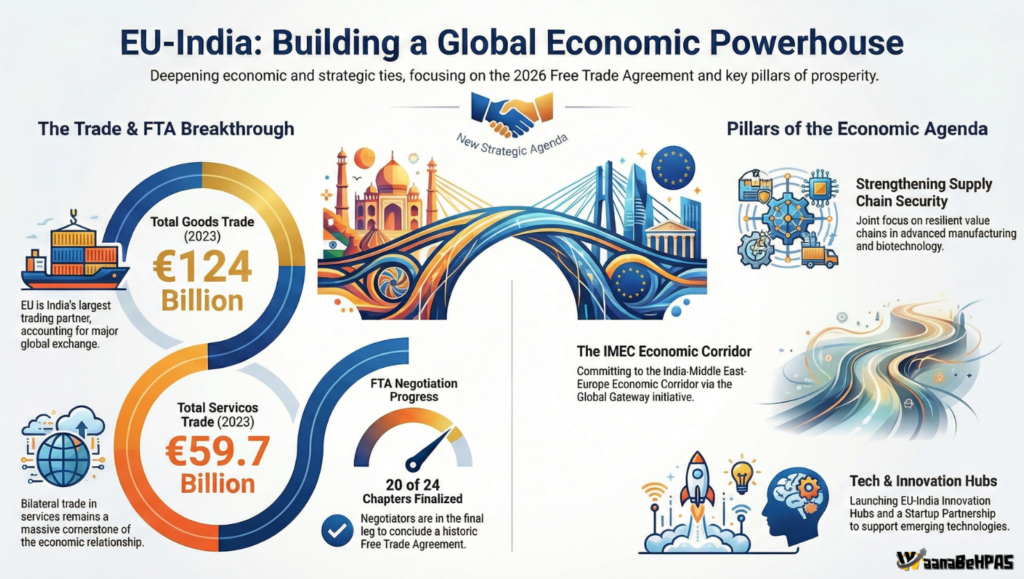
| 20/24 chapters closed | EU Carbon Border Adjustment Mechanism (CBAM) |
| Rules of Origin near final | Automobiles – German interests vs Make in India |
| Services & mobility aligned | Tariffs on wines & spirits |
| Investment protection progress | Sustainability clauses |
Strategic Choice:
Agriculture kept outside to avoid political backlash (lesson from EU–Mercosur protests).
UPSC Economic Takeaways
- Market access for Indian IT, pharma, textiles, mobility of professionals
- EU gains in automobiles, machinery, high-end manufacturing
- Need for Indian compliance with EU standards & green regulations
5. Five Pillars of the New Agenda (Joint Communication 2025)
1) Prosperity & Sustainability
- Secure supply chains
- Clean energy transition via “Blue Valleys” platform
- Investment in renewables & critical minerals
2) Technology & Innovation
- Association with Horizon Europe
- EU–India Innovation Hubs
- Cooperation on AI, semiconductors, digital standards
3) Security & Defence
- Security of Information Agreement under negotiation
- Indo-Pacific maritime cooperation
- Protection of undersea cables & critical infrastructure
4) Connectivity & Global Issues
- IMEC Corridor
- EU–Africa–India Digital Corridor
- Global Gateway financing as alternative to BRI
5) Enablers
- European Legal Gateway Office in India – help firms meet EU norms (esp. CBAM)
Institutional upgrade: Annual Summits + strengthened Trade & Technology Council (TTC).
6. Geopolitics: Convergences and Frictions
Convergences
- Multipolar world & strategic autonomy
- Resilient supply chains
- Maritime security & freedom of navigation
- Green transition
Friction Points
- Russia–Ukraine: EU seeks stronger Indian positioning
- CBAM: viewed by India as protectionist
- Data governance & digital taxation
- Mobility vs migration concerns
Strategic Insight:
EU is engaging India as BRICS Chair while coordinating with G7 (France Chair)—positioning India as a bridge in global governance.
7. What This Means for India
Opportunities
- Export diversification
- Technology transfer
- Standards shaping (AI, data, green tech)
- Defence industrial cooperation
- Investment for EVs, hydrogen, semiconductors
Risks
- Compliance costs of EU green norms
- Impact on MSMEs
- Regulatory asymmetry
8. How to Write in Mains (Ready Frameworks)
GS-II: Significance of India–EU Partnership
- From aid & trade → technology & security
- TTC as new model of geo-economics
- Complementarity: India’s market + EU tech/capital
- Challenges: CBAM, Ukraine, regulatory barriers
- Way forward: mutual recognition, green finance, skills mobility
GS-III: Trade & Climate
- CBAM impact on steel/aluminium
- Need: MRV systems, carbon efficiency, border tax adjustment fund
- Opportunity: green manufacturing hub
9. Prelims Flash Facts
- Chief Guests 2026: Ursula von der Leyen & António Costa
- Event: 77th Republic Day
- Summit: 16th India–EU Summit (27 Jan 2026)
- Key Platform: India–EU Trade & Technology Council
- New Office: European Legal Gateway in India
10. Model Questions
- Republic Day diplomacy reflects India’s strategic priorities. Discuss with reference to the EU invitation.
- Evaluate prospects and challenges of the India–EU FTA.
- Assess impact of EU CBAM on India’s exports and policy responses.
11. Conclusion: From Ceremony to Structure
The 2026 Republic Day marks a transition:
From symbolism → institutionalised geo-economics.
Three enduring outcomes:
- Economic security through diversified trade
- Defence & tech partnership in the Indo-Pacific
- Regulatory convergence for the 21st-century economy
India–EU relations are thus moving from a values-based partnership to a capability-based strategic compact—a critical pillar of India’s quest for multipolar leadership.